Revealing cover, Golden Gate perspectives, Dave and Dan, advising advice, and more.
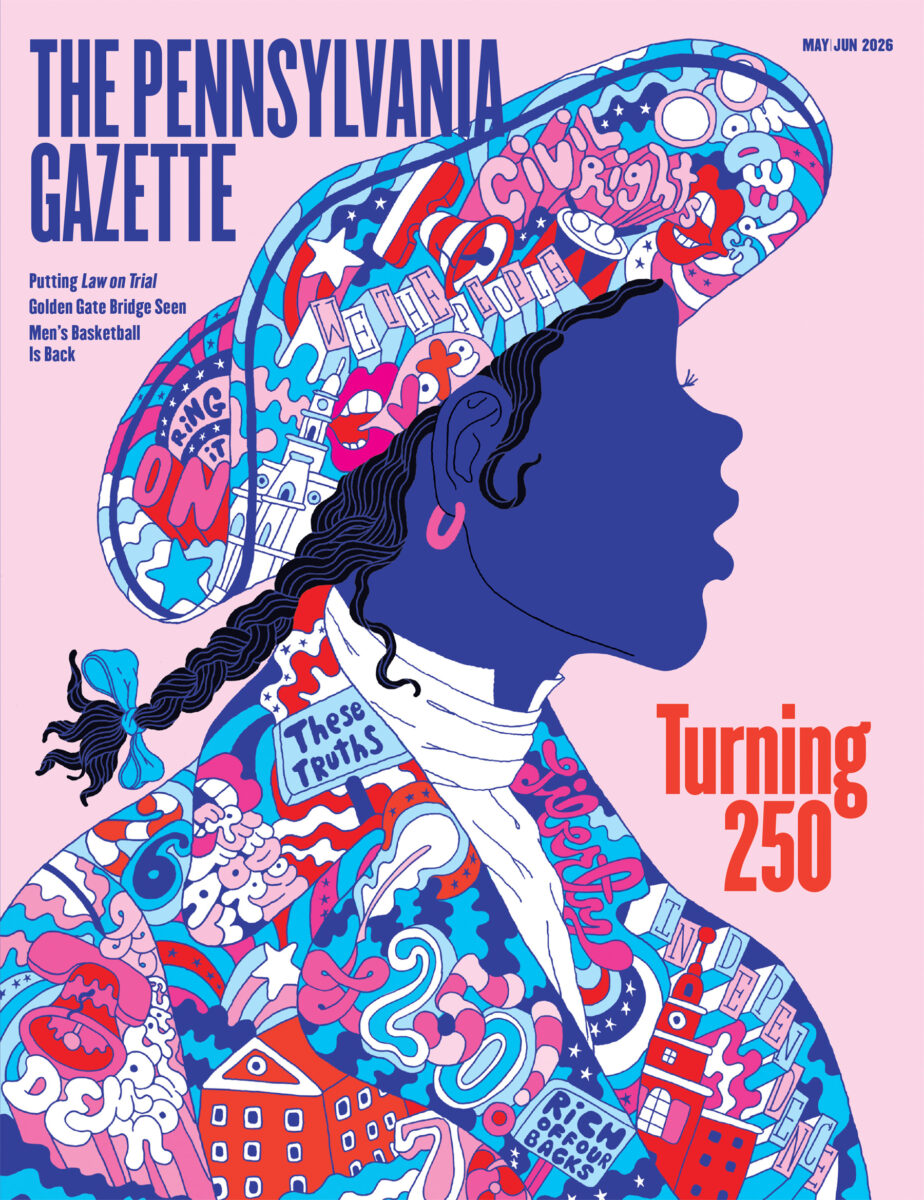
Obvious Virtue Signaling
My husband and I used to be proud that we went to Penn, and over the years, we have despaired over the obviously liberal route the University has been taking.
I can’t believe it. You have finally topped the “diversity” cover of years ago [Nov|Dec 2002, concluding a series of issues marking the Gazette’s Centennial]. Words cannot describe my disgust at your obviously virtue-signaling choice of subjects. The style? 1960s? 1970s? Really? You couldn’t think of anything more original? And a woman who is clearly a PoC but not Asian or Hispanic?
And to your obviously color-impaired “graphics” staff: Penn’s colors are Red and Blue.
Sophia Kelly Shultz C’84, Pottsville, PA
More Racial Diversity
This makes it seem like there are no white people in the history of the United States in the last 250 years. Please include more racial diversity in the next issues, so as to accurately portray the entire Penn community.
BJ Courville L’20, Princeton, NJ
Yes, That Orrery
The article “When Penn Was a State School” in your “Semiquincentennial Sampler” [May|Jun 2026] noted that the school seal was at one point changed to “an image of an orrery.” Was this likely an image of the Rittenhouse Orrery, which was displayed in the Van Pelt Library in my days as a student? Thank you.
Sarah Rose Torok C’92, Philadelphia
The orrery is still on display in the Kislak Center on Van Pelt’s sixth floor. The library’s website doesn’t mention the seal, but an article in Almanac (October 19, 2004) states: “The Orrery Seal, in use as Penn’s corporate seal from the time it was drawn in 1782 until 1797 and then again in the years 1823 to 1847, displays the mechanical planetarium—the orrery—made by David Rittenhouse.” —Ed.
Our Colonial Architecture
“When Penn Was a State School” is certainly a fascinating article. But sadly, the illustrator should have done more research before producing the three-story building on the right page. Windows were often reduced in size as the floors rose. But the size of the panes was not reduced; rather, the quantity of panes was reduced. In this case, as the first floor was 12 over 12 panes, the second floor might be 12 over eight and the third floor eight over eight. I bring this to your attention because, even as a retired contemporary architect, I still admire our colonial architecture.
The thought of our great early architecture compels me to tell about the fact that at age six I was so enthralled with our colonial architecture, which surrounded me in Philadelphia and its environs, I found a triangle in my father’s studio and began drawing these marvelous buildings. My father, the artist Leon Karp, was so impressed he gave me large sheets of paper for my drawings. And when I was nine and at summer camp, he was visited by his close friend, Penn’s own Louis Kahn, and showed the famous architect my drawings. Kahn was so impressed he took one with him when he left. Of course this led to Penn’s architecture program, Kahn’s undergraduate course, and six years in his office.
I also feel compelled to talk about a fascinating component of colonial architecture. Following some tenures at architectural offices and a relatively short period of my own practice, my last office was the office of Barton Myers Associates in Los Angeles [“Looking In, Looking Out,” Mar|Apr 2000]. Barton too was a Kahn alum, at the same time I was. We both loved colonial architecture, and we both discovered that their builders made the most comfortable stairs we had ever climbed. Their secret was the six-inch riser and 12-inch tread, producing a slightly less incline than usual. Thus, we produced these wonderful stairs in his extraordinary performing arts centers.
David H. Karp Ar’59, San Mateo, CA
Fresh Look, Fond Memory
The article and photographs depicting unusual views of the Golden Gate Bridge by Arthur Drooker C’76 is intriguing [“Fresh Angle,” May|Jun 2026]. My father, John Guss, while serving in the navy aboard the USS Mississippi in the 1930s, was based in San Francisco during the construction of the bridge. He included snapshots of same in his lively photo album, which I donated to the Pennsylvania Military Museum in 2025.
Thanks for the fresh look; wish he could see them.
Carolyn R. Guss, Bryn Mawr, PA
The writer is a former editor, writer, and illustrator for the Gazette. —Ed.
A Darker View of the Golden Gate
Although the article and photographs in “Fresh Angle” provided an interesting perspective, it was heart-wrenching to read since a relative who was in her teens took her life there, as many others have. It is no secret that suicides are unfortunately a part of the bridge’s history. Notably, her parents worked tirelessly with other suicide loss survivors for years to have netting installed to prevent further travesties, fighting against those who argued that the netting would “ruin the view”! The fact that the article refers to the photographer’s selection of the final photos as having to “kill a darling or two” was a gut punch, especially in this context. That old-fashioned word choice should have been nixed. Hopefully, future editions of the book can include a mention about the bridge’s unfortunate history, and the daunting effort by grieving families to install netting there to save future lives.
Laurie Yulsman Kazenoff C’82, Lloyd Harbor, NY
Starring Role
I very much enjoyed the photo essay “Fresh Angle.” While the photographer, Arthur Drooker, provided some stimulating photographs of the bridge, and eschewed what he called “postcard views,” I am sure he would agree that one of the finest inclusions of the bridge appears in Alfred Hitchcock’s classic film Vertigo. The juxtaposition of the massive structure, beautifully lit, against the silhouetted figure of Kim Novak about to jump into the bay, reveals the skills of the cinematographer, Robert Burks, as well as the director. Many cinephiles consider this film one of the greatest ever made. I am one of them!
As a lifelong, dedicated amateur musician, who plays both the piano and the organ, I also read with interest “Player Piano,” Robert Elias’ essay about his grandfather, a skilled artisan specializing in piano building [“Salvo,” May|Jun 2026].
While Elias stated that the piano is the “king of instruments,” this term was actually coined by Mozart when he experienced and wrote music for the pipe organ. Given the rather rudimentary status of pianofortes at the time of this storied composer, it’s no wonder Mozart was more impressed with the far more sonorous and powerful organ available to him.
Jonathan Kleefield M’70, Newton Center, MA
In the Seeing
One reader was moved to poetry by Arthur Drooker’s photographs.—Ed
Golden Gate
The Golden Gate Bridge is in the seeing,
A centerpiece in black and white a fabled form!
Unusual context with environment alone.
Majestic fog-shrouded, mysterious form,
Looms views of various angles design awaken—
Reflections in rain-puddles, a misty Alcatraz at Bay,
Between grave markers, a damp feeling at National Cemetery—
Bridge-span shots, its underside’s context,
Place the bridge in today’s environment.
Joseph Strauss, a relentless driving force,
Took almost a score of years and herculean effort
To design, raise money, and construct a world-first bridge!
His attentive views of minor landscape features,
Inspired San Francisco’s center piece,
A sacred existence and tribute to humanity,
Crossing different seasons and the weather conditions,
An engaged perspective near and far away
Carries San Francisco forward.
Every photograph evokes a memorable feeling
A propulsive visual flow of surprise
Its history champions Joseph Strauss
Selected the best there was to build the bridge
An impressive suspension—a symbol of possibility!
An architectural masterpiece of engineering
“Our world revolves around what can’t be done
Beyond the limits of human endeavor…
Don’t be afraid to dream!”
Peter Clark C’60, Lawrence Township, NJ
I Could Not Write Anything Better
I just read Dave Zeitlin’s piece “Treasured Texts” [“Alumni Voices,” May|Jun 2026], about the death of his Daily Pennsylvanian colleague and friend Dan McQuade. I am still in tears—not just over Zeitlin’s loss and the loss experienced by McQuade’s family and friends, but also over what is to come for me, a Penn alum from the Class of 1981. My closest friends are still the friends I made at Penn—Dave had the DP, and I had my fraternity SAM (Sigma Alpha Mu). Of the 30 of us who are so close, we have not lost one yet. I know it is a matter of time. We’ve been to each other’s weddings (some more than one), some bar/bat mitzvahs and confirmations of our kids, even weddings of our kids, and to the funerals of many of our parents.
We have yet to gather for one of our funerals, and I am not looking forward to any of them—and if God is kind, I will go first, so I will be spared going to any others. (My wife hates when I talk that way.) The thing is, there are at least two of my fraternity brothers who are my Dan. They made me laugh or smile from the day we first met, and they still do. They have that kind of Oscar Wilde wit that one can aspire to yet never have. Their name on a text or email is always eagerly opened.
And that is why I write now. Not just to compliment Dave Zeitlin for this piece, but to get his permission to plagiarize some of his essay when one of these brothers dies. I could not write anything better to describe or to honor them. (OK, only kidding. I think.)
Thank you again for this piece. Wonderful.
Alan Thomas C’81, Nutley, NJ
Of Course Dan Was There
Dave Zeitlin’s touching remembrance of Dan McQuade left me misty eyed about our dearly departed friend.
I won’t pretend that I was particularly close with Dan; I came to know him through Philadelphia’s closeknit journalism community. As Zeitlin so admirably captured, Dan held a loving obsession for all of Philly’s quirks and madcap characters, which I shared and admired. So it’s fitting that I last saw Dan at the estate sale for Frank Rizzo, the city’s famously pugnacious mayor from the 1970s. I was covering it for WHYY, but Dan was there just for fun—there were hundreds of diehard fans of Philadelphia’s worst mayor combing through boxes of Christmas decorations and old vinyl records in a wood-paneled basement; of course Dan was there. And that’s how I’ll remember him: Simultaneously joining in and laughing at such an absurd—and absurdly Philly—scene.
Jim Saksa C’08, Washington, DC
Lost Opportunity
The headline “Too Many Students, Not Enough Knowledge” [“Gazetteer,” May|Jun 2026] caught my eye. What I read is not what I expected, especially in the “lightly condensed and edited” remarks of Atlantic writer Tom Nichols at the 2026 Levin Family Dean’s Forum.
Nichols lost a wonderful opportunity when advising the student who didn’t understand why she might have to study German. This was chance to actually teach (what any good academic adviser would do) and to explain why German might be necessary to meet her academic and career goals and also not to potentially misinterpret any facial “look” the student may have exhibited.
As someone who spent the bulk of his professional career in higher education academic advising, I know that an academic adviser does not and should not be a clerk but must take the time to find all the teachable moments and act accordingly. Dismissing a student as dimwitted, uneducated, or overindulged helps no one.
And just what are the “very expensive boutique schools” he refers to? Are these the institutions that cater to students making them happy with climbing walls? I am not sure how asking if a student is happy is all that bad, but there are very few colleges and universities that do not provide mental health programs and services for their students.
While it isn’t surprising to acknowledge that all universities are different, does that mean that the differences are in quality? Is Nichols talking about well-endowed private universities versus small, struggling liberal arts colleges, or flagship state universities versus regional schools, or PhD-granting research schools versus community colleges? I would hope that all have a place in the American higher education system and that all take seriously their role in educating students.
And then he jumps to telling us that he isn’t against the liberal arts, singling out art history as a convenient (and I would say overused) target. And then he ends with the notion that all people don’t need to go to college and might be better off in trade school. Nothing especially new, revolutionary, or controversial here.
I would have hoped for a more nuanced discussion of the current state of higher education from Nichols. Alas, at least, in this condensed and edited piece, it was not there for me.
By the way, I thoroughly enjoyed the other articles in the Gazette, especially those focused on the 250th anniversary of the US.
Eric R. White GEd’67 GrEd’75, State College, PA
Thouron Winners Mini-Reunion
As the former administrator of the Thouron Award for many years, I was delighted to read “Imaginary Kinship” [“Arts,” May|Jun 2026] about former Thouron Scholar John Wind. Immediately following that very interesting article was “History in Motion” [“Alumni Profiles”], about Justin Marozzi, who was also a Thouron Scholar. John went from Penn to England and Justin from England to Penn, exemplifying the design of the Award, which supports Penn graduates at British universities and British graduates at Penn. I am never surprised—but always thrilled—to see what Thouron Scholars have accomplished. Sixty-six years after its founding the Thouron Award continues to flourish.
Carole Clarke, staff, Malvern, PA
College and Career Advice
Over the years, I’ve often noted connectivity among the Gazette articles in a given edition. This happened again with the May|Jun 2026 issue, and this time it reflects a couple of personal views I’ve held and shared with others for many years.
First, in the article “Too Many Students, Not Enough Knowledge,” Tom Nichols quoted one graduate’s view of his college experience as “those magical seven years between high school and your first warehouse job.” Joking aside, there is a kernel of wisdom there. This thought mirrored my own view, which I’ve shared over the years with a number of prospective college students, that college is the one time in your life that you are generally free of the other major responsibilities that come after graduation. I’ve encouraged these students to take full advantage of this time and the resources the college experience offers to learn about themselves and the communities around them—knowledge that is well beyond academic and which will help them live a full life following their college years.
Second, in “Mimi’s Magic Flute,” [“Alumni Profiles,” May|Jun 2026], Mimi Stillman, the subject of the article, says: “I’m very lucky that I’m following my passion. Classical music is a difficult career. There are not that many career paths.” While Stillman’s musical career is quite different from that of most others—whether or not involving a college education—the key point to me is that any career should involve doing something that you really care about and enjoy doing. It may take a few tries at specific jobs to find this role, but over a multi-decade career, the sense of personal happiness and satisfaction and the economic value created for all parties involved is more than worth the effort.
Jim Waters WG’71, Pearl River, NY
Super Signer
While attending my son’s recent graduation at Franklin Field [“Gazetteer,” this issue], I was captivated by the performance of the official signer who translated the proceedings into American Sign Language for the benefit of the hearing-impaired. This remarkable woman stood in a black dress in the blazing sun of a 90-degree day for over two and a half hours, signing the entire pageant, from the first line of The Star-Spangled Banner to the last words of the Dismissal. Her skill and endurance would shame many professional athletes! Can you tell us anything more about this amazing woman?
Christopher Kocher C’71 GEE’76, Philadelphia
We checked in with the Office of the University Secretary, which oversees Commencement, and they sent the following from the events team: “We hire the signers through the Deaf-Hearing Communication Centre (DHCC). There are two sign language interpreters assigned to the ceremony, since they take turns if needed. This year the interpreters were Joy Harris and Jennifer McGown. The person who is being referred to in this note is Joy Harris. Both she and Jennifer actually signed for both the College ceremony and the Commencement ceremony in Franklin Field, as well as six ceremonies in the Palestra throughout the weekend! Joy has been coming back for many years now to sign for the ceremony and does a wonderful job.” —Ed.
Perfect Blend
I was both instructed and deeply moved by Joanne B. Mulcahy’s creative nonfiction piece “Communion with the Dead” [“Elsewhere,” Mar|Apr 2026].
I certainly knew about El Día de los Muertos, but I had no idea there was a folk saint of death (Santa Muerte), and the author’s description of the cemetery threshold honoring the “animas olvidadas” (forgotten souls) is poignant.
But what makes the piece come alive is the author’s perfect blend of her personal experience with larger human concerns, including the ways various cultures treat death. Now in my early 80s and regularly attending funerals for family and friends, I think a lot about these issues. Like the author, I fear the loss of my spouse far more than my own death.
Joanne Mulcahy is a wonderful writer, and I hope anyone who overlooked this piece returns to read it.
John Getz G’77, Cincinnati, OH
