In an installation at the Rosenbach, jewelry designer John Wind fabulates a curiously personal relationship with an art patron from Philly’s distant past.
The “wow” factor is alive and well in the 6,000-square-foot South Philadelphia studio of jewelry designer John Wind C’83. Shelves line the long walls and tables are heavily laden with boxes upon boxes of bric-a-brac: metal initials and plastic dice, political pins and gaudy brooches, chandelier crystals and religious symbols. Organized by themes like “food and drink” or “beauty and fashion,” they’re ready to be mixed and matched into customized charm bracelets or collaged into tributes to cultural icons like Georgia O’Keeffe (lots of turquoise), Madonna (lots of crosses), and the Sex and the City character Carrie Bradshaw (tiny stilettos, pink champagne).
“It’s insane, I know,” Wind laughs. “I save everything—it’s in my nature.”
For him, jewelry making isn’t about showcasing precious metals or gemstones. Instead, he’s constantly on the lookout for tchotchkes and gewgaws, scouting vintage stores, gift fairs, auctions, and factory closeouts. “My work has always been playful and artistic,” he says. “I appreciate that element of freedom, plus it helps keep the pieces within a certain price point while still giving a lot of bang for the buck.”
Recently, however, he’s mined this trove to create one-of-a-kind works for an exhibition that’s brought him full circle to the fine art he originally studied. He describes Dear John, at Philadelphia’s Rosenbach museum, as a dialogue between himself and arts patron and collector John Frederick Lewis (1860–1932). Other figures of the day, including bookdealer extraordinaire Abraham Simon Wolf Rosenbach C1898 Gr1901 (1876–1952), also make appearances.
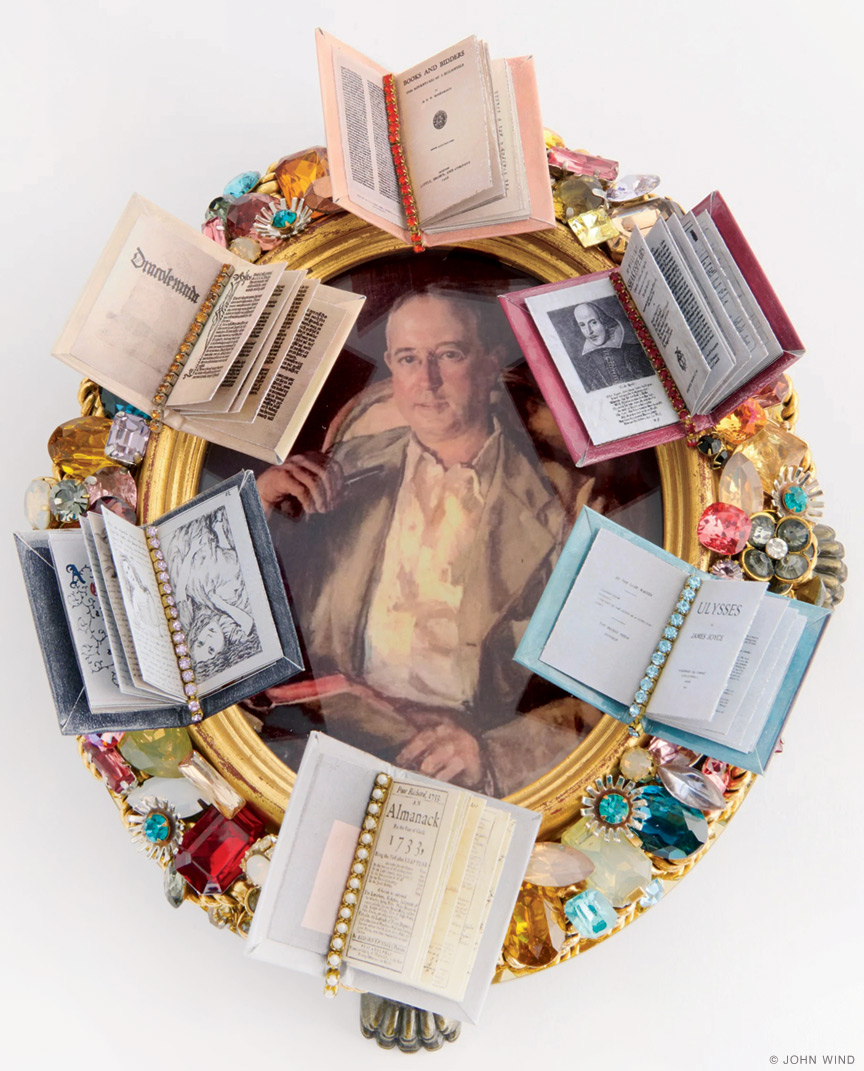
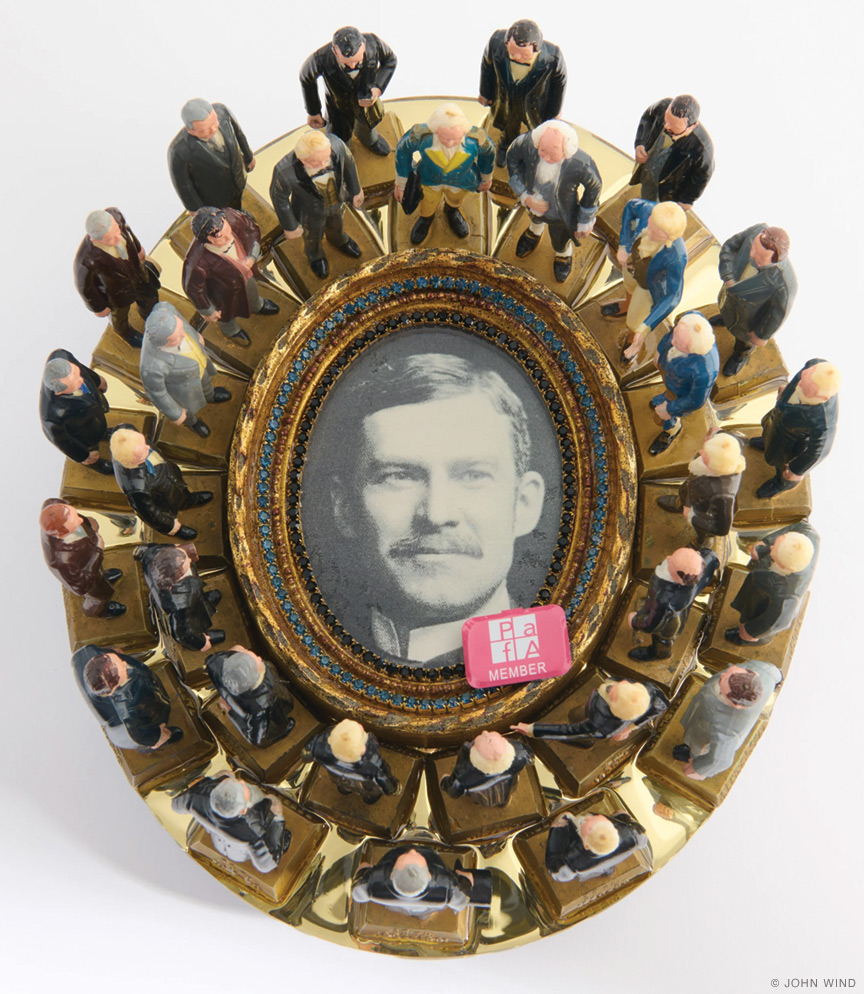
At first glance, the objects on display seem as if they were pulled from the Rosenbach’s valuable holdings, including its collection of European portrait miniatures. But peer more closely and you’ll notice the artist’s hand at work. In one, a tiny reproduction of an oil painting depicting educator and activist Rebecca Gratz is framed by sloganeering buttons that read This is what a feminist looks like and It’s a Philly thing. In other such Wind creations, Rosenbach’s image is encircled by thumb-sized versions of the most famous books he bought and sold during his career. Wind’s biographical vignette of Lewis sets his likeness at the center of a ring of plastic American president figurines, referencing how the wealthy collector adorned his home with portraits of the nation’s leaders. Further, Wind teases, “I’m sort of playing with the notion of the ‘male gaze.’”
Wind first grew curious about Lewis after moving into a Rittenhouse townhome that once comprised the rear section of the philanthropist’s mansion, serving as his library. “I’m a first-generation immigrant from Israel, I’m Jewish, I’m gay. I’ve always suffered a bit from outsider syndrome,” Wind says. “I assumed Lewis was the exact opposite—a patrician, Mayflower-type Philadelphian.”
He was, but as Wind dug deeper, an unexpected kinship between John the kitsch-loving artist and John the gentleman lawyer emerged. Lewis’s first ancestor to make it to America, Wind learned, was a Hessian fighting for the British in the Revolutionary War who changed his surname from Ludwig once he decided to stay. The story resonated with Wind since his own parents, Vardina and Yoram, had Americanized their first names after emigrating from Israel in 1963. Yoram later joined the Wharton faculty and became known as the trailblazing professor Jerry Wind. Meanwhile, Vardina made a name for herself as sculptor Dina WindASC’75, and their son, Yaron, grew up as John.
For years, Wind wondered how to stitch the common threads that he shared with the other John, whose home he wound up living in a century later, into his artistic practice. When the Rosenbach underwent a redesign, he approached the museum with an exhibition idea. The intersections with his own identity deepened when he learned that although the Rosenbach brothers could trace their roots in America to the 1760s, their Jewish heritage often ostracized them from Philadelphia society.
The exhibition, which occupies a corner of a new gallery devoted to material texts, is on view through December. Although “the jewelry thing was always a fluke,” the artist says he’s excited to be using the stuff of his long career—found objects, colored acrylic baubles, animal trinkets, and the like—“in more conceptual ways.”
Wind’s accidental career began with a move to London where, aided by funding from Penn’s Thouron Award, he enrolled at the Slade School of Art. There, he tried painting, photography, and sculpture, looking for something to stick. “I was 6’6” with orange hair and walking around with a long black duster,” he relays. “I started making these large brooches that were more like small-scale sculptures than anything, to embellish my outfits.” It was a look partly inspired by his artist mother, who favored rusted metal scraps, and partly by the pop stars that ruled ’80s Britannia (think: Boy George). Wind, and the steam-punky pieces he created, started getting noticed. By the time he graduated from Slade in 1985, his work had appeared in British Vogue, Brown’s department store was selling it, and the Thompson Twins were buying it.
Wind returned to Philadelphia and formalized his burgeoning business with a new name—Maximal Art—and a Penn pal, Hilary Jay C’83, as partner. At its height, Maximal Art employed a staff of 40 and both mass market retailers like Anthropologie and upscale boutiques such as Joan Shepp sold its products. National magazines like Oprah oohed and art museums aahed, adding it to their collections.
When he turned 50, though, Wind grew tired of the whirl. “The jewelry was no longer my art,” he says. He began slowly downsizing the business, and today he runs a much smaller operation, John Wind Jewelry, with just one full-time employee. It sells limited-production pieces and a handful of signature Maximal Art hits like the Sorority Gal bracelet, which features a monogrammed coin and a large “pearl” of cotton covered in lacquer.
As Wind devotes more of his time to fine art and exhibitions, he also concentrates on running the Dina Wind Foundation, which is dedicated to his mother’s legacy (she died in 2014 [“Obituaries,” Jan|Feb 2015]) and to supporting contemporary artists. “It’s interesting that we both focused on assemblage but went in different directions,” he says. “She was abstract and external, and I like narrative and biography.”
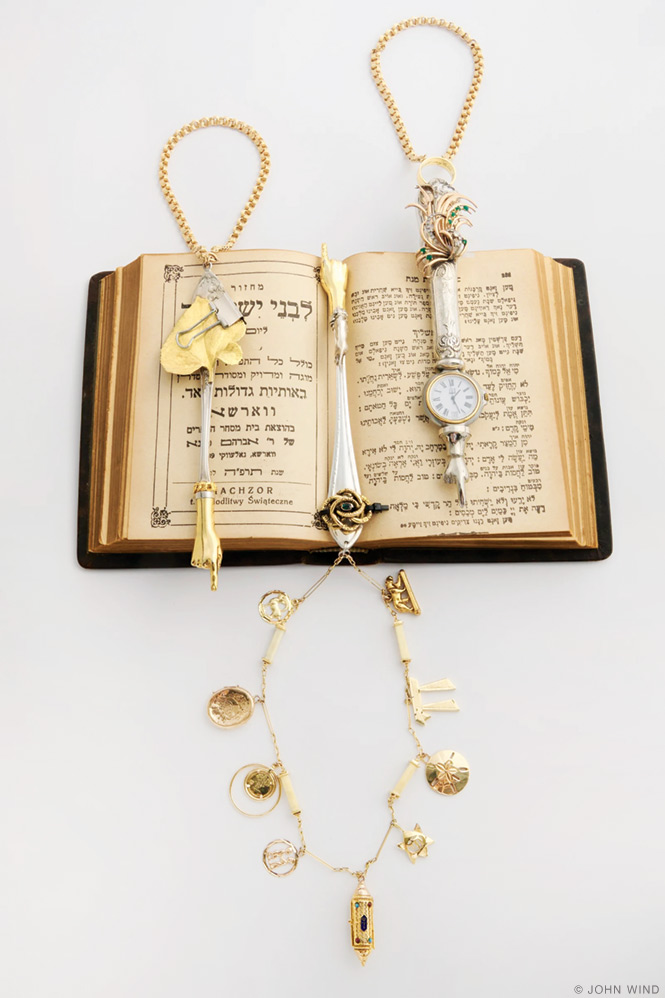
Many examples of his proclivity for storytelling can be found in Dear John, but none more clearly illustrates Wind’s blend of cheekiness toward the present and reverence for the past than the vitrine of Judaica he’s put together in response to the Rosenbach’s collection. It includes three silver yads—Torah pointers used by worshippers so they can follow along during readings—that Wind fashioned from antique cutlery and his grandfather’s Dunhill watch. He’s placed them alongside family heirlooms like a seder plate, dreidel, and kiddush cups, and interspersed everything with mirrored disco balls and rhinestones grouped by the colors of the Pride flag. The whole ensemble “serves the original purpose of the ritual objects and honors my family, while staying true to my own aesthetic,” he says.
Call it the story of Wind himself.
—JoAnn Greco