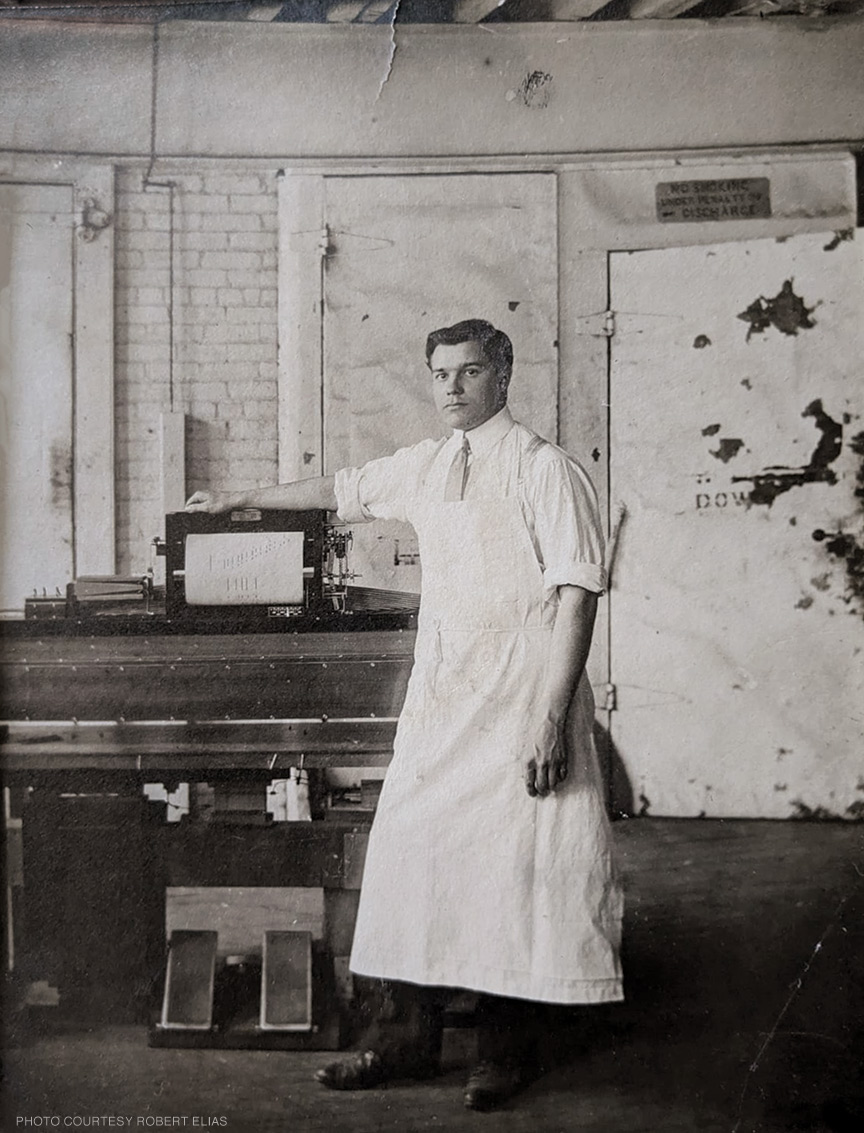
Exactly 100 years ago, my grandfather’s prospects as a skilled craftsman seemed assured.
By Robert Elias
In the late 1970s, after my grandfather died, I lived for a while in the Elmhurst, Queens, house that had been his home since 1923. The basement contained a little shop where all his drafting and woodworking tools remained. For our family, these tools were imbued with deep meaning. He had used them to build us desks, chests, tables, hat racks, lamp stands, and other furniture. But these projects were a far cry from his real craft. My grandfather was a piano maker.
August Elias was born in 1888 in a small village outside Brno in the Moravia region of the present-day Czech Republic. By the time he was a teenager, August was living in Vienna, where he trained as a piano maker at the Tischler-Genossenschaft before emigrating to the United States in 1910. After settling initially in the German and Czech enclave of Yorkville on the Upper East Side of Manhattan, soon he relocated to Queens.
In New York, he used his skills to find work in the piano industry. In the early years of the 20th century, hundreds of piano companies competed to meet the demand for what was known as the “king of instruments.” Pianos were widely sought even by households with limited means. Both adults and children were encouraged to learn the instrument, and many did. Listening to piano performances and singing around the piano was a primary entertainment for millions of families and their friends. “The piano,” according to music historian James Parton, “was only less important to the home than the kitchen stove.”
Piano making was thus a very viable career for a skilled craftsperson. It was also rewarding in deeper ways. The piano maker had the satisfaction of constructing the entire instrument and developing a relationship with his creation and fellow artisans. Craftspeople were never just cogs in an assembly line.
August quickly found a piano job after passing through Ellis Island, initially working for Steinway making conventional pianos. But a technological upheaval was already underway—offering music on demand, with no skill or training required—and my grandfather felt the need to swiftly adapt. So as phonograph record players began to proliferate in American living rooms, August moved to the Standard Pneumatic Action Company on West 52nd Street in Manhattan to make player pianos.
Initially powered by foot compression (and later by electric motors), the player piano’s pedal pulled air through holes in a paper roll that fed across a tracker bar, activating a small pneumatic bellows that pushed a lever. The lever pushed the piano key down, causing the hammer to strike the string and produce a note. In effect, it was a very large music box.
In the 1910s, the production of conventional pianos declined as the number of player pianos rose. Then the phonograph industry got a jolt of its own: Americans started filling their homes with radios, and record sales fell off a cliff. Piano Trade Magazine took it all in stride. Radio might prove a passing fad, it reckoned, and even if it didn’t, so much the better: all that frictionless exposure to music would whet consumers’ appetites to buy more pianos and player pianos.
Instead, between 1914 and 1925, the number of piano companies declined by 44 percent. And that was just a prelude. In 1927 in New York there were 53 piano companies that collectively employed 6,751 workers. By 1935, 14 firms remained, employing only 1,443 craftsmen.
Yet in 1926 optimism for the piano trade remained high, at least for player pianos. My grandfather’s firm, Standard Pneumatic Action, was featured in The Music Trades magazine, predicting bright prospects ahead. The previous two years had been the biggest ever for Standard, and 1926 promised to be even more prolific.
But it wasn’t to be. In 1930, only four years after Standard’s optimistic projections, August received a letter from superintendent A. K. Gutsohn. It was a notice that the company was closing and he was being terminated. My grandfather could have hardly received a more sympathetic dismissal.
“After nearly twenty years of constant struggle side by side struggling along and advancing to the positions we have finally held in this organization, it is hard for me to find the words [to tell you that] our business relations have to be severed,” Gutsohn wrote. “During this time you have proven yourself a perfect gentleman and very capable of filling all the positions you have held and particularly that of Assistant Superintendent … [I can’t] tell you how much I appreciate your friendship, and the loyalty and cooperation you have shown not only to the company we both served but to myself, personally.”
About my grandfather, Gutsohn also concluded that he had “no fear of [his] future success because besides being a competent production engineer you know fully well all phases of the wood-working industry.” But Gutsohn’s confidence was misplaced for August, not to mention the thousands of other piano craftsmen who never again found work making the king of instruments. Not only did he fail to secure employment in the declining piano industry, he never again worked a skilled job.
My grandfather had experienced the satisfaction of handcrafting beautiful pieces of musical furniture, and quite likely expected that he would be a piano maker for life. Instead, at age 42, he was unemployed with a homemaker wife and two children. When a job emerged, he was thrown into factory work far below his skills, ultimately landing in a shop at Grumman Aircraft on Long Island.
Of course, many will observe that technology not only destroys but also creates. We rightfully celebrate the emergence and the staying power of radio; I’m a particular devotee. Even so, the disruption can be devastating for the workers it displaces, especially for those whose skill no longer has any market value. Today only two piano-making firms remain in the US: Steinway & Sons and Mason & Hamlin.
The rise of automated mass manufacturing was the death knell for craftspeople of so many kinds. Now artificial intelligence is poised to replace men and women who have derived dignity, along with their daily bread, from all sorts of other work whose social value once seemed beyond question. Besides the loss of jobs, what will be the societal and psychological consequences as we remove ourselves further and further from meaningful work?
My sister Pat and I have inherited my grandfather’s ancient tools, which we’ve carefully preserved in his timeworn, old wooden toolboxes. The chisels, clamps, saws, planes, tuning hammers, and other implements remind us of August—but also of a time when being a skilled craftsman really mattered.
Robert Elias C’72 is an Emeritus Professor at the University of San Francisco. His 12th book is Dangerous Danny Gardella: Baseball’s Neglected Trailblazer for Today’s Millionaire Athletes (Bloomsbury, 2025).