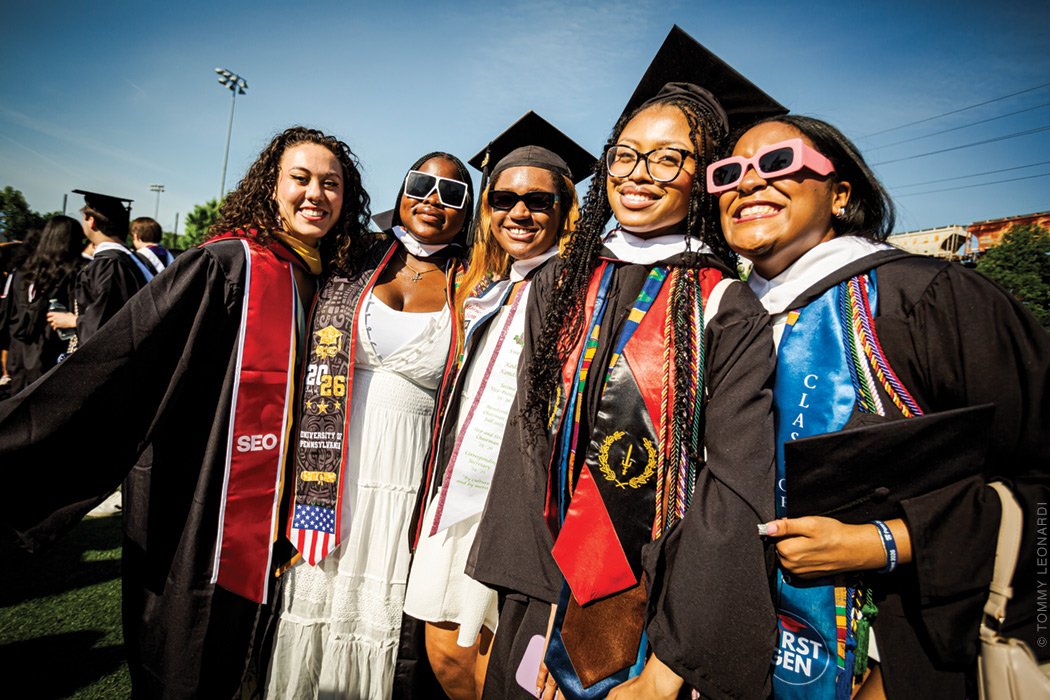
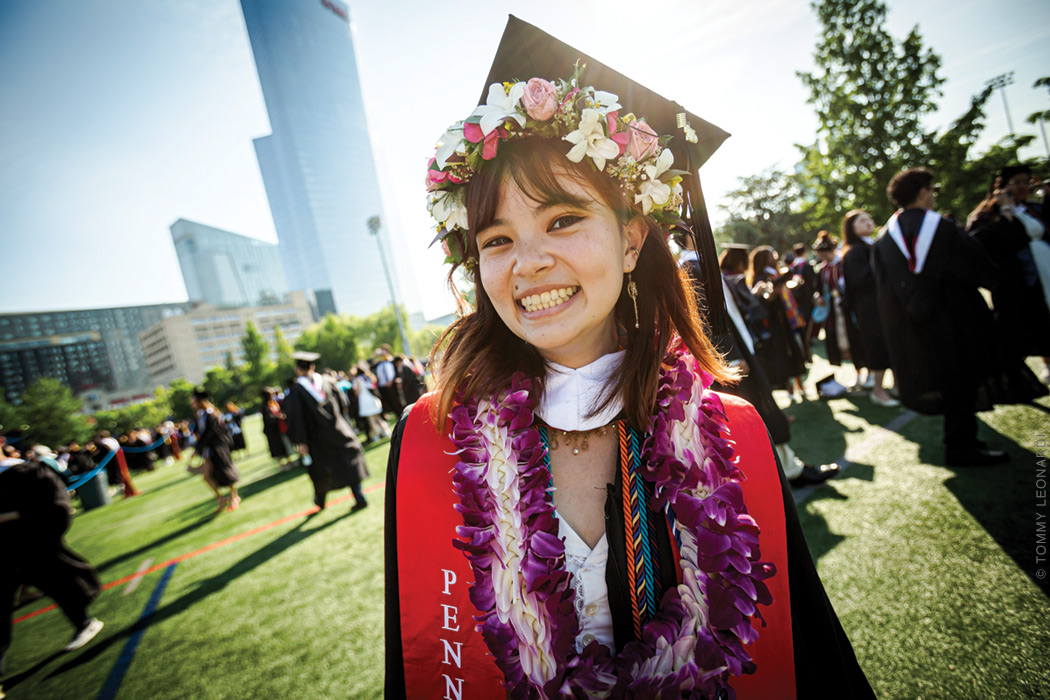
Photography by Tommy Leonardi ’89
Historian Michael Beschloss urges the Class of 2026 to follow FDR’s lead on resiliency.
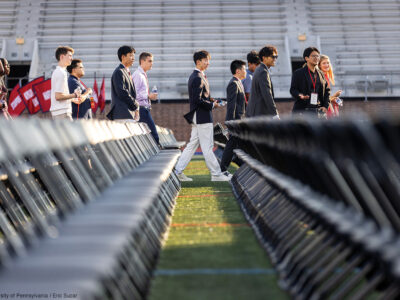
Ninety years before Michael Beschloss delivered the keynote address at the University’s 270th Commencement at Franklin Field, Franklin D. Roosevelt gave a stirring speech of his own inside the same stadium.
That June 1936 address was a famous one as FDR accepted the Democratic renomination for president and famously declared that Americans had “a rendezvous with destiny.”
“But few people know what happened to FDR in this stadium just before he came out and spoke,” Beschloss told Penn’s Class of 2026 on a scorching hot mid-May morning. Wearing his “heavy steel leg braces hidden by his baggy trousers,” the polio-stricken president slipped and fell. Yet inside the stadium, Beschloss said, few people witnessed the fall. “Had there been live TV cameras there, Roosevelt’s secret incapacity would have been exposed to every American voter. FDR might have conceivably lost the 1936 election. And with no Roosevelt as president in 1940, it is possible that the Allies might have lost World War II.”
“What is important in this story is not that Roosevelt fell—we all fall—but that he was able to get up and start moving again,” Beschloss continued. “He asked his son Jimmy to dust him off and get him back on his feet.” That’s an important lesson for the Class of 2026 to heed, the historian added. “When it happens that you’re disheartened or feel set back, straighten yourself up, dust yourself off, try to get back on your feet, and most of all, get moving again. And as you get moving again, remember that kind of resilience is exactly what our beloved nation has shown for 250 years.”
An award-winning historian, author, and scholar who’s written several books on American presidents, Beschloss used his Commencement speech to explain why Americans have needed to be resilient throughout the country’s history. The University’s 6,879 graduates, he pointed out, are “living through complex times”—from growing up in the shadow of 9/11 and during the Great Recession and, more recently, coming of age during the COVID-19 pandemic. (Beschloss was especially “terrified” during the pandemic as his son, Alex Beschloss M’22 WG’22, worked inside hospitals at the time.) And although he didn’t mention President Donald Trump W’68 by name, he delivered some not-so-subtle critiques of the federal government for straying from “our founders’ dream of a political system that showed honesty, competence, candor, ethics, compassion, decency, and self-sacrifice,” Beschloss said. He implored the graduates to help renew “profound American traditions” including the rule of law, free and fair elections, and a place in American society for historians and scholars like him to question authority rather than “perform like obedient circus clowns” as some politicians may wish.
“All of us should remember that, under our constitution, we Americans do not ever work for a president—a president is supposed to work for us,” Beschloss said. “Everything I’m saying, if I had given this speech 20 years ago, people would say, ‘Well, what are we supposed to disagree with?’ We are living in a different nation today.”
The historian also called for national unity as the country marks 250 years. “With the flawed but noble George Washington as their model, our framers hoped that our leaders would strive, whenever they could, to unite our fractious nation—the nation that Jimmy Carter, on our American Bicentennial in 1976, aptly called ‘a beautiful mosaic.’ My prayer for our country today is this: no matter how bruising our political differences, we should never forget that we are all members of the same big American family.”
In his Commencement speech, Penn President J. Larry Jameson also looked to the nation’s founding when the colonists—and the seven members of Penn’s Class of 1776—“faced an uncertain future with no roadmap, only preparation and courage. They stepped into a world being remade from scratch.” Looking out onto the Franklin Field crowd, Jameson continued: “You, too, are stepping into a transforming world. Forces moving faster than we imagined are reshaping how we live and connect. Every day brings new tools—in computing, energy, robotics, and medicine. The pace of change can feel exhilarating. But it can also feel disorienting.”
Jameson reassured graduates that other generations felt similar worries about technological advances like the printing press, radio, and television, before finding ways to adapt. And even as they enter “a word that rewards acceleration,” he offered them “three time-tested ideas for building a meaningful life: cherish the arts, embrace nature, and choose people.”
“When you face a choice between scrolling and connecting, choose people,” Jameson implored. “Screens can inform and entertain. But it is time spent together that gives meaning.”
While Beschloss urged the Class of 2026 to save our nation and world (“no pressure,” the historian deadpanned), University chaplain Chaz Howard C’00 lowered the expectations in his closing benediction after degrees were conferred and before graduates left Franklin Field to celebrate with their families.
“You are enough,” said Howard, whose daughter Charissa is a member of the Class of 2026. “Before any job titles, further degrees, or future accomplishments, you are already enough. … May you be free to chase dreams in joy, not from insecurity. May your enoughness free you to work hard from passion, not pressure. May it free you to create, build, rest, love, and to help those who do not have enough. And may you remember that your Penn family will always be cheering for you.” — DZ