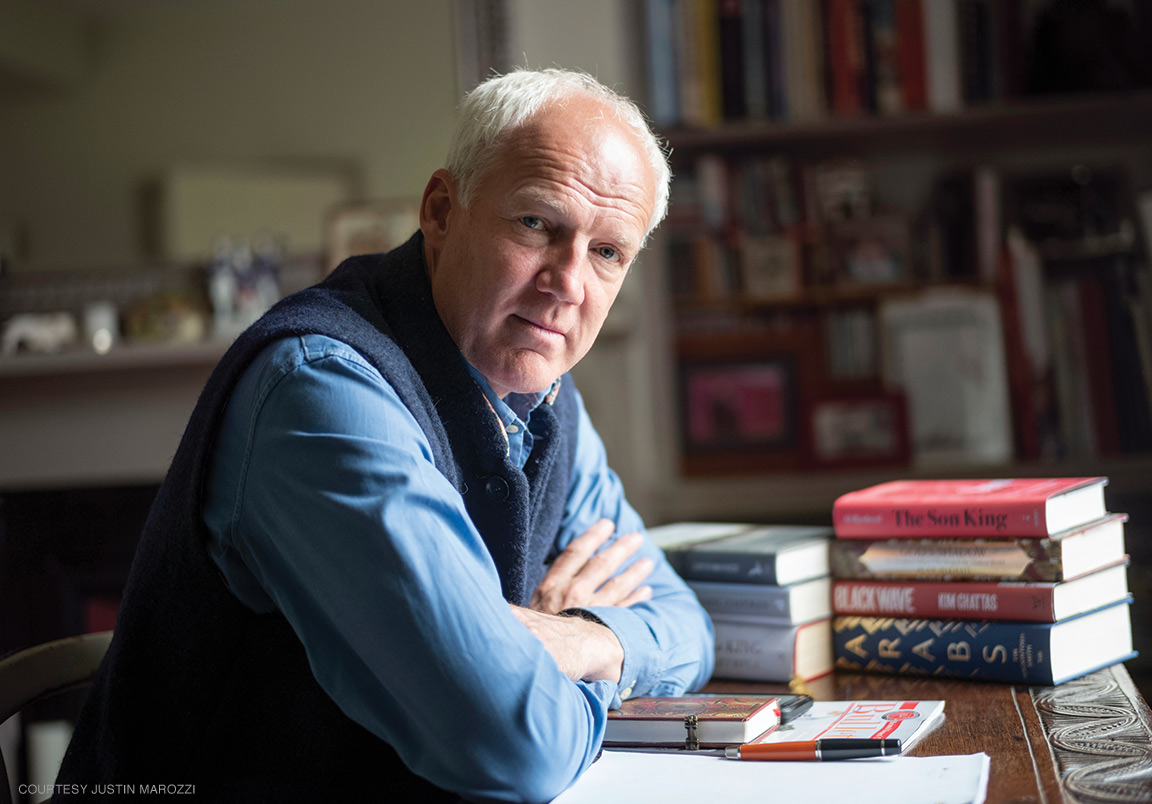
This historian, author, and adventure seeker believes “the world is far too interesting not to explore.”
The adventures of Justin Marozzi G’95 could tempt some to compare him to the scholar-diplomat-soldier Thomas Lawrence, better known as Lawrence of Arabia. After all, how many people can say they rode a camel for months in the Sahara, counseled leaders of three war-torn nations, and wrote widely praised scholarly books?
“Nowadays we’ve got Google, and it’s gone on to AI,” says Marozzi from his home in Norfolk, England. “But for the historian or journalist, getting out and about is a great way to get out of one’s typical life, experience other cultures, and get some sand under your shoes.”
During the Libyan civil war of the 2010s, Tuareg rebels kidnapped Marozzi and threatened him with death. (The next morning he awoke to see a captor digging a hole in front of him. Instead of his grave, it was for stakes to support a sun screen.) An earlier camel trek took him 1,250 miles through the desert, and as a freelance BBC radio correspondent he voyaged to the bottom of the Atlantic in a submersible. “There’s a swoosh as the vents are opened,” he dramatically told listeners. “Air rushes out of the ballast tanks—and then what sounds hideously like a cracking noise in the two-and-three-quarter-inch thick acrylic sphere in which we are suspended.”
Back on the surface Marozzi put to good use his master’s degree in political science from Penn by serving as an advisor to the leaders of Libya, Mali, and Somalia when all three nations were in chaos.
He has long been a go-to guy for the UK government, specializing in what he says are called “fragile states.”
In Somalia, he devised and ran a campaign to undermine the terrorist al-Shabaab group and tried to garner international support for the government. In Libya, his work had him supporting a fledgling post-Gaddafi administration and promoting national unity during a worsening civil war.
To keep stress at bay in Somalia, he and a friend batted a cricket ball in the presidential compound. Mercifully, he was away in England when seven al-Shabaab suicide bombers with AK47s stormed in and killed one of his friends. When he returned, he found his room shot up. “It was a nasty moment,” he told the BBC.
Most recently Marozzi has made several lengthy trips near the front lines in Ukraine consulting with MOAS (Migrant Offshore Aid Station), which is one of the biggest providers of emergency medical aid to the Ukrainian army.
His zest for travel ignited as a teen on a trip to Libya with his businessman father. A summer in Cairo learning Arabic when he was 18 stoked his wanderlust. “To be there on my own, no friends or family at all, was incredible, thrilling, and exhilarating,” he recalls.
His love of adventure began as a boy in Canterbury in southeast England where he attended The King’s School, a posh private academy. “My daily commute was either through the 14th-century nave or the cloisters of Canterbury Cathedral. One of its many highlights—very striking for an impressionable schoolboy—was the tomb of Edward, the Black Prince.”
Marozzi first dabbled in journalism as a stringer with the Financial Times in Asia. He went on to share curry with Nobel Peace Prize winner Aung San Suu Kyi and fly in a helicopter with the president of the Philippines. “Being a journalist gives you the opportunity to witness people in all walks of life, speak to them without any profound research, and then you’re moving on to the next adventure,” says Marozzi, who majored in history at Cambridge.
When such thrills proved insufficient, Marozzi jetted to Libya. He and a friend bought five camels, hired guides, and waded into towering sand dunes. “There’s nothing like it—sleeping under the stars with your camels, an ancient part of the landscape. Traveling by camel is the way to do it. That pace of two or three miles an hour is the perfect speed at which to immerse in that environment.”
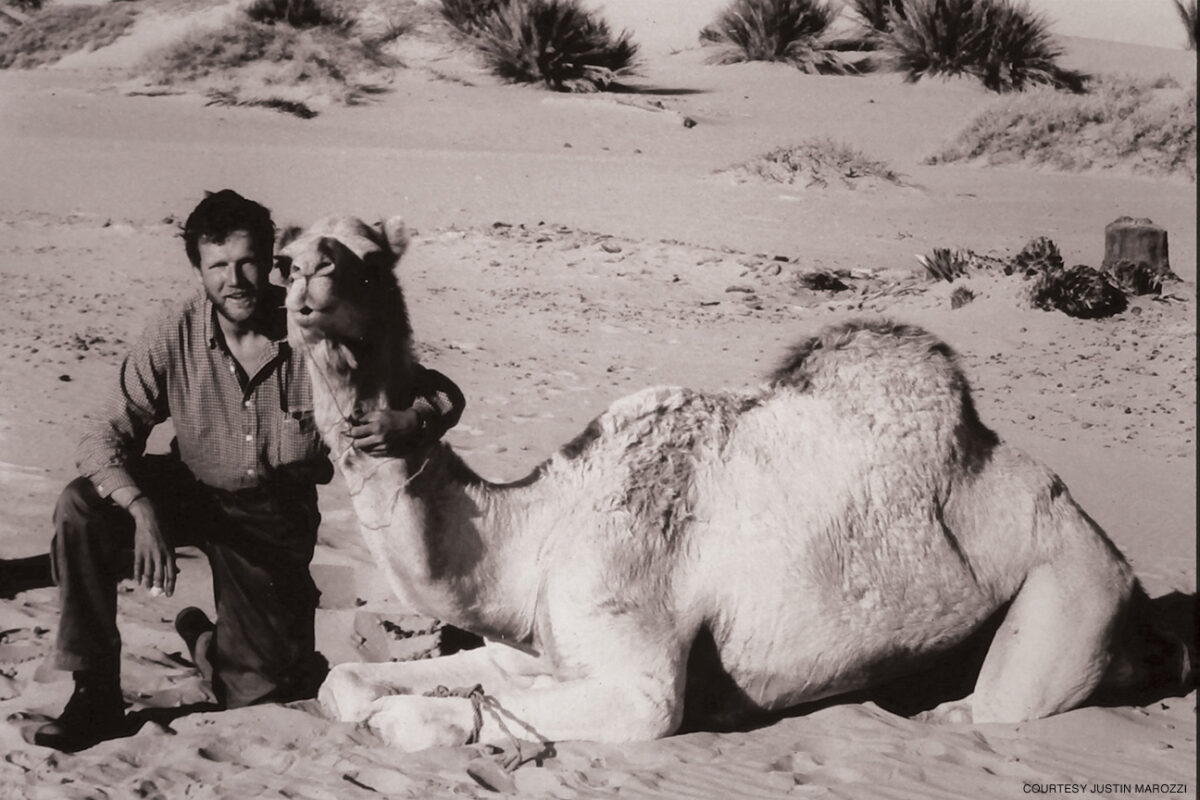
The odyssey took him to the ancient caravan and slave-trading crossroads of Murzuk, into the Wau au Namus oasis, legendary for its beauty and sheltered by a towering extinct volcano, and finally to Kufra near the Egyptian border where he was arrested—and later released—by an officious policeman.
The desert and, most notably, its silence cast a spell on him. “It’s such an overwhelming feeling, because you realize the immensity all around you and how insignificant you may be,” he says. “I loved it. People say it changes you forever. I’ve always wanted to go back.”
Over the years Marozzi has also found the time to take deep dives as an author. He has written seven books on topics including a biography of the warrior-king Tamerlane; interviews with the world’s great explorers; an exploration of Baghdad’s 1,300-year history; his own camel trek; and a meditation on Herodotus informed by retracing the great fifth-century BC historian’s footsteps in Baghdad [“Arts,” May|Jun 2009]. “He wanted to get out there, to explore, presumably to have some adventures and, like Tennyson’s “Ulysses”—To strive, to seek, to find, and not to yield,” Marozzi says of Herodotus, known as “The Father of History.” “I feel the same way. The world is far too interesting not to explore.”
Marozzi’s latest book, Captives and Companions: A History of Slavery and the Slave Trade in the Islamic World, came out in October. The Wall Street Journal called it “a monumental revisionist work that will alter views on slavery inside and outside the Islamic world.” The Times of London said, “Reading him, one thinks of Tintoretto: vast canvases, mannered style, high drama, narrative drive.”
Marozzi learned much in Libya about the history of slavery in Africa. “Early British explorers came back with terrible stories about how men, women, and children were treated on long, dreadful caravans,” he says. “There is a historical ignorance about slavery and the slave trade in the Islamic world which is baffling—it lasted from the seventh century to the 20th century.”
While doing research Marozzi interviewed formerly enslaved people. He met a freed Malian named Hamey, recovering from a mob beating, who lived as a refugee with his two wives and 12 children. “Live or die, I’ll never be a slave again,” Hamey declared, but having no prospect of employment, he added “I’m closer to despair than hope.” A woman named Habi told Marozzi that before being liberated at the age of 35 she slept in the sand with goats, never had a day of rest, and was told she had the soul of an animal. Her master raped her daily, even when she was a child. After being rescued, she ran for parliament twice in Mauritania but lost both times. “Now, praise God, I am free,” she told him.
The Malian abolitionist group Temedt estimates that one million people in that nation live in bondage. “It’s a story which regrettably has not entirely finished,” says Marozzi.
—George Spencer