In pursuit of the perfect suburban lawn.
By Janet Fu
“Don’t feel bad if the grass doesn’t grow,” chuckled Mrs. Brick as she paused in front of my house while walking her golden retriever, Cici. “Our neighbor across the street works at the University of Arkansas Agricultural Extension, and he even struggles to get his Bermuda to grow.” The dog days of summer were upon us, but Mrs. Brick was the picture of unhurried Southern charm, radiating sympathy as she cast her eye upon my plight.
My family had been trying for the last 12 days to grow grass. Yes, grass. How hard could it be? Acres of pastureland dot the roads 10 minutes from my house, crabgrass crops up in sidewalk cracks under the blistering sun, and let us not forget that Arkansas used to be a mix of temperate deciduous forest, prairie grasses, and alluvial plain. So why was I struggling to get blades of tall fescue to show their pointy heads above some topsoil?
Earlier in the spring, my parents had received emails, and then an angry, typed notice, from our homeowners’ association alerting them that our yard “was not up to curb-appeal standards” and was “deteriorating the value of the neighborhood.” Three mature oaks, two maples, a bunch of hollies, and one mystery tree grace our front lawn and block sunlight from reaching the ground, which keeps our heating bill down in the summer but also keeps our lawn perpetually threadbare—a patchwork of eroded sandy soil and crisscrossing roots. Our HOA decided that enough was enough.
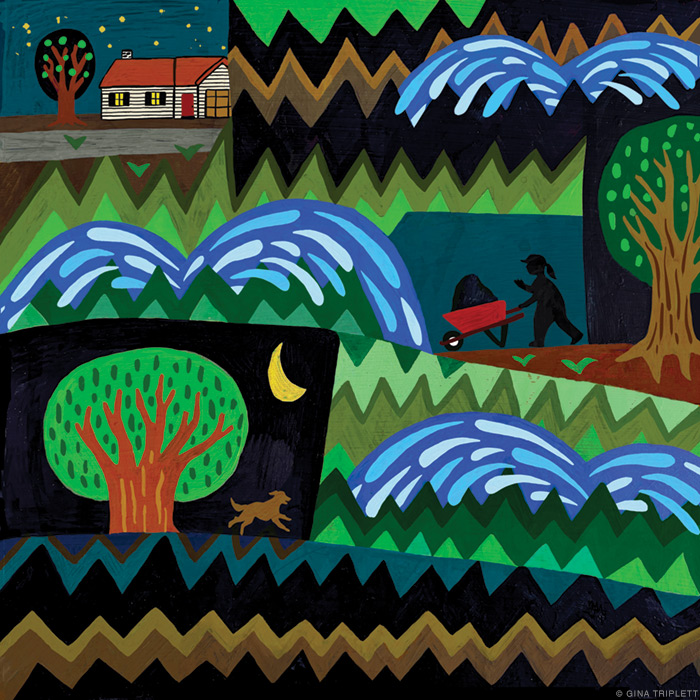
Enter me: A 20-year-old college student whose return home for the summer meant one thing to my parents—free manual labor. After a landscaping company quoted $6,600 for a half-pallet (22 rolls) of sod, my mom balked and decided it was time for me to roll up my sleeves. She called White River Nursery and ordered 10 tons of topsoil. It arrived in a dump truck that shuddered as it jumped the curb, shaking the ground as all 20,000 pounds of earth was ignominiously dropped onto our front yard. The dirt piled well over six feet tall, taking up more space than a children’s play set. My mom promptly purchased a $99 wheelbarrow from Lowe’s, and sent me into the front yard under the baking August sun to level the soil, seed it with tall fescue, and cover the new grass seed with straw.
As an added bonus, I would be performing for an audience: our neighbor Paul. Paul was a retiree who wore a gridded, collared short-sleeve shirt and jeans every day, with his phone in the left breast pocket. He had thinning white hair above shockingly blue eyes and spent the better part of his time patrolling the perimeter of his property, picking up offending sticks, making sure the bushes and garden were perfectly manicured, and filling his bird feeder. These activities provided him with constant opportunities to supervise my progress and offer unsolicited commentary.
“That much soil won’t be enough. Better order double.”
“You need more straw. And finer straw. I like the EZ-Straw stuff—I buy it by the bale at Lowe’s, and it works like magic for keeping the moisture in. Lay it on thick and make sure you water a lot.”
“Tall fescue, now, that is a good choice. I like a Bermuda and tall fescue blend myself, everything under my trees is tall fescue and it tolerates the shade. But you have to mow it at a higher trim height. And it doesn’t propagate at all, or spread as much as the Bermuda.”
Yet I had learned that this pedant with a penchant for keeping order was a resourceful and well-meaning man. One who harvested the chestnuts from his stinky tree after it blossomed every spring, lavished love upon his grandkids when they visited for Thanksgiving, and waved hi to me every time I ran laps around our neighborhood to train for track and cross country. Once, I was running in the morning and encountered him taking a morning stroll. He ducked some low branches that were blocking the sidewalk next to a house with a For Sale sign. A few hours later, as I was studying in my room, I looked up and saw him walking by, a long saw with an extension pole in hand. The next morning when I ran, the low branches were gone.
So though it may have been true that Paul had too much spare time on his hands, my parents were inclined to take his advice. We set up automatic sprinklers and layered on the EZ-Straw.
A few days into the watering, tiny thin blades of grass erupted from the straw, looking like a baby’s first hairs. My parents celebrated.
On the third day, the city passed a drought ordinance. In light of scant summer rainfall and dwindling water levels in reservoirs, all unnecessary household activities that required water were to cease, including, but not limited to, filling swimming pools, washing cars, and watering lawns.
On his next daily stroll, Paul approached my father and me. “I don’t know if you folks know,” our helpful neighbor began, “but the city passed an ordinance today prohibiting lawn watering. Such a pity with your newly planted grass, but I wouldn’t want you all to get in trouble or be reported.”
Later, within the safety of our own walls, my parents wrung their hands in despair.
My dad saw no choice but compliance. “It’s against the law!” he exclaimed.
“Yes, but we just spent $1,000 on topsoil, another $100 on supplies, and $250 on grass seed!” my mom retorted. “We can’t just let that go to waste!” So we hatched a plan. Under the cover of nightfall, we would water the lawn at 10 p.m. and 3 a.m., when the neighbors would be asleep. My dad took refuge in rationalization. It would be dark, he observed, and therefore evaporation would be far lower than in the midday heat and sun. We could save our grass even as we minimized our impact on the city’s water supply.
So we continued to water, in secret, and the grass grew taller and thicker day by day. Neighbors who had been curious about our topsoil mountain started commenting on the flourishing fescue and congratulating us on our success.
When we confided our secret to Mrs. Brick, one of our closest friends in the neighborhood, she laughed and said, “Y’all aren’t the only ones. We walk Cici every night around nine, because it’s too hot for her during the daytime, and everyone’s sprinklers are going at that time.”
And so I returned to school at the end of August, relishing my double victory over our sandy soil and the HOA. As classes got under way, my mom texted me photos as periodic updates of our triumph. The grass was thriving. All seemed well in the world.
Then, out of the blue, my dad called me in palpable distress. It was the grass, he told me. It seemed to have just “evaporated.”
“What do you mean, ‘evaporated?’” I huffed. “Did you forget to water the lawn? Did the grass wilt? Is it brown and dry?”
“No, no. It just disappeared!” he cried. “The grass isn’t there anymore! The thick blades that were there yesterday are now just thin wisps!”
I was incredulous. “Matter doesn’t just disappear! Did deer eat the grass? Did you water it? Is the grass dead?”
“Well, it’s certainly not there!”
And that was how my perfect suburban lawn fell prey to brown patch, a common fungal disease that strikes fescue when nights are humid and the temperature fails to drop below 65 degrees Fahrenheit. Leaves of the fescue roll up inward as they are taken over by the fungus, leaving behind bare and brown patches on the lawn. Brown patch disease typically happens in mid to late summer, caused by watering turf at dusk and leaving it prey to heavy moisture overnight. Our 10 p.m. automatic watering time? A death sentence.
Some people say the American Dream is dead. I say, the American lawn is dead. The perfect suburban lawn is dead.
Janet Fu is a senior from Arkansas studying finance and mathematics. This essay won first prize in the Gazette’s 2026 annual essay contest.