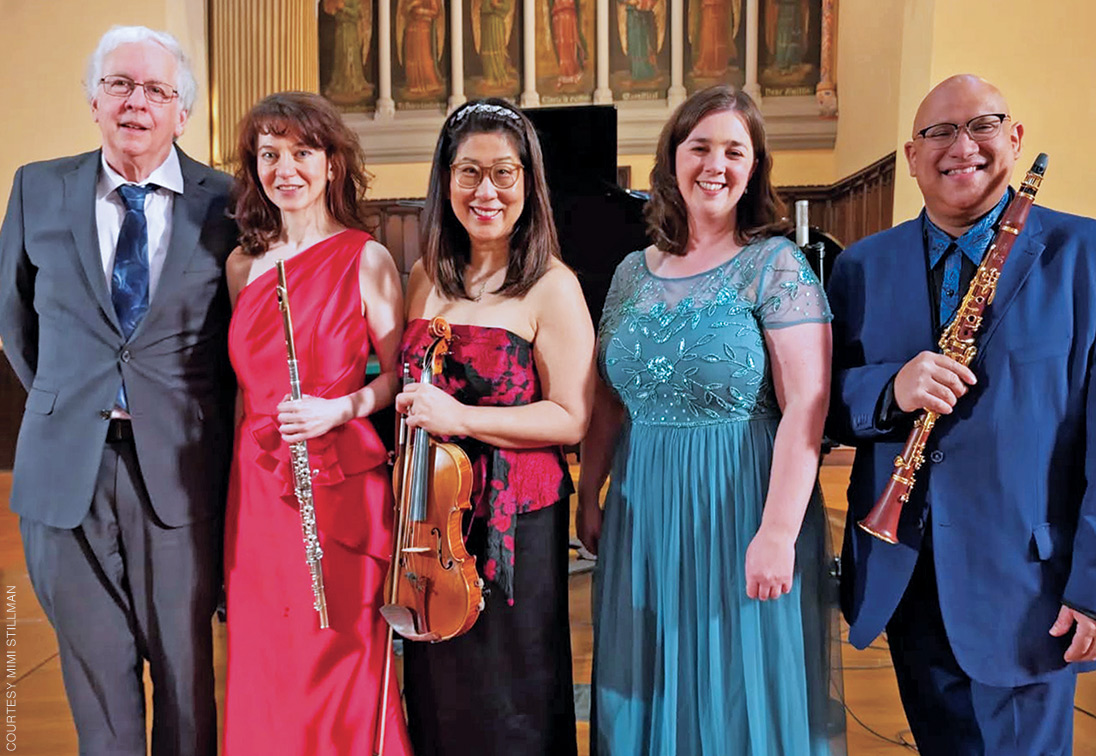
A onetime child prodigy’s chamber music group is celebrating its 20th anniversary.
Mimi Stillman G’03 was 11 years old when the National Flute Association’s convention came to her city.
It had already been love at first trill for Stillman, who’d been taking private flute lessons since age six. “I can’t remember a time before I knew that I wanted to play the flute,” she says. So the convention was a big deal. Even better: the renowned flutist Julius Baker, one of her musical idols, was slated to appear. Stillman planned to watch his demonstration for Yamaha. Maybe she’d even get to meet him.
When they actually did meet, Baker surprised the 11-year-old by asking if she knew any Mozart—and then by inviting her to perform the Concerto in G Major on stage, right then and there, in front of the audience that had gathered to see him. “I thought about it for about 30 seconds and said yes, of course,” Stillman remembers. “I don’t think I had time to be nervous.”
That’s where it all began. Meeting Baker led to the Curtis Institute of Music, which led to a professional career playing the flute, and now running a dynamic chamber ensemble that just marked its 20th anniversary. Her job titles have proliferated over the years—musician, entrepreneur, educator, researcher—but Stillman says they all have the same root: “I just really love sharing music with people, and I always have.”
Stillman grew up in Boston, listening to her mom and older brother playing their clarinets. When she got into Curtis at age 12, she became the youngest wind player ever admitted to the school—a title she says still holds today. Her parents moved to Philadelphia with her so she could attend.
“A lot of people called me a child prodigy,” she says. “I never really thought too much about that as a term because I was just having the time of my life. I think it took me years to realize that I had been a child at that time.”
She graduated from Curtis at 17, won a major competition for emerging classical musicians, and started performing fulltime as a soloist. Still, she didn’t feel ready to be out of school just yet. So at 19 years old, she enrolled at Penn to pursue a master’s in history and then continued through the PhD coursework.
“Being at Penn was absolutely broadening and mind-opening in such a tremendous way,” she says. She studied everything from art history to military strategy. A Dante seminar held in the Henry Charles Lea Library in Van Pelt inspired her to name her now-20-year-old chamber group Dolce Suono Ensemble, after the term “sweet sound,” which the medieval poet coined.
Under Stillman’s leadership, Dolce Suono Ensemble (DSE) started off by giving concerts at Penn in 2005, inside the Rare Book Library until their audiences grew too big. Today they’re based in Center City Philadelphia, and you’ll find them playing everything from baroque pieces to current Latin popular styles—a testament to Stillman’s wide-ranging interests and musical abilities.
DSE’s core performers rotate in and out depending on the piece they’re playing. “It’s a little like a repertory theater company,” notes Stillman. Its roster of regulars includes artists from the Philadelphia Orchestra and the Metropolitan Opera Orchestra, accomplished professional soloists, and of course Stillman herself, who maintains a busy concert schedule as an in-demand performer.
“On the most basic level, we are looking for good music—music that communicates, has depth, that’s fun to play,” she says of DSE. “I also love to discover, arrange, and commission new works.” In fact, the group recently performed its 72nd world-premiere piece.
Most DSE concerts focus on an intellectual theme or question: the life and legacy of French composer Claude Debussy, a Stillman favorite; composers who were affected by the Holocaust; women pioneers of American music. “Sometimes we like to break down genre definitions and put together things that are very unusual in chamber music programs,” she says.
This spring, as part of its 20th anniversary season, the group was preparing a concert of American works to perform at the Library of Congress in April. In June, it will present the Philadelphia premiere of David Serkin Ludwig’s Woman in Gold for flute and string quartet, inspired by the story of Gustav Klimt’s painting of the same name.
Stillman knows that her daily life as a classical musician can be enigmatic to some. Sometimes, when mingling with the audience after a concert, someone will ask what she does all day as a professional flutist. Her busy Instagram account gives plenty of hints. There she is running through a Bach solo right before a performance. Now she’s giving a tip for “starting high E softly” in a specific flute sonata. She’s plugging an upcoming DSE concert; she’s playing “Flight of the Bumblebee” at warp speed inside the Barnes Foundation art museum; she’s marking up a score; she’s giving a masterclass at the Juilliard School’s summer program.
“I’m very lucky that I’m following my passion,” she says. “Classical music is a difficult career. There are not that many career paths.”
A highlight of her own successful career came in 2022, when the Grammy-nominated composer Zhou Tian wrote Concerto for Flute and Orchestra specifically for Stillman, and she performed it with “The President’s Own” Marine Chamber Orchestra. Commissioned by a group of seven orchestras including DSE, the piece showcases the range of both the instrument and of Stillman as a player.
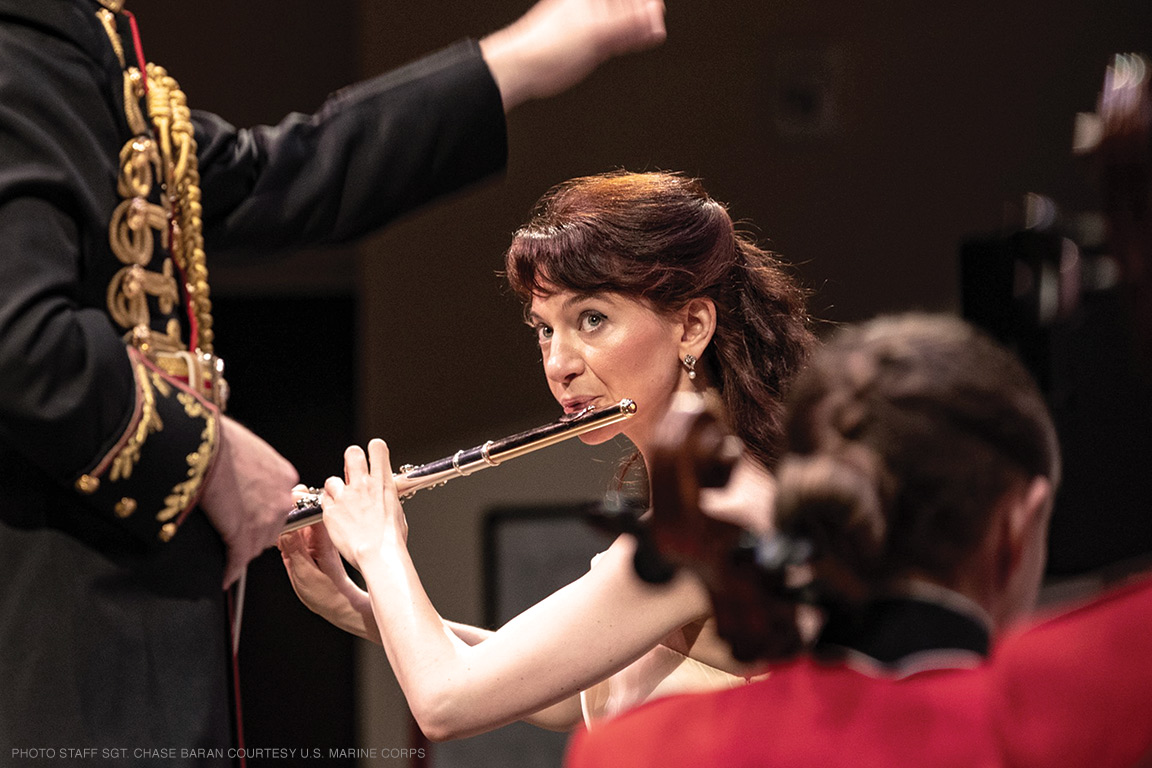
“I knew that she would bring imagination, intellectual curiosity, and emotional depth to the piece, and that gave me great freedom as a composer to explore a wide range of musical characters and styles,” Tian says. “Her playing is not only powerful,” he adds, “but also has an exceptionally beautiful, singing quality.”
The concerto landed a recording on Aspire, an album celebrating the Marine Band’s 225th anniversary in 2023. “Bringing a new work to life is deeply rewarding,” Stillman says of the experience, which she now calls “an exhilarating artistic journey.”
The piece joins a long list of works she has premiered throughout her career, while she “continually expands the possibilities of the flute,” Tian says.
Outside of her own playing, Stillman also nurtures other instrumentalists and advances music education wherever she can. She’s taught students at Temple University’s Boyer College of Music and Dance since 2017, and last summer she became an instructor of art and music at the Barnes Foundation. She also visits schools in Philly’s Latino communities through a DSE program, coaching and performing with young students.
And several decades after Baker plunked her on stage in the moment that changed her life, Stillman is herself a Yamaha Performing Artist—and she’s returned to the National Flute Association’s convention multiple times to teach masterclasses and perform.
“I feel grateful for my life as a musician,” she says, “and hope to continue sharing my joy in musicmaking with others.”
—Molly Petrilla C’06