
“Hackney Files” pro and con, help wanted, Fauré fans come forth, and more.
A Gift
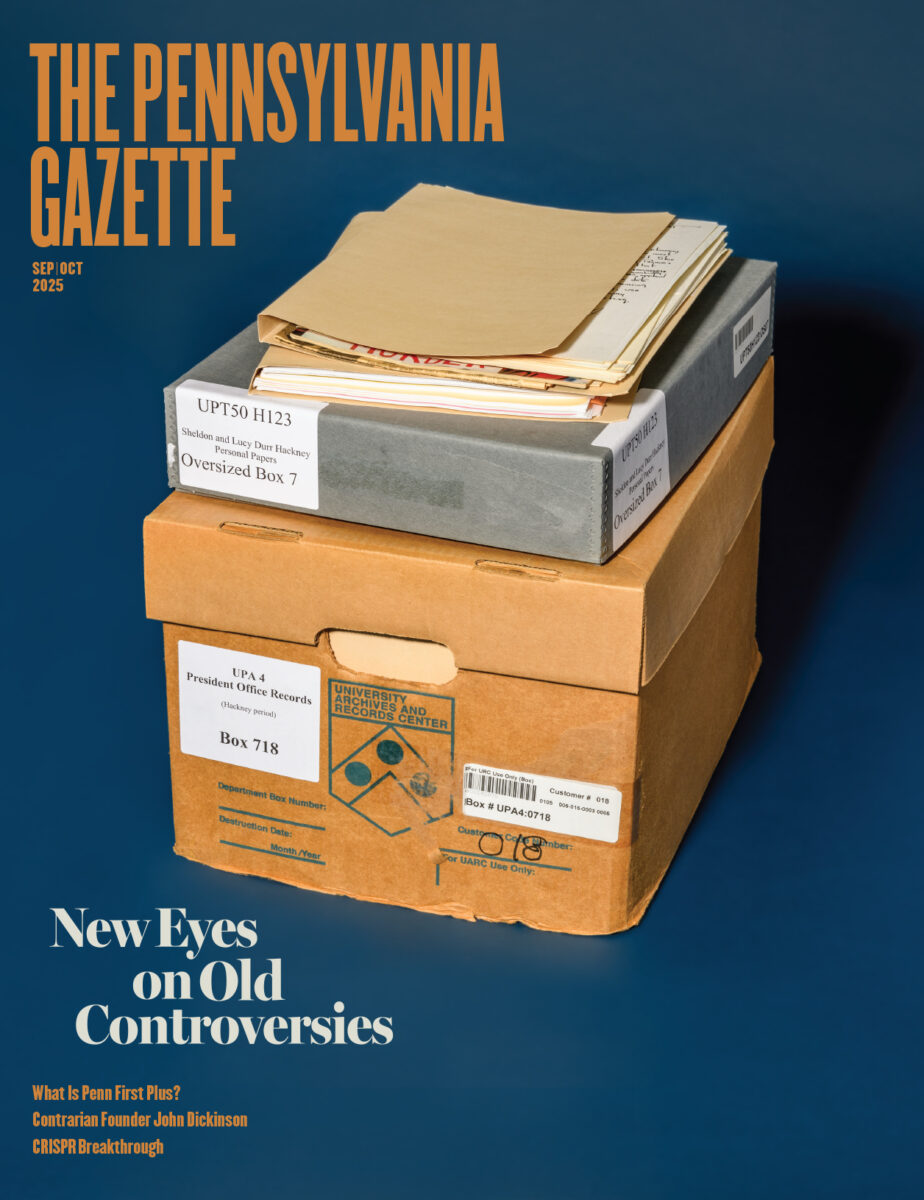
Reading Trey Popp’s article “The Hackney Files” [Sep|Oct 2025] on Jared Farmer’s History Workshop class was a gift to so many of us who were at Penn in the 1990s, as we witnessed both the Water Buffalo scandal and the incident of the 14,000 stolen Daily Pennsylvanians, taken by a group identifying itself as the “Black Community.” I appreciated hearing that Farmer and his students revisited these events years later, with the greater perspective (and greater distortion) of history. As an undergraduate, both the Water Buffalo incident and stolen newspapers left me unsure what to think or how to react. Is stealing 14,000 newspapers the best way to protest? Why was a student columnist given a platform to spout racist and sexist ideas? Was the “water buffalo” comment racist or was there a cultural component we needed to consider? Was the University’s response appropriate or ineffective? I was lost.
As a young student I thought having strong convictions was preferable to uncertainty—it was those with strong convictions who curried favor with professors and whose voices we heard on campus. And yet here we had these two incidents where many of us couldn’t decipher our convictions. What should a decent human think, we wondered? Revisiting the events through Popp’s article, I still don’t know the right answers and this not knowing is what is wonderful about Professor Farmer’s class.
In visiting the archives, the students landed in a place that felt pretty real to what I felt at the time. Of course, Farmer’s students weren’t there—so they can’t know the frustration of having one’s studying regularly interrupted by the endless reverberations of sorority girls chanting and foot stomping, and they don’t know the icky feeling one inevitably had reading (or even just seeing) the racist and sexist comments by the Daily Pennsylvanian columnist issue after issue after issue.
But despite the unknowable nature of the past, these students do know what it’s like to be an undergraduate, sometimes unsure about how to interpret the chaos bubbling everywhere. And although they did not live through the history they are studying, I’m impressed by their approach to the archives, their willingness to be unsure of the answers, and their suspension of judgment on those of us on campus during these events. Personally, I feel both reassured and surprised that even all of these years later, the questions I had in the ’90’s about these “free speech” events are still with me.
Tara Bandman C’95, Dobbs Ferry, NY
The Right Tools to Succeed
As a working architectural historian, team lead, and manager of junior level staff, I cannot emphasize enough how much I enjoyed reading “The Hackney Files.” One of the things most surprising to me about many of the junior level historians I encounter now is their lack of ability to do non-digital research, as well as a lack of ability to quickly scan, understand, and synthesize primary source documents and materials efficiently. Being able to do so is a critical component of being a working professional historian, particularly in a consulting environment where every hour counts (and costs), and I have seen too many young historians who are ill-equipped to be able to do this.
Kudos to Jared Farmer for understanding the importance of teaching these methods to young history majors. In my professional years, I have worn many hats, from urban planner to corporate banking compliance officer and for the past 10 years cultural resources consultant, and I can assure you that having the ability to seek out information and resources, quickly digest it, and analyze and interpret it is a skill applicable in many professional careers. I can only hope others follow Jared Farmer’s example in equipping the next generation of professionals with the right tools to succeed.
Amanda Miller Stander GCP’07, Pittsburgh
Hackney Ranks at the Top
I read with great interest the article on Professor Farmer’s History Workshop because I was Sheldon Hackney’s provost from the outset of his administration in 1981 to 1987. During that time, I came to know President Hackney as a man of great moral courage, one who kept the University true to the principle of open inquiry as well as dedicated to the highest standards of teaching, research, and public service.
Those years were filled with turmoil, as the article chronicles. I often dealt with sit-ins in my office. But under President Hackney’s leadership, his administration treated with respect all sides in grappling with tough issues of divestment in South Africa and increasing the numbers of Black students and faculty. For those interested, my memoir, Learn, Lead, Serve: A Civic Life (Indiana University Press, 2025) gives a full account of my years working with President Hackney.
The article is an excellent commentary on what must have been a valuable learning experience for students. But it states that “Farmer’s students emerged from the class with a keen appreciation for how expediency can shape administrative decision-making.” As one student said, “it is upsetting that the University never seems to take an enduring stand on any area—it simply tries to not step on anyone’s toes in the moment.” These are grossly unfair charges against President Hackney, who took a consistent and principled stand in dealing with each of the many controversies at the time.
No leader is perfect, of course, but having been involved with many university leaders during my years in higher education, Sheldon Hackney ranks at the top, and I know this judgment was shared by the great majority of Penn faculty, staff, and students at the time.
Unique among those leaders in my experience, he was a great teacher. His administrative style was always to ensure that all of us privileged to work with him learned valuable lessons in the process. It is no surprise that he won the outstanding teacher award after he stepped down as president and returned to full-time teaching in the History Department.
Thomas Ehrlich, faculty, Palo Alto, CA
Penn Required a Scalp
“The Hackney Files” glosses over the University’s “maladroit handling” of the Water Buffalo incident. Penn brought disciplinary charges against the student, not because his reference to “water buffalo” was “more memorable,” but because Penn required a scalp when the other students denied shouting any insults. The accused student, an observant Jew, probably took seriously the commandment against bearing false witness. Penn singled him out for telling the truth and made him the scapegoat.
Creighton Meland W’78, Hinsdale, IL
“The Hundred Dollar Scholar”
Your article on the controversies faced by President Sheldon Hackney in the 1980s and 1990s, and the current history course based upon them, recalled my own experience with one of these issues: the Mayor’s Scholarship program for Philadelphia residents. An entering freshman in 1975, I was the fourth generation of my family to be born and raised in Philadelphia, but among the first generation to go to college.
For the preliminary stage, I was summoned to an interview in a claustrophobic conference room in one of the older buildings on the Penn campus. The room was dominated by a rectangular conference table around which sat about a dozen people with their backs jammed against the walls and the windowsill. I took my seat at the head of the table, the only available space in the room. For the next 40 minutes I was bombarded with rapid-fire questions from all points around the table. The questions mostly concerned my attitudes on certain subjects, with some of the questioners almost hostile and others merely curious. I assumed that most of the inquisitors were city employees; I had to guess because many of them failed to introduce themselves.
A few weeks later I received a letter saying I was being awarded a Mayor’s Scholarship of $100 per year, about the cost of a single science textbook, and almost negligible in light of Penn’s $4,000-plus tuition (which increased 15–20 percent yearly in the inflationary 1970s) and the additional costs for fees, textbooks, weekday lunches between classes, and the hour-long commute from my parents’ home in Feltonville to West Philadelphia (it was too expensive for me to live on campus). I considered myself “The Hundred Dollar Scholar.” I wondered whether the paltry amount of the grant was due to disapproval of my answers to their questions, opinions of mine they disliked, the fact that I came from a local private school (only because I had won an academic scholarship) rather than a public high school, or another, unfathomable reason.
Your article mentions the lawsuit against the city, suggesting that the reason may have been that the program was grossly underfunded (like many city services), and perhaps I could only get a tiny slice of an undersized pie. At least that’s what I would like to speculate.
John H. Brand C’79, Gardnerville, NV
A Helping Hand Would Have Been Welcome
Reading Caren Lissner’s article about the Penn First Plus Program [“Helping Hands,” Sep|Oct 2025] brought back some painful memories of my experience as a freshman at Penn. Coming from a small town in rural Pennsylvania and being the first generation in my family to attend a four-year college, I always seemed to be at least a couple of steps behind my classmates both socially and academically.
Perhaps the epitome of the gulf between me and those who seemed to belong on campus came one day prior to Spring Break. I was planning to take another dismal Greyhound bus trip home for the week and was stunned while traversing campus when I heard another student casually tell his mates that he was planning to spend the break climbing Mount Kilimanjaro. What!?! I didn’t need to read Heinlein’s Stranger in a Strange Land; I was living it.
Having jumped into the deep end of the pond, I eventually came to appreciate and even enjoy my time at Penn. And I take great pride in being a graduate. But I certainly wish Penn First Plus had been available back in the day. I might not have scaled Mount Kilimanjaro, but it would have made the transition to college life considerably easier and more enjoyable.
William Babcock C’73, Philadelphia
Prudent Choice of Subject
Really enjoyed the article on John Dickinson [“The Prudent Patriot,” Sep|Oct 2025], a founding father about whom I knew little. Thank you.
Walter Beh L’70, Kailua, HI
Sadder Taxi Tale
David Porter’s “Student Driver” [“Alumni Voices,” Sep|Oct 2025], about driving a cab in Philly for the summer while a student, brought back memories of my own experience doing the same for Yellow Cab in the summer of 1971. Being from a small New England town, I knew nothing about Philadelphia streets and there was no GPS. I picked up an elderly woman who said in a distinct Main Line accent, “The Philadelphia Hotel.” “Where’s that?” I asked. “My dear boy,” she replied, shocked and amazed. “You don’t know where the Philadelphia Hotel is?” I worried I was in the wrong job.
I got the worst cab in the fleet, and all the other cab drivers knew it as they snickered at me at the start of my shift. Stopping on an incline to get a fare, I put the cab in park, jumped out, picked up the ride’s suitcase, only to turn and see the cab rolling backwards down the hill. I got the July 4th shift of 100-plus degrees and not a soul to be seen anywhere all day.
My last ride was a shady-looking guy who had me drop him off in what I remember as the kind of deserted warehouse area where corpses are left. A downpour hit as I was about to leave. I put on the wipers and lights … the cab died along with my enthusiasm for being a cab driver. I remember calling in (if that was possible) and telling them “I quit.” Then I abandoned the cab and walked through the downpour all the way back to my seedy, little room.
Kevin McLean C’73, San Diego
A Closer Comparison
I really wish the editors had placed the articles on page 24 and page 26 on facing pages [“Gazetteer,” Sep|Oct 2025]. If so, readers would have learned how Penn faculty, staff, and students combined the absolute latest molecular medical breakthroughs to enrich the life of the infant KJ Muldoon in “CRISPR’s First Custom Cure,” then immediately read, in “University Announces Title IX Settlement,” that the Trump administration used Penn’s adherence to NCAA rules to put lives like KJ’s in jeopardy.
If the editors had done that, KJ’s cute face would be on the left, and the threat of no more treatments for patients like KJ on the right—a threat leveled because of who swam on which swim team a few years ago.
Jonathan Rosenblum C’91, San Diego
Musical Memories
Thank you so much for the excellent article, “The Organ Protector,” profiling my friend Ray Biswanger, who has performed superbly as the longtime director of the Friends of the Wanamaker Organ, of which I am a member [“Alumni Profiles,” Sep|Oct 2025]. I also noted his interest in the Curtis Organ, which resides in Irvine Auditorium at the University, which I was fortunate to play when I was a medical student at Penn.
The Curtis Organ gave me the first opportunity I had to learn to play a pipe organ. Teaching myself, I got good enough that I was able to include the organ in the annual medical school show, where I performed the then-popular tune “Downtown,” originally sung by Petula Clark. Because it was a medically oriented show, the title and lyrics were changed by my classmate, the late Sylvan Green C’66 M’72, and the song was called “Infarct.”
The other article that deeply touched me was “Diminuendo for a Dream,” written by Gerald Kamens [“Elsewhere,” Sep|Oct 2025]. As it was for him, Fauré’s Requiem has been one of the most significant pieces of music throughout my life, entering it when I was about to be married in the early 1980s. I presented a chamber orchestra version CD to my future wife, Sharon, who loved it as well. Last year, we celebrated our 40th wedding anniversary by going to a performance of the Requiem. So as it has been for Mr. Kamens, this particular piece of music continues to enchant us. By the way, we have also visited the same Geneva cathedral in which the essay is set a few years ago, so his word images were all the more vivid for us.
Jonathan Kleefield M’70, Newton Center, MA
Magical Experience
Kudos for publishing the essay on Fauré’s Requiem. I never miss a chance to attend whenever it is being performed near home. So what a pleasure to learn that a fellow alum is also drawn to it!
Two vignettes come to mind regarding the Requiem:
More than 30 years ago, the New Yorker was doing its first profile on the famed British actor Daniel Day-Lewis. The writer arrived at his house at the agreed upon time. The actor’s sister opened the door and apologized that her brother was being detained in a back room; he was listening to Fauré’s Requiem and couldn’t be disturbed.
More than 55 years ago, my wife-to-be lived in an apartment just above her landlord. They had a hate-hate relationship. While visiting her one Sunday, I heard a beautiful melody wafting through the floor. Not allowing their animosity to deter me, I went downstairs and knocked on the landlord’s door. He opened it slightly, I gingerly apologized for the intrusion, and said, “You’ve got to tell me the piece of music you are listening to.” He muttered “Fauré’s Requiem” and abruptly shut the door.
Fast-forward another 40 years to 2010, when I learned that St. Luke’s Church in Manhattan was performing the Requiem. I came up from Baltimore and took my two daughters-in-law (both Penn alumnae) living in New York to the performance. What a magical experience being with them for this gorgeous piece of music!
Barrett W. Freedlander C’62, Baltimore
Shared Admiration, One Observation
I share writer Gerald Kamens’ great admiration for Gabriel Fauré’s sublime Requiem. One observation in the article calls for a correction. The third movement, the “Sanctus,” does not offer praise for the dear departed. The Sanctus is a standard element of the Catholic Mass, and it offers praise to God. The Latin text of the Requiem reads: “Sanctus, Sanctus, Sanctus, Dominus Deus Sabaoth. Pleni sunt coeli et terra gloria tua. Hosanna in excelsis.” In English: Holy, Holy, Holy, Lord God of Hosts. Heaven and Earth are full of Thy glory. Hosanna in the highest.” Fauré’s Requiem is a prayer for God’s mercy on the deceased, deliverance from eternal damnation, and entry into Paradise. Nowhere does it address whether the deceased is anything other than a sinner.
Raymond C. Wilson L’83, Twinsburg, OH
Cowardice and Shame
Richard Samuelson’s astonishment concerning Penn’s “overdue apology to the members of the women’s swim team” [“Letters,” Sep|Oct 2025] was exactly the opposite of mine.
Indeed, I was so astonished that Penn would so meekly accept the dictates of an authoritarian president that I mailed my diploma back. Continuing to allow it to hang in my office would only be an unacceptable daily reminder of cowardice and shame.
“Leges sine moribus vanae”; never truer.
David Berman C’73, Andover, MA
No Brainer
I was really happy to see the responses against schools allowing men to compete in girls’ sports. It really is a no brainer! Boys are bigger, faster and stronger, and girls are prettier, sweeter and nicer! That is the way God made us!
Neal Hunt WG’68, Raleigh, NC
A Pattern of Performance Differences
Elise Auerbach writes “the assertion that transgender women’s participation in college sports is unfair to cisgender women is spurious” [“Letters,” Sep|Oct 2025]. This makes me question whether she has ever checked performance differences, especially in sports that provide easy comparison.
Two scholars from Duke University Law School once monitored track performance globally over a full year. In the 400-meter sprint there was an approximate 6 second difference between fastest man (43.62 seconds) and fastest woman (49.46). More notable, the number of men that could run faster than the fastest woman was 4,341, including 285 high school level runners. Across all the other running events this pattern is repeated.
Advocates for biological men in women’s sport should provide guidance on how to handle women’s records when they are shattered. Track records in sprint events crawl slowly, by hundredths of a second over decades. If one of those 4,341 runners were to transition and achieve a 46-second woman’s performance (well short of men’s record, but a quantum leap forward for women’s), it would be so beyond credibility that track associations and coaches would not take it seriously. It would degrade the integrity of the sport. An alternate set of record books confined to “real” women’s records would emerge. And, ultimately, a much harsher form of trans vilification will result.
Tom Compernolle W’76, Golf, IL
Consistently Interesting
Thank you for a consistently interesting magazine. I found the Jul|Aug 2025 issue waiting for me on my return from my annual cycling trip in Europe even more relevant than usual.
At Auschwitz in July I saw displayed a woolen pair of toddler’s shorts, very similar to those I wore back in 1944. Seeing them in that display case drove home that the victims were never “other,” they were part of a Europe-wide culture in which a toddler’s shorts bought in Lidice or Liverpool could have been made in the same factory in Lille or Leicester. The article “Survival Story” about Michael Katz [“Gazetteer”] brought a similar rush of empathy: If someone who had survived as much and lost as much as he had could still live a superbly productive life, what might the little boy who had worn those shorts have achieved if he had been allowed to live?
The essay “Bar Soap” was quite brilliant. One develops a close relationship with one’s bar of soap when traveling under one’s own power for weeks on end. As that bar shrinks it becomes ever more important to economize and to protect it at all costs from falling into water. My bar only just made it this year!
“The Scopes Trial at 100” and “Travels in Trashland” both demonstrate how intelligent people can deny facts that make them uncomfortable. The exponential growth built into both our economic system and our life expectations cannot last forever. The production of food and material goods and their disposal as trash both take land, sometimes large amounts of land. At some point land-use conflicts are going to become so serious that they will lead to physical conflict.
John Berry C’63, Austin, TX
What Is That Thing on the Cover?
I always receive my copy of the Gazette with pleasure. But with the Jul|Aug issue, the question immediately arose, what is that thing on the cover? I consulted all family members (four adults, in total). Three of us thought that they were three ribbon cables. Only my youngest daughter Nadia, who is trained as a 3D illustrator, said, “they are three medicine bottles.” I think that the illustrator could have used a few more 3D clues to make the medicine-bottle interpretation more possible for us. His rendering was at some level rather Escher-esque, with impossible contortions of 3D objects. But I suspect that he was not really in control of the impression that he was giving.
Still, a very engrossing issue (mainly the trash story).
David DiVincenzo EE’79 GEE’80 Gr’83, Voerendaal, Netherlands
Two Essays
Thank you so much for two essays in the Jul|Aug 2025 Gazette:
The first is “Beyond Salvation” by Mollie Benn [“Notes from the Undergrad]. I too went through some of her pangs in becoming a Christian, including not going forward when Billy Graham was on Long Island years ago. However, today I am a Lay Eucharistic Minister in my church and serve as the chair of our Food Ministry. My eyes were finally opened and I believe.
I also loved “Trash Tribe,” by Berenice Leung [“Alumni Voices”]. I often took my family on cruises for the February vacation from Fort Lauderdale. One year while they were enjoying the pool at the Marriott, I walked the beach. I finally got a bag from a beachside restaurant, as I also collected trash along the way. Until!!!! There was a toilet seat, and I had had enough. Now after COVID I do not pick up other people’s trash!
Katie Barney GEd’69, Easton, MD
The Way to Salvation
In “Beyond Salvation,” the author closed with her exclamation that she had been saved and tried to convince herself “this time, it would actually stick.” One is not saved simply by saying “I want to be saved.” The way to salvation is revealed in Scripture, and even if one is saved, there is no Divine promise of a blissful life in this age. The desire to be saved must be from the heart, not the mouth, and salvation demands complete surrender to our Savior.
Scripture is replete with accounts of patriarchs, prophets, apostles, and martyrs who did not have carefree lives and suffered even death because of their faith. Anyone who truly desires salvation should pray to be filled with the Holy Spirit to help them comprehend God’s revelations in Scripture. Simply stated, salvation requires faith and acceptance of God’s will.
Nicholas J. Letizia W’73, Woodcliff Lake, NJ
My List Could Go On and On
In the Jul|Aug 2025 Gazette there was a very long letter from a 1996 grad from liberal California expressing his opinion that our Penn President Larry Jameson’s statements are an “exercise in futility.” The writer pounds hard on President Trump, and I am wondering if the Gazette will print opposing views. The anti-Trump list is long: not paying income taxes, sexual misconduct, attacks on elite universities, plays to racism, his mass of uneducated voters, supposed trade wins, and so on.
The letter notes the writer learned from his Wharton School class “trade can be the rising tide that lifts all boats.” I was president of a technology company way back in 1985 when we helped install advances into the Chinese economy, which by then had created a dozen capitalistic enterprise zones. However, we were told not to come back—to instruct our engineers to sit and convey our technology to the Chinese or face not getting paid for our work.
The point is, witness Apple and Nike, much trade has been with nations that steal technology; employ very cheap labor, including child labor; and lack the cost of environmental regulations—that is, unfair trade not free trade.
I like the fact that our needed immigrants should come in legally, that our streets be safer, that elite universities should be more balanced in their liberal/conservative views, and my list could go on and on.
Mr. Trump is doing some pretty good things.
Roger Colley W’60, Dresher, PA
Clarification
Responding to “The Hackney Files,” several readers asked why the article described the young man at the center of the Water Buffalo incident as having been born in Israel. In addition to the fact that it is not unusual for foreign-born students to have some difficulty navigating American sensitivities pertaining to language and race, the freshman’s defense at the time was that “water buffalo” was a rough translation of a Hebrew colloquialism used to describe a thoughtless or noisy person. A sentence explaining that context has been added to the online version of the article.
