
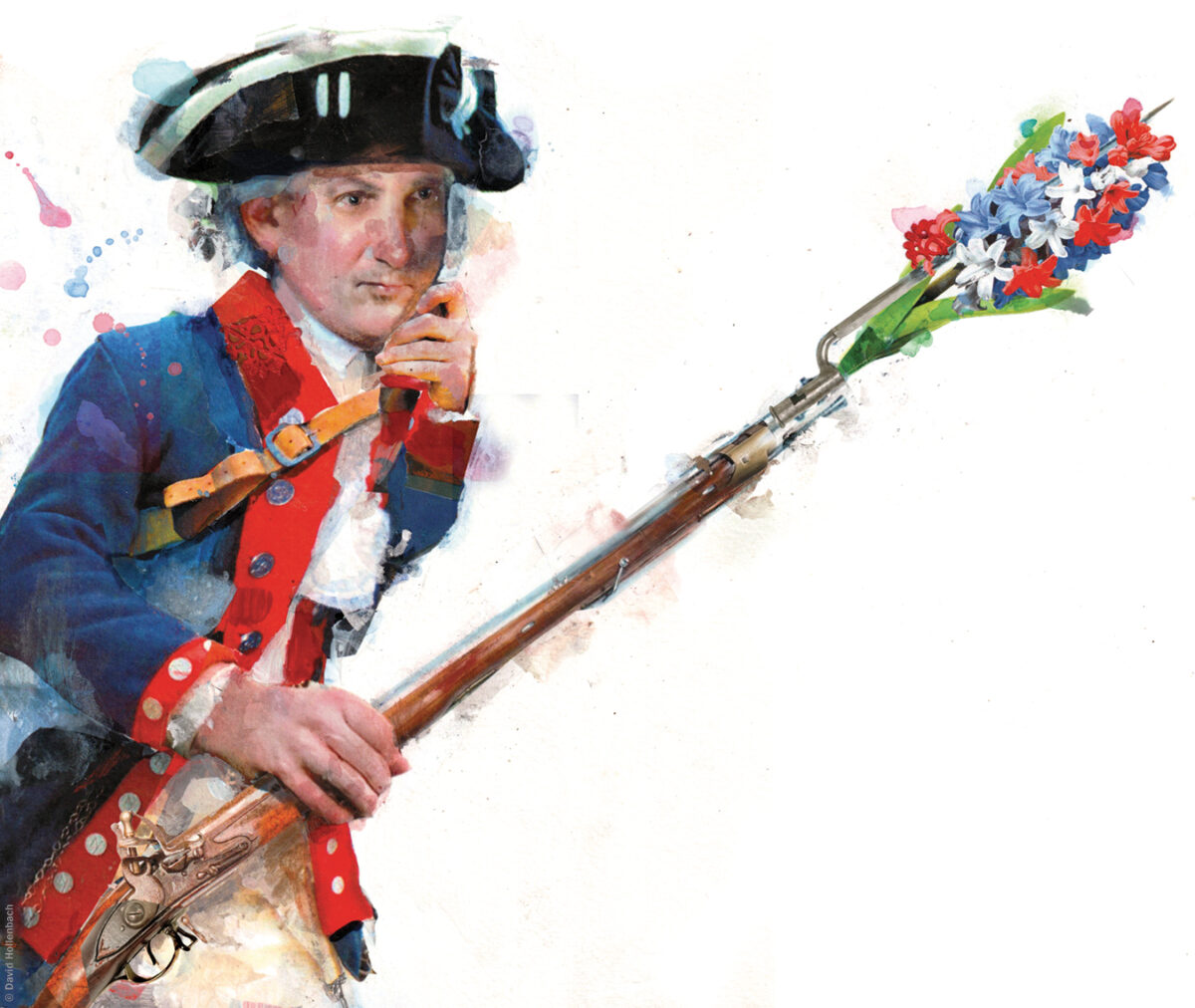
There’s a lot more to Founding Father John Dickinson than not signing the Declaration of Independence.
By Dennis Drabelle | Illustration by David Hollenbach
Download a PDF of this article
He is “a Shadow—tall, but slender as a Reed—pale as ashes,” John Adams wrote in a 1774 diary entry. “One would think at first sight that he could not live a Month. Upon a more attentive Inspection, he looks as if the Springs of Life were strong enough to last many Years.” The reedy paleface under Adams’s microscope was John Dickinson, a lawyer, writer, and public servant whose Springs of Life did indeed last many more years. Thirty-four of them, to be exact, at the end of which he had been president of the Pennsylvania Assembly, a Founding Father, and a trustee of the University of the State of Pennsylvania, as Penn was once called.
Throughout, Dickinson rarely saw issues in absolute terms. Take, for example, the series of actions he took—or refrained from taking—with regard to the American Revolution: declining to sign the Declaration of Independence but fighting in the War of Independence and, after the colonies won, helping to draft the United States Constitution. If John Dickinson was a Shadow, it was a complex one, and examining it from all sides can lead to a more nuanced understanding of American revolutionary history than civics textbooks tend to provide.
Dickinson was born to wealth on Maryland’s Eastern Shore in 1732. His father was a tobacco farmer, and his mother was said to be “a distinguished woman of fine understanding and graceful manner.” They were both Quakers. In 1741, the Dickinsons moved to what is now Delaware but was then a part of Pennsylvania known as The Three Lower Counties on the Delaware; there they built a house called Poplar Hall. When John grew up and showed an interest in becoming a lawyer, his parents approved. He read law in Philadelphia and passed the bar. In 1753, he moved to London and joined one of the Inns of Court to study law formally. In a letter home, he wrote of taking “as much pleasure in unraveling an intricate point of law as a florist receives when he sees some favorite flower, which he has long tended himself, at last unfold its glowing colours & breathe its sweet perfumes.” Londoners’ loose morals, however, took the young provincial aback. “It is grown a Vice here to be Virtuous,” he complained.
Three years later, Dickinson returned to Philadelphia and set up a law practice. He won some big cases, including one in which he defended a printer against a charge of libeling the Pennsylvania Assembly, which itself judged the case and found him guilty. Benjamin Franklin approved the Assembly’s action, but Thomas Penn, who had succeeded his father, William, as the colony’s proprietor, appealed the verdict to the King in Council. The result was a vindication of Dickinson’s contention that for the Assembly to act as both prosecutor and judge of a case in which it was a party was a travesty of justice.
In 1759, Dickinson was elected to a seat in the Lower Counties Assembly, which had broken away from the Pennsylvania Assembly because of dissatisfaction with being ruled by Quakers. With an eye toward a political career in the larger colony, Dickinson did not run for reelection when his term ended. His gamble paid off in 1762, when he was elected to fill the seat of a Pennsylvania assemblyman who had died. While in office, Dickinson maintained his law practice. One of his clerks was the brilliant Scottish immigrant James Wilson, who later worked with his mentor on the Constitution, taught law at Penn, and became a US Supreme Court justice before being embroiled in debt and dying a fugitive[“Flawed Founder,” May|Jun 2011]. Dickinson also managed the plantations associated with Poplar Hall—a credential that later inspired him to call his masterwork Letters from a Farmer in Pennsylvania—and in doing so dealt with another kind of property: human beings. After wrestling with his conscience for years, Dickinson became the first Founding Father to free all his slaves.
In 1764, Dickinson and Franklin were again at loggerheads. The Penns’ overlordship had become increasingly unpopular, and Franklin’s proposed solution was to get their proprietary charter revoked and have Pennsylvania become a crown colony. Dickinson had the gumption to challenge Franklin on this, urging the Assembly to “let our resentment bear proportion to the provocation received; and not produce … effects more fatal than the injury of which we complain.” As an example of such an unwanted effect, Dickinson cited the charter’s guarantee of religious freedom and warned that the sought-after change could lead to the establishment of the Church of England in Pennsylvania.
Franklin was not dissuaded. He went to England and contravened his instructions from the Assembly by submitting to the British Privy Council a petition for direct rule of Pennsylvania by the Crown. Although this was rejected, the petitioner’s reputation took a hit. Franklin’s biographer Walter Isaacson calls his handling of this matter “one of [his] worst political misjudgments. His hatred of the Penns [had] blinded him to the fact that most of his fellow Pennsylvanians hated taxes imposed from London more.”
In the meantime, the relationship of all the American colonies to England had changed. Parliament had passed the Stamp Act, which as explained by Dickinson’s most recent biographer, Jane E. Calvert, “required that all vellum, parchment, and paper receive an embossed royal stamp costing a specified amount; otherwise, use of these materials would be deemed illegal and any business conducted with them null and void.” Dickinson decried the law for two reasons. First, he thought it was unfair, imposing burdens that fell most heavily on “merchants and people of little substance.” Second, he considered it an unconstitutional violation of the fundamental principle that those being taxed should have a say in the matter, which in this case they had not.
The slogan “no taxation without representation” (attributed to James Otis of Massachusetts) spread through the colonies, and the Pennsylvania Assembly sent Dickinson to New York as one of its representatives to the ad hoc Stamp Act Congress. It was clear to the delegates that the new law was unacceptable, but thanks in large part to Dickinson’s leadership they stopped short of fomenting a crisis, instead urging civil disobedience—resolving to conduct business as usual, as if the Stamp Act did not exist.
Though not himself a Quaker (for one thing, he couldn’t bring himself to forswear using force in a defensive war), Dickinson drew upon his familiarity with the faith to propound a democratic philosophy of human rights in Friends and Countrymen, a broadside he published in 1765. Rights come not from kings or governments, he asserted, but from God, and thus belong to every man. This expansive view of rights and equality set the tone for the treatment of rights in the Declaration of Independence 11 years later.
Dickinson tried a back-door approach to a reputedly sensible British statesman, William Pitt the Elder. In a letter to Pitt, Dickinson noted that sentiment for independence was growing in the colonies and that Parliament was to blame. He also made the dire prediction that a severance of ties with Britain would divide the colonies from one another, too, leading to “Centuries of mutual Jealousies, Hatreds, Wars and Devastations; till at last the exhausted Provinces shall sink into Slavery under the Yoke of some fortunate Conqueror.”
In March of 1766, the Stamp Act was repealed, but Parliament soon passed the Townshend Acts, so called after Charles Townshend, the Chancellor of the Exchequer whose brainchildren they were. One of the five new laws imposed taxes on paper, lead, and paint; another protected the East India Company against competition from tea smugglers; and a third pressured New Yorkers to quarter British soldiers on their land. Public response was so tepid, however, that Dickinson was moved to gather his thoughts into a thoroughgoing analysis of where Parliament had gone wrong.
The British Constitution is not a document but an accrued web of precedents, rules, and relationships among the Crown, Parliament, and the people. As explained by the historian Forrest McDonald in his introduction to a modern edition of Letters, “Americans needed someone who could state their case in such a way as to make king and parliament out as radical innovators, and themselves as defenders of ancient traditions.” Dickinson became that someone. Adopting his persona of a farmer—albeit one who could cite Tacitus, Cato, Montesquieu, and Hume as readily as he could milk a cow—between December of 1767 and February of ’68 he published a dozen closely reasoned essays in the form of letters to “My dear Countrymen” in two Philadelphia newspapers; they were reprinted elsewhere in the colonies, as well as in London, Dublin, and Paris.
In his first letter, he took care to distinguish between the king and Parliament, assuring his majesty of the colonists’ fealty while taking the legislative body to task for passing the Stamp Act and others of its ilk. “Here we may observe an authority expressly claimed and exerted to impose duties on these colonies; not for the regulation of trade; not for the preservation or promotion of a mutually beneficial intercourse between the several constituent parts of the empire, heretofore the sole objects of parliamentary institutions; but for the single purpose of levying money upon us. This I call an innovation, and a most dangerous innovation.”
In his third letter, Dickinson explained that he was writing the series “to convince people of these colonies that they are at this moment exposed to the most imminent dangers; and to persuade them immediately, vigorously, and unanimously, to exert themselves in the most firm, but most peaceable manner, for obtaining relief.” Elaborating on the qualifier “most peaceable,” he asserted that “liberty is a cause of too much dignity to be sullied by turbulence and tumult. … Those who engage in [that cause] should breathe a sedate, yet fervent spirit, animating them to actions of prudence, justice, modesty, bravery, humanity and magnanimity.” Farther down in the same letter, Dickinson specified the tactic he would have the colonists use instead of turbulence and tumult: “petitions of our assemblies, or where they are not permitted to meet, of the people, to the powers that can afford us relief.”
In the 12th and last letter, Dickinson played cheerleader, assuring his fellow colonists, “You will prove that Americans have that true magnanimity of soul, that can resent injuries, without falling into rage; and that tho’ your devotion to Great Britain is the most affectionate, yet you can make PROPER DISTINCTIONS, and know what you owe to yourselves, as well as to her.” Align his emphasis on sedateness, magnanimity, and petitioning with his fear that revolution might separate the colonies from one another, and you can see why he couldn’t wholeheartedly embrace the Spirit of ’76. Even so, the Letters were so well-received that, like Lord Byron, Dickinson woke up one day and found himself famous. His renown reached the trinket-begetting level, with his likeness appearing, in Calvert’s words, “on canvas, in miniatures, etched in copper, molded in gold, and carved in wood.”
In his private life, Dickinson had been courting Mary Norris, known as Polly, daughter of Isaac Norris, a longtime speaker of the Pennsylvania Assembly. She and her parents were Quakers, and there was a roadblock: the risk of Polly’s being expelled from her meeting if, as John preferred, they wed in a civil ceremony. In 1770, at the ripe age of 37, he got his way—a civil ceremony it was. Dynastic as the marriage may have appeared at the time—the Norrises had an estate of their own, Fairhill, in Philadelphia—it proved to be a love match as well.
Friction between the colonies and the mother country heated up until, in the fall of 1774, what became known as the First Continental Congress met in Philadelphia. Composed of delegates from 12 of the 13 colonies (Georgia was the truant), the Congress set about formulating a Bill of Rights, a List of Grievances, and a petition to the king. Early in the going, Calvert writes, John Adams was “as star-struck [with Dickinson] as anyone,” recording in his diary “every detail of his interactions with the Farmer.” But Adams’s hero-worship waned after some of his drafts were edited or replaced at Dickinson’s behest. Adams took umbrage, for example, when Dickinson criticized his work as “written in Language of such asperity, as little accorded with the conciliatory disposition of Congress.” Before long, Adams was dismissing his former hero as “delicate” and “timid.”
After the king rejected the so-called Olive Branch Petition, a Second Continental Congress convened on May 10, 1775, in what soon became known as Independence Hall, this time with delegates from all 13 colonies. Three weeks previously, British attempts to enforce the laws being civilly disobeyed had led to the battles of Lexington and Concord. “The impious war of tyranny against innocence has commenced in the neighborhood of Boston,” Dickinson lamented in a letter to a friend. “While we revere and love our mother country, her sword is opening our veins.”
Like many other Americans, Dickinson was resigning himself to what he called “this most unnatural and inexplicably cruel war.” But he recommended that preparations be accompanied by “Measures of Reconciliation,” including a second petition to the king. Even so, when Philadelphians formed a militia, he agreed to command it.
In January of that year, Thomas Paine had published his incendiary pamphlet Common Sense, which cited the fact the only a third of Pennsylvanians were of English stock to undermine the notion of England as the “mother country,” called reconciliation “a fallacious dream,” sneered at “the summer soldier and the sunshine patriot,” and excoriated George III as “the Royal Brute of Great Britain.” Yet Dickinson continued to resist the burgeoning independence movement, emphasizing a rationale that might be called “no independence without a plebiscite”—that is, don’t change our form of government without obtaining a popular mandate.
Undeterred, Adams published his Letters of Novanglus, characterized by Calvert as “essentially a blueprint for the structures of self-government.” Momentum for a rebellion increased, but Dickinson was unmoved. To the Pennsylvania Assembly he declared, “I can defy the world, Sir, but—I defy not heaven; nor will I ever barter my conscience for the esteem of mankind! So let my country treat me as she pleases, still I will act as my conscience directs.” Speaking against the resolution for independence laid before Congress on July 1, he argued that the people would be right to “complain about our Rashness & ask why We did not first apply [for help] to foreign Powers, why We did not settle all Differences among Ourselves.” Adams then took the floor to make the case for breaking away; by the time he sat down again, Calvert writes, “It was clear that in the vote to be taken the following day, Congress would declare independence.”
At this juncture, Dickinson tempered his conscience with realpolitik. Anything short of unanimity on the resolution would be taken as a sign of weakness, so rather than vote nay, he absented himself. And shortly after the Fourth of July, Colonel John Dickinson led his men into New Jersey to fight. Years later, he accounted for his seeming inconsistency by saying he felt obliged “whenever the public Resolutions are taken, to regard them tho’ opposite to my opinion as Sacred … and to join in supporting them as earnestly as if my voice had been given for them.”
Dickinson’s military service didn’t last long; his battalion was called home in September, and he submitted his resignation. By the time the war ended, both Poplar Hall and Fairhill lay in ruins, but Dickinson still owned enough property to donate 600 acres to the new college named after him in Carlisle, Pennsylvania.
Owing to poor heath, Dickinson was not at his best during the constitutional convention of 1787–89. Nonetheless, he argued successfully for a bicameral national legislature, one with equal representation of every state (the Senate), the other with proportional representation (the House of Representatives), in order to keep the smaller states from being dominated by the larger ones. He also prevailed in the debate over whether senators should be elected by popular vote or by state legislatures; he expected voters to elect the best men to their own legislatures, which in turn would send the best of the best to the federal senate. (This method lasted until 1913, when the 17th Amendment, providing for direct popular election of senators, went into effect.)
Another cause of Dickinson’s failed, however: making Americans face the evils of slavery by at least speaking frankly about it in the Constitution’s fugitive slave clause. Instead, Congress adopted the waffling language “person held to Service or Labour in one state … escaping into another … shall be delivered up on the Claim of the Party to whom such Service or Labour may be due.” “The omitting of the Word,” Dickinson noted, “will be regarded as an Endeavour to conceal a principle of which we are ashamed.”
John Adams continued to badmouth Dickinson in the latter’s retirement, berating him, Polly, and their Quaker religion for their opposition to independence as well as for Adams’s defeat by Thomas Jefferson in the presidential election of 1800. Adams was both spiteful and wrong on the facts—John was not a Quaker, and he and Polly had nothing to do with Adams’s 1800 defeat—but historians tended to slight Dickinson’s foundational achievements until the publication of two revisionist biographies in the 21st century, William Murchison’s The Cost of Liberty: The Life of John Dickinson and Jane E. Calvert’s Penman of the Founding: A Biography of John Dickinson.
A man of immense learning, great powers of persuasion, and a conscience that was both strong and subtle, the Pennsylvania Farmer deserves the encomium given him by Calvert: “If there were a single individual who could be credited with bringing the United States into being, it would be Dickinson.”
Dennis Drabelle G’66 L’69 is the author, most recently, of The Power of Scenery: Frederick Law Olmsted and the Origin of National Parks.
