How a longtime fan of the world’s largest functioning pipe organ became instrumental in preserving it.
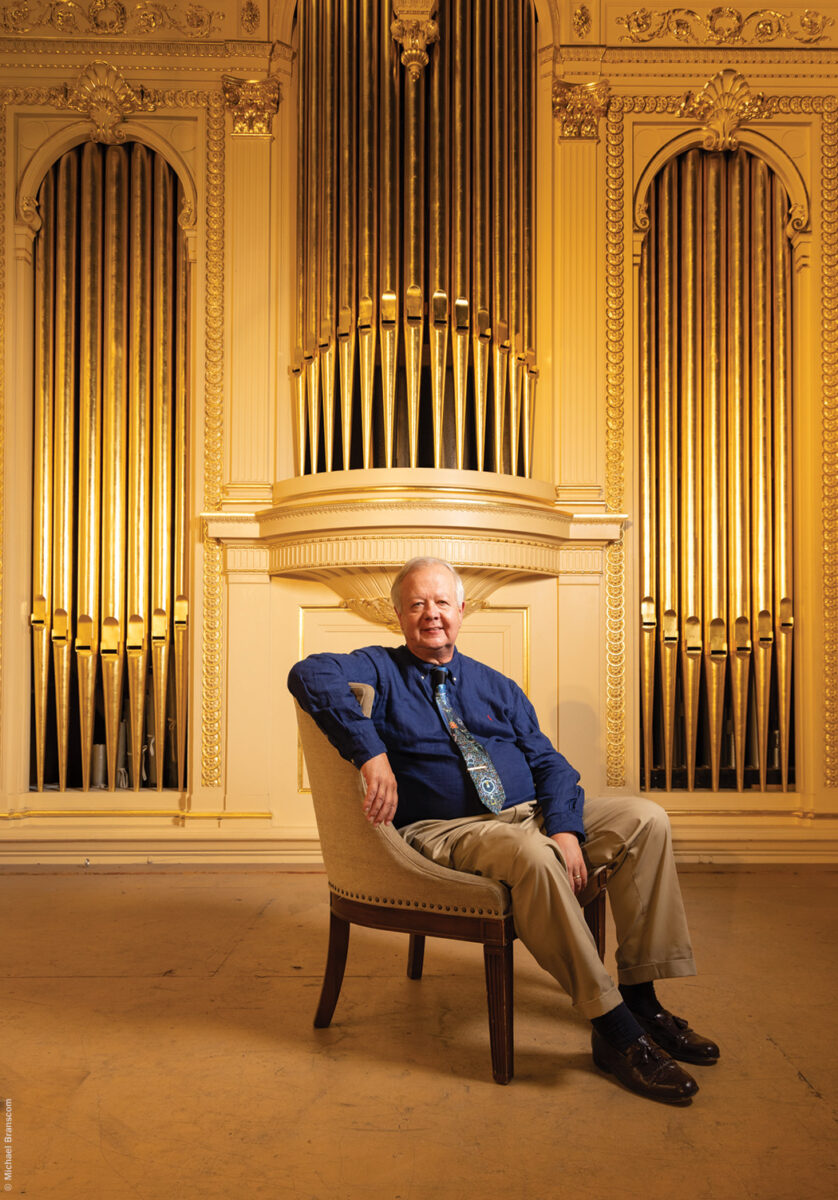
At age 71, Ray Biswanger C’75 climbs the ladders within the hidden seven-story labyrinth that houses the inner workings of the Wanamaker Grand Court Organ—the largest fully operational organ in the world—with the ease of long familiarity.
He shows off the workshop dedicated to keeping the instrument in top working condition, reeling off facts about the organ with equal mastery. Passing a row of metal organ pipes propped up against a wall, Biswanger notes that the largest of the organ’s 28,482 pipes is more than 32 feet long and the smallest is just a quarter of an inch. He explains that the organ was built at the beginning of the 20th century “to be a symphony orchestra in pipes” and is powered by electricity, magnets, and wind pressure.
As the executive director of Friends of the Wanamaker Organ for the last 17 years, Biswanger guides the nonprofit organization’s fundraising efforts for restoration projects and music performances. Earlier this year, he helped parties navigate the sale of the Wanamaker Building, the organ’s home for more than 110 years and a beloved fixture in Center City Philadelphia, to keep the organ and its music available to the public.
“It’s always ‘How can we help?’” Biswanger says. “We’ve worked ourselves into a position of trust here.”
The instrument that became known as the Wanamaker Organ was originally built for the 1904 St. Louis World’s Fair. Retail pioneer John Wanamaker purchased it in 1909 for his first Wanamaker’s department store in Philadelphia, which opened two years later. The organ had to be taken apart and shipped from St. Louis in 13 freight train cars.
Wanamaker spared no expense, hiring organ experts to expand the instrument so its sound would fill the store’s soaring, seven-story-tall Grand Court. Wanamaker “wanted the biggest and best organ in the world,” notes Biswanger. “The organ has a phenomenal sound because so much money was spent on making it the best it could be.”
The retailer loved staging publicity stunts to bring people into the store. He and his son, Rodman Wanamaker, arranged for the first notes of the Wanamaker Organ to be heard in 1911 at the exact time King George V of the United Kingdom was crowned in London. The store instituted daily organ concerts to attract and entertain customers.
The organ, bought by Wanamaker for a fraction of the $105,000 it cost to build in the early 20th century, is valued today at more than $79 million, according to the Friends of the Wanamaker Organ’s website. For generations of people in the Philadelphia region, the organ is iconic, initially known for the store’s daily concerts and later for its part in the beloved annual Christmas Light Show, which debuted in 1956. The Wanamaker Organ remained in the Grand Court through the sales of the Wanamaker’s store chain and the Wanamaker Building in the 1980s. A succession of department stores took up residence, with Macy’s arriving in 2006.
The Wanamaker Building was declared a National Historic Landmark in 1978 and both the Wanamaker Organ and the Grand Court are protected by the Philadelphia Historical Commission. Yet when news broke earlier this year that Macy’s was closing its Wanamaker Building location, questions immediately arose about the organ’s fate. Biswanger’s lifelong interest in the Wanamaker Organ put him in a position to help safeguard the musical landmark for the public.
The Wanamaker Organ first captivated Biswanger as a child when his parents took him to the department store’s Christmas Light Show while visiting family in Philadelphia. “It was like Disney—that magic,” he says. Years later, as a Penn student, Biswanger gained practical skills in organ stewardship from the University’s Curtis Organ, whose 10,731 pipes make it the 11th-largest pipe organ in the world.
Biswanger followed in the academic footsteps of his father, Raymond A. Biswanger Jr. C’44 GEd’48 G’50 Gr’51, by enrolling at Penn. While studying for a degree in English and history, Biswanger also fundraised, organized concerts, and did restoration work for the Curtis Organ, located in Irvine Auditorium. “I was understudying for my future career without knowing it,” he says.
Biswanger, who worked as a journalist at TV Guide for more than 30 years, launched Friends of the Wanamaker Organ with other organ enthusiasts in 1991 to raise funds for repairs after parts of the organ sustained water damage. Biswanger became the nonprofit organization’s executive director in 2008. He says his best decision as the head of the organization was recruiting restoration expert Curt Mangel, who’s worked on many historic organs in the region, to bring the Wanamaker Organ back to top form. Friends of the Wanamaker Organ has raised more than $11 million for ongoing restoration and concerts, and it has 1,500 members around the world.
Biswanger visits the Wanamaker Organ every week to help the restoration team with projects, discuss concerns, and provide the occasional tour. One thing he doesn’t do is play the organ, although he took lessons years ago. Because the organ’s capabilities are more extensive than most, there’s a learning curve for anyone who sits down at the console to play, Biswanger says, adding, “It was never going to be my career.”
Macy’s closure of its Philadelphia location posed an unsettling end of an era. The Friends of the Wanamaker Organ held a series of concerts to mark the occasion in March, with approximately 10,000 people showing up to listen. By June, New York real estate company TF Cornerstone secured ownership of the building. The developer plans to renovate the building for residential, retail, and office use, but has pledged to keep the organ accessible to the public and will work with the Friends of the Wanamaker Organ to take care of the instrument. The Philadelphia Visitor Center recently announced a fundraising campaign to continue the light show tradition, with the support of Friends of the Wanamaker Organ and the developer. And Opera Philadelphia will host a series of pop-up concerts featuring the organ this fall, before renovations on the building begin.
Although the Wanamaker Organ will no longer be the historic centerpiece of a bustling department store, Biswanger remains optimistic about the instrument’s importance—and the emotional connection people have with its music.
“Buildings change purposes over time,” Biswanger says. “You just have to work with people and steer them in the best possible direction.”
—Samantha Drake CGS’06