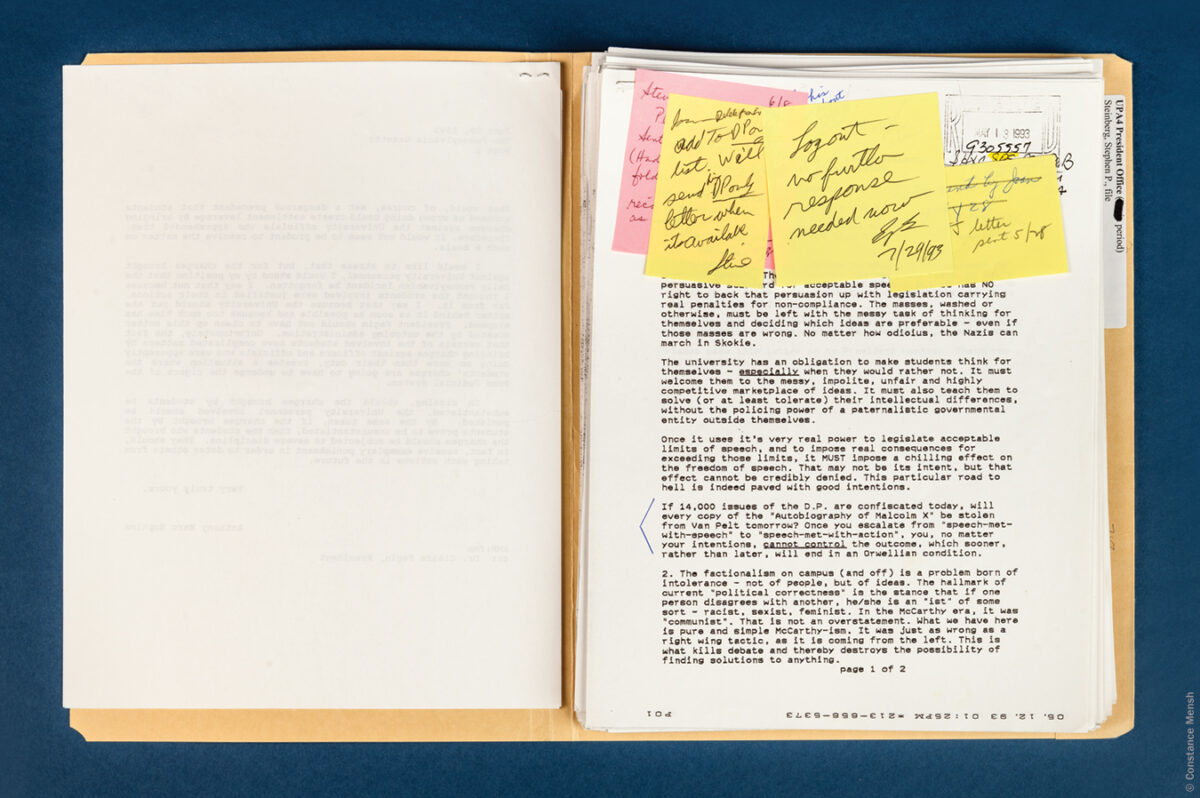
For 10 budding history majors living through tumultuous times for Penn and US higher education, Jared Farmer’s class on archival research methods doubled as a crash course on how the University navigated the culture-war clashes of another era.
By Trey Popp | Photography by Constance Mensh
Download a PDF of this article
An Ivy League presidency is not a carefree job, and Sheldon Hackney Hon’93 did not have to wait long to find out. Two days after the picketing of his inauguration gala by Black students protesting the “intolerable conditions” they faced on a campus where “pervasive” racism was met with “benign neglect,” the genteel historian-turned-administrator got a bracing taste of what they meant. On the night of October 25, 1981, a series of phone calls vilifying the predominantly Black residents of DuBois College House with unprintable racial epithets culminated in a bomb threat that precipitated the building’s evacuation.
Three months later, 300 students rallied outside a trustees meeting to protest the University’s investments in companies doing business in apartheid South Africa. If the trustees thought they could simply outwait critics of their reluctance to divest, the four-year anniversary of that peaceful demonstration proved otherwise. On January 22, 1986, Penn students occupied College Hall for a “round-the-clock” sit-in that lasted 20 days, during which a symbolic wooden shanty was erected on College Green.
Among the events vying for Hackney’s attention before the sit-in was the unspeakably vile harassment of two local Black girls wearing Catholic school uniforms from the neo-Georgian windows of one fraternity on Locust Walk, and an alleged gang rape of an undergraduate woman at another. Among the incidents to confront him afterward was a hack of the Wharton School’s ticker-tape machines to spit out the message “Fuck you Asians, Get Out of Wharton.” Later a coalition of Philadelphia high school graduates and civil organizations sued Penn and the city, accusing the former of failing to fulfill contractual agreements with the latter around the provision of scholarships to Philadelphia natives; the plaintiffs included both Penn’s Black Student League and a University association of Black faculty and employees.
Then, no sooner had that lawsuit finally been decided in favor of Penn—which meanwhile signed an agreement with the city to boost the recruitment of students from Philadelphia high schools while modestly expanding the financial aid available through the Mayor’s Scholarship program—came what was destined to become the most notorious controversy of the Hackney era. In April 1993, national media flocked to a story about an unresolved and previously obscure disciplinary case stemming from the night of January 13, 1993. On that date, a Penn freshman struggling with writer’s block responded to the celebratory clamor of a group of African American sorority sisters on the Superblock by shouting from his sixth-floor window: “Shut up, you water buffalo! If you want a party, there’s a zoo a mile from here.”
Although this was hardly the ugliest insult hurled at the Delta Sigma Theta sisters, its Israel-born source had the misfortune of being more memorable than the multitude of grimly unoriginal racial and misogynistic epithets rained down upon the revelers from other rooms. (The freshman’s defense at the time was that “water buffalo” was a rough translation of a Hebrew colloquialism used to describe a noisy or thoughtless person.) And the University’s maladroit handling of the aftermath furnished catnip for culture warriors crusading against both political correctness and Hackney’s recent nomination to chair the National Endowment for the Humanities—especially since it came to light right after the theft of 14,000 issues of the Daily Pennsylvanian by Black students infuriated by the racially charged columns penned by a right-wing undergraduate columnist.
Many alumni may regard these controversies as ancient history. Some might be wondering why, in 2025, the Gazette would see fit to dredge them up again. But for the 10 undergraduates in Jared Farmer’s HIST 2000: History Workshop this past spring, the episodes were even more remote. In fact, they were utterly unknown. “Even other history professors I have talked to,” College sophomore Liam Tan attested, “had no idea what the Water Buffalo incident was.”
Farmer, the Walter H. Annenberg Professor of History, joined Penn’s faculty in 2020 [“The Olden Bough,” Mar|Apr 2023]. This spring he was tasked with teaching HIST 2000, which the department created several years ago as a way to introduce newly declared and prospective history majors to archival research. It’s a methodology course, in other words, aimed at digital natives who’ve scarcely imagined the confusion and tedium awaiting anyone who hunts for insights within the endless boxes of committee reports, correspondence, meeting minutes, and unpredictable ephemera of an institutional archive.
As he contemplated how to hook and hold his students’ interest, Farmer reflected on the tumultuous period they had all just come through. The 2023–24 academic year opened amid controversy over the Palestine Writes Festival—described by organizers as a celebration of Palestinian culture, but which national Jewish organizations, Penn Hillel, and more than 4,000 alumni signatories to an open letter asserted included many speakers with antisemitic views. Hamas’s deadly October 7 attack on Israeli citizens supercharged an already acrimonious campus debate over how to balance Penn’s commitments to academic freedom and open expression with its duty of care to the University’s Jewish community. By year’s end, Penn president Liz Magill had resigned along with trustees chair Scott Bok C’81 W’81 L’84 and Faculty Senate chair Tulia Faletti; Penn’s chapter of the American Association of University Professors had accused “unelected billionaires without scholarly qualifications” of “attempting a hostile takeover of the [University’s] core academic functions”; and a 16-day encampment by protestors demanding divestment from companies “that profit from Israel’s war on Gaza and occupation in Palestine” had been disbanded by Penn Police [“Gazetteer,” Jul|Aug 2024].
“They lived through last year—I wanted to help them better understand it,” Farmer reflected. “So much of what Penn went through [involved] issues that I actually think stem from the 1980s and 1990s.” And it happens that Sheldon Hackney’s papers are the most recent presidential files to be unsealed by the University Archives and Records Center, which abides by a 25-year mandatory closure period. Why not set these College sophomores loose in those boxes and let them draw their own conclusions?
So Farmer hatched a plan. He’d split them into four groups and assign each a topic. One team would examine the University’s response to student demands for South Africa divestment. Another would investigate the Mayor’s Scholarship dispute of the early 1990s along with other challenging aspects of Penn’s relationship with the city of Philadelphia. A third would probe the Hackney administration’s efforts to promote “Black presence” and “minority permanence” in the student body and faculty during the 1980s and early 1990s. The fourth would tackle the Water Buffalo affair.
Collectively, the projects would shed light on how a past administration dealt with issues that continue to reverberate today. Open expression and identity-based harassment. Diversity/equity/inclusion initiatives. Student activism and institutional neutrality. These debates have roiled campuses before. Through HIST 2000, Farmer aimed to give students the chance to discover the similarities and differences for themselves. His main aim was to teach them skills they’d eventually need to write a senior honors thesis—and that would serve them well in a variety of careers. But he also had another goal: “I hoped they would come to understand Penn better, and to see themselves as part of a larger history.”
First they had to hone their interpretive and analytical chops. In late January they assembled in a classroom in the Kislak Center for Special Collections, Rare Books and Manuscripts, on the sixth floor of Van Pelt Library, where Farmer flashed the image of a 3-by-5-inch library catalog card on a white screen.
“Does anyone know what this is?” he asked.
A couple students nodded. Most shook their heads. So Farmer explained its function and then passed around a few well-worn exemplars of two other paper-based technologies that have traditionally made libraries and archives work: checkout cards and IBM computer punch cards. Next he explained the two major library classification systems, contrasting the benefits and drawbacks of the Dewey Decimal System and the Library of Congress Classification that Penn, like most academic libraries, uses. Then he invited the students to reflect on their first assignment.
He had asked each of them to choose a row in the library stacks and scan every title of every book on at least 20 consecutive shelves, pulling out and skimming any volume that caught their eye. They were to time the exercise with a stopwatch and collect observations in a short essay that would note the call numbers of the first and last books in their shelf sequence, the minute mark at which their attention waned, and how this old-fashioned method of browsing compared to the search-engine keyword queries to which they are accustomed.
Most of the students had never perused library stacks at all. One sophomore intended to target the D section—world history—but had trouble finding it. So he ended up starting in KS, where books on African legal systems rubbed up against unabridged constitutions from India and other countries, a biography of Mohandas Gandhi, and volumes containing enclosed pamphlets that conventional book-digitization efforts would miss. Christian Chun confessed to getting “bored after 10 minutes” on Van Pelt’s third floor, so started over on the fifth, where the library’s extensive Korean language holdings captivated him. “I’m second-generation, but don’t speak it,” he told the class—so he found himself snapping photos of old textbooks and Korean literature and texting them to his parents, who added their own gloss to volumes they recognized. Others noted how elements like due-date stamps, wear and tear, or duplicate copies could serve as proxies of a book’s popularity and scholarly influence, or lack thereof.
For Hayden Moore, the class’s lone freshman, the exercise crystallized how blinkered his typical approach to research had been. “Searching through the stacks,” he reflected, “made me realize how much I missed looking through online databases for narrow searches. For my high school projects, I felt like I was on a particular time crunch to find sources that were directly relevant to the argument I had chosen.” Yet that mad dash to cherry-pick sources often produced “confused” arguments.
Izzy Feinfeld was struck by the way that Van Pelt’s stacks revealed a particular set of scholarly and institutional priorities. The Jewish history section, he noticed, documented some diaspora populations in considerably more breadth and depth than others. “It was interesting to see which areas of Jewish history have these 50-part collections, like on the Jews of Czechoslovakia—which are really not present for non-Ashkenazi Jews,” he said. “You can’t see that disparity when you’re searching for specific subjects” in a digital library database. Perusing physical shelves also fostered serendipitous discoveries. “There was a big book jutting out that turned out to be photos of European Jewry before the Holocaust,” he said. “I found it pretty moving.”
Several students commented on the challenge of deciding how to allot their time and attention. One spent the first five or 10 minutes “trying to read every word on every book,” which wasn’t sustainable. Another took exquisitely detailed notes by hand—but reckoned that it might have been overkill. And even students who found the exercise fun, as many professed to, could only muster their undivided attention for so long. Which was part of the point.
“When you encounter a huge amount of information, how do you decide what’s important?” Farmer explained retrospectively, as the semester wound down. “Of course you can tell a machine to do it—but you don’t know what its algorithm is. Really, the best way to do this is the analog way, through browsing.
“But then you have to learn time-management skills,” he continued, “and develop the skills of differentiation that are critical to creating knowledge.” A lot of archival research boils down to figuring out how to go through a box of file folders efficiently and without getting overwhelmed. “Determining what I can ignore, what I can skim, what I must scan, what I must read carefully—that is such a great skill to have in life, if you do any kind of knowledge production or analysis. Or consultancy—this is also the kind of work they do. So it’s a really valuable skill for students, even if they don’t write a thesis.”
The class spent the first half of the semester wading deeper into the weeds. They mined a collection of handwritten courtship letters for insights about the Great Depression era. Farmer brought in Nikitas Tampakis, the director of application development at Penn Libraries, to teach them about the back-end infrastructure of library databases and the algorithmic biases of proprietary search engines. Penn Libraries digitalization specialist Jessie Dummer C’05 shared how she helped build the Daily Pennsylvanian archive. The class conducted an oral history interview with Joan Plonksi, a 40-year veteran of Penn’s history department who joined as a receptionist the year Hackney became president, and who reflected on Hackney’s predilection for eating brown-bag lunches en plein air and making himself accessible to students. On March 3 assistant archivist J. M. Duffin welcomed them to the University Archives, acquainting them with the history, scope, purpose, and rules of the place where they would spend most of their time from there on out.
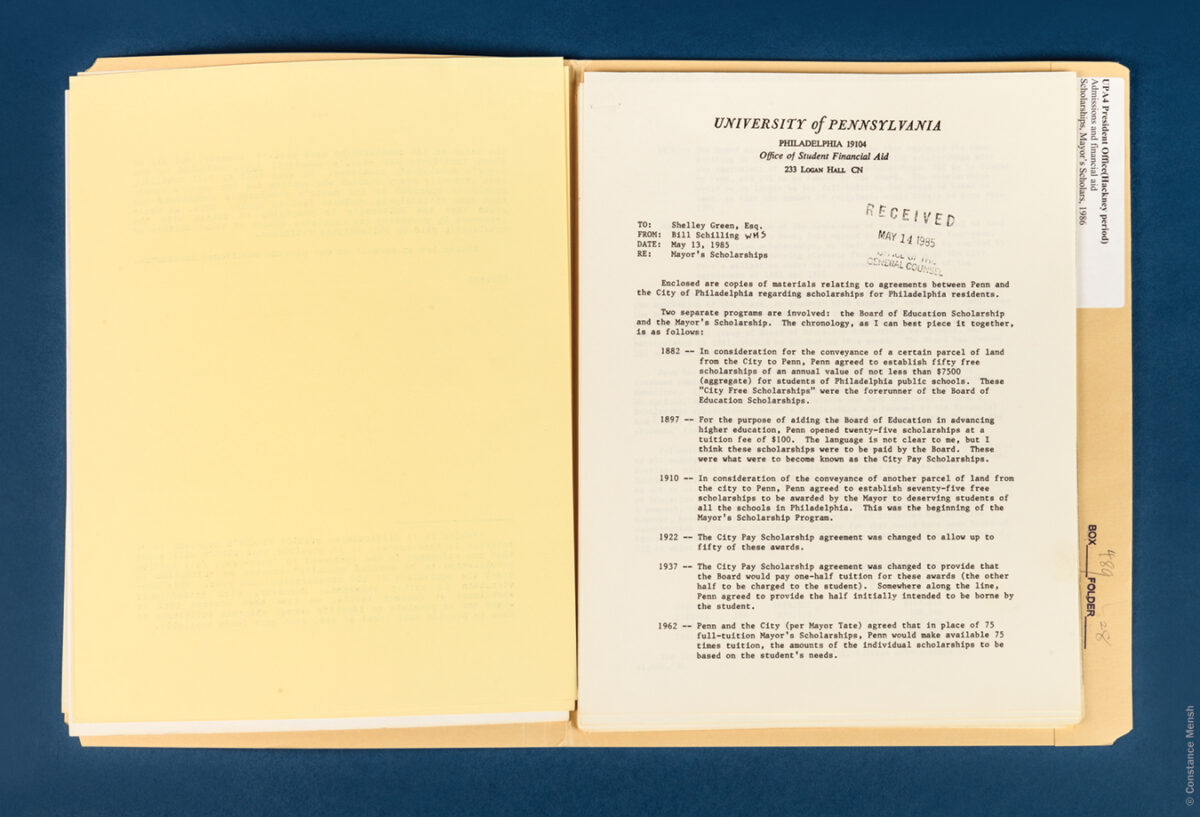
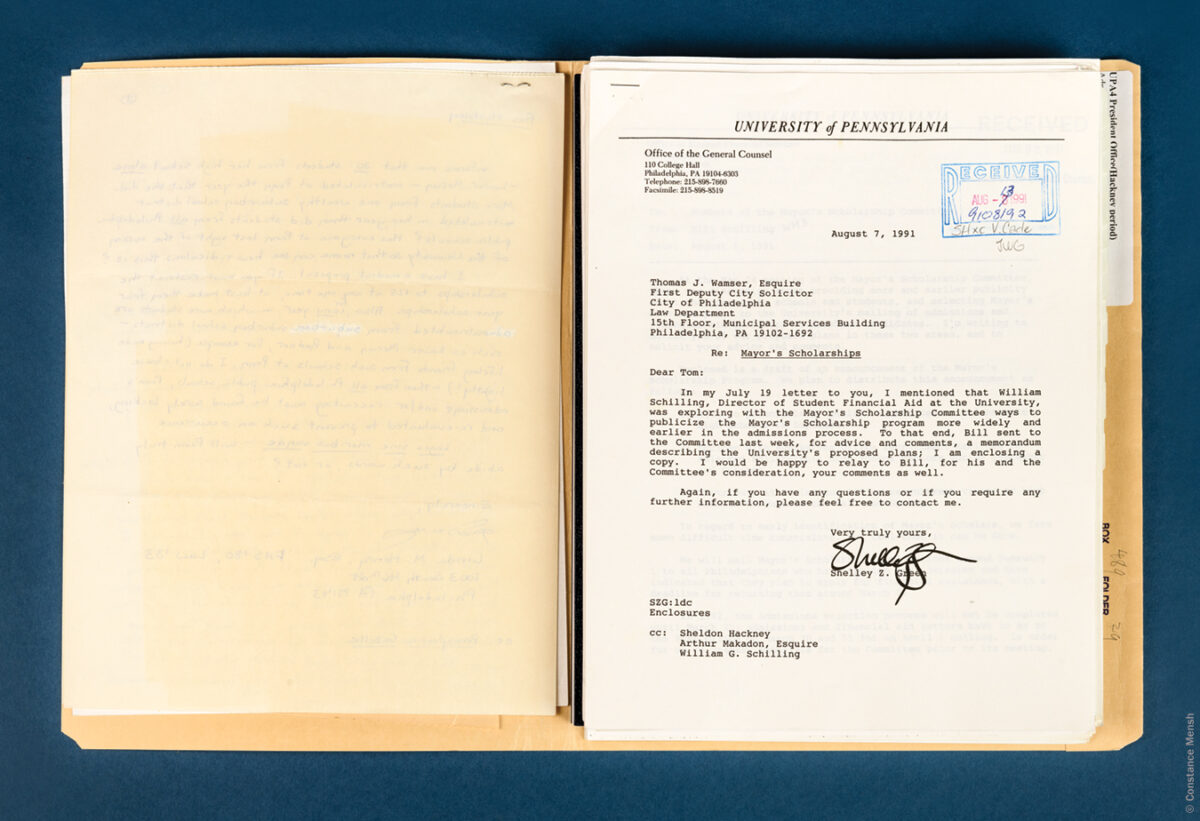
“Even as a sophomore with a declared major in American History, I had never performed archival research,” Arianna Baptiste reflected at the end of the semester. “I had not known that the University Archives even existed.”
Baptiste and her partner, Sophie Gala, would be jumping into the deep end. Farmer gave them a list of 138 numbered folders spread across 35 boxes, from which they were to distill the Mayor’s Scholarship litigation against the backdrop of contemporaneous disputes over minority admissions and recruitment, city taxes and tax exemptions, charitable giving, and Penn’s relationships with Philadelphia public schools.
Other groups were provided with similar lists. Farmer didn’t ask them to write a history of each event, which would have required far more than three credit hours’ worth of work. Instead he charged them with creating a curated digital archive encompassing scanned documents from their boxes along with supporting material from secondary sources, accompanied by freshly created timelines, glossaries, dramatis personae, capsule biographies, and explanatory summaries designed to serve as research aids for future users.
He invited me to attend their final presentations, after which each group shared its curated digital archive with me. For their last assignment the students wrote lengthy individual reflections about what they’d learned. These ranged from assessments of Penn’s responses to the specific episodes under review—and tentative comparisons to some present-day challenges—to revelations about how the process of historical inquiry actually works.
“In all of the history classes I’ve taken at Penn prior to this class, I studied history and the historical content that was placed in front of me by my professors,” Audrey Kim observed. “This class was completely different,” she continued, because “we were the ones charged with the task of creating new historical storylines and piecing together the pieces of Penn’s history.” The experience gave her a “profound appreciation” for all the curated historical analysis she has encountered in other courses.
That was a common refrain. “When I was younger, I always thought history was about learning the ‘facts’ about what happened,” reflected Arjun Kishore. But this course exemplified what the discipline of history is really about: “using available information to make arguments and create a stronger understanding of what happened.” Sometimes the available information is scarce. Other times it may be overwhelming. Either way, eureka moments can be a long time coming. “Historical research involves concentrated, concerted, and methodical searching,” as Kim came to appreciate, “and more occasional and sporadic finding.”
Archival research embeds intellectual challenges within organizational ones. Often the significance of any one document doesn’t become clear until you’ve reviewed hundreds of them, because only then does the broader context snap into focus. So you need to develop a system of sorting information into categories you may not know at the outset. Likewise, it’s only by mastering an archive’s contents that you can begin to sense its limits—all the documents that weren’t saved, or weren’t created to begin with, whose absence a conscientious historian must also take into account.
Trying to distill a coherent historical narrative from Penn’s archive and assorted secondary sources forced Farmer’s students to do something that turns out to be as rare in high school as it is in contemporary political punditry: truly proceed from evidence to conclusion. No successful student makes it through AP English without mastering the art of the “persuasive essay.” This staple of middle- and high-school writing pedagogy requires them to defend a position with evidence—which is precisely the order in which most students go about it: choose a position, then Google your way to facts that support it. But when you don’t really know the story of a controversy to begin with—and it has long faded from editorial pages and airwaves—sifting through the actual evidence is the only sensible way to start. As Hayden Moore reflected, “Working with archival materials made me realize that arguments arise out of source reading and interpretation,” not the other way around.
Not that it was all old-fashioned, analog searching. “Professor Farmer also helped me to unlock an entire world of databases that apparently Penn pays a lot of money” to access, remarked Arianna Baptiste. “I used databases like JSTOR and EBSCO but also HeinOnline, ProQuest, and NexisUni.”
Farmer also emphasized to the class that archival research involves conquering not just intellectual challenges but emotional ones. “History can be tedious,” he told them. “It can be boring. It can be overwhelming. And you actually have to manage these emotions. You have to do the critical thinking and the analysis, and you’ve got to be meticulous and all that—but also you are dealing with feelings.”
Several students credited the class with expanding their capacity for patience. Some others discovered that the “emotional management” aspect of historical inquiry can go beyond dealing with tedium. For example, the Hackney administration saved a prodigious quantity of angry letters sent by alumni in response to the Water Buffalo incident. They can make for dispiriting reading. Like others in his group, Christian Chun found it “shocking” to discover how many “Ivy League-educated people carried a blind rage” against not only campus administrators who struggled to navigate the tension between free expression and protection from racial harassment, but often against the Black sorority sisters themselves for having the temerity to object to poor treatment.
One correspondent likened Hackney and his “sleazy” deputies to Hitler and Stalin while asserting that precious few of Penn’s “black minority” were “truly eligible” to study at the University. A letter addressed “Dear Water Buffalo” bade the sorority sisters to “hide in the corner” but lamented that they were likelier to head to Washington, DC, to “wreck the country.” Others relabeled the Black students “hyenas,” “loud mouth rats,” and so on. “If they were so offended by the ‘N’ word (and I have no doubt that’s what was hurled at them from various floors),” wrote one alumna, “then they shouldn’t have been acting like the ‘N’ word.”
“Researching Penn’s history through this project was both intellectually clarifying and emotionally heavy,” reflected Shannon Hodges, a Black sophomore for whom the Water Buffalo incident was rife with “failures,” not the least of which was a “failure to recognize how Black students were feeling on campus” at the time. From the vantage point of today’s “more inclusive” campus culture, it felt tragic that the Delta Sigma Theta sisters ultimately felt just as demoralized by the “corruption of the [University’s] judicial proceedings,” as they put it, as by the verbal abuse they had sustained to begin with.
Liam Tan was also struck by the “unexpected amount of emotions” the project elicited in him. As the son of parents who’d endured “undue harassment for being Chinese” as immigrants in both the US and Peru, Tan empathized with the sorority sisters—who ended up withdrawing their complaint after Penn’s poorly handled internal disciplinary process broke into the editorial pages of the Wall Street Journal and right-wing talk radio, where it was tried in a decidedly one-sided court of public opinion.
For Tan, who entered the semester doubting whether history was the right academic path for him, that emotional engagement ended up reinforcing his commitment to the major. “Something this project has illuminated is that I am, put simply, an emotional student,” he reflected. And “some of the most important parts of history are the ones that you can feel,” he continued, whether it’s “reading angry letters from alumni” or contemporaneous accounts about “the experiences of minority students at the time.”
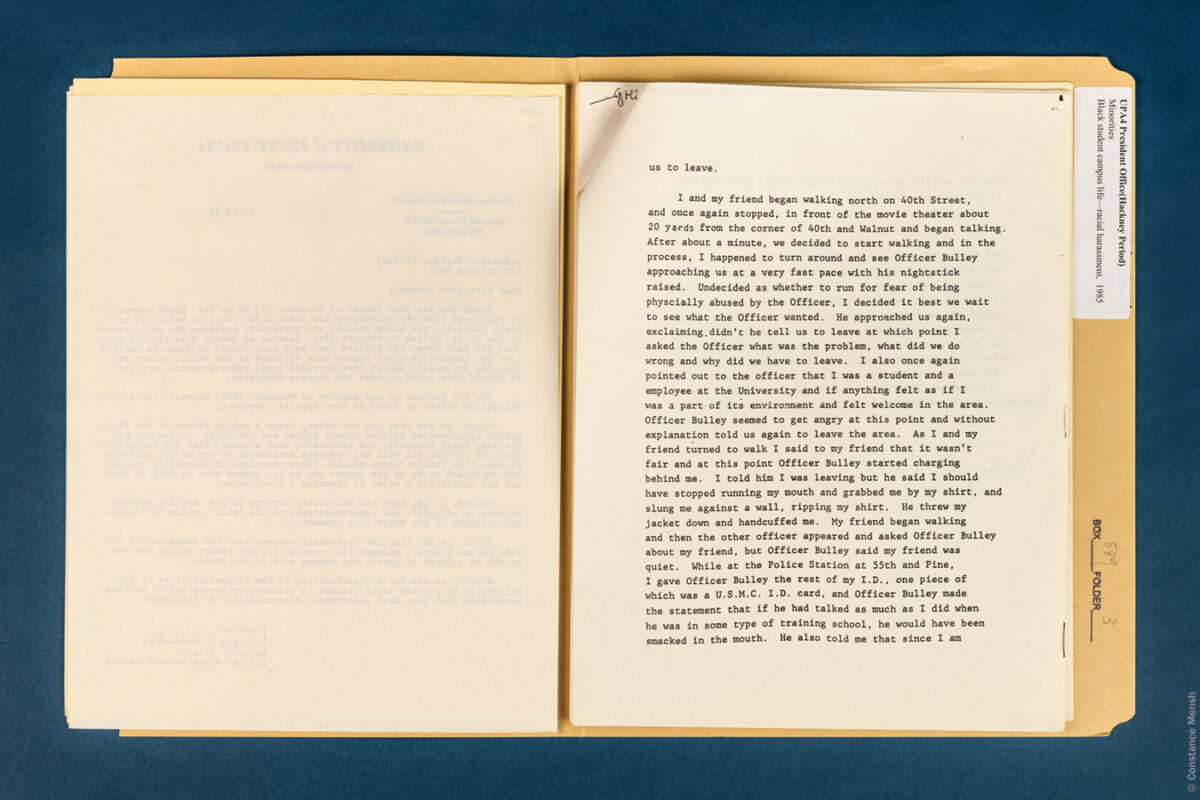
The point of this article is not to relitigate any of the incidents the students studied in the archives. Nor, really, was that the object of the class. Farmer wanted to develop his students’ interpretive and analytical skills. He wanted to encourage them “to be more critical in their use of search-based research in digital formats and to be more aware of the unique advantages of browsing-based research in material formats.” And he also hoped that immersion in the archives would give them a “richer kind of historical context for thinking about the tumult of last year.”
The students’ final presentations and curated digital archives varied in terms of focal sharpness and comprehensiveness. But the semester seemed to have served as a constant spur to careful thinking.
“I’ve done secondary sources and academic articles before, but nothing beats sifting through hundreds of actual documents in an Ivy League archive,” reflected Christian Chun. “We got to see confidential letters and emails that no one in the public had ever laid eyes on. It made the research more tangible, less of a class assignment and more of an actual historical inquiry. I felt like I was peeking behind the curtain, getting a glimpse of the rarefied process of how decisions were made, how administrators responded, and how quickly events could snowball once publicized.”
Chun’s experience researching the Water Buffalo incident also opened his eyes to the perils of putting too much faith in a single perspective—or even in your own moral sensibilities.
“My first instinct was to side with the sorority sisters,” he wrote. “That reaction was reflexive in me. I’ve been raised with a good sense of political correctness and an awareness of racial injustice. But as I read actual primary sources, letters, emails, and internal memos of the University, I realized the incident was far more nuanced. The student who shouted ‘water buffalo’ was not simply being racist, and the incident was more complicated than I had initially assumed. That experience has instilled in me the value of suspending judgment, of letting primary sources speak for themselves before rushing to conclusions. I now read news articles more carefully, cognizant of how easily accounts can become distorted. In fact, I saw firsthand how media coverage, like that of the Wall Street Journal on the Water Buffalo Case, can misrepresent key facts and sensationalize campus life at the cost of accuracy and fairness.”
And even as the students toiled in the Penn Archives, they were meanwhile watching a similar dynamic play out in real time. Over the course of the spring, the Trump administration revoked or froze scientific research funding to Penn and other universities under a variety of pretexts, driven largely by partisan-media portrayals of higher education as irredeemably “woke” [“Gazetteer,” May|Jun 2025]. Meanwhile Penn administrators responded to the pressure in various ways, including by scrubbing language about Penn’s commitment to “diversity, equity, and inclusion” from University websites.
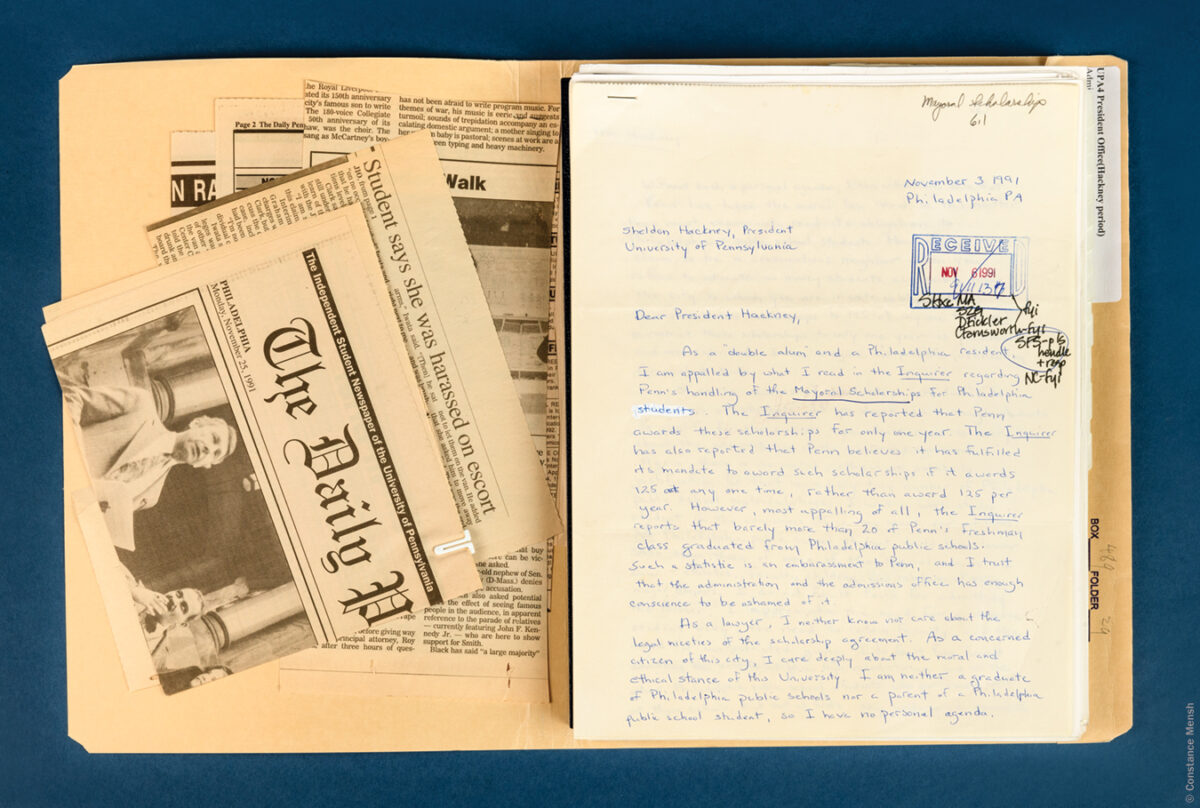
“Some of the controversies we studied in class are almost eerily applicable to the political issues facing Penn’s campus recently,” observed Arianna Baptiste. Baptiste was also one of many students to emerge from the class with a newfound and unexpected sympathy for University administrators, past and present.
“The research helped to humanize the University’s administration even if I do not necessarily agree with the stances they take or the policies they pursue,” she reflected. “Working with the Sheldon Hackney Presidential Papers showed me that a lot goes into the University’s creating a stance on a controversy. There are so many groups that want the University to take specific stances—some student groups might want the University to do one thing while donors, the Board of Trustees, parents, representatives and community leaders all might want the University to do something else, and the University is then tasked with trying not to upset too many people—or maybe even more importantly, to upset the wrong people.”
“What is clear from my research and other classmates’ research is that the University tries extremely hard to avoid controversy,” reflected Arjun Kishore. “In both the past and current moment the University prefers to move as little as possible on any political issues.”
If you sense a whiff of criticism in those comments, that’s no accident. Farmer’s students emerged from the class with a keen appreciation for how expediency can shape administrative decision-making.
“I understand that the [Penn] president is just a person trying to make the best that he can of the situation,” Baptiste continued. “On the other hand, however, I also feel that it is upsetting that the University seems to never take an actual enduring stance on any area—it simply tries to not step on anyone’s toes in the moment.”
And since political, economic, and other kinds of pressures can shift substantially from one moment to another, an institution’s responses serve as a reminder that no matter how much a university may venerate its own history or valorize a particular credo, it survives through constant adaptation. That process is rarely as inspiring as a lofty Latin motto, but it does serve as a sign of changing times.
“Consideration of key events from the 1980s and 1990s explored by the class prompt tentative conclusions about Penn’s shift away from morals-based rhetoric and towards proactive defensive responses,” noted Sophia Gala, who studied the Mayor’s Scholarship dispute. She was struck by Hackney’s public statement after Penn’s legal victory in that case, in which he asserted that “our real challenge is not winning a lawsuit, but raising the community’s awareness of the University’s commitment to Philadelphia, including the educational opportunities at Penn.”
Whether motived by a desire to appear gracious in victory, or to reset town-gown relations riven by suspicion and mistrust, or to use the moment to build more momentum toward a perceived social imperative to diversify the student body, the authors of this statement were responding to circumstances that seemed to call for a semblance of moral leadership. So they “chose to include optional additional language addressing the concerns of those alleging harm by the university,” Gala observed. “In contrast, the statements from Penn’s administration in the spring of 2025 over rescinded federal funding address the topic of legal compliance without taking a stance on the underlying issue of withdrawal of government funds based on policies targeting LGBT Americans.”
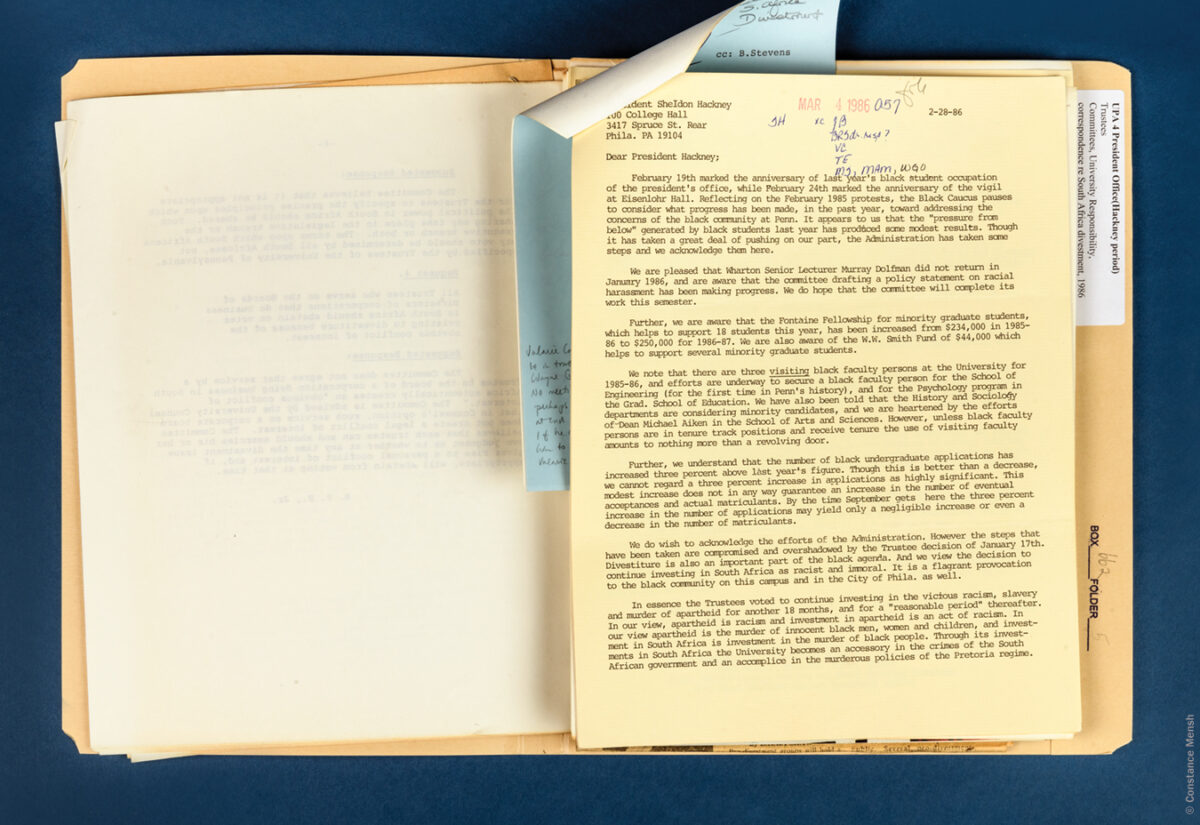
As a Black undergraduate toggling between archival research and current events, Baptiste marveled over how Penn’s institutional tone could shift amid changing circumstances. “Even after it had been ruled that their obligation as agreed upon in the 1977 Ordinance was fulfilled,” she observed about the Mayor’s Scholarship litigation, “the University still threw itself into making new programs to engage with the West Philadelphia public schools community and the West Philadelphia community at large.” Meanwhile, in the present day, “it was interesting for me to see Penn go from publicizing how much it cares about children of color in West Philly to all but dismantling DEI.”
“Penn, whether it claims otherwise or not, is part of the world and its political and economic systems,” reflected Hayden Moore. “It does not have a neutral or value-free presence. Choosing to divest from South Africa in 1988 was a political statement. Choosing not to divest from Israel today is a political statement. I do not consider myself in a position to tell the University how it should spend its money, but I do find it frustrating that as a student I cannot find out, and that the University claims that it does not have any stance on the world’s affairs.
“I find it a form of dishonesty that Penn supports the advancement of a diverse student body yet changes the meaning of diversity,” Moore added. “Penn claims to be a world leader in academics but is in many ways a follower of political trends.”
Of course many students recognized that their assessments of present-day administrative actions are hampered by the opacity of closed-door decision-making. A proper historical inquest may await the unsealing of Magill’s and J. Larry Jameson’s presidential papers 25 years from now.
Moore ended up feeling like his time in the archives gave him a better understanding of “the nebulousness and shortsightedness of people in power.” But it also made Penn seem “like a more real place … more alive and dynamic.”
Shannon Hodges concurred. “It’s easy to see Penn simply as a name,” she mused in a summer interview. “But the University is a breathing machine. We met with a lot of people through this class. Dr. Farmer brought in different administrative officers, and talking with them helped us realize that this is a physical place that people are running and putting their time and energy into.”
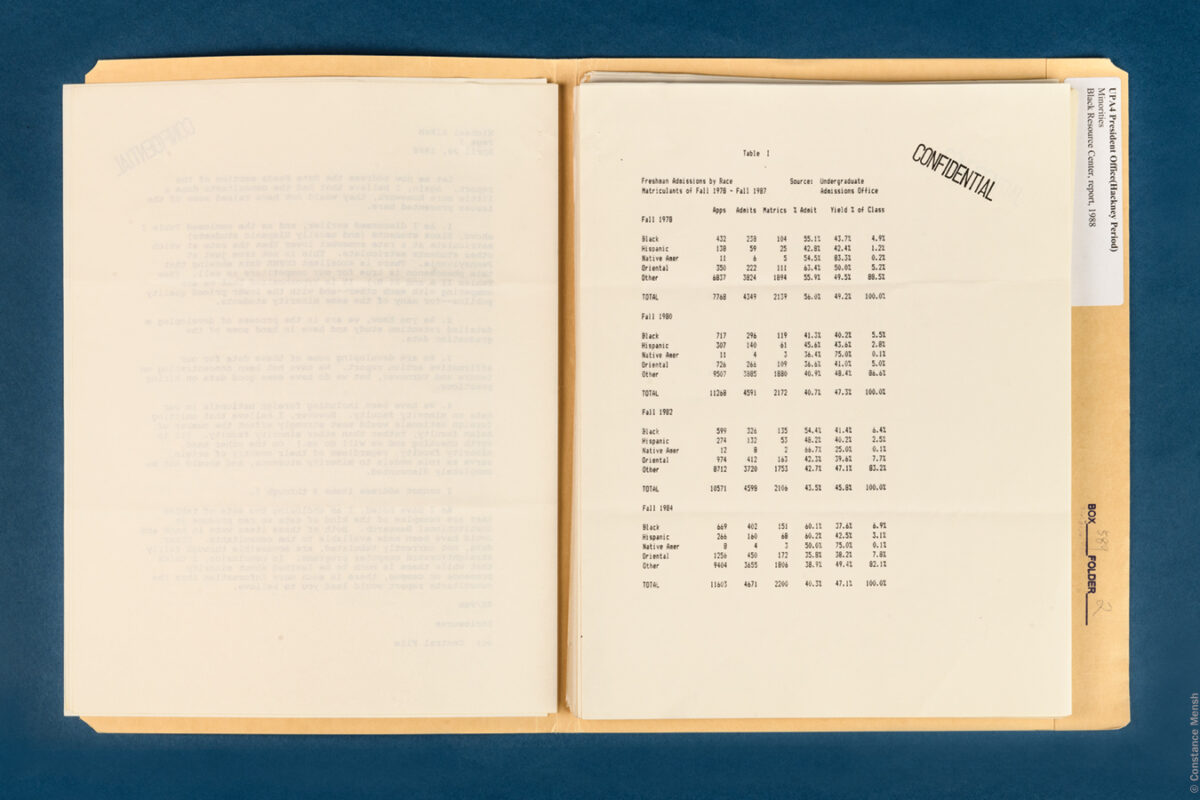
Insofar as Farmer’s twin aims were to get students excited about archival research and also “help them better understand the recent and ongoing issues affecting campus by examining controversies from the past,” perhaps the final word should go to Audrey Kim, who’d never conducted research of this kind before.
“This was an amazing way for me to better understand the present moment where elite institutions, like Penn, are being scrutinized by the government for promoting DEI initiatives similar to those of the 1970s and 1980s,” she reflected. “With all of the drama regarding the encampments and administration changes of last year and the current issues revolving around attacks on DEI initiatives, this archival project made me more aware of the way the Penn administration handles these campus issues. Furthermore, our research gave me insights into the limitations of the administration and its power to handle issues relating to race.
“I think I have more sympathy for the annoying and tedious nuts and bolts of administrative life,” she added. “My archival research also provided me with insights into why the administration chooses to handle certain situations the way they do.”
She also voiced a regret that could double as the best course review Farmer could have hoped for.
“I feel like there are still so many documents I didn’t even get to scan through,” she lamented. “While many of these documents were probably unhelpful to the general story we were piecing together, I feel like the project is unfinished because we did not get the fullest scope of information that was available to us. In some ways, I’m disappointed that we didn’t completely close the circle on this historical story.”
Or to put that another way: “I felt like a true historian.”