
Trash heap (of praise), more on “Despair,” letters on letters.
Eye-Opening Exposé
My Jul|Aug 2025 Gazette sat upon various tables in my house, its bright blue cover beckoning, and I did wonder if I would find time to read it. On two occasions it nearly made its way into the recycling, but I hesitated. I’m glad I did. Finally, here it is the end of July, and I sat up until midnight reading “Travels in Trashland,” Trey Popp’s interview with Alexander Clapp about his new, already highly regarded book, Waste Wars, and I just finished reading the accompanying excerpt, “Catfisher Lagoon.” My one-word summary: astonishing.
And so long overdue. Do the citizens of the wealthy world, wherever that may be, know this? Clapp’s subtitle, The Wild Afterlife of Your Trash, will make it hard to ignore now. The excerpt revealing, amongst other things, the secrets of Agbogbloshie is so well written and also hard to read. Hard not as in difficult, but hard as in eye-opening. I hope Clapp’s book will become a bestseller and win a Pulitzer Prize.
This particular issue of the Gazette had many good pieces but, for me, “Travels in Trashland” was the capstone.
Catherine Carroll GNu’91, Dearborn, MI
Imaginative and Appropriate
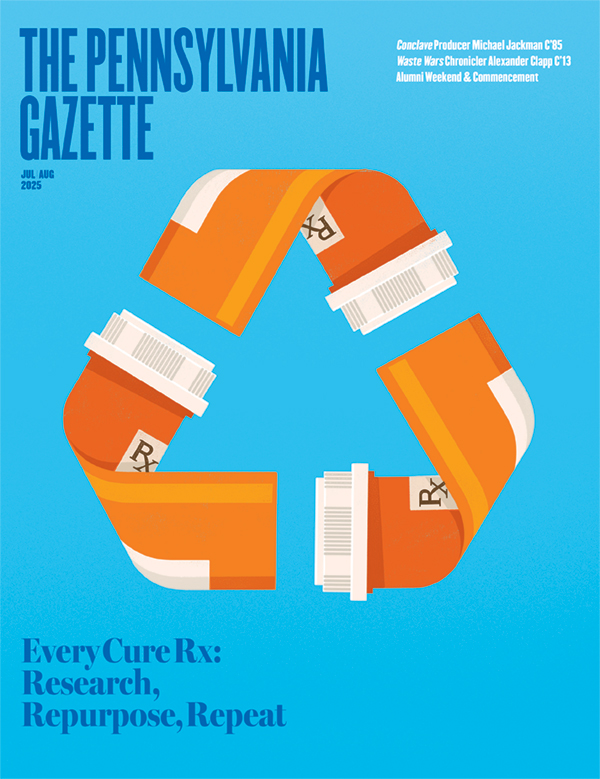
Kudos to Chris Gash for his very imaginative and appropriate cover art for the Jul|Aug 2025 issue.
Reminds me of the “Planning P” [used in emergency management].
Gene Laughlin W’62, Duvall, WA
We Can’t Escape It
I have enjoyed and looked forward to every issue of the Gazette. The “Travels in Trashland” article backs up some other things I’ve read recently. Author Alexander Clapp’s quote in Trey Popp’s interview about plastics disposal being an “absolute nightmare” is on the money because it’s infiltrating our brains and our bodies. And we can’t escape it no matter what we do.
Bill Staton WG’71, Charlotte, NC
Standard Bearer
Regarding “Beyond Salvation” [“Notes from the Undergrad,” Jul|Aug 2025]: Grand Prize Undergrad Essay contest? You gotta be kidding. No quibble with the topic, but the body of the paper reads like a lightweight freshman essay that looks forward to intellectual development hopefully to be encountered at Penn.
Ivy League standards seem to have slipped.
Fred C. Bergamo D’64, Oradell, NJ
Cause for Despair?
I thoroughly enjoyed the story about Justin McDaniel and his Existential Despair course [“Welcome to Despair,” May|Jun 2025]. As a college professor myself, I plan to steal several of his ideas. But I couldn’t help noticing that a disproportionate number of the students quoted in the piece were from Wharton. Their descriptions of a Wharton education—“My brain was built for spreadsheets over these past four years,” says one of them—made it seem pretty narrow, dull, and impoverished. These students are, to paraphrase Professor McDaniel, paying more and getting less, and perhaps Penn ought to look hard at what passes for a college education at Wharton.
Steven Conn Gr’94, Yellow Springs, OH
An occasional Gazette contributor whose book The Lies of the Land was reviewed in our May|Jun 2024 issue, the writer is also the author of Nothing Succeeds Like Failure: The Sad History of American Business Schools.—Ed.
A Beacon of Hope!
I have never felt better about despair! Your story about Justin McDaniel and his “unorthodox” courses may be the best I have ever read in the Pennsylvania Gazette. His commitment to his students, their fortitude to sign up and abide by the course guidelines, and his support of them outside the classroom was inspiring. When so many of our institutions of higher learning are being questioned, I see a beacon of hope! Thank you for helping me to embrace despair!
Paul C. Kelly WG’82, Yachats, OR
Enlarge Their Vocabularies
There are about 500,000 words in the English language. The opening paragraph of “Welcome to Despair” included “Oh, fxxx.” That’s the best an Ivy League publication can do? Professor McDaniel’s course is clearly needed by much of the population to enlarge their vocabularies.
Arlene Dannenberg Bowes D’77, Crownsville, MD
Learning about Lea
I attended the Henry C. Lea Elementary School at 47th and Locust Streets in Philadelphia from second through eighth grades. I am now 85. At no time did I know anything about the person for whom my elementary school was named, except to be aware that our Lea spelled his name differently from the Civil War’s Lee. Thank you for publishing a review of the new book The Inquisition’s Inquisitor: Henry Charles Lea [“Arts,” May|Jun 2025]. Now, for the first time, I know what an interesting man he was and that he was a “Penn benefactor” as well.
Robert W. Tollen C’61 L’64, San Rafael, CA
My Life in a Ghost Building
I am so excited, I have to write! I just read “Architectural Afterlives” [“Arts,” May|Jun 2025] about the book Building Ghosts: Past Lives and Lost Places in a Changing City. Thumbing through I immediately recognized the picture of 1830 Rittenhouse Square and couldn’t believe my eyes. The ghost image outlined on its side—1828 Rittenhouse Square—was home for me as I was growing up.
I am writing because author Molly Lester was quoted as saying she wished she knew who lived in the buildings that she and photographer Michael Bixler chronicled. I could recite who lived in each unit but instead choose to relate a few instances from my time while there.
In those days nothing was ever locked, anywhere, including the building entrance, so I never gave it a thought when I stepped over sleeping strangers in the main hall downstairs on my way to elementary school. As I got older, walking the dog at 2 a.m. was totally safe. We shared the bathroom with our neighbors … no door locks.
When I was an undergraduate at Penn, I came home from class one day to find police crawling everywhere. A resident of 1830 had jumped, coming through my skylight. At age seven, I had a dear friend in 1830. We visited each afternoon: he from his concrete balcony; me from my metal fire escape. However, times change, and as an older teenager I found a stranger crawling through our back window from that same fire escape.
Eventually the city condemned the building—rightly so; it was decrepit. Gone were the days of skating in the street, of my father finding parking at the sidewalk, and many other innocent activities theretofore taken for granted. We moved down the street to an upper floor in 1810.
Lots of memories still haunt me, and books [or magazine articles] where that address is mentioned make my nose itch.
Thank you for publishing that article and photo.
Valentine M. Albright FA’58, Emerald Isle, NC
Disappointed
In response to Dr. Alan Deegan [“Letters,” Jul|Aug 2025], who objected to the University of Pennsylvania’s original decision to permit Lia Thomas to participate in the Penn women’s swimming team, I actually supported that original decision and am very disappointed about Penn’s capitulation to the Trump administration’s pressure to force a reversal of their policy on transgender athletes [“Gazetteer,” this issue]. Not only will Ms. Thomas’s accomplishments and records be officially nullified, but the settlement Penn agreed to will mean that transgender athletes will not have an opportunity to compete on the University’s sports teams in the future.
The argument that this settlement will benefit women athletes is highly ironic, as the Trump administration is decimating the Department of Education and making student loans harder to get and more onerous to pay off. These policies will make it more difficult for women athletes to access universities and therefore to have the opportunity to participate in college sports.
The assertion that transgender women’s participation in college sports is unfair to cisgender women is spurious and is another example of Donald Trump’s demonization of certain groups of people for political advantage. Far from being some kind of existential threat to society, transgender people are in fact much more likely to be bullied and to attempt and die by suicide.
I would have hoped that my alma mater would stand by its principles of fairness and inclusion, rather than cave in to the Trump administration’s extortionate demands.
Elise Auerbach C’81, Chicago
Common Sense at Penn
I read the Jul|Aug 2025 edition of the Pennsylvania Gazette with interest.
I was astonished, however, to find there was no mention of the University’s overdue apology to the members of the women’s swim team.
Delighted to a see a big dose of common sense at Penn. My compliments to the administration.
Richard Samuelson WG’85, Anderson, SC
Penn’s Title IX settlement was announced on July 1, after the issue went to press.—Ed.
New Motto Needed
In light of Penn’s surrender to Trump’s Department of Education, I look forward to seeing what the new Penn seal and arms will be, now that Leges Sine Moribus Vanae obviously no longer applies.
Jeffrey Porten C’90 G’90 ASC’92, Philadelphia
Lifesaving, But Disqualifying?
Regarding Alan Deegan’s statement that “If one were to test Lia Thomas’s DNA, an X and a Y chromosome would be found. That signifies maleness” [“Letters,” Jul|Aug 2025]:
My niece recently completed chemotherapy after a 16-month battle with leukemia. She is in full remission and got to “ring the bell.” A major reason she survived is that her younger brother donated stem cell transfusions to her, and the cancerous blood cells were eliminated.
Her oncologist jokingly told her not to try out for the Penn swim team, because her blood tests would now and forevermore reveal both X and Y chromosomes. Nevertheless, I can assure you she does not exhibit any “maleness,” and is quite feminine in appearance.
Edward J. Connor C’73, Suitland, MD
Humans Are Most Definitely Not Binary
Alan Deegan’s claim that the presence of an X and Y chromosome “signifies maleness” and that “we humans remain binary” may have been the prevailing opinion in medicine and biology when he graduated from Penn, but we have learned much more about human sexual diversity in the intervening years. Humans are most definitely not binary with respect to sexual phenotype. While some politicians continue to ignore the complexity of this biology, seeking to reduce it to television talking points, the reality that sex is not binary is visible to the naked eye, and well supported by molecular biology. The simplest comparisons of secondary sex characteristics shows that a whole range of genes, and environmental influences, serve to modify phenotype. (Just look at the range of sizes available in the bra department.)
There exist within our species women who carry a Y and yet are clearly female. Likewise, we know of men who are chromosomally XX. Even more confusing are the Guevedoces in the Dominican Republic. Due to a genetic mutation in the enzyme 5-alpha-reductase, they make insufficient dihydrotestosterone (the active form of testosterone) to develop external male genitals and thus are raised as girls. At puberty, when testosterone production increases, it overcomes the genetic deficiency and results in the appearance of male genitals.
Within the medical and biological literature, there are many cases of intersex children, born with indeterminant genitals and often surgically assigned to a sex of their parents’ choosing soon after birth. With all of this variability in overt phenotype, it is hardly a stretch to understand that the brain could also vary in its orientation. The question of sexual assignment and advantage has long plagued athletics. While the East Germans were notorious for steroid doping of their female athletes, the question was broader than just supplementation.
When the gene that initiates the male phenotype cascade was discovered, it was thought that a molecular test for it could be the deciding factor. However, there are women who have the gene that is inactivated by mutation, making them female.
The current standard in international sports is dihydrotesterone level. Unfortunately, some women have a genetically inactivated androgen receptor, making them insensitive to this hormone, and phenotypically female. These women have been forced to take medications to reduce testosterone or be disqualified, even though the additional testosterone is not an advantage, given that they lack the receptor.
Other women, with two X chromosomes, also have elevated testosterone, outside of the range defined for “female” athletes. These are chromosomally and phenotypically female individuals who are being told that their natural bodies are unfairly competitive. Is that fair?
If we look at a trait other than sex, some individuals carry a specific version of the ACTN3 gene, which plays a role in fast-twitch muscle fiber development, resulting it being known as the “speed gene.” Should individuals who benefit from this mutation be disqualified from racing against “normal” people?
The reality is that the number of transgender women who rise to the top of their sport as women is extraordinarily small. To do so following transitioning is a remarkable feat of athleticism, not cheating. Lia Thomas has the testosterone level of a woman. That fact that she excels is likely just because she trains hard and is an excellent swimmer, not because she has a Y chromosome. To fail to understand the reality of sexual phenotype simply serves to promote bigotry and frankly, I thought that Penn could do better.
Dr. Bruce F. Smith V’88 Gr’93, Auburn, AL
Heavy-Handed Power Play
President Jameson demonstrates full capitulation on transgender athletes. President Trump uses inflated hysteria as a ruse to further intimidate universities. USA Today sports columnist Nancy Armour presented a cogent analysis of why this amounts to capitulation in her column on July 2, 2025, one of several she wrote on the hysteria over transgender athletes. The NCAA president acknowledged there are fewer than 10 transgender men and women out of over a half-million athletes in all of college sports, so they’re hardly taking over women’s sports. The International Olympic Committee concluded that transgender women may not have a biological advantage, and there is scant research supporting a ban. Gender is not a simple biological binary. Armour notes: There are women with three X chromosomes. There are women missing one of the X chromosomes. There are women who have XY chromosomes but female reproductive systems. There are women who have naturally higher levels of testosterone and androgen. There are women who have external female genitalia and internal male reproductive organs.
Even if you believe that there should be limitations, that is a discussion the NCAA, the IOC, and other athletic organizations are actively exploring. Consequently, transgender athletes have been more restricted under recent rules. The heavy-handed power play by the federal government is out of place in a functioning democracy based on rules and processes.
Apologies to those who competed against Lia Thomas when her participation was within the rules at the time!? Are we handing out participation trophies now? How pathetic. In a scholastic environment, athletics are supposed to be a part of the educational experience, not about winning at all costs. No one is “entitled” to win. Sporting behavior is supposed to be the overriding value. Teamwork, applying oneself to the task, setting personal and team goals, learning life lessons: these are the primary purposes.
There are thousands of young boys and girls struggling to maintain psychological stability in the face of these continuous attacks on their very identity. Suicide rates are increasing, violence against these kids is on the rise. They suffer in this threatening and demeaning environment. What is happening to any female athlete who stands out as strong and skilled? Increasingly, their gender is being called into question. Will any gifted athletic woman now be intimidated into submitting to strip searches and DNA tests? Look at the abuse heaped on Imane Khelif, the Algerian Olympic boxer. If a woman looks too “masculine,” not meeting society’s absurd definition of “femininity,” what then?
I am disheartened that Penn is capitulating.
Paul Krissel C’71, Salem, OR
Why Not Try to Listen?
Perhaps David Weiss [“Letters,” Jul|Aug 2025] has spent a little too much time encircled by the vast numbers of liberals employed in academia and not enough time with those of us who generally “don’t get trained in critical thinking.” Instead of dining, working, enjoying the company of the 90 percent of liberal teachers in colleges who support your political beliefs, why not stoop down to our level and have a frank discussion of what this administration has been saddled with by its predecessor? Instead of accepting the opinions of those who are likely to parrot yours, why not try to listen to why Trump’s approval ratings continue to climb?
The Democrats’ only playbook is not to solve the immigration problem, not to attempt to lower taxes and reduce the deficit, not to curb spending, but to label Trump a Nazi, a king, a racist, and spin yarns predicting the pain we will suffer should the successes of this administration continue.
Heff Heffernan C’68, Asheville, NC
Bigger Would be Better
I read my Penn Gazette often. I have one suggestion: Please enlarge the font for the captions for the pictures. There is plenty of room, and I know I am not the only older alum who can’t read that small font.
Norman Kahn C’69, Prairie Village, KS

“That fact that she (Lia Thomas) excels is likely just because she trains hard and is an excellent swimmer, not because she has a Y chromosome.”
This quote from Dr. Bruce F. Smith V,88 in your August 2025 letters about sums up the absurd logic of the pro transgender advocates. Evidently, “she” didn’t train hard enough when competing against males.