
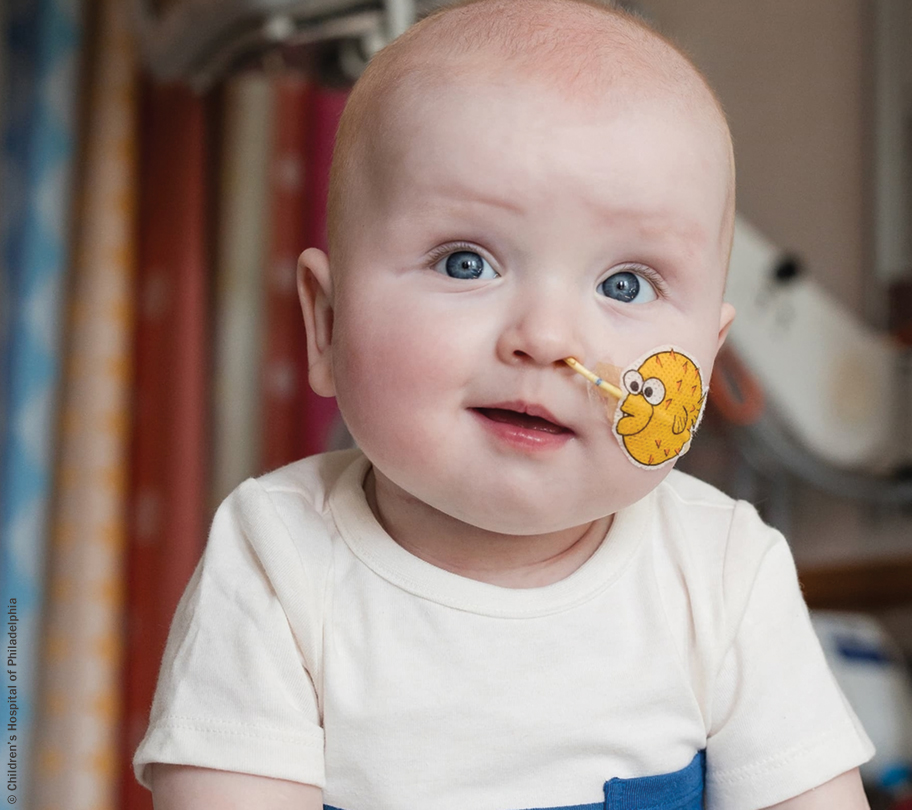
How Penn Medicine and CHOP achieved a historic medical breakthrough.
KJ Muldoon was born on the first day of August in 2024 at the Children’s Hospital of Philadelphia (CHOP). Within 48 hours, the baby boy developed symptoms of a rare genetic disease known as CPS1 deficiency, which causes toxic levels of ammonia to build up in the bloodstream whenever a child eats protein. Fewer than one in a million babies are born with the condition, which carries a 50 percent fatality rate in early infancy and inflicts brain damage on many of the rest. Liver transplantation offers the best prognosis—but by the time afflicted babies are large enough to get one, they’ve often already suffered irreversible neurological injuries.
Yet after seven months of intensive care and a radically restricted diet at CHOP, KJ became an even rarer patient: the first in the world to be successfully treated with a personalized CRISPR gene editing therapy. Three months after that, his family took him home.
The pioneering breakthrough was the fruit of a collaboration between Rebecca Ahrens-Nicklas, director of CHOP’s Gene Therapy for Inherited Metabolic Disorders Frontier Program, and Kiran Musunuru ML’19 GM’24, the Barry J. Gertz Professor for Translational Research in Penn’s Perelman School of Medicine. Both are members of the NIH-funded Somatic Cell Genome Editing Consortium—and they had started practicing for this moment about a year and a half before Nicole and Kyle Muldoon entered the labor-and-delivery unit to bring their fourth child into the world.
The physician-researchers had set out to solve the vexing problem of what are known as “N-of-1” disorders, in which a single person’s unique genetic code requires a therapy so specifically tailored that it would only be expected to work on that individual alone—if it indeed worked at all. CPS1 deficiency is emblematic in that each case often arises from a slightly different inherited genetic mutation, making every patient somewhat unique.
Musunuru and Ahrens-Nicklas developed a process to use lipid nanoparticles to deliver a base-editing therapy to targeted cells—first on a petri dish, then in mice, then in cynomolgus monkeys. Their aim was to design, test, and deliver a bespoke gene-editing therapy to a human patient fast enough for it to make a difference. Similar gene-editing therapies have been administered to a small number of adults in recent years, but designing a personalized therapy for a specific patient (rather than for a preselected mutation) represented a new frontier.
They began challenging themselves with “time trials,” as Musunuru explained in a podcast interview at the American Society of Gene and Cell Therapy (ASGCT) Conference in June. “She [Ahrens-Nicklas] would give me a variant and say, ‘How quickly can you solve this in a laboratory?’” he recalled. At the beginning, it took about a year and a half—which was too long “to be able to help patients,” he said. So they kept refining and practicing the process. Thanks in part to the skill and tenacity of Sarah Grandinette, a PhD candidate at Penn who “did the lion’s share of the bench work,” the team compressed the timeline to approximately six months. And by the time KJ Muldoon was born, “we felt like we were in a good position to actually do it for real.”
As detailed in a May 15 article in the New England Journal of Medicine, Musunuru and Ahrens-Nicklas led a North American team spanning academia and industry to carry out the first-of-its-kind treatment. Within a month of KJ’s birth they developed a patient-specific cell line, which was then used to generate experimental mice that effectively reproduced KJ’s specific mutation. The customized therapy was tested on these mice, whose livers showed substantial corrective editing without worrisome side effects. Additional toxicology and efficacy studies were done in monkeys and on cell cultures. Armed with these positive results, the team submitted a single-patient, expanded-access Investigational New Drug application to the FDA when KJ turned six months old, and received approval one week later.
In late February 2025, KJ received his first infusion of the experimental therapy. The low dosage appeared to work; doctors were able to increase KJ’s protein intake without causing harm. That opened the way to two more planned infusions in March and April. Although KJ continued to need a medication used to manage high blood ammonia levels, its dosage was significantly reduced as the baby boy seemed to turn a corner.
“He had this huge growth spurt,” Musunuru recalled at the ASGCT conference. “He was really undersized—he wasn’t getting enough protein because it would turn into ammonia and build up in his body and could cause injury to his brain … but after the treatment we could give him a full amount of protein and he just thrived.”
At 10 months, KJ Muldoon was well enough to return home with his family.
Since it’s not considered ethically acceptable to biopsy the liver of a small child whose organ now seems to be functioning well, the extent to which KJ’s liver cells were transformed through genetic editing remains unknown. “We don’t actually know how well it worked in his body,” Musunuru explained. “So everything has to be inferred.” That said, “he’s doing well. He looks great, and he has gained a large amount of weight. Before we treated him he was in the ninth percentile for body weight for his age. Now he’s in the 40th.”
An editorial accompanying the NEJM report expressed hope that the breakthrough “could be transformational for N-of-1 disorders,” especially if regulators were to validate the overall approach rather than require approval for each unique disease-specific application.
“Years and years of progress in gene editing and collaboration between researchers and clinicians made this moment possible,” Ahrens-Nicklas said in a statement announcing the breakthrough, “and while KJ is just one patient, we hope he is the first of many to benefit from a methodology that can be scaled to fit an individual patient’s needs.”
“The point of this,” said Musunuru, “is we want to be able to personalize for any patient—not just the patient who comes along who has the perfect variant, the right disease. That’s the old way of thinking. We want to be able to help every single patient who comes our way.” —TP