
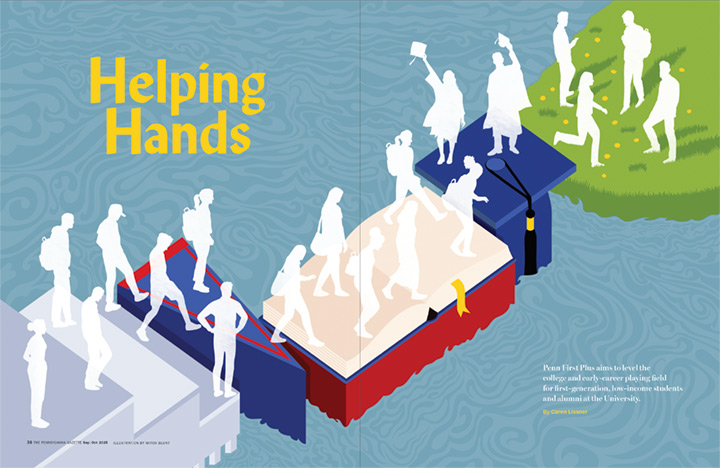
Penn First Plus aims to level the college and early-career playing field for first-generation, low-income students and alumni at the University.
By Caren Lissner | Illustration by Mitch Blunt
Download a PDF of this article
When Jonathan Muruako C’17 Gr’20 Gr’21 GM’22 SPP’24 applied to Penn from his small-town Mississippi high school, he didn’t know much about the University or the college application process and didn’t have anyone around with the experience to help.
He’d never even visited the East Coast or been on a plane.
“I was in a pretty low-performing high school,” he says. “We didn’t have any AP courses. I just applied to all of the Ivy League schools. Everyone at my school, including my guidance counselor, thought [Penn] was Penn State. No one had anything to say.”
Muruako’s parents were Nigerian immigrants, and his father died when he was young. But his mom encouraged him to work hard. He became first in his class, started a recycling program at his high school, and worked bagging groceries.
A decade later, with several University degrees under his belt, he’s an entrepreneur in Philadelphia leading a startup called Fitalyst, which provides online tools to empower students confronting the kinds of challenges he faced to “better allocate their time, effort, and campus resources.” And he’s part of a growing Penn network designed to build community and support among first-in-their-family college students and alumni who lack the resources that some Ivy Leaguers take for granted. When a student faces a family emergency, isn’t sure how to pursue graduate school, or can’t afford housing for an internship, this network is providing mentorships and resources to meet needs that have always been there but were largely hidden in the past.
Muruako falls into a category described as first-generation, low-income (FGLI, pronounced “fig-lee”) at the University, a demographic that in 2024–25 included approximately 24 percent of undergraduates on campus, according to Marc Lo, executive director of Penn First Plus, a program founded in 2019 to assist FGLI students with a hand up toward independence and security.
In the years since, the program has continued to evolve with a growing network of faculty, mentors, and alumni who want to make sure anyone trying to follow in their footsteps isn’t alone. Penn First Plus, or P1P, defines itself broadly as “the hub of University efforts to enhance the academic experiences of students who are the first in their families to pursue a four-year baccalaureate degree or come from modest financial circumstances.” But because other students may lack resources for a variety of reasons, the program offers help to any student who similarly struggles with a gap in resources.
Muruako—a biological basis of behavior (now neurology) major who finished his undergraduate degree before P1P was in place, but wishes he’d been able to call on that kind of help—says he’s seen Penn First Plus become crucial in identifying unmet needs. He cochairs the Penn First Plus Alumni Association as a way to use the knowledge amassed during what he estimates are 22 semesters spent at the University to benefit current and future students. The alumni group seeks to “advocate for more visibility and representation of the P1P experience on University alumni leadership boards and governance” and to “build and maintain a supportive network for social and economic advancement through knowledge-sharing and mentorship.”
Growing FGLI Presence on Campus
In the years since Penn introduced its all-grant-based financial aid program in 2007—which covers the full cost of attendance for students with family incomes below a certain level, currently set at $75,000—the proportion of FGLI students at the University has gone from one in every 20 undergraduates in 2005 to one in five. (About 45 percent of Penn undergrads overall receive some financial aid; the average package is around $70,000. In the most recent expansion of the aid program, the Quaker Commitment, the University will no longer include primary home equity in determining financial aid eligibility and will provide full tuition scholarships at minimum for students with family incomes up to $200,000. [“Gazetteer,” May|Jun 2025].)
In 2015, a student group called Penn First—which currently heads a list of eight or so FGLI student organizations on the P1P website—was formed. In an article titled “First Generation Students Unite” [“Gazetteer,” Jan|Feb 2016],students spoke about being recruited by Penn but feeling adrift once they arrived on campus, navigating both academic challenges and social ones (like whether to skip a hallmate’s birthday party at a fancy locale or scrimp elsewhere to afford the $30 or $40 cost), connecting first-gen students with each other and with alumni, and making the group more visible on campus through New Student Orientation (NSO) and other avenues.
In October 2016, a dedicated resource center was opened in the Greenfield Intercultural Center (GIC).“The FGLI Center consists of two rooms,” a Daily Pennsylvanian article noted then, “a lounge for students and an office for two staff members.” At the time, the staff focused on programs like a donation-based food pantry and a textbook library from which FGLI students could borrow books. Then in May 2018 Penn President Amy Gutmann Hon’22 and Provost Wendell Pritchett Gr’97 announced that the University would create a “Penn First Plus Office” for FGLI students and hire an executive director.
Brown University was considered the first Ivy League school to establish a dedicated program to identify and respond to the needs of FGLI students, with Penn close behind. In January 2019, Penn tapped Lo—who had previously worked as assistant director for assessment and evaluation at Brown and done graduate research into socioeconomic diversity at selective colleges at New York University, where he earned master’s and doctoral degrees—for the executive director position.
The announcement also promised the appointment of faculty codirectors in the humanities/social sciences and from a STEM discipline, now known as the Bozza Family Penn First Plus Faculty Directorship thanks to a gift from Anthony Bozza W’98 and Rita Roure C’98. Currently serving in those roles are Fayyaz Vellani, a geographer and lecturer in critical writing who is also the faculty director of the College House Research Program and Hill College House Fellow, and Russell Composto, Howell Family Faculty Fellow and a professor of materials science and engineering, who was recently named vice provost for undergraduate education [“Gazetteer,” this issue].
Initial programming efforts included the development of a pre-freshman week held in early summer to acclimate students to campus and partnerships with Career Services and the Center for Undergraduate Research and Fellowships (CURF). COVID restrictions slowed things down somewhat, but in February 2021, a dedicated space—now known as the Shleifer Family Penn First Plus Center, thanks to an $18 million gift from Scott Shleifer W’99 and Elena Shleifer [“Gazetteer,” Mar|Apr 2022]—opened in College Hall, with offices for counseling and meetings, as well as a lounge for students to chat or recharge.
A Boost on the Path to Success
Students and recent graduates spoke with the Gazette about coming from families with few resources, not knowing how to navigate college admissions, and feeling different from their peers once they landed on campus. They wondered if they were the only ones with those feelings—but then, a little help or an encouraging word at the right time opened up new opportunities. Penn First Plus is meant to provide the resources to boost a student onto the path of success.
As described on the Penn First Plus website, the University’s definition of what makes a student “first generation” extends beyond having one or more parents or guardians who have not completed a bachelor’s degree. Also included are students whose parents or guardians have taken more than six years to complete a degree or who completed their degree outside the United States. Other eligible criteria include being the first person in a family to enroll at a “research university with the resources and opportunities a Penn education provides” or having a “strained or limited relationship” with any degree-holding family members.
Students from families with incomes under $75,000—termed “highly aided” by the Office of Student Registration and Financial Services—receive priority for “supplemental funding opportunities within the limitations of the university resources” available from the program. However, since a bit more than half of all Penn undergraduates don’t require any financial assistance to attend the University, the website also suggests that perceptions of relative wealth and status may to some extent be in the eye of the beholder. “Therefore, while we may abide by financial aid policies in limiting access to funding opportunities, we do not police terms such as lower-income, limited-income, and modestly resourced given their subjectivity in this space.”
About 2,400 undergraduates used P1P’s services last academic year, says Lo, which is nearly a quarter of Penn’s total undergraduate enrollment. More than 70 percent of the students identified as both first-gen students and of limited income. Others fell into only one of the categories or sought support for some other reason. Challenges have included food insecurity, dealing with health insurance, helping family members back home who were struggling financially, navigating medical school applications, and figuring out travel for research and internship opportunities.
Students find out about P1P through outreach both before and while on campus, Lo says, noting, “A member of the Undergraduate Assembly recently told me that it may be the most well-known resource on campus.” Interested students can take advantage of P1P in many ways: stopping into the Shleifer Family Center in College Hall for counseling, searching for an alumni mentor, applying for emergency funding for a tough situation, or finding another program to fit their unique needs. “If you stop by our office, we open at nine, and come at any point before 10:30, we might only have a few students here, but soon,” Lo says, “most of the seats are taken, and the couches are filled.”
The P1P staff helps students navigate challenges large and small—from providing grants for procuring professional attire through its Career Launch initiative, to professional development, to learning about careers. Resources include the PennCAP college achievement program, academic counselors, mentors, and even help for students in exploring the cultural resources available in Philadelphia, Lo says.
The Penn Alumni point person for Penn First Plus is Aman Goyal GEd’13 LPS’18 LPS’20, director of Penn Traditions, Young Alumni Programs, and Penn First Alumni & Career Initiatives. Goyal says that, years before the formation of P1P, he became aware of some of the challenges that first-gen and low-income students experienced on campuses—yet were hesitant or ashamed to share. In an outreach program for low-income students that he was involved with, one student confessed that his computer had been broken for a year, and he couldn’t afford to fix or replace it. So he did all his work in the library without telling anyone.
In a case like that, Lo says, P1P would provide grants to repair the computer or buy a new one, and help the student borrow a computer while they wait. Students can apply for funding through the Emergency and Opportunity Fund to meet unexpected expenses of various kinds.
“Some students are food insecure,” says Lo, listing various historically unaddressed needs on campus. “If their financial aid is not enough to cover it, it becomes a conversation: ‘What additional resources are there? Do they need a different meal plan?’ We ask, ‘How can we come up with a plan so that you have a structure in place to meet your nutritional needs without having to come back to us to ask for more help?’”
A medical student shared in an interview that he had encountered setbacks and costs during his undergraduate career that he hadn’t anticipated, such as applying to graduate school (the fee to take the MCAT is $345, and even with assistance, application costs are steep). Another recent University graduate—who wants to become a doctor because his mother died when he was young—revealed that he might not have found out about, or been able to afford, the research trips he took as a pre-med student without the help of Penn First Plus. Beyond financial assistance, the program also helps students make connections and seize opportunities that may not be obvious to someone from a family of more limited means.
“As a highly aided international student, I truly would not have been able to attend Penn—let alone thrive—without the support of Penn First Plus,” says Alejandra Andrade C’25 W’25, a recent graduate from Equador, who majored in international studies and business economics & public policy in the Huntsman Program in International Studies and Business. “From emergency assistance that helped me manage unexpected challenges back home, to funding that made essential career-building experiences possible, P1P has supported me in moments that shaped my academic and professional path.”
Expanding Alumni Involvement
While many University programs end at graduation, the administrators behind P1P realized that first-gen graduates will often still struggle after leaving campus. They need wise counsel, conversations, and resources that may be difficult to find in the real world. P1P has been expanding its alumni involvement—with a focus not just on alumni helping students but counseling each other as well.
Last spring, Ashish Rughwani EE’95 W’95, who cochairs the program’s alumni association with Muruako, helped oversee an online panel called “Penn First Plus Alumni: Entrepreneurial Ventures vs. ‘The Stable Option’” to lay out the pluses and minuses of each career path. Participants noted that FGLI students tend to be reluctant to take risks, even if they have a promising business idea. Their families, too, may find entrepreneurship too risky.
And first-generation students may take the first job they’re offered, Goyal adds, because they need to help families back home or to simply survive on their own without help. The mentorships and programs from other alumni aren’t a handout but a hand up, shepherding students toward avenues and opportunities available to them. Even if students do have a 9-to-5 job, there may be avenues to pursue a dream project on the side.“There’s this idea that your family already sacrificed so much to send you to college,” Goyal notes, “so even if you have a great idea, you can’t pursue it until later in life. That’s something I hear a lot.”
Three more virtual panels in the Penn First Plus Alumni Discussion Series—all available for streaming—were designed to provide FGLI alumni with tools for their post-graduation life: “A Measured Pace: The Basics of Financial Planning,” “It’s Our Turn: Taking Care of Our Parents,” and “Looking After Our Health and Wellbeing.”
Rughwani—founding partner in the investment firm Dominus Capital, who grew up in India, Egypt, Nigeria, and the United Kingdom and now lives in New York—has a long-term goal to narrow the gaps that create obstacles for FGLI alumni. Those gaps include “the knowledge gap, financial gap, and the mental health gap,” he says. “I want to point them in the right direction of resources, whether it’s for health, financial planning, or entrepreneurship. We can tap into the same people who have navigated hardships and found their way through it and go back and help graduates still going through it. It’s been satisfying to see how open our first-gen, low-income community has been to helping other first-gen, low-income people.”
Whatever their circumstances, lots of Penn graduates don’t know about or take advantage of the career placement and other resources the University offers to students and alumni.
Penn First Plus is increasing awareness of those tools and adding new programs for alumni, says Elise Betz GEd’03, the senior executive director of Alumni Relations. One such resource is Penn FLASH, a collaboration between the Greenfield Intercultural Center (GIC) and Penn First Plus Alumni, which is open to students and alumni who are first-generation, low-income, or of similar circumstances; who have an interest in and want to support the FGLI community; or who are/were members of the GIC family as students, alumni, faculty, staff, or friends. Penn FLASH is a platform for mentorship, networking, and other “flash” connections, and according to its website, it currently includes more than 900 community members.
With Penn FLASH, Betz says, alumni can fill out a profile to be a mentor and provide students with answers and life advice. “You can be a mentor without a [lifelong commitment],” she adds. “Students could have a question about their career, or maybe it’s ‘I’m going to move to San Francisco and don’t know anyone, can you help me?’”
Lisette Garza LPS’20 LPS’22, who was the first director of alumni and career resource initiatives for Penn First Plus, saw how impactful a program like P1P can be, and the necessity of offering resources after graduation. “One of my findings at Penn was that we took care of FGLI student as students,” she says, “but they struggled the first two years after graduation. They couldn’t find a job, or they got mired in family issues.”
Some students had the “bootstrap mentality” in which they hesitated to ask for help, even mentorships, because they might take away from someone who could need it more. “It’s been healing work, giving alumni the opportunity to talk about these experiences, and letting them contribute by mentoring,” Garza says.
“At its most basic, this is a question of parity, of leveling the field, of insuring that our environments are diverse enough to even benefit the least privileged person in the room,” she adds. “This is supporting these young people to survive and thrive. It would be a shame if someone with so much potential can’t take off because they’re missing social resources.” (Current staff report that 92 percent of P1P students know their plans for employment or further schooling within four months of graduation.)
The University has been emphasizing the alumni aspect of P1P, which was a priority for Gutmann from the time the subject was broached around 2017, Betz notes. “We were the first school that had a director-level position focused on first-gen alumni,” she adds. “Just because a first-generation student graduates doesn’t mean that they don’t need support. We wanted to be very intentional about creating a network of support that wasn’t stigmatized, wasn’t ‘othered.’ It was very much in the mainstream, integrated with alumni relations, reunions, and other work we do.”
Goyal believes that today’s students are more willing to talk about their challenges. In working with Wharton alumni in the past, he found that “first-gen folks felt invisible,” he says. “Within the culture of Wharton, there was a little more of the feeling that everyone else is from means, everybody is well-networked. I think the culture from the MBA population trickled down to the undergraduates.
“When a FGLI group was established for the Wharton alumni, people started coming out of the woodwork to say, ‘Oh, I’m also experiencing this.’ A professor might ask, ‘Where’s everybody going for Spring Break?’ when first-gen students are staying on campus, or they may be working at work-study jobs to pay for their books. They’re having to navigate a bit of a busier schedule because they have to work to make ends meet.”
Garza, who is now a leadership development consultant with Independence Blue Cross, is the child of migrant workers in Texas. She graduated from the University of Texas and became a Fulbright scholar before being hired at Penn. “I knew I was first-gen, but never had any validation how challenging it was,” she says. “Hearing the language to use [at Penn First Plus], it finally gave a name to these feelings. I’m tearing up. Everything was such a blur. I felt out of my element.”
Betz says she often hears alumni saying they wish they had had such a program sooner. “They tell us that when they were in school, we didn’t have any first-gen support, and it was almost stigmatized,” she says.
Benefits Entire Community
Lo notes that a program like P1P doesn’t just help the students who are part of it—but helps all students on campus in different ways.
“It expands the bubble of awareness of how folks live their lives in the world,” he says. “Imagine you’re an engineer or an entrepreneur and your only frame of reference is designing products for people who can afford luxury goods. You’re missing the majority of the population if you miss the folks who qualify for need-based aid. It helps to create empathy and understanding of the different class hierarchies in the United States and other societies, how that influences access to resources, and why it’s important to open up these pathways.”
Obviously, initiatives like Penn First Plus aren’t going to completely close the gap between the wealthy and poor, but they can make sure those lacking in resources can see a path toward better opportunities and have a safety net if they hit an unexpected snag.
“This is probably one of the most impactful initiatives that Penn has undertaken over the course of the last couple of decades,” Lo says. “We’re thinking carefully about access and opportunities to all of what becomes the Penn experience. So many of the alums come back and tell us they wish Penn had undertaken this earlier. We’re happy to see how—six years in—we’re improving the academic health of our students, and that we’re making a difference of how they feel about being in the Penn community. While there are still those signifiers of wealth out there, these students feel more and more like they belong.”
Caren Lissner C’93 is finishing up a memoir, How We Became Homeless. Her first novel, Carrie Pilby, was adapted into a comedy film. Find more of her writing at carenlissner.com.