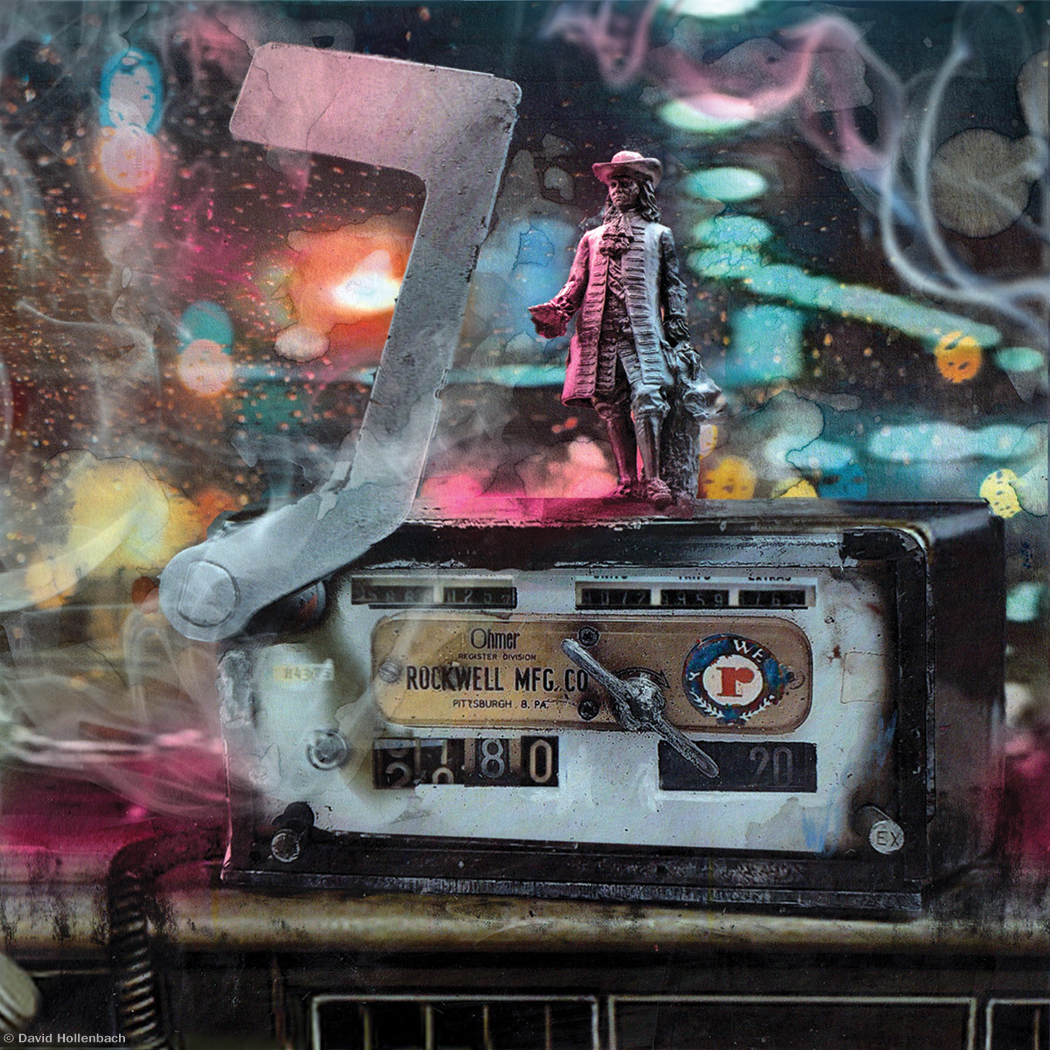
Experiencing Philly’s Summer of 1980, at 20 cents a click.
By David Porter
“So, you married?”
The question came out of the blue from the woman in the back of my cab. It was about 4:30 a.m. on a June morning in 1980, and I’d picked her and a man up on South Broad Street in front of the former Bellevue-Stratford Hotel, which had been closed between 1976 and 1979 after an outbreak of what became known as Legionnaires’ Disease.
They made an odd couple. She was a curvy, loud-talking blonde and he was a mousy, middle-aged professor type. After I’d dropped him off, she’d asked me to take her to Sixth and Cross Streets, so we set out toward the heart of South Philadelphia. It was my first night on the job and she was my first fare.
“Um, no,” I responded.
“Got a girlfriend?”
“Well … yeah, but she doesn’t live here,” I said, silently wondering why I was offering details as if I was applying for a job.
Another pause.
“Know any guys who want to go for $20?”
“Uh, I don’t know.”
“What about you?”
Not wanting to appear ungrateful, I stammered an excuse about just having started my night and not wanting to get off on the wrong foot with my new boss.
“But I am flattered, thanks,” I added.
She shrugged. “OK.”
We pulled up to her address, a nondescript brick rowhouse that could have been on any of a hundred blocks in South Philly, and she fished in her pocket for the fare. The meter read $7.55. She gave me a fistful of bills and change that came to $7.90.
“I’m sorry, I would give you more,” she said. “But my husband would kill me.”
And so began my love affair with the city of Philadelphia, from behind the wheel of a red-and-white United Cab in the summer between my sophomore and junior years. I had a front-row seat to the whole gamut of human behavior staged by the sex workers, businessmen, fortune-tellers, drunks, amorous couples, tourists, and just regular folks I picked up. I took them to glitzy addresses on Rittenhouse Square and to the “invisible” outlying neighborhoods that only ever made the evening news when they’d been the site of a particularly gruesome crime.
There was plenty of that in 1980—the FBI logged more than 17,000 violent crimes in the city that year, including 440 homicides.
On a brighter note, Philadelphia’s sports-mad residents were witnessing the kind of year other cities’ fans could only envy: the 76ers and Flyers had reached their respective leagues’ championships, and the Phillies and Eagles would go on to title games with the Phillies bringing home their first World Series crown that fall.
On the streets, the picture was more complicated. Cities are in constant flux, but Philadelphia in 1980 seemed at a particularly significant crossroads. Frank Rizzo, the burly ex-police commissioner who oversaw a department beset with allegations of racism and misconduct, had left office after two polarizing terms as mayor. Change was coming for the physical city as well. The longtime prohibition on buildings higher than William Penn’s hat atop City Hall would be rescinded soon, and the aging Reading Terminal would cease operation as a rail hub but would revive the past glory of its public marketplace. But for now, burlesque houses still dotted east Market Street, and for every upscale restaurant there seemed to be at least two where scrapple was prominent on the menu.
Against that backdrop, I walked down to the parking lot by 30th Street Station one evening to meet my future employer, a rough-around-the-edges guy named Mike who operated a United franchise consisting of about a dozen cabs. Time has erased the details of who gave me his number, but had Google existed in 1980 I would have discovered that Mike had been a material witness in a murder trial a few years earlier and had been mentioned, but never charged, in connection with a separate murder-for-hire plot.
It didn’t take long for the rest of the cabbies to gather around and engage in a little impromptu hazing.
“I bet you don’t even know the city, man,” one sneered.
“Yeah, where’s Red Lion Road?” another demanded.
Mike ended the inquisition by informing me I’d start with the day shift, 4 a.m. to 4 p.m. Before long I moved to nights starting at 4 p.m., considered more lucrative for encompassing the afternoon rush hour as well as restaurant and bar traffic into the wee hours.
I settled into a routine: I’d walk from my rented room at Alpha Epsilon Pi near 40th and Spruce to get the Market–Frankford El downtown, pick up my cab, and head out. Whoever was taking my cab for the day shift would usually drop me off at 40th and Walnut, where I’d pick up some breakfast at McDonald’s before heading back to the frat house to sleep. During the day I’d go for a bike ride or find a pickup soccer game at Franklin Field. I tapped into reserves of stamina I didn’t know I possessed, and soon the 12-hour shifts were no big thing, bolstered by the occasional stop at Jim’s Steaks on South Street.
The rest of the crew warmed up to me fairly quickly, aided by an exchange I had with Mike one afternoon. Our payouts were computed using counters that tallied the number of trips and 20-cent increments on the meter. United took a percentage and we got the rest plus tips. Whatever sorcery he practiced on those two numbers is still a mystery to me, but I didn’t care since the money was good. “I know you’re screwing me, Mike, but you know what—it’s OK,” I told him in front of the rest of the crew. They fell out laughing like it was the funniest thing they’d ever heard.
They were a diverse group in race, age, and demeanor. There was Marvin, Mike’s co-owner, a bilious, middle-aged white guy who never had much good to say to or about anyone; rumor had it Mike used to make him empty his pockets and socks after shifts to make sure he wasn’t skimming off the top. Frank, a middle-aged Black man, was probably the nicest to me; he’d been at the cab game a long time but had been a professional dancer in his younger years. Bobby and Juan were younger and more gregarious and would regale me with stories of bizarre fares they’d had. I can still see droopy, middle-aged Lenny heading out on his shift, a bottle of Maalox sticking out of his back pocket. When two Russian immigrants arrived midsummer they went onto the schedule as “Russian 1” and “Russian 2” and managed to rack up big numbers despite (or maybe due to) knowing almost no English.
The quality of the cabs we drove was … inconsistent. The air conditioning would break, they’d idle too high or stall out, and sometimes you wouldn’t be able to coax a car out of third gear. One, No. 587, was highly coveted because of an electrical quirk that would jump the meter 20 cents whenever you hit the horn. A fare had noticed it a while back and complained, but Mike, in his infinite wisdom, decided it wasn’t worth fixing.
Then there was the infamous “bop switch,” a toggle affixed to some of the cabs’ steering columns that would make the meter go faster. It was to be used judiciously. “I had a guy tell me to turn the radio down, which I did,” Juan told me once. “Then he said to turn it down again. So after I turned it down I reached right down and flipped the switch. I bopped the guy pretty good.”
My adventure came to an end in August as I prepared to visit my parents before the start of school. On my last day I was sitting in a long line of cabs at the airport when I saw Juan gesturing wildly up ahead—he had snagged a South Jersey fare for me, the equivalent of a three-run homer in the ninth inning. I took the guy to Sicklerville, made enough to breeze through the rest of my shift, and turned in my cab for the last time.
Truths, particularly personal ones, often become self-evident grudgingly, over time. It took until a few years ago—sadly, on the occasion of the passing of an old friend I’d met in Philly—for me to appreciate that although I had spent my childhood and teenage years in a small college town in New England, I had really “grown up” in Philadelphia, arriving as an unsure 18-year-old and, over the next four years at Penn and 15 years afterward, developing a career and immersing myself in the city’s rhythms and rituals. I’ll always see the summer of 1980 as the start of that journey.
David Porter C’82 spent more than 35 years in the news business in Philadelphia, New Jersey, and New York City, most recently with the Associated Press.

I cannot believe what I read! I drove a United cab in Philly that same summer during nightshift. Mine was from 6pm to 6am. With the money I made I went skiing in Switzerland during winter break and met a girl whose father worked for Shell who ended up getting me a job at Shell. I wrote a paper about my cab experience for some English class and got an A. Boy, what an experience it was!!