Two new books weigh the area’s revitalization and its costs.
A decade before the term “gentrification” was coined by British sociologist Ruth Glass, celebrated city planner Edmund Bacon Hon’84 began work on Philadelphia’s signature redevelopment project that would turn the historic but seedy and congested Fifth Ward into Society Hill. Abandoned by the gentry during the 19th century, the area stretching east of Independence Hall to the Delaware River docks had become the home of a declining population of working-class Blacks and immigrants, mostly renters rather than owners, long before progressive political leaders, bankers, and developers facilitated its metamorphosis into a prestigious district of expensive residences and thriving businesses. Marked by demolition, renovation, and construction, the creation of Society Hill would be a model for the transformation of a substantial part of West Philadelphia.
But here universities, Penn and Drexel, were the prime movers in the revitalization effort. The creation of University City is a story told in two new books: Race, Real Estate, and Education: Inventing Gentrification in Philadelphia, 1960–2020 (Temple University Press) by Edward M. Epstein Gr’20 and Redesigning Urban Centers: Adapting to Changing Real Estate Markets (Routledge) by Jonathan Barnett, emeritus professor of practice in city and regional planning at the Weitzman School of Design. Both authors agree that the redevelopment of the area around the two campuses benefited white and wealthier citizens who found it attractive to live and raise families there to the detriment of poorer Black residents of the physically blighted but for the most part stable neighborhoods that supported a communal culture. Barnett estimates that more than 5,000 people were displaced when, as Epstein notes, urban renewal funds were used to drive them from an area known locally as “Black Bottom.”
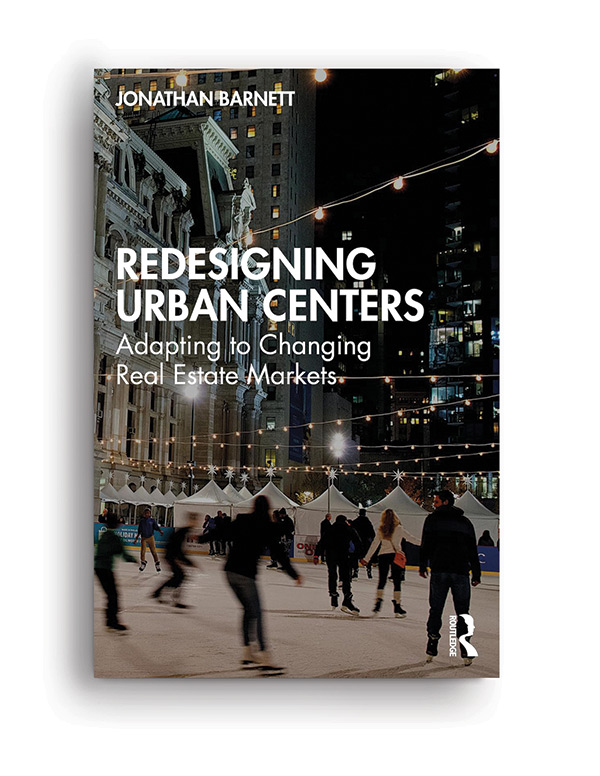
Barnett has produced a data-driven and clearly presented guide to the development of successful mixed-use communities in which University City is one of seven case studies from the Philadelphia metropolitan area. His other foci, all exemplars of national trends, are: the reinvention of Center City Philadelphia to meet suburban competition; the conversion of residential subdivisions and a shopping mall at the junction of major highways in King of Prussia into an edge city with a business park that includes inviting public spaces; the transformation of suburban centers in Ardmore and Conshohocken; the redevelopment of land near the Philadelphia International Airport; and the revival underway in downtown Camden, New Jersey, one of the most disadvantaged cities in the United States.
Barnett identifies the impulses for the dynamic change he describes as the appeal of downtown living together with “fewer places where urbanizing rural land continues to be profitable.” The coincidental emergence of other factors generated by new technologies, from e-commerce to remote work to decentralized meetings to space demands created by genetics-based research, as well as future trends involving the risks posed to independent workers by artificial intelligence and a transition to driverless vehicles, are all part of the mix that he says planners need to take into account. Barnett makes a compelling argument that regulations requiring separate land uses, once regarded as an immutable template for development, can be changed to permit the creation of places where people live and work in walkable spaces that cater to their needs for shopping, recreation, and entertainment. He demonstrates that place-based management for public spaces is the best way to make the centers work for the benefit of all.
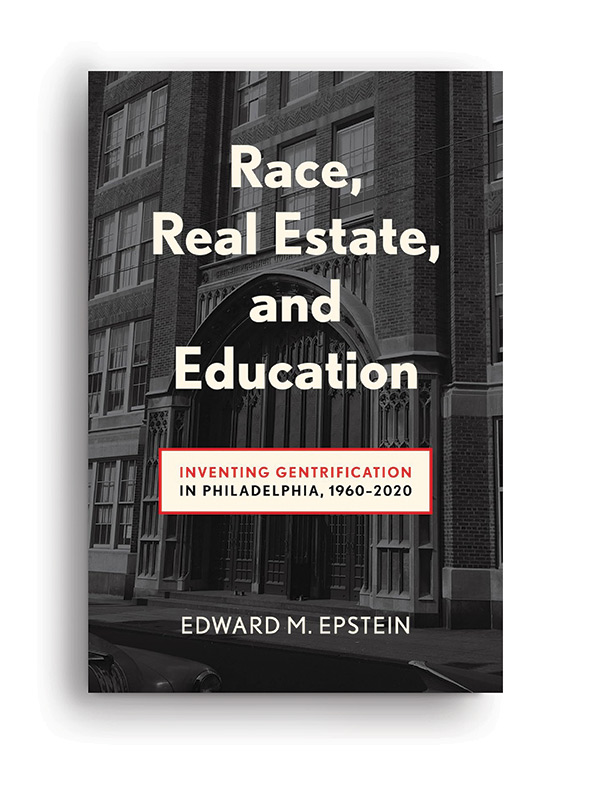
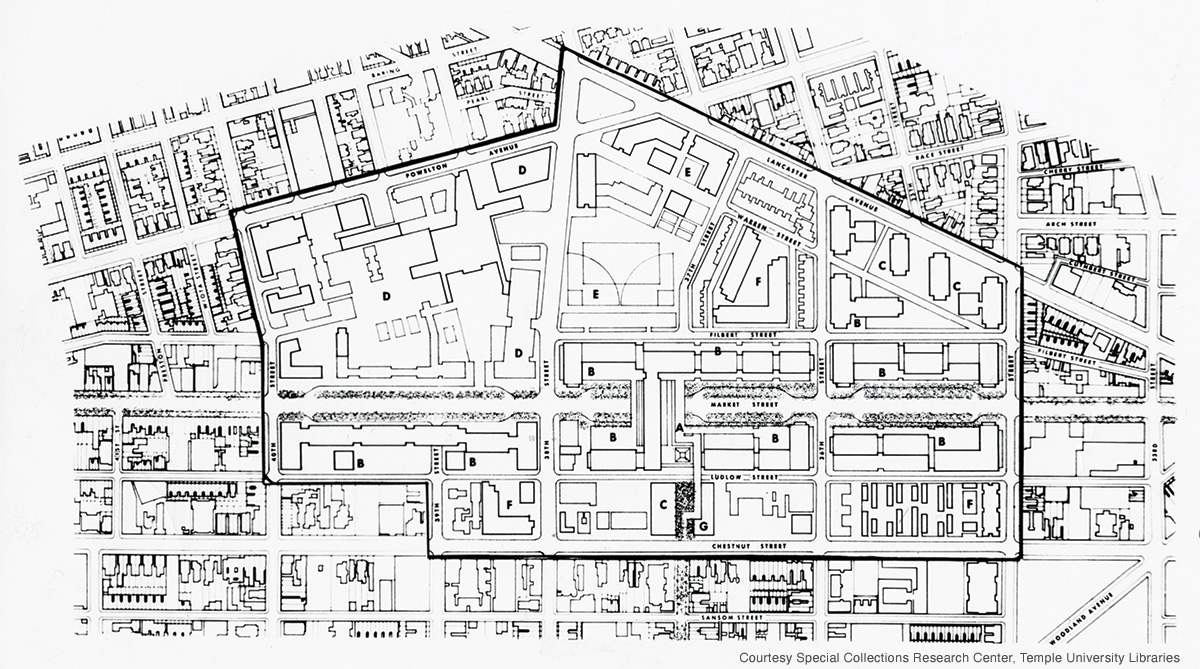
Epstein, the director of the Teachers Institute of Philadelphia, has written a story of conflict: his own, as a resident of University City, whose amenities—including the Sadie Tanner Mossell Alexander University Partnership School—he and his family enjoyed even as his research, enriched by dozens of interviews, revealed deeper tensions. Those tensions lay between well-intentioned developers and University administrators and the people who might have been West Philly neighbors, had it not been for the “racially tainted” clearing of 83 acres north of Chestnut Street, south of Powelton and Lancaster Avenues, and sandwiched between 34th and 40th Streets during the era of “urban renewal.”
The change these powerful players brought about began with the formation in 1959 of the West Philadelphia Corporation, a coalition of local higher education and medical institutions, in which Penn was the largest shareholder. Its major project was building the University City Science Center, intended as a science incubator. According to the developers’ plan, a science-focused high school was to be erected nearby. But pushback from neighborhood parents who had not been consulted and did not think the proposed academy would serve their children’s needs resulted in a general-purpose high school that, according to Epstein, became “a highly segregated and deeply troubled institution.”
He notes that an “organization whose primary mission was real estate development” was “over its head” when it came to trying to improve the city’s public school system. University City High School opened in 1971, the beginning of what Epstein calls the “dark years,” a two-decade long period when Philadelphia’s reputation sagged even as Penn prospered and undertook several initiatives to improve town-and-gown relationships by engaging with local communities.
Crime in the area—notably the murder of two Penn students in the 1990s—spurred a vigorous effort led by President Judith Rodin CW’66 Hon’04, at the behest of faculty and staff, to readdress underlying issues they believed contributed to neighborhood unrest and violence. Building on earlier partnerships spearheaded by the former student activist Ira Harkavy C’70 Gr’79, founding director of the Netter Center for Community Partnerships [“Ode to Ira,” Jul|Aug 2023], the University involved community members in planning a new K–8 public school, which opened its doors in 2001 [“School’s In,” Nov|Dec 2001].
As of 2000, Epstein writes, the catchment area was “predominately Black,” but the Penn Alexander School (PAS) was located in the heart of Spruce Hill, an area increasingly populated by white residents, many with Penn affiliations. The University put up the money to build PAS, the state reimbursed the cost of construction, and Penn leased the land to the Philadelphia School District for a dollar while making a long-term commitment to subsidize its operations.
“The school would quickly gain recognition as one of the top public schools in the state and nation,” Epstein tells us. But he notes that its diversity eroded as gentrification set in. Housing prices rose sharply, and low-income Blacks were priced out of the market. Epstein ends by considering options for reparations. In addition to a return to rent control and rescinding constraints on the construction of affordable housing, he advocates more equitable state funding of public schools, so cities are less reliant on property taxes. He offers his book as a means of recognizing how racism contributed to present disparities. He does not despair of changing minds and hearts.
—Mary Ann Meyers Gr’76