Filmmaker Spike Lee recalls his harrowing civil rights documentary during a lively campus visit.
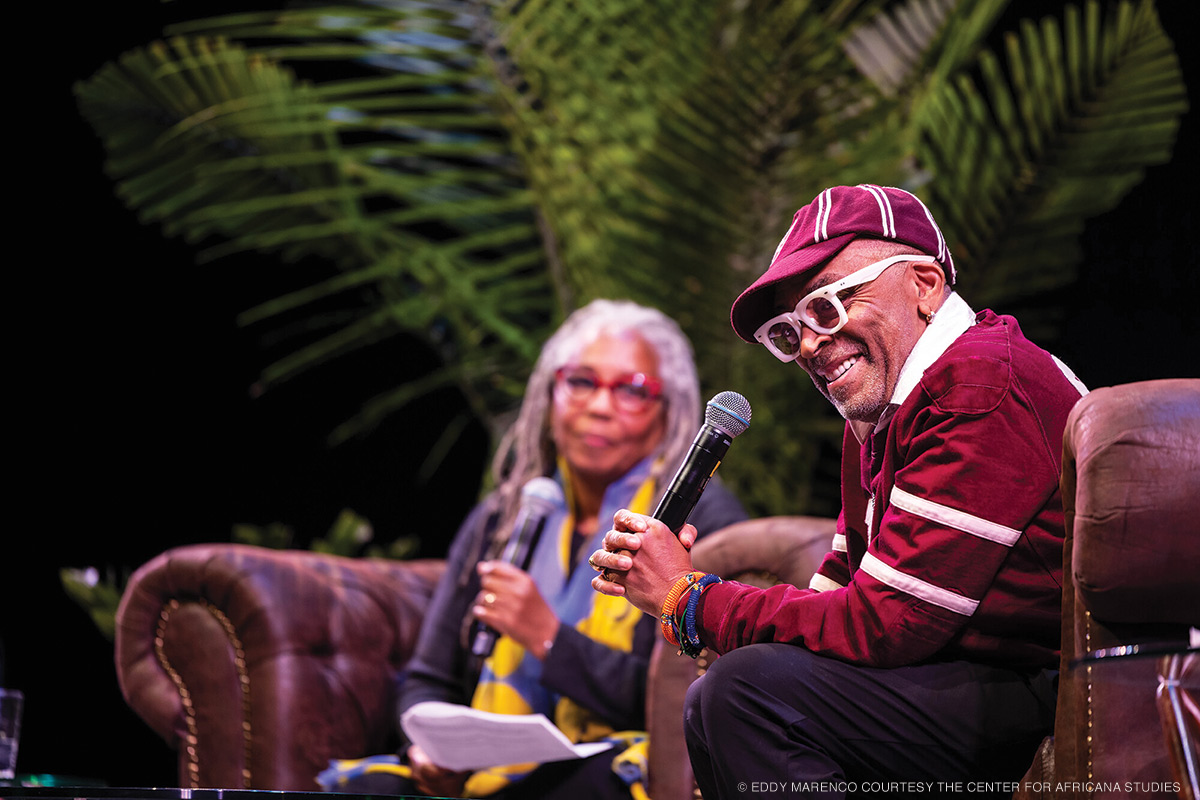
For most of Spike Lee’s visit to Penn in January, the provocative filmmaker bantered with his old friend Heather A. Williams, who moderated the 25th MLK Jr. Social Justice Lecture & Award featuring Lee, and cracked jokes in front of an energetic and sold-out crowd at the Annenberg Center’s Zellerbach Theatre.
But when the conversation shifted to his 1997 documentary film 4 Little Girls, Lee took a softer tone. “That’s the best work I’ve ever done,” said the director who’s more widely known for narrative classics like Do the Right Thing and Malcolm X. “That’s the one for me, 4 Little Girls.”
The historical documentary tells the story of the four African American girls—Denise McNair, Cynthia Wesley, Carole Robertson, and Addie Mae Collins—who were killed in the Ku Klux Klan’s terrorist bombing of the 16th Street Baptist Church in Birmingham, Alabama, in 1963. Described by Martin Luther King Jr. as “one of the most vicious and tragic crimes ever perpetrated against humanity,” the bombing served as a catalyst for the passage of the Civil Rights Act of 1964.
Williams—Penn’s Geraldine R. Segal Professor in American Social Thought and Professor of Africana Studies—agreed that 4 Little Girls is the filmmaker’s best work, praising not only the tightly shot interviews with family members that painted a picture of the girls’ personalities, but the way Lee connected their murders to the broader civil rights struggles in Birmingham at the time. And she believes the film’s significance has not waned in the nearly 30 years since its theatrical release. “I was thinking that everybody in this room needs to see that film now,” said Williams, who began plotting a return appearance for Lee along with a campus screening of 4 Little Girls, which was nominated for an Academy Award for Best Documentary Feature Film. “Everybody in the country should,” she added, “because it has such resonance for when we think about what’s happening in Minnesota. You know, they haven’t brought out the fire hoses, but they have brought out tear gas.”
Lee noted that one of the toughest decisions of his career was whether to include the postmortem photographs of “those four beautiful, young Black girls who weren’t allowed to grow up” after his researcher found them in post-production. In the end, he decided to not shield viewers from the painful images, showing them on screen but “very quickly.”
Lee also touched on the “funny but pathetic moment” when former Alabama governor and staunch segregationist George Wallace was interviewed for the film (near the end of his life) and brought over his “Black best friend … who did not want to be in the shot” but got a closeup anyway. The director had much kinder words for Fred Shuttlesworth—a minister and activist who was featured in the film’s historical footage along with his ally Martin Luther King Jr. and, Lee noted, “does not get the credit” he deserves for his role in the civil rights movement. Lee went on to name two main characters after Shuttlesworth in his 1998 basketball movie He Got Game, starring Denzel Washington.
Much of the rest of the discussion between Lee and Williams centered around the Penn professor’s longstanding friendship with the director—and his mother, Jacquelyn Lee, who had been Williams’s Black Studies teacher at Saint Ann’s School in Brooklyn Heights in the 1970s, taking her students on trips to Broadway shows and poetry readings and “opening up this other world of Black culture.”
Spike Lee’s mother opened a new world for him too, in a different way. “I did not grow up wanting to be a filmmaker,” Lee said, but “my mother was a cinephile, and I’m the oldest of five, and I was my mother’s movie date. … That’s where the seed was planted.”
Lee was an undergraduate at Morehouse College—an alma mater he shares with MLK and whose shirt he wore on stage—when his mother died of liver cancer in 1976. Williams met Lee at her funeral, and the two remained close. Lee invited her to a small screening of a student film he made when he was at NYU (where he’s now a tenured professor) in the early 1980s, and not long after asked her for a $100 loan while working on another film. “Thank you for the $100,” Lee said to her more than 40 years later, before standing up to give her a hug on stage. Reflecting on his journey since then, the famous filmmaker added: “For the students who are in the audience, I didn’t do it alone. I had a gang. I had my people.”
Williams—who today is the department chair of Penn’s Center for Africana Studies, which hosted the MLK Lecture along with the Annenberg School for Communication—at times appeared playfully exasperated with her old friend, who needed constant reminders not to talk about sports (he’s famously a New York Knicks superfan) and to look at a clock ticking down in front of him to avoid launching into too many tangents and cutting off her questions. But Lee had the crowd howling and applauding all night—and standing in appreciation when, at the end of the event, he was presented with the 2026 Martin Luther King Jr. Social Justice Award by Wale Adebanwi, Presidential Penn Compact Professor of Africana Studies and the director of the Center for Africana Studies.
“Tonight, we honor not only a filmmaker but a moral witness,” Adebanwi said. “An artist whose work has helped shape public consciousness and whose voice continues to insist that America confronts its past, reckons with its present, and imagines a more just future.” —DZ