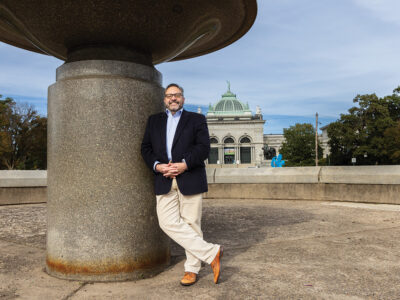
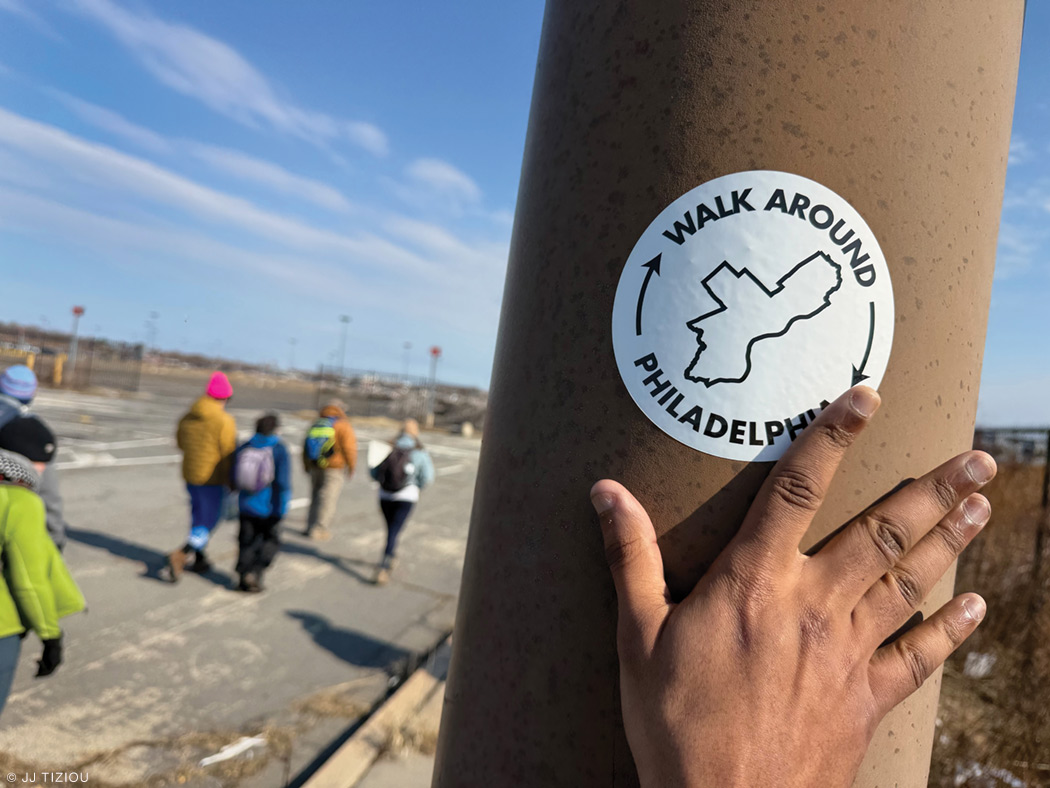
JJ Tiziou has been walking around the city of Philadelphia for a decade. Now he wants everybody else to join him.
By Trey Popp
Photography by JJ Tiziou
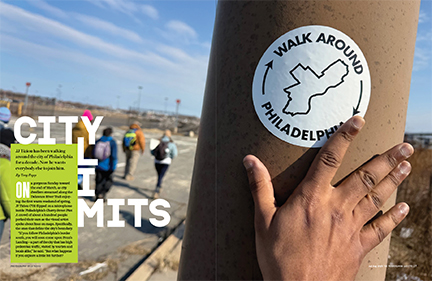
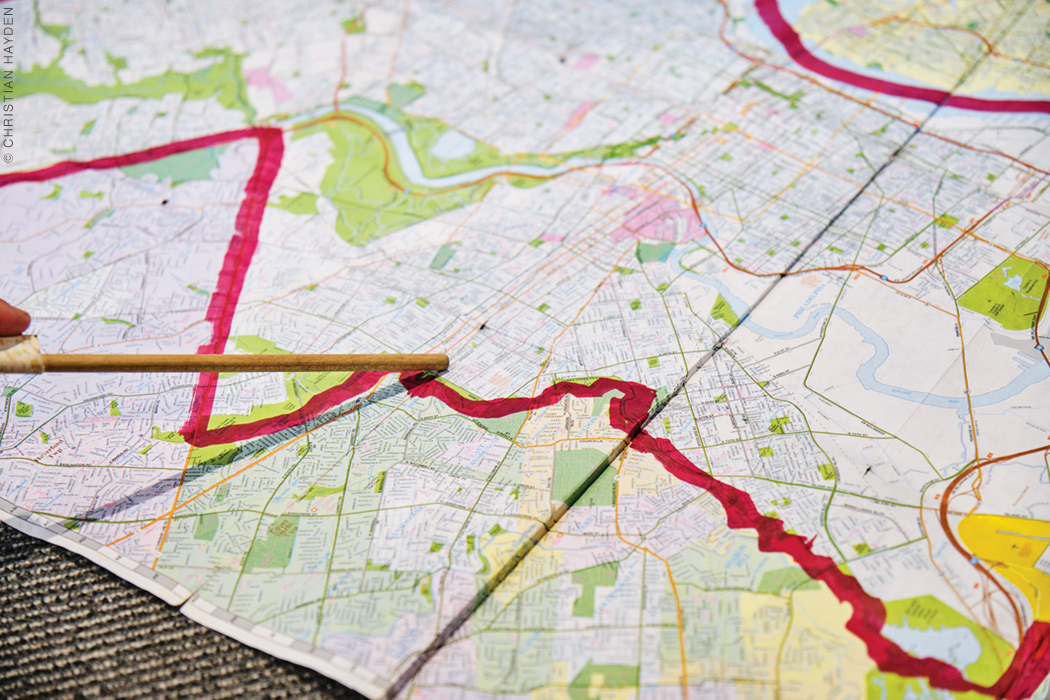
On a gorgeous Sunday toward the end of March, as city dwellers streamed along the Delaware River Trail enjoying the first warm weekend of spring, JJ Tiziou C’02 flipped on a microphone inside Philadelphia’s Cherry Street Pier. A crowd of about a hundred people perked their ears as the visual artist spoke about lines on maps. Specifically, the ones that define the city’s boundary.
“If you follow Philadelphia’s border south, you will soon come upon Penn’s Landing—a part of the city that has high pedestrian traffic, visited by tourists and locals alike,” he said. “But what happens if you explore a little bit further?
What might you encounter if you followed the city’s border all the way around, a hundred-something miles, until you came back to the place where you started?
“How might those experiences shift your understanding of the city?” Tiziou went on. “What might happen if more of us thought of the city not just as its tallest buildings, businesses, and historic districts, but in relation to its margins and all that they hold? This is the invitation to Walk Around Philadelphia. And when we say Walk Around Philadelphia, we mean around it: the long way, all the way around.”
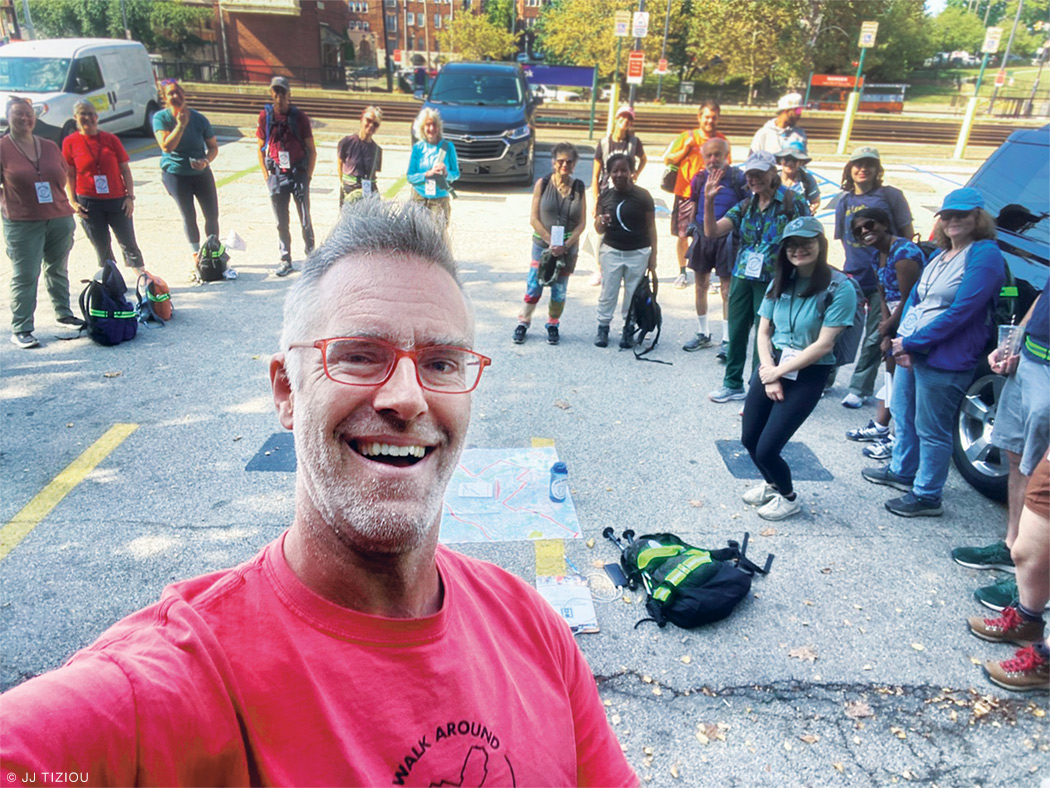
Tiziou has been doing this yearly since 2016. Writing about the experience for the Gazette six years ago [“The Edge,” May|Jun 2020], he described it as “a personal ritual that has also captured the imagination of others.” That year, 16 people joined him for the final leg of his pilgrimage, which involved “making an unconventional exit from the airport, edging along highways before diving into the sanctuary of the Heinz Wildlife Refuge.”
Since then, roughly 40 people have completed the entire circumambulation, and more than 1,000 have joined groups to walk one or more stages of the 12-day trek. (Tiziou completed his original foray in five and a half days within the span of a single week, “but those were long days.”) What began as an artist’s idiosyncratic one-off ramble has evolved into an unlikely platform for community building and educational programming. Tiziou has forged partnerships with organizations ranging from the Natural Creativity Center, which describes itself as a “self-directed learning community” for home-schooled and “unschooled” children, to Penn’s Stavros Niarchos Foundation (SNF) Paideia Program, which aims to foster dialogue, civic engagement, community service, and wellness through undergraduate courses and fellowships [“Creating Civil Citizens,” May|Jun 2024]. The Schuylkill Center for Environmental Education has gotten in on the action. So has Drexel University’s College of Engineering. The list goes on.
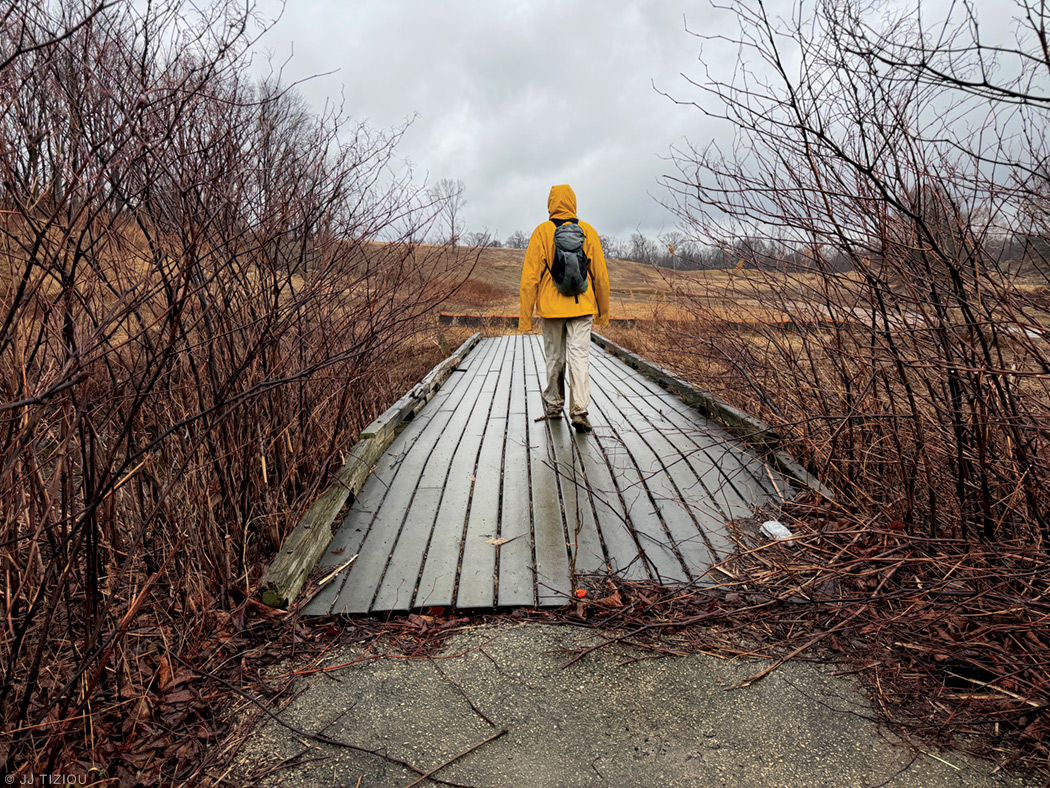
In his 2020 Gazette article, Tiziou asked, “What would it be like if we matched a city councilperson, a citizen just returning from incarceration, a historian, and a plumber and sent them off to explore the city’s edge together?” Since then councilmember Jamie Gauthier GCP’04 and Pennsylvania Representative Joe Hohenstein have walked with groups that are often as diverse as the city districts they serve. (Former councilmember-at-large Helen Gym C’93 GEd’96 also hooked up with a group, albeit only for a post-walk talk.) The youngest person to finish the entire circuit was 11 years old. The oldest was 96. Amateur historians, birdwatchers, students, working adults, and retirees have come together to cross woodland creeks, plod over the Platt Bridge above the old refinery, bushwhack through shoulder-high overgrowth in the far northeast, learn about shipping on a surprise tour of the Packer Avenue Marine Terminal and SouthPort Auto Terminal, and encounter oddities of all sorts on a largely trail-less trek that never quite unfolds the same way twice.
Slow Hugging the City
The Reverend Charles “Chaz” Howard C’00 first encountered Tiziou long before the latter began walking the city’s edge, or the former became Penn’s chaplain. It was on a retreat for an undergraduate class on cross-cultural education. “And if I recall correctly,” Howard says, “JJ just sort of volunteered to cook.” Tiziou’s manner of doing so left a lasting impression. “He just made food for the students who were doing this program … and then left,” Howard remembers. “And it was just a beautiful labor of love for people that he hardly knew. It was such a small thing, but for whatever reason, I never forgot that.”
About 20 years later, Howard signed up for his first leg of the Walk Around Philadelphia. Penn’s chaplain and vice president for social equity and community walks a lot. Weekdays often find him looping around Penn Park or the Kaskey Memorial Park BioPond. When time allows, he’ll stride out along Boathouse Row or in Valley Forge. “As someone who’s naturally introverted,” he says, “my regular posture is to look inward—to be reflective, to listen to the birds and savor every footstep, and focus on my breath and all that. And there is room for that in the Walk.” But as he discovered during that first segment, and a few years later on his second time out, there’s something else going on too.
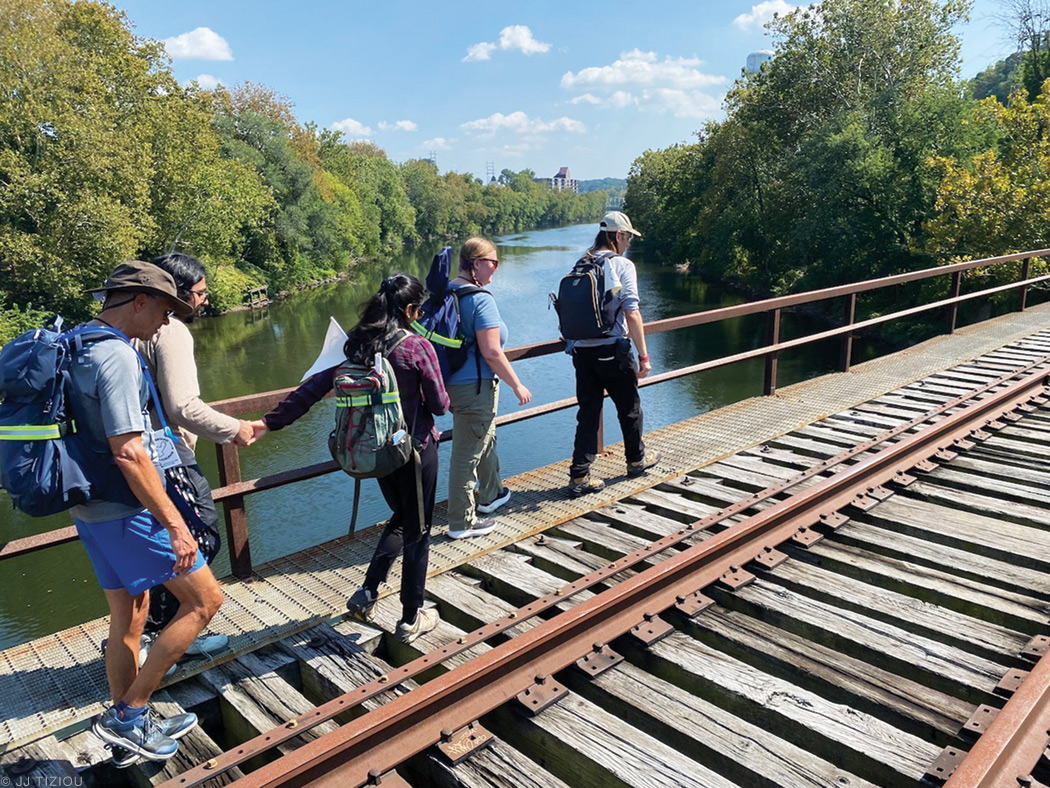
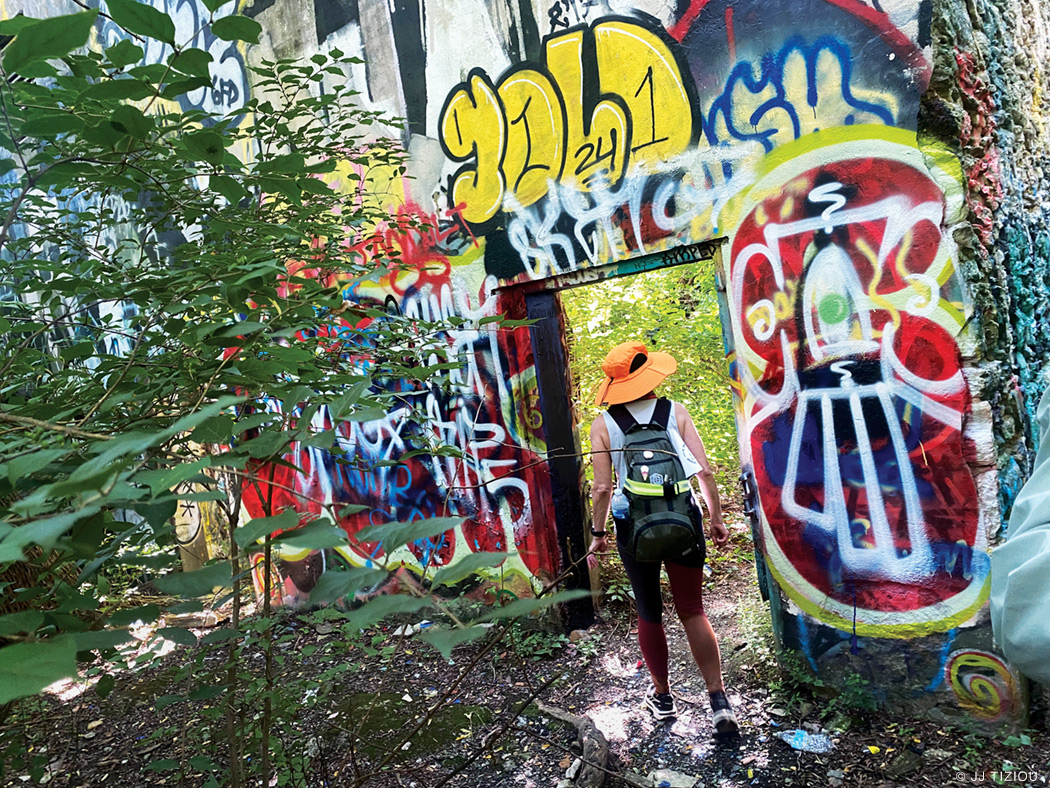
There is no path lining the city’s edge. Philadelphia’s border runs through fenced yards, vacant lots, streams, farmland, and utility easements. It skirts correctional centers, sewage treatment infrastructure, and burial grounds. The border runs right through the middle of Philadelphia International Airport, bisecting Runway 17-35. So as much as anything else, the Walk is an exercise in creative route finding and collective decision making. The guiding principle is to stay as close to the perimeter as safety permits. But that can look different depending on the weather, or the time of day, or the capabilities and comfort levels of the people involved.
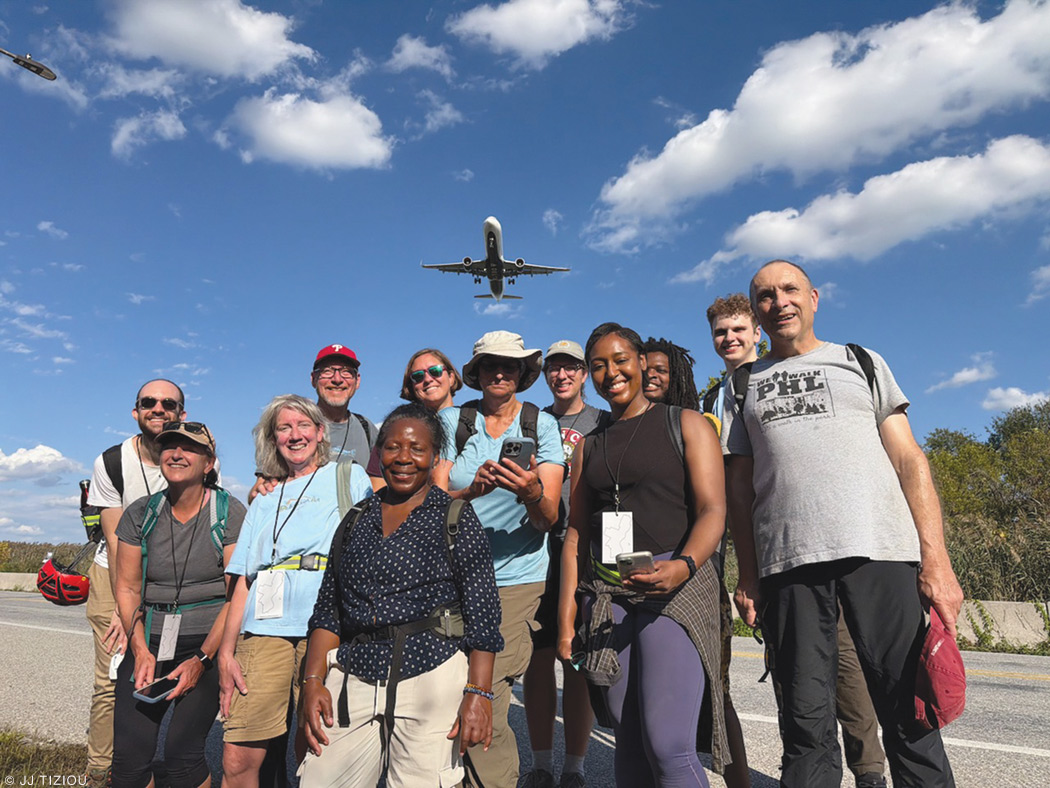
“We’re not bringing bolt cutters,” Tiziou explains. “But if that gate’s wide open, and if there’s no No Trespassing sign, well, maybe we wander through there. But we’re also honoring boundaries. So if someone asks us to leave somewhere, or if there’s a big No Trespassing sign—or if everyone wants to cross those train tracks or that creek, but someone in our group doesn’t feel safe doing it—then we find a way around.”
In Northeast Philadelphia, for instance, the border cuts across the Forest Hills Cemetery. The closest access points are from residential cul-de-sacs that effectively create a moat of private property separating the city’s streets from its official edge. Every group approaches the quandary in its own way. As Tiziou puts it, “Who feels safe just tromping in between these houses without asking for permission? Who feels safe going and knocking on a door—when we’ve already seen people get shot for ringing the wrong doorbell in this world? Who wants to detour around several blocks to find another way through?” Every walker brings their own mix of adventurousness, anxiety, impatience, and fatigue to such questions, which recur over and over again. So the Walk Around Philadelphia becomes an exercise in finding common ground.
“We’re practicing doing this collectively. We’re practicing not leaving anyone behind. We’re practicing not coercing anyone into anything. … So we’re exploring the city’s boundaries—but also our own,” Tiziou says. “It’s an opportunity to practice the best kind of world we want to live in.”
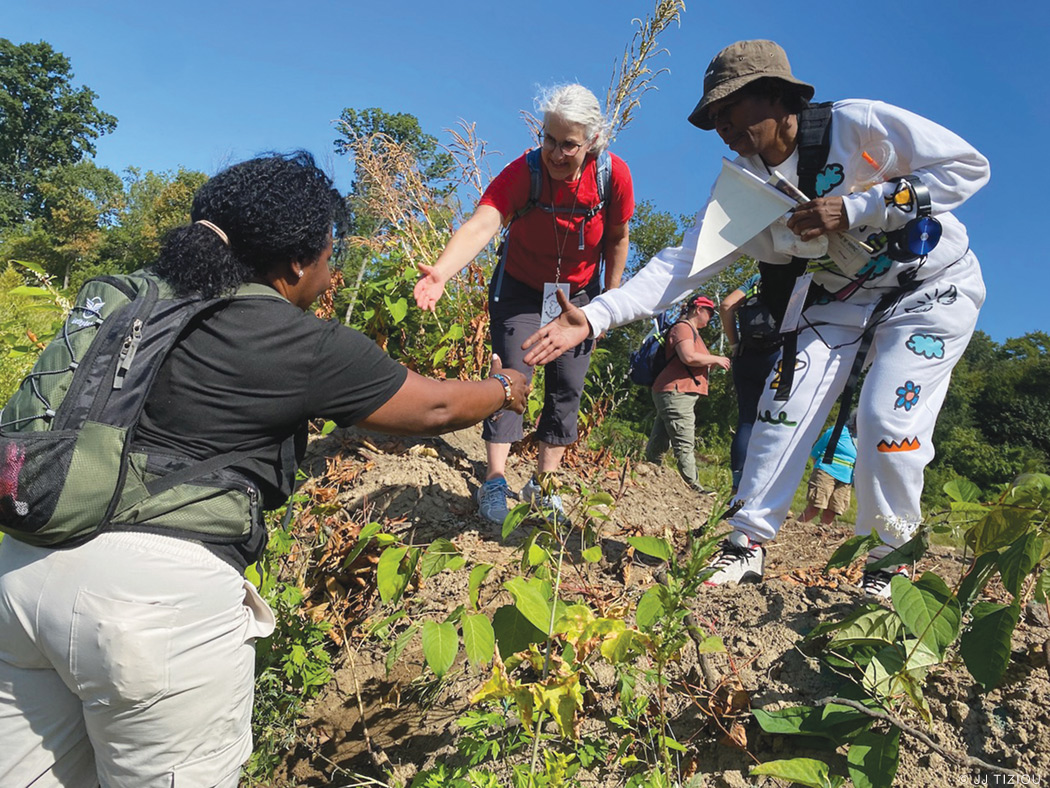
For Howard, that manifested as a social experience imbued with an ethic of care. “The first time I went on one of the walks with JJ, I was among the younger folks—and got to sort of help people up a hill, you know, or through a fence, or whatever,” he recalls. “And the last time I went, I definitely needed a little help, because now I’ve got a bad knee and can’t swing it like I used to. So it’s nice to experience the help side of it all, from both ends. … It’s such a small little metaphor for the way I think we need to love each other through hard times.
“You end up bonding with the people you’re working with—or walking with, I should say,” he observes, caught between two verbs in search of a more elusive one. “It’s not just a walk, you know. It’s not just a meetup. There is something generative and something beautiful about it that I think is an extension of JJ as an artist.
“You bond with the city in a different way,” Howard concludes. “It felt kind of like giving a slow hug to Philadelphia.”
The Art of Connection
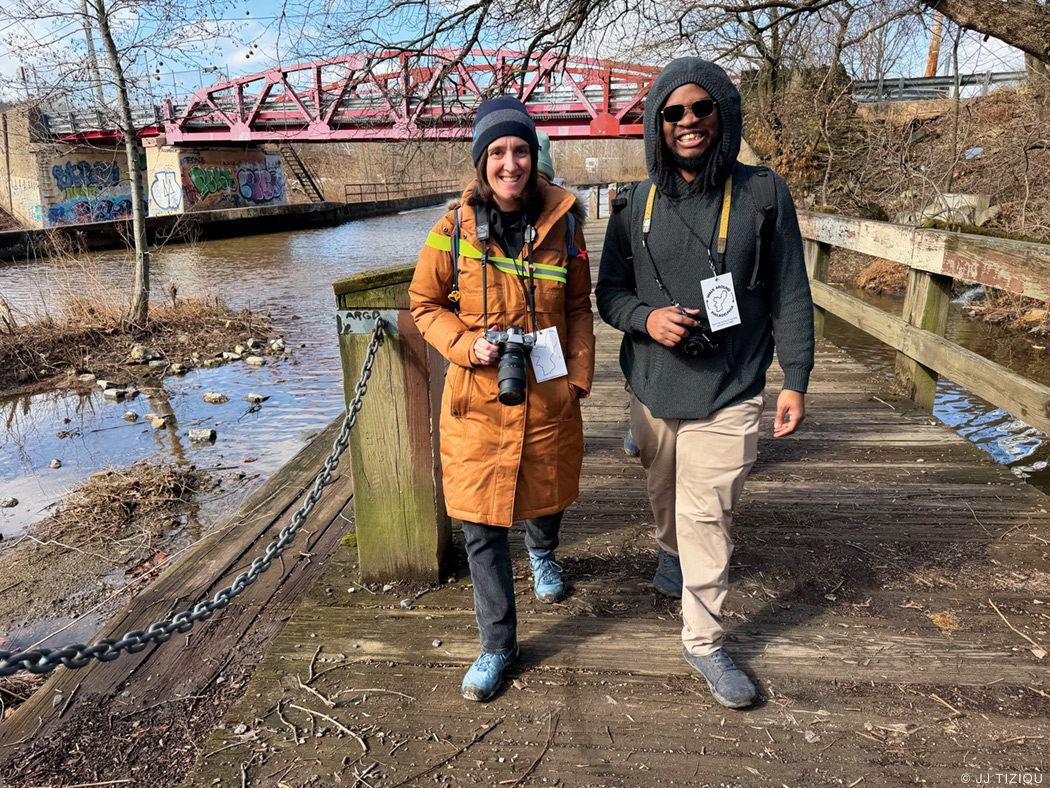
As artists go, Tiziou is an exceptionally social—and kinetic—one. A longtime photographer who insists that “everyone is photogenic,” he is frequently drawn to community portraiture. To cover the Philadelphia Fringe Festival in 2003, for instance, he set out to attend every single event and ended up shooting about 30,000 frames. (And if his work for the Gazette over the years is any guide, there’s no telling how many invitations he issued to one of his block parties in West Philly.) His most-viewed work, an 85,000-square-foot dance-themed mural that adorns the I-95-facing parking garage façades at Philadelphia International Airport, exemplifies his participatory sensibility. To produce “How Philly Moves” (2011), Tiziou issued an open call for Philadelphia dancers of every variety, from professional ballet performers to middle-aged radio lovers more accustomed to bounding around their bedroom furniture [“Arts,” May|Jun 2010].
“Some public art is like—Okay, this is art, and it’s for us,” he told the Gazette at the time. “Or it’s about us. Or it’s nice to look at when you walk by. Whereas what I’m about is art that comes from us. That’s what’s so great about this project, you know? All of us made it. And all of us can see ourselves in it.”
Fifteen years later, that’s precisely the spirit he’s trying to cultivate through the Walk. After the February 2020 ramble he wrote about in the Gazette, Tiziou began building organizational capacity. The COVID-19 pandemic became an unlikely catalyst for a partnership with the Philadelphia Fringe Festival, which saw the Walk as a way to provide unconventional outdoor programming. Tiziou put together “perimeter walking kits” for four-person pods, equipping them with printed maps, reflective safety belts, and online wayfinding resources, and hosted a virtual debriefing where participants could connect and share their experiences.
The Fringe edition also established an enduring template that combined sliding-scale fees to defray costs with stipends to extend access to people who would otherwise struggle to participate. “As long as 20 percent of our population lives below the poverty line,” Tiziou says, he wants “20 percent of each group be stipend supported.” This is a point of emphasis. “It gives neighbors an opportunity to have a shared experience in a world where we’re so divided,” he explains.
“The thing I love is random strangers reaching out and holding each other’s hands to help each other. That’s a thing that’s rare in this world,” he reflects, and yet on the Walk it seems to happen “without fail.” A recent crossing of the City Avenue bridge—a “hairy pedestrian situation” that many groups opt to find a way around—furnished an example. Around four hours into the day’s hike, “I saw two folks walking side by side, patting each other on the back, laughing about the upcoming election, and talking about barbecue,” Tiziou recalls. “And I’m the only person who knows that she lives just across the border in a wealthy neighborhood, paid $250 to be there, and her family foundation just gave the project 10 grand. And he recently lived out of his van right off of Clark Park, and just got a little room in North Philly. These paths wouldn’t normally cross—and today, they’re sharing a path all day.”
For Gregory McGaughy, a multi-stage walker who was on hand for the event at Cherry Street Pier, the Walk has been a chance to experience “freedom” in a city that can feel full of strife. “Where I live is sort of rough. You got to be looking over your shoulder,” he said. But walking the city’s edge, “I’m in nobody’s war zone. … I’m just floating with the vibe and everybody else. It’s just an easy kind of thing. Everybody’s laughing, everybody’s feeling good together. There’s just peace with a group of people. … It gives you a chance to relax and think about stuff and come back with a clean head to be motivated to do something else.”
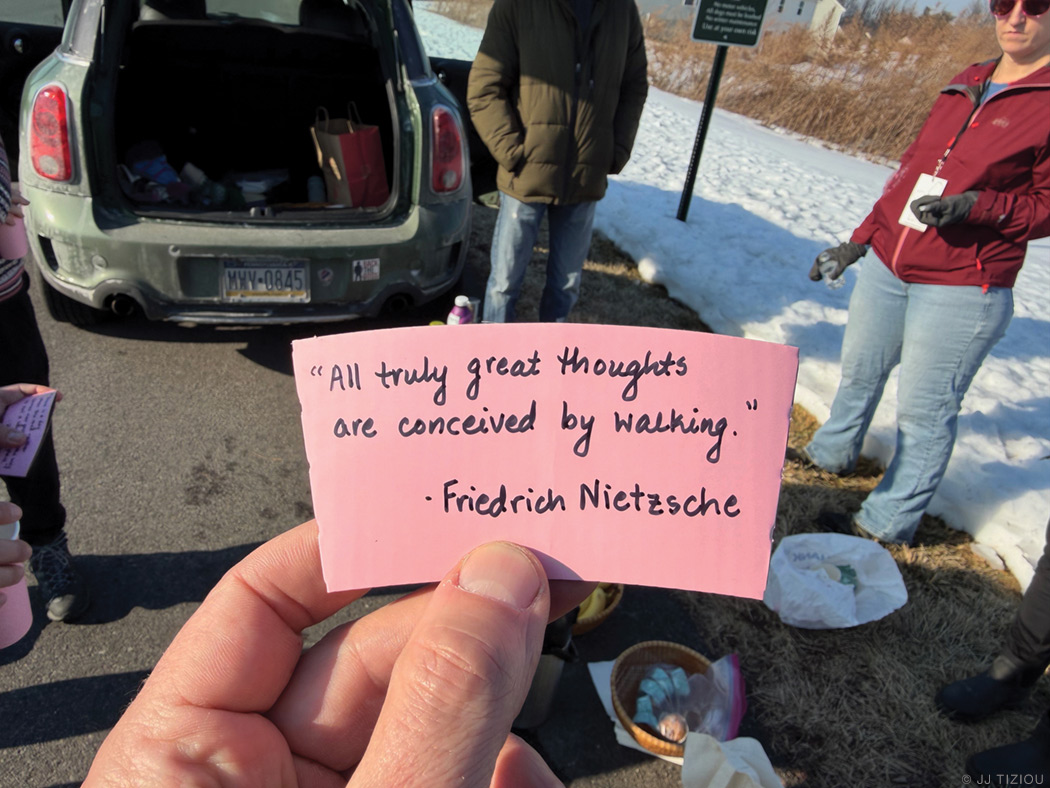
Anyone who has ever run a group retreat would probably tell you that kumbaya moments rarely just happen on their own. They can take some delicate engineering to bring about. And while the simple act of walking does have a way of freeing the mind to wander toward unpredictable connections, Tiziou nudges participants with discussion prompts, spells of silent contemplation, and subtle appeals to self-control and social receptivity.
At a 2024 celebration of 10 people who’d completed the full circuit—earning a nifty lapel pin Tiziou bestows upon circumnavigators—a relative newcomer to Philadelphia named Graham Brent reflected on one unavoidable reality of the Walk. “You may be walking with people who you find a little challenging, and who you certainly wouldn’t choose to be with,” said the longtime executive officer of the National Commission for the Certification of Crane Operators, who in his retirement has joined the Walk Around Philadelphia’s community advisory board. “But you are with them. And you’ve got four or five hours to figure this out.
“One of the things JJ says at the beginning is, ‘Try just being curious about the situation you’re in,’” Brent said. “And walking is a kind of meditation—so you think, Well, why is that? Why do I have an issue with that? So for me it’s been mind-expanding.”
Outdoor Ed
When Tess Liebersohn GEd’18 read Tiziou’s 2020 Gazette article, she was running the teen program at Philadelphia’s Natural Creativity Center, a social hub for homeschooled children. The center organized much of its programming around its library, wood shop, maker space, and other indoor amenities whose viability had suddenly been cast into doubt by the COVID-19 outbreak. “I thought, ‘Huh, this would be something to do with the teenagers,’” Liebersohn recalls. “It would get us outside. It would have a project element, and it would be new and challenging. And our parents are often trying to find ways for their young people to be more engaged with the world, more comfortable moving around and independent, and to learn about their area.”
So she cold-emailed Tiziou with a lengthy explanation that stretched from her professional bona fides and Penn connection to her avocational experience as a hiker, hoping that he’d take her seriously enough to hit Reply. “And I didn’t need to do all of that,” she laughs now. “He was like, ‘Sure, of course. Let’s go on a walk.’”
With his consultation and support, Liebersohn and an adult cofacilitator ended up leading eight adolescents all the way around the city. Starting in September, they walked every Tuesday and Thursday for two months, splitting the circuit into 14 segments. They were hot, they were cold, their feet hurt, but they kept at it. They climbed fences, crossed creeks, found “interesting animal remains.” A stop at the Philadelphia Fire Academy training center led to an impromptu tour. They found an abandoned shopping cart and pushed their backpacks in it for a few miles. They trampled on a beehive and Liebersohn suffered 10 stings. “I kind of threw myself onto the grenade,” she says. But only one kid got stung, “so it all turned out okay.”
“They were very excited about getting their circumnavigator pins from JJ when they completed it,” she says. And then the group decided to just keep on going, tackling one major arterial avenue at a time. “A lot of them just gained confidence. So we did the whole border, and then we walked all of Broad, we walked all of Market, we walked all of Frankford, we walked all of Ridge, we walked all of Germantown.”
Three years later, another cohort embarked on the border journey—this time using SEPTA to reach daily starting and ending points, which added another layer of engagement with the city. “What they’ve gotten out of the walk has been a sense of accomplishment,” says Liebersohn, as well as “physical exercise, exposure to all parts of the city, and some problem-solving skills—like how do we read this map? How do we figure out if this is the right way to go?” But perhaps just as importantly for young people who lack the built-in social experience of traditional schooling, they’ve experienced “the group mind that comes from walking together for 100 miles.”
In September 2021, as Penn’s campus emerged from pandemic social-distancing restrictions that had frozen student social life for the previous year, the SNF Paideia Program partnered with Tiziou to turn the Walk into a fall retreat for the program’s fellows and campus partners. Roughly 100 students, faculty, and staff split up into 10 groups, each of which walked a section of the city’s perimeter before coming together to compare notes. It proved a natural fit for a program that focuses on cultivating “dialogue across difference” to advance personal wellness and community-oriented citizenship.
“There’s nothing like walking and talking,” says Lia Howard C’01 Gr’11, the program’s fellows director (and the chaplain Chaz’s wife), “to get at deep values and things that people wouldn’t say in a classroom. Your mind feels free and more imaginative when you’re moving.”
Yasmin Abdul Razak C’24, a then-sophomore from Malaysia who would go on to major in sociology and philosophy, politics, and economics (PPE), was part of a group that traced the edge of Cobb’s Creek—way further west than most Penn undergrads ever think to venture. It felt different from the typical icebreaker exercise. “Walking with people is a great way to connect,” she told Penn Today at the time. “You get past the shallow conversation and end up talking about meaningful things. It was a time to do a lot of reflection as a group.”
Lia Howard was struck by how much this kind of “face to face, gritty engagement with the city” had to teach her about the metro area she’s called home since she was nine years old. “You say you’re from a place like Philadelphia,” she reflects, “but until you walk a part of it that you had no idea was even the perimeter of it, you don’t really know Philadelphia.”
She has applied that lesson to her work as the director of the Paideia Program’s Political Empathy Lab. In the summer of 2024, she led a group of seven undergraduates on five road trips throughout Pennsylvania to conduct ethnographic research about the influence of geography on social and political identity in an era of “extreme disconnection between those who identify differently ideologically because they do not share information or space.” The trips featured visits to municipal buildings, historical archives, state fairs, energy infrastructure, union workers’ offices, and other sites of civic life. But Howard took a page out of Tiziou’s book whenever they reached a new destination—including during a second phase of the project in the summer of 2025.
“We land in a town or a place, and I send students out in pairs, walking, and I just say, ‘I’ll see you in three hours.’” Instructed to encounter people on their own home turf, the students would then translate their notes into maps. “What do people who live here see? What do they hear? What do they say?” she explains. “A lot of times, as academics, we go straight to what people need,” often by “categorizing people” on the basis of aggregated data. What the Walk Around Philadelphia underscored for her was not just the folly of trying to classify people without understanding the places they inhabit, but the power of moving through a landscape on two feet. “It’s the human pace, as opposed to the rapid pace of conquering with data,” she says. “We’re conditioned right now not to have the time to slow down or pay attention.” Walking encourages both. “I don’t believe that you can fully understand people devoid of place. We can have all the data in the world about different people [and] where they are, but if you decontextualize it—if you try to understand it outside of place—you’re missing a really important piece.” Howard has integrated some of these practices into PSCI 4201: Political Empathy and Deliberative Democracy in the US, a Paideia Program seminar she teaches in the spring.
Mira Olson is an associate professor of civil, architectural, and environmental engineering at Drexel University. After learning about the Walk from Lia Howard, she reached out to Tiziou for help adapting it for a cohort of engineering students involved in Drexel’s Peace Engineering program, which focuses on “the application of science and engineering principles to promote and support peace and a sustainable future for the planet.” Soon she was tromping along the line that divides Northeast Philadelphia from the suburbs with a troupe of aspiring engineers.
“The Walk is a great way to get to know the city—but it’s also a really great way to look at the built environment, infrastructure, cities, roads, streets, buildings, and think about it in terms of what it means to the people who are living there,” Olson says. “Engineers, by training, are taught to think of things in isolation—to remove context and just simplify things and only think about the technical thing that you’re designing. We don’t think about, like, how does this actually sit in a context? So yes, it works, but does it work for everyone? Does it work in all situations? … Who’s using this? Who’s not using this? What does it do when it’s working? What does it do when it’s not working?”
Whether it was permanent infrastructure like streets and sidewalks, service infrastructure like trash collection, or maintenance patterns as revealed by pothole (non)repair, the Walk was full of learning prompts. And not just for the students. “I had spent a lot of time already working in different communities and different spots of Philadelphia, but this still took me places where I had literally never been, despite having lived here for 20 years,” Olson marvels. “And even the places where I had driven, it just feels different when you’re walking.”
Olson is currently working to adapt the Walk for a cohort of Drexel Honors College students next year. And after her foray with the engineering students, she kept tracing the city’s edge with her daughter, Dori.
As a senior at Lower Merion High School in 2022, Dori Olson was required to undertake an “experiential exploration of a topic” entailing at least 70 hours of engagement culminating in a final presentation. Dori connected with Tiziou, who acted as her project advisor, and set out to explore the city she would soon be departing to attend Rice University in Houston. She kept a journal, whose entries reveal Philadelphia in all its splendor and squalor. Taking SEPTA to Penn’s Landing for the first leg of her clockwise journey, she recorded the pungent scene of “people smoking weed at 10 on Mother’s Day morning.” One of her last segments took her through Bridesburg on Memorial Day, where “the patriotism was unlike any place I’ve seen,” with flags decking every dwelling along with red, white, and blue decorations, and “even the style of townhouse felt like it should be in a rural Pennsylvania town.” In between, she walked with a series of companions in a sort of valedictory loop marking the end of one life phase and the beginning of another. She walked with her mom, her dad, her brother, and three of her closest friends. She discovered that Kensington, despite being ground zero of America’s opioid crisis, turned out to be “very safe and pretty” by the Delaware River. She learned that the grated walkway on the Platt Bridge is no place for a 55-pound dog, which had to be carried for nearly two miles. Poquessing Creek, which separates Philadelphia from Bucks County, proved to be the land of “short-cuts-turned-long-cuts.” Traversing Pennypack Park, “my grandmother told me the whole story of how my grandfather proposed to her,” which Dori had never heard in full. “It was really sweet—both the story and being able to talk with her for a while.”
Looking back on the experience now, Dori Olson says the best aspect was cultivating those close relationships. “It was really special,” says Olson, who recently graduated from Rice with a bachelor’s degree in social policy analysis and statistics. “The only thing we had to do was walk and talk to each other, and kind of explore the city—but also just spend time with each other.”
Yet after walking the border with friends and family, she couldn’t help feeling like there was something she was missing. “I had never done a walk with strangers, which is kind of the way Walk Around Philadelphia is designed to be experienced.” So in the summer of 2025, she joined the first Spanish-language iteration of the Walk.
“It’s a really great and cool way to onboard immigrants in their own language,” Tiziou remarks, swiftly pivoting to an example from a French edition he mounted the same year. “A West African gentleman, a French speaker, came and walked with us in French in the fall—and then walked with us in February in English, to practice his English. And then starts making new connections. And that’s what happens: We have complete strangers, and they instantly fall in, two by two, and start connecting.”
Rites of Passage
If Chaz Howard is right that the Walk Around Philadelphia is a generative “extension of JJ as an artist,” then Tiziou hopes that 2026 will mark the year that the Walk outgrows its creator. Having recently received a three-year funding commitment from an anonymous donor, he hopes to build a skeleton staff that can expand institutional partnerships. This April brought the “first offseason longer walk that is being entirely run by our new cofacilitators, without my even being there at the start point,” which he calls “a big next step in scaling and sustainability.”
During several iterations of the Walk, stipends have supported the participation of several citizens returning to society after prison terms. Tiziou dreams about launching a formal reentry program. “My goal is that 20 years from now, folks can have an opportunity to opt into a reentry program where they would learn about the Walk beforehand [and] earn a cash stipend to support reentry by doing this transition ritual—walking alongside social service providers and prospective employers and neighbors who have been trained to be allies.
“My goal is that 20 years from now,” he adds, “every young person in the region might have the opportunity to do the Walk as part of an experiential learning curriculum, or alternative spring break, or graduation ritual.”
And for Tiziou, of course, “in the region” encompasses everyone from lifelong residents to yesterday’s latest arrival. “If you move here for college, or grad school, or a new job,” he says, “this can be your way to connect to the city, to connect to neighbors, understand the scope and complexity of the city a little more.”
Even though he’s been all the way around 17 times—logging enough miles to reach San Antonio, or Saskatchewan—Philadelphia has yet to exhaust his rapt attention.
“It never ceases to surprise me,” Tiziou marvels. “There’s still places I’ve never been. There’s always something new getting built, something else falling apart or burning down or being demolished. There’s always a new obstacle or a new trail—or just a choice that the group makes that leads to a new discovery.”