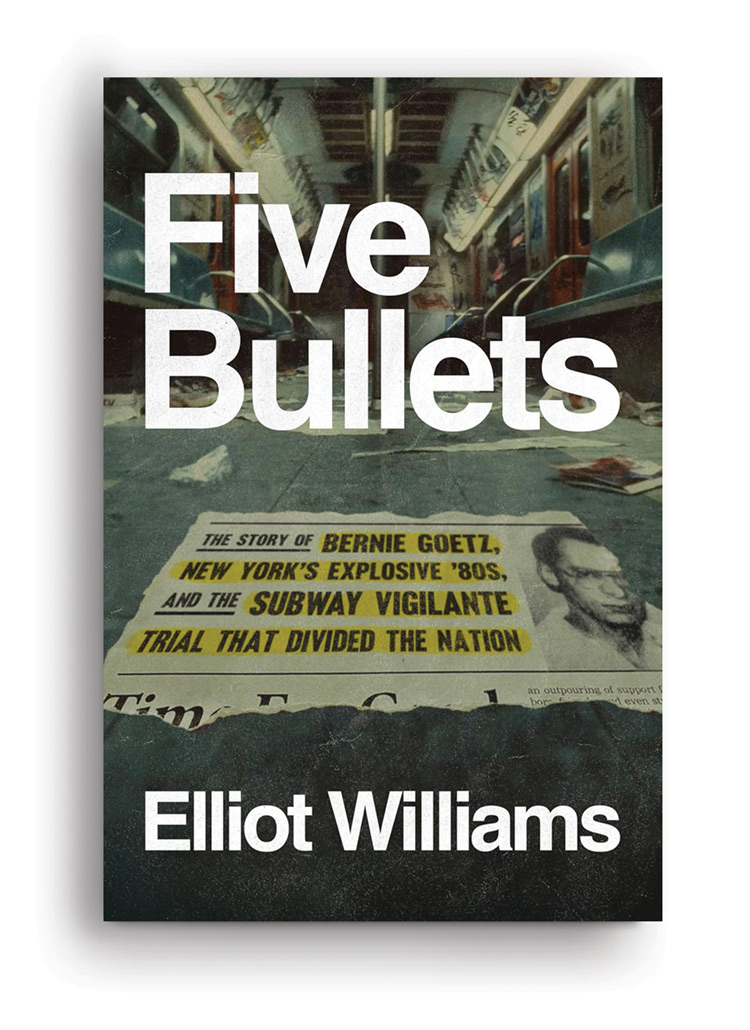
By Elliot Williams C’98, Penguin Press, 384 pages, $32
The 1980s trial that exposed a city riven by enmity, anxiety, and frantic anger.
Review by Julia M. Klein
The saga of Bernhard Goetz, an eccentric white engineer who shot and seriously injured four Black teenage boys in a New York subway car, is barely remembered today. But it loomed large four decades ago, a mass Rorschach test that elicited vehement reactions across the political spectrum.
Along with its legal aftermath, the 1984 shooting spawned celebratory songs and a Monopoly knockoff, in decidedly poor taste, called the Subway Vigilante Game. In the game, players represented by small pewter handguns “would race to survive a ride between Brooklyn and the Bronx,” according to Elliot Williams C’98’s Five Bullets, a lively account of the incident and the era. Contestants began with six—rather than the eponymous five—bullets and drew cards with instructions such as, “Cops help stop punks: ROLL AGAIN.”
New York at the time was a different, more frightening place. Now, Williams writes, in many neighborhoods “one is far more likely to trip over a purebred labradoodle than a crack pipe.” But in the 1980s anxiety about crime, on both the city’s gritty streets and in its dank, graffiti-covered subways, was widespread—and justified by high rates of homicide and other violent crime.
Against that backdrop, the Goetz shooting and his subsequent trial took on a symbolic heft, Williams suggests. Seen more clearly, the facts of the case indicated that neither Goetz, whose past experiences and biases fueled his violent reaction, nor the boys, a Bronx crew with prior criminal records, deserved the mantle of heroism.
Williams resolves any ambiguity on that score. He also parses the somewhat confusing legal issues raised by the case. In particular, he focuses on the mutating and complex “reasonableness” standard critical to the argument of self-defense. Finally, he attempts to sketch a throughline between past and present, arguing for the relevance of the Goetz case to contemporary debates on race, gun rights, and criminal justice.
A familiar face as a CNN legal analyst, Williams is well positioned to tell this story. The Penn art history major and Mask and Wig alum, who went on to earn degrees from both Columbia Law School and Columbia Journalism School, is a former federal prosecutor deeply versed in criminal law. As the Brooklyn-born son of Jamaican immigrants, he also understands the toll of racism, which, along with poverty, warped the lives of the troubled teenagers that Goetz targeted.
At the heart of the story is Goetz himself, a nerdy, divorced loner and longtime gun owner. Bullied as a child, he later survived at least one brutal mugging and may have suffered from post-traumatic stress disorder. He had Black and Latino friends and claimed not to be racist, but the racial epithets he uttered at a 1980 tenants’ association meeting suggested otherwise. The insults amounted to “a bad choice of words,” he told Williams in a recent phone interview, a characterization the author dismisses. “Racist words used about other races in a racist way are racist,” William writes.
When 19-year-old Troy Canty approached Goetz in a crowded subway car and asked for $5, Goetz could have declined. He could have moved away. Instead, he unsheathed a handgun and shot five bullets in quick succession, injuring all four boys. Darrell Cabey, the worst casualty, ended up paraplegic, with irreversible brain damage that left him with the intellectual capacity of a third grader.
Given the context, was the shooting legally justified? Was Canty “simply panhandling,” as the boys later maintained? Or was the request a prelude to a violent mugging? Did Goetz reasonably fear that he was in danger? Would others have felt the same? Those were the central questions for two grand juries and the eventual trial jury.
As Williams notes, the four teenagers were hardly choir boys. Barry Allen had already served time for assault and been sentenced for grand larceny, and Cabey was awaiting trial on armed robbery charges. James Ramseur was later convicted of robbery and sexual assault in a particularly gruesome case. On the day of the shooting they were all headed downtown together, armed with screwdrivers, to steal coins from video arcade machines.
Goetz knew none of this. But in the subway, Williams writes, the teens were rowdy, “raising their voices, hanging on the bars, doing pull-ups, pounding on the seats, shadowboxing, and approaching other riders for matches.” Though they harmed no one, some passengers found their conduct alarming.
After the shooting, Goetz jumped out of the subway car, fled to New Hampshire, returned to his West Village apartment, then traveled to New England again. After ultimately surrendering to police, he offered a series of disordered confessions. Meanwhile, the media, led by the New York tabloids, were hyping the case, largely styling Goetz as a righteous avenger. Newsday columnist Les Payne, who was Black, was among the few who suggested that “the public’s warm embrace of Goetz could almost exclusively be traced to Goetz’s and his victims’ races.”
Given the city’s mood, it took two tries before the Manhattan district attorney could secure grand jury indictments on the most serious charges of attempted murder, reckless endangerment, and assault. The 1987 trial didn’t go the prosecution’s way either.
The defense “was smooth in nudging the jury on race,” Williams writes. In Barry Slotnick, Goetz had a top-flight attorney who portrayed the shooting victims as “hooligans” and “punks.” In the end, Goetz was convicted only on an illegal gun-possession charge and served just over eight months in prison.
Williams, who appears to find the jury verdict legally defensible but morally questionable, tracked down many of those involved with the case, including the trial judge, reporters, lawyers, activists (including the Rev. Al Sharpton), and a subway eyewitness. Neither the shooting victims nor their relatives would speak to him. His detailed report on his conversation with Goetz makes the man seem both unhinged and defiantly unrepentant. “Those guys needed shooting,” Goetz tells Williams.
Why return to this story now?
Williams argues that, while crime is down in New York, much else remains unchanged. “A close look at Goetz’s case reminds us that we are still afraid, still haunted by America’s racist past (and present and future), and still very quick to kill strangers,” he writes. He offers the example of a 2023 subway tragedy: former Marine Daniel Penny’s fatal attack on a Black man, Jordan Neely, who was in the grip of a frightening psychotic episode. Penny was later acquitted of criminally negligent homicide.
But Williams also insists that societal norms have shifted. “Today Goetz’s victims would not have been reduced to caricatures; Goetz’s oddities would have been regarded with concern, not eye rolls,” he writes. And where Williams himself stands is clear from his epigraph, excerpted from a 1904 New York Court of Appeals ruling: “The worst man has the right to live the same as the best, and no one may attack another because his general reputation is bad.”
Julia M. Klein, a frequent contributor to the Gazette, has been a three-time finalist for the National Book Critics Circle’s Nona Balakian Citation for Excellence in Reviewing.