
From housemate hijinks to high court triumph.
By Dennis Drabelle
On the morning of November 6, 1973, William “Bill” Eggers L’69, who died last fall, stood at a podium and said, “May it please the court.” That’s the salutation with which any lawyer introduces a case in almost any American courtroom, but Bill was a 29-year-old addressing it to one of the hardest-to-please tribunals of them all: the US Supreme Court.
Six years earlier, Bill had joined four other members of Penn’s 1969 law class—Mike Levy L’69, Sam Tilton L’69, the late Lee Hymerling C’66 L’69, and me—in renting a rowhouse on Lombard Street in Center City to live in during our second and third years. In the fall of ’73, I was an attorney-adviser at the US Department of the Interior in Washington, DC, so on Bill’s big day all I had to do was take a cab to the Supreme Court building. Mike came down by train from Philadelphia, where he was embarking on what became a long and distinguished career as a prosecutor. (He is currently on the Penn Carey Law faculty, teaching the evidence course and a seminar on prosecuting cybercrime.) He and I were expressing our support for a highly talented friend as he argued his side of the prisoners’ voting-rights case O’Brien v. Skinner, 414 U.S. 524 (1974).
It’s impossible to appreciate O’Brien v. Skinner fully without placing it in the context of the Sixties and its onslaught of civic upheavals: riots in African American sections of Los Angeles, Detroit, Newark, Washington, DC, and elsewhere; massive demonstrations against the Vietnam War; Eugene McCarthy’s and Robert Kennedy’s primary challenges of President Lyndon Johnson for escalating that war; the exasperated Johnson’s March 31, 1968, decision to end his candidacy for a second full term; the assassinations of Martin Luther King Jr. and Kennedy later that spring; the Chicago police riot that spoiled the Democratic National Convention in August; and the election of Richard Nixon, who promised to end the war while concealing his determination not to be the first American president to lose one.
Throw in the bullyboy rhetoric of Philadelphia police chief Frank Rizzo, and you have a milieu far from conducive to study and reflection. As law students we sought relief by clowning around in ways more appropriate to undergraduates. One night a couple of us made liberal use of food coloring to prepare an all-blue supper; a week or so later, a retaliatory red meal appeared. On another occasion, some of us came home from class to find that every stick of living room furniture had been moved into the dining room. And then there were our neighbors Donna and Georgia, also known as the Back Street Girls.
At around 5:30 p.m. on move-in day, the doorbell had rung. On the stoop with a favor to ask were two elegantly turned-out young women working as clothes buyers for the department store Strawbridge & Clothier. Our house fronted on a street, but Donna and Georgia’s house, directly behind ours, did not. They had been reaching it via a narrow gap between our house and an adjacent, boarded-up building, and they felt vulnerable all the way to their front door. Might it be possible, they asked, for them to go through our house to reach theirs safely on weekday evenings? “Of course,” we replied.
It was Bill who dubbed them the Back Street Girls, after the Rolling Stones’ song of that name. We used the term only out of Donna and Georgia’s hearing, and on warm weekend afternoons they would invite us into their minuscule yard to play quoits and slurp “banana whackies,” which was their pet name for frozen banana daiquiris. Now and then we Front Street Boys would have guests for dinner—visiting relatives, say, or one of our law professors and his wife. During the cocktail hour there would be a knock on the door, followed by the entry of two stylish young women. After their transit, insinuations would be aired, and our protestations that this was not what it looked like would be hooted down.
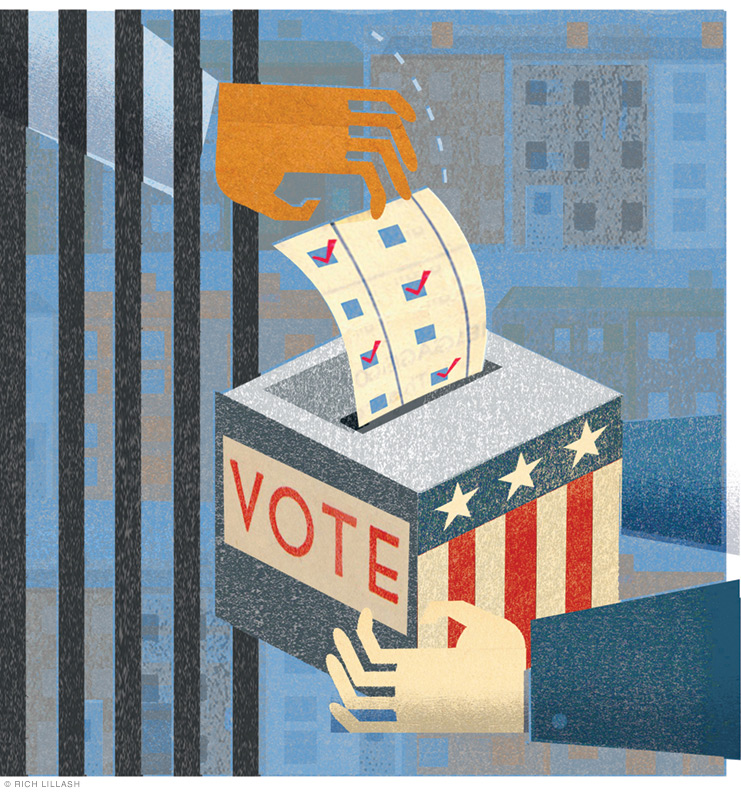
Fun and games aside, as law students we may have coped with the pervasive mayhem better than most. We were acquiring skills useful for challenging a system that seemed rigged against dissent and change, and a few years later, Bill’s representation of inmates who just wanted to vote struck his ex-housemates as a fulfillment of group aspirations.
The case arose in Monroe County, New York, which includes Rochester, where in the early ’70s Bill was practicing law with the firm Nixon, Hargrave, Devans & Doyle (today known as Nixon Peabody—and for the record, the leadoff namesake was not that Nixon). Like many other states, New York stripped convicted felons of the right to vote, but in the run-up to the 1972 election, dozens of non-felons confined in the Monroe County jail—some of them convicted misdemeanants, others pretrial detainees who couldn’t raise bail—found themselves barred from the electoral process. Not by any specific law or policy, but because of what during oral argument Justice Potter Stewart was to call an “interplay” of denials.
Denial #1, issued by the county sheriff, nixed the prisoners’ request to take advantage of a state program for setting up polling places in jails. Denial #2, made by the same official, turned down the prisoners’ petition to be taken to an off-campus polling place. Denial #3 gave a crabbed interpretation to a potentially helpful provision of state law: eligible voters with a physical disability could cast absentee ballots. Sorry, the county board of elections ruled, but “physical disability” is a strictly medical criterion, which none of the plaintiffs had shown he or she could meet. The rejections made for a disenfranchising Catch-22—a classic example of Authority Wearing Blinders that was a Sixties specialty. The League of Women Voters took up the Monroe inmates’ case, which landed in Nixon Hargrave’s pro bono office, where a senior litigator assigned it to Bill. The trial court found in the inmates’ favor, an intermediary appellate court agreed, but the Court of Appeals (the state’s highest) overturned the decision, ruling that the relevant portion of New York’s absentee ballot law applied only to persons “medically disabled by reason of some malady or other physical impairment.” A more flexible reading might have saved everybody a lot of trouble by classifying cell bars as physical impairments, but the Court of Appeals lacked imagination. Because Bill had based his appeal mainly on the equal-protection clause of the Fourteenth Amendment to the US Constitution, the Court of Appeals decision was appealable to the US Supreme Court—a lever that he and the League pulled.
Listening to the oral argument more than half-a-century later—on the website JUSTIA Supreme Court—one hears Bill start off a tad nervously (though who in his shoes would not have?). Soon, though, his commanding intelligence kicks in, and he lays out a principle he wants the justices to keep uppermost in mind: voting is a fundamental right, not to be denied except for a compelling reason, which New York has not supplied. When Justice William Rehnquist asks whether some rights are fundamental and others are not, Bill answers that he “wouldn’t want to create a hierarchy of constitutional rights” but goes on to cite a previous case in which the Court itself called the right to vote fundamental.
Replying to a friendly question from Chief Justice Warren Burger, Bill agrees that his case is strongest for pretrial detainees because they still enjoy the presumption of innocence until proven guilty. An unidentified justice (probably Harry Blackmun) asks Bill sarcastically if he won’t be “back in here tomorrow” to argue that felons, too, should get to vote in New York. Bill answers, “Your honor, I represent the clients I have,” repeats that none of them is a felon, and notes that although New York seems to have decided that a felony conviction signifies such disrespect for the law that the guilty party should forfeit the right to vote, the state has imposed no such stigma on convicted misdemeanants.
In answer to a question from Stewart, Bill aces his equal protection argument. The current situation in New York, he points out, could lead to this unequal and absurd result: a convicted misdemeanant who is a resident of County X but serving time in the Monroe County jail can vote by absentee ballot, whereas his cellmate, a Monroe County resident, cannot.
When opposing counsel took his turn at the podium, he failed to articulate a cogent rationale for deciding in the state’s favor. Bill came out of the experience smelling like a winner.
It didn’t take the Supreme Court long to confirm that impression. On January 16, 1974, in an opinion written by the chief justice, a 7–2 majority ruled that “New York’s election statutes, as construed by its highest court, discriminate between qualified voters in a way that, as applied to pretrial detainees and misdemeanants, is wholly arbitrary. … We have no choice, therefore, but to hold that, as construed, the New York statutes deny appellants the equal protection of the laws guaranteed by the Fourteenth Amendment.”
What should the remedy for this miscarriage of justice be? Install a voting booth at Monroe County jail? Bus appellants to the nearest outside polling place? Distribute absentee ballots inside the jail? Any of those would have worked, but the Court left the repair job to state and local officials; the last line of the majority opinion reads, “Reversed and remanded for further proceedings not inconsistent with this opinion.”
A concurring opinion, written by Justice Thurgood Marshall and joined by Justices William Brennan W1928 and William O. Douglas, pounced on opposing counsel’s banana-whackiest explanation for not letting the appellants vote absentee: the possibility of jailers unduly influencing inmates’ votes. “It is hard to conceive how the State can possibly justify denying any prisoner his right to vote,” Marshall scoffed, “on the ground that his vote might afford a state official the opportunity to abuse his position of authority.”
Writing in dissent for himself and Rehnquist, Blackmun pointed out that New York’s denial of the vote to these inmates was unintentional and that the state could have declined to allow absentee voting for any reason without running afoul of the Constitution—in other words, there is no right to vote by absentee ballot per se. “I would refrain from continued tampering and interference with the details of state election laws,” Blackmun summed up. “If details are deserving of cure, the State legislature, not this Court, ought to be the curative agent.” Yet hadn’t the curative agent had plenty of chances and muffed them all?
The circumstances that gave rise to O’Brien v. Skinner may have been unusual. But to my mind, the decision makes an important point: trying to excuse the denial of a right by calling it inadvertent won’t wash.
In the aftermath, Bill’s supporters assured him that his stellar performance all but guaranteed further appearances before the Supremes. That, however, was not to be. He went on to advise Corning, Inc., so ably that they hired him away to be their general counsel; after retiring from that position, he rejoined Nixon Hargrave. In later years, Sam Tilton, also a member of the firm, saw a lot more of Bill and his wife (and law partner), Deborah McLean, than the rest of us did, but all five ex-housemates faithfully attended our class reunions, held get-togethers of our own in the years between, and stayed in touch via email. A week before Bill’s death, in fact, we were grousing about the recent perversion of the US Justice Department into a tool for waging one man’s personal vendettas.
At our 55th class reunion in 2024, I urged Bill to put his reminiscences of O’Brien v. Skinner down on paper. He never got around to that, but I consulted Deborah, Mike, and Sam for this account, which is our attempt to do the job for him. As for the Back Street Girls, I wonder if they ever realized how much their daily pass-throughs burnished our household’s image.
Dennis Drabelle G’66 L’69 left the law in 1981 to become a writer. His most recent book, The Power of Scenery: Frederick Law Olmsted and the Origin of National Parks, has been reissued in paperback.