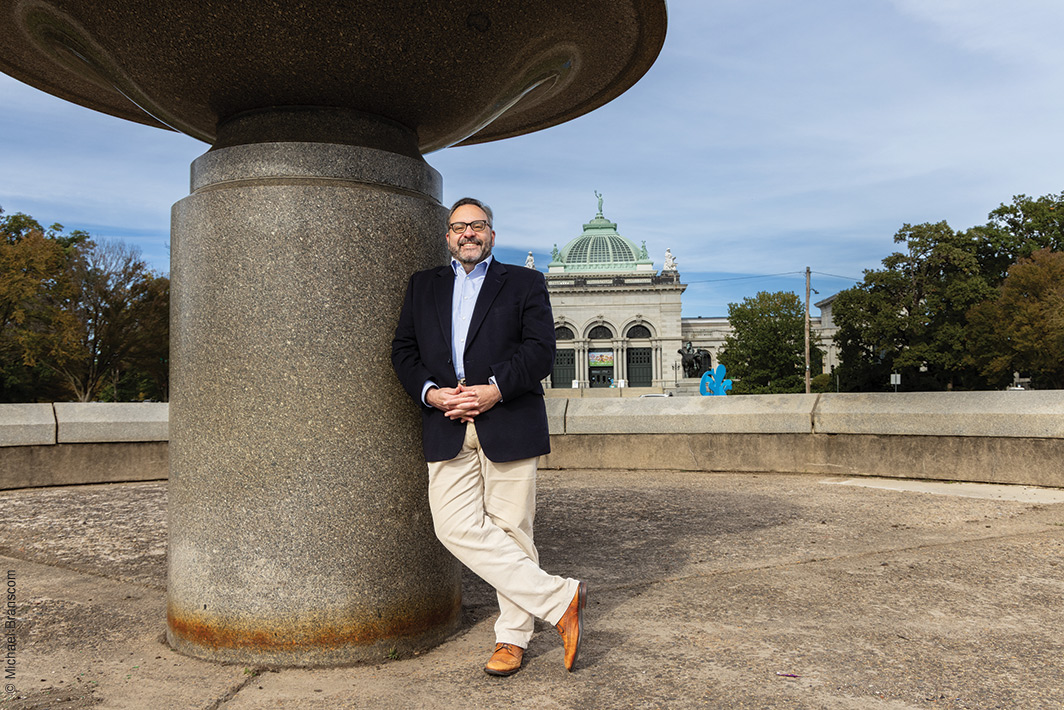
A former Penn administrator now champions Philadelphia’s green spaces.
After working at Penn for 25 years, the last nine as the associate vice president in the University’s Office of the Executive Vice President, Tony Sorrentino GCP’05 found himself at a crossroads.
“I turned 55 years old when I hit my 25th anniversary. Turning double nickels is a big deal, and being in a place for 25 years is also a big deal,” he says. “I wondered if I had something in me to contribute professionally to the city at a bigger level.”
In October 2025, Sorrentino joined the Fairmount Park Conservancy as its CEO. The nonprofit organization, which was founded in 1998, operates as part of a public-private partnership with the city of Philadelphia to protect and maintain the city’s 10,200 acres of parks. It also leads and fundraises for capital projects and organizes events and programs for the public. The organization is based in West Fairmount Park in a Gothic Revival-style building known as the Ohio House, constructed for the 1876 Centennial International Exhibition to house that state’s exhibit.
Sorrentino has played significant roles in Philadelphia’s civic life on and off campus. He joined Penn in 2000 as the manager of economic development in Penn’s Division of Business Services and earned a master’s degree in city planning from the Weitzman School of Design in 2005. Over the course of his Penn career, much of his work focused on urban policy, economic development, and community relations. He helped Penn launch various initiatives including the technology incubator Pennovation Works, the 30-year campus development plan Penn Connects, and an online repository of information about the University’s community partnerships called Penn & Philly [“Gazetteer,” May|Jun 2024].
He’s also served on the boards of several major Philadelphia civic organizations and authored the upcoming book Medicine for the City, which details how a city’s academic medical districts can drive economic growth, with Philadelphia as a case study.
“I wasn’t leaving Penn to go work for another university,” he says. “I was wrapping up a 25-year university career to see if the lessons I learned there could be applicable at something citywide. I thought this was an opportunity that I should probably not pass up—the universe might be talking to me.”
Philadelphia’s park system includes East and West Fairmount Park, “one of the largest contiguous pieces of [urban] parkland in the nation,” Sorrentino notes. His purview also encompasses FDR Park, Cobbs Creek Park, and 140 neighborhood parks. As head of the Fairmount Park Conservancy, Sorrentino directs initiatives that have a lasting community impact, from supporting major city events, to running popular neighborhood programs, to helping make the city’s environment more resilient in the face of climate change.
During this summer’s FIFA World Cup, the city staged a bustling fan festival at Lemon Hill in East Fairmount Park that featured giant screens broadcasting the games, along with concerts, interactive games, and food and beverages. In advance of the festival, Sorrentino spearheaded a five-week cleanup of the area powered by volunteers and funded by Comcast.
The FIFA fan festival gave Sorrentino the opportunity to wander the Lemon Hill and Boathouse Row area, engaging with visitors from around the country and the world. “People would say, My god, if we had this in our city, it would be unreal. To have a riverbank with these boathouses and watching people do crew,” he recalls. “And I realized that maybe there are times we take such things for granted. Outsiders can give you a new perspective.”
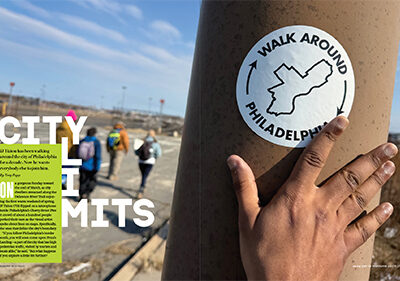
Philadelphia’s parks also connect people on a day-to-day basis. We Walk PHL is a nearly-decade-old free walking group launched by the Fairmount Park Conservancy and the city to encourage people to pursue fitness goals and get to know their neighbors in city parks. The program “makes the city healthier and better,” Sorrentino says, noting that people’s “quality of life goes up and, ultimately, it’s a public good.”
At the same time, Sorrentino oversees the Fairmount Park Conservancy’s role in helping offset the effects of climate change on the city. The organization is charged with transforming a 33-acre corner of FDR Park in South Philly into a tidal wetland. The area’s redevelopment plan, the city’s first park project to incorporate climate change projections, is designed to mitigate chronic flooding problems and provide a new wildlife habitat.
“I think that there’s plenty of time for us to make public policy decisions and use our land in thoughtful ways to push back on, or at least give us an opportunity to reduce, the impact that climate change is having on the population,” he says. “I think an economic reason for parks to exist has to do with helping reduce climate change.”
Sorrentino’s wide-ranging interest in his hometown’s civic life grew out of formative childhood experiences. When he was about 12 years old, his family moved from West Philadelphia to a nearby suburb, where they discovered their new neighborhood’s school was closing.
“My mom, who had a high school degree and was a housewife with three children, took it upon herself to lead a campaign to save the school,” Sorrentino says. “She didn’t know anybody and she didn’t have any social or political capital.” He often accompanied his mother as she went door to door talking to people about the school and what they cared about. The campaign saved the school and Sorrentino’s mother subsequently ran for a seat on the school board, which she held for more than two decades.
Sorrentino’s father managed pharmacy departments at several Philadelphia hospitals and taught pharmacy students in clinical training. “He could have made a lot more money doing other things in the pharmaceutical industry. But he liked being in a clinical setting and he liked helping people,” Sorrentino notes.
“So, that’s what we talked about at the dinner table—public schools and public health,” he adds. “And it stuck with me. I decided at an early age that I wanted to participate in that somehow.”
One of Sorrentino’s favorite areas in the city’s park system is Welsh Fountain Gardens in West Fairmount Park, near the Fairmount Park Conservancy’s headquarters. Built in 1887 to memorialize the city’s 1876 Centennial Exhibition—and honor its finance board chair John Welsh—the historic space embodies both the past and future of Philadelphia’s parks. The landmark fountain hasn’t flowed since the 1970s and the area has fallen off in popularity despite its location near attractions such as the Please Touch Museum and the Shofuso Japanese Cultural Center.
Plans led by the Fairmount Park Conservancy are under way to restore the fountain, add seating, and plant shade trees, all practical measures that serve the larger goals of revitalizing the public space as a connected social hub and increasing the area’s climate resilience.
The project also represents a simpler objective. “It’s about how you program parks that make people feel invited,” Sorrentino says, “and how you create a place that people want to be.”
—Samantha Drake CGS’06