Thanks to a last-minute audible, a passionate broadcaster marks 45 years calling Penn football games.
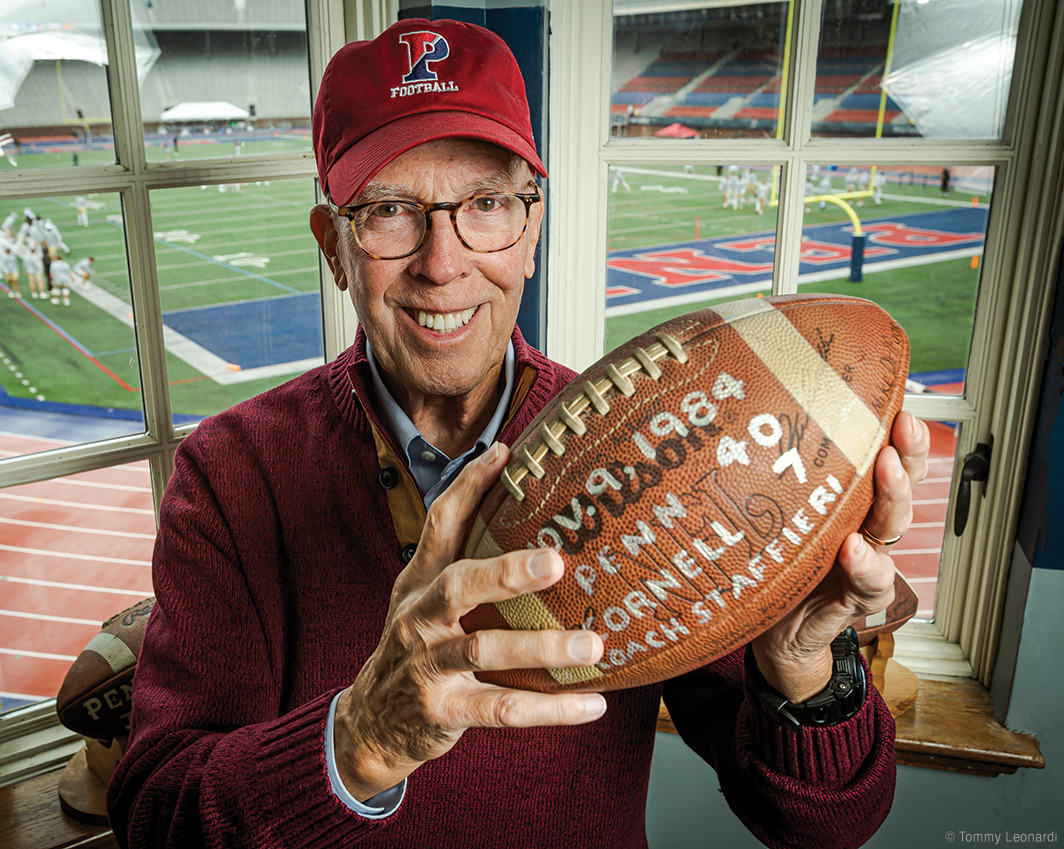
Less than three weeks before the start of Penn football’s 150th season, John “Hench” Murray C’66 GEd’67 ambled around Franklin Field, spotting construction work under way in the press box that had become his second home every fall.
Eager to talk about his upcoming 45th year calling Penn football games, he settled into a window table at a student-athlete fueling station, one of the newer upgrades to the still-evolving 131-year-old stadium.
His broadcasting journey, he told me then, had been fortuitous and unexpected. Little did he know it was about to take another twist.
Not long after our first chat, Murray learned that Penn would be ending its audio broadcasts and only maintaining the television ones that stream on ESPN+. At nearly 82, the longtime radio voice of the Quakers thought he’d be out of a gig, lamenting that “Saturdays will not be the same.”
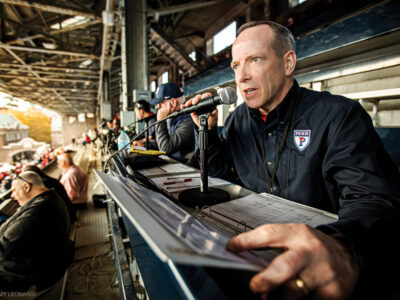
But then, just days before the start of the season, he received an invitation to join Penn’s TV announcers Joe Tordy and Joe Valerio C’97 G’07 in the broadcast booth for three home games—meaning Murray would get to hit the 45-year milestone after all. Or, as he put it in an email to friends, “Not dead yet!”
For Matt Leon and Brian Seltzer C’07, who combined to serve as Murray’s broadcast partner for the better part of the last 20 years, the news was as exciting as any last-minute Quaker comeback. “He loves Penn football with the passion of 1,000 suns,” says Leon, a KYW Newsradio veteran who until this year had moonlighted as a Penn football and basketball play-by-play broadcaster. “He loves the program, loves everybody associated with it, loves to watch film.” Seltzer—who’s also at KYW after previously working as Penn’s play-by-play voice and then as a digital content manager for the Philadelphia 76ers—agrees that Murray’s love for Penn football is unmatched. He also called him the “kindest, gentlest, wholesome soul” who has remained sharp in his analysis even after five decades in a headset. “I don’t think there’s anything else he’d rather be doing on a Saturday in the fall,” Seltzer says.
Once upon a time, Murray didn’t even want the job—though he always enjoyed football. He began coming to Franklin Field as a kid because his father Donald Murray W’37 G’40 Gr’44 only worked a couple of blocks away, first as a statistics professor and then in University administration. Murray’s older brother, Robert Murray C’63 WG’71, had followed their dad to Penn, where he played sprint football and baseball. (He later coached both teams and worked in sports information before getting into banking.)
For Hench, attending Penn may have seemed like a foregone conclusion but he had a “really good time” once he got there. He played on the freshman basketball team, where in practice he was tasked with defending classmate Stan Pawlak C’66, who’d go on to become one of the all-time great Penn basketball players and a color commentator (for Quaker hoops games) himself. Murray also played on the baseball and sprint football teams, enjoyed Delta Tau Delta fraternity parties, and “toyed with the idea of being a doctor” before deciding he was better suited to major in English than biology.
After graduating, he took a year at Penn’s Graduate School of Education before landing a job as an English teacher at Philadelphia’s William Penn Charter School, which had been his fierce rival when he attended and played football at Germantown Academy. Murray began coaching football at Penn Charter, initially working with head coach Ray Dooney W’50, a former Penn football star. But when Dooney left after the 1969 season, Murray became the head coach of the storied high school program, at just 25 years old. “It was a learning experience,” says Murray, but he amassed an impressive 45–23 record there from 1970 to 1977.
At that point, he began to harbor ambitions of coaching college ball. But he was cured of that idea when a University of Virginia assistant, who was recruiting one of his Penn Charter players, called him on Thanksgiving, while on a recruiting trip in Montana. “I said, I don’t want to be in Montana for Thanksgiving, ever,” recalls Murray, who instead pivoted to another one of his dreams: running a school.
In 1981, he became the head of Woodlynde School on Philadelphia’s Main Line, introducing a number of programs to boost enrollment and establish it as a leader in instruction for students with learning disabilities. (He stayed there until 1995, and after a number of other jobs, returned to helm the school from 2005 to 2009.)
That same year—1981—marked the beginning of another, more surprising, new career. According to Murray, his friend Bernie Zbrzeznj W’70, a former Penn quarterback, was supposed to call Penn football games on the radio for the 1981 season but bailed out when his wife got pregnant. He asked Murray to do it multiple times, and Murray repeatedly said no. “I didn’t really want to make a fool of myself,” Murray says. But Zbrzeznj had apparently already told the play-by-play man Joe Eichhorn that Murray would take on the role of color commentator, so by the time the season rolled around in September, Murray had little choice but to slide into the broadcast booth. “It’s worked out all right,” says Murray, who remains close with Zbrzeznj.
In 1981, the Quakers sputtered to a 1–9 record and “I was nervous the whole season,” recalls Murray. “Sometimes the words come out the way you want them to. But sometimes they don’t.” He still got a great thrill in his first game when a 93-yard touchdown catch by Karl Hall C’84 highlighted a 29–22 Penn win over Cornell.
The excitement level ballooned the following year. With the NFL on strike, Philadelphia Eagles radio announcing legend Merrill Reese was brought in to call Penn games. “Now I was really nervous because that was the big time,” says Murray, Reese’s partner in the booth during a season that would become one of the most iconic ones in program history. In their final home contest of the 1982 campaign, the Quakers defeated Harvard to capture a piece of their first Ivy League title in 23 years. The game was especially memorable because Dave Shulman W’84 had two chances to make the game-winning field goal, missing the first but getting a reprieve with no time left on the clock after a Harvard penalty [“Old Penn,” Nov|Dec 2022]. If you watch footage of the game, which is available on YouTube, you’ll mostly hear Reese’s booming voice. But Murray jumps in with a well-timed tablesetter before Shulman’s final kick: “Absolutely unbelievable. No time left on the clock. Here comes the kicking team back on the field. It’s one shot for the championship.”
For the next several decades, Murray continued to make an art of knowing just the right time to offer his commentary and not step on the play-by-play broadcaster’s toes. “He understood the flow of the broadcast,” Leon says. “We immediately picked up on each other’s rhythms.” He was always mild-mannered, adds Seltzer, as well as “completely egoless, and 100 percent respectful of letting the play be described before coming in with his analysis.”
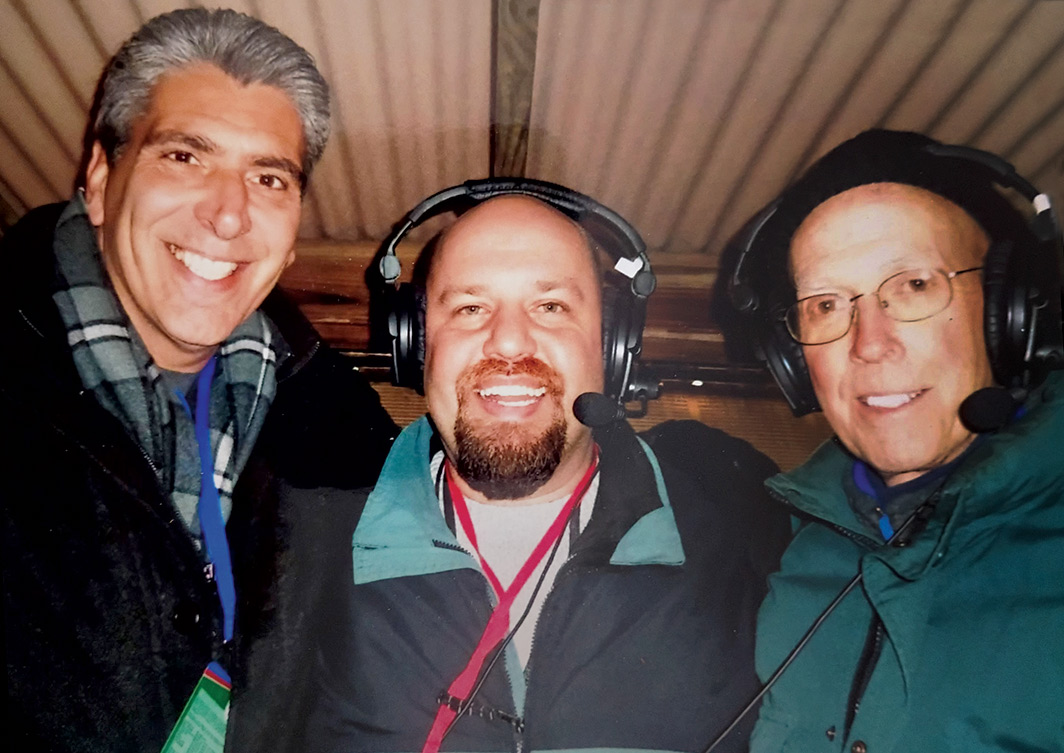
Yet Murray occasionally let himself be heard in the background of play calls. “There were just these utterances and noises that would come out of his mouth, good and bad,” laughs Seltzer. “If it was a great play, you might hear a yip or a hand clap, or something really subtle. It never disrupted the call, and I loved those moments because I think it just captured the essence of his love and passion for the program.” Leon fondly recalls Murray “whooping and hitting the table” when Penn closed the 2022 season with a dramatic last-second win at Princeton. “It makes the call exquisite because it’s just the natural emotion that he’s letting out. And then I look over and he’s wiping his eyes, crying from excitement and how happy he is by beating Princeton and the way they beat them.”
While Murray’s broadcasting and love for Penn football remained steadfast, changes were happening all around him. Penn’s broadcasts moved from WXPN to several other lower-wattage AM stations over the years until finally shifting to digital streaming only in 2019. Whereas at one time Penn football fans not at the game needed to tune in to the radio to keep tabs on the Quakers, redundancies were created with the rise of TV streaming as Penn Athletics began producing games for the Ivy League Network and then ESPN+. In the past they’d have a producer or engineer on site to help, Leon says, but in recent years it was “basically just the two of us” lugging up all the equipment and calling the streaming company to make sure everything was working properly. They were told that operational changes involving the streaming distributor led to the sunsetting of the Quaker Audio Network this year.
Murray figured he was nearing the end of his career anyway. Over the last few years, the climb up to the “rickety” press box hanging under Franklin Field’s upper deck had become harder, and it was even more onerous at Harvard Stadium with “no rails and no elevator,” Murray says. The games played in especially cold weather were never fun. Neither were some of the long road trips to New England, when he took the team bus.
But he still loved it, especially watching game film and meeting with the Penn head coach each week to discuss the previous and upcoming games. “You get to a point where your life slows down,” says Murray, who lives in a retirement community in the Philadelphia suburbs with his wife. “One of the good things about doing the games is that my life never slows down in the fall.”
And so, on September 26, Murray braved a weekend nor’easter and stepped inside a soggy Franklin Field for Penn’s 2026 home opener against Lehigh. Because space constraints prevented a three-man booth setup, Murray filled in for Valerio for the third quarter only. Tordy announced the switch to TV viewers after halftime, introducing Murray as a “legend and an institution on the Penn football radio broadcasts.” Murray thanked him, “because I was kind of feeling left out.” And then, just as he’s done for 45 years, he dug into his deep well of football knowledge to smartly analyze each play, quickly adapting to a new broadcast partner and some of the subtle changes moving from radio to TV (like a producer talking through the headset). Not even the awful weather, two Lehigh touchdowns that quarter, and an eventual 20–7 Penn loss could dampen his emotions.
“To still be entertaining and fun to listen to and informative after 45 years,” Leon says, “is even more impressive than the longevity itself.”
Although only calling parts of three home games and not traveling for road contests is a far lighter workload than he’s used to, Murray still feels lucky to hit 45 years—“not quite a round number, but it’s close,” he says. And, with his retirement from broadcasting on the horizon, he’s grateful that Penn allowed him to be able to go out on his own terms.
“One of the things I really admire about Hench is you know this really matters to him,” Seltzer says. “Are there going to be people to whom this all means as much as it did for people like Hench?”
“I think I got the best of it, honestly,” Murray says, reflecting on how his second career in broadcasting allowed him to get a close-up view of a sport he loves and a team he wants so badly to win. “I’ve felt honored to be able to do it.” —DZ