Facing a rare brain tumor, a mother of two is advocating for better care while finding joy in everyday moments.
On January 31, 2020, Sundas Hashmi C’05 EAS’05 was in her kitchen frying shrimp spring rolls for her daughter’s birthday party when she started feeling off. Two days later she woke up in the hospital with no memory of the previous 48 hours. Doctors told her she’d had a grand mal seizure. “Fortunately my nanny found me, or the house would have burned down,” she says.
At 37, with two children ages two and six, she was diagnosed with oligodendroglioma, an incurable brain cancer. It was devastating but not entirely surprising. “Twenty years ago my brother had also died of brain cancer,” she says, “so somehow it was always in the back of my mind that one day it was going to come for me too.” In the past she had even gone to doctors and demanded MRIs after having headaches. “One just told me I wasn’t sleeping enough,” she says.
Two weeks later, she underwent a brain surgery known as an awake craniotomy, in which the patient remains conscious so surgeons can monitor brain function in real time. “They keep asking you questions, and they get more difficult. Or they tell you to move your arm or your leg, so they know the moment you can’t do that anymore is when they need to stop,” she explains. The surgical team removed 95 percent of her tumor.
Unlike her brother’s aggressive cancer, Hashmi had a more slow-growing and treatable type of tumor. She opted not to undergo radiation and chemotherapy that could affect her cognitive skills in the long term. Instead, she decided to take a medicine for the rest of her life that would make her feel fatigued and affect her short-term memory. “Cognitively, I’m only operating at 75–80 percent,” she says.
Over the past six years, she has not just adjusted to this new reality but written about it publicly, with poignant pieces in the Washington Post and New York Times. Her goal is to advocate for more funding for her type of brain cancer, as well as share how she’s learned to appreciate small moments of beauty amidst adversity and grief. The funny part, she adds, is that before her diagnosis she hated writing. “I spent my college years avoiding writing classes.”
Hashmi, who grew up in Pakistan, describes her childhood as rough, mostly because of her brother’s illness. “He was diagnosed when I was 13 and passed away when I was 15,” she says. “Because of the culture in Pakistan, nobody spoke about it. They just wanted to bury it, and that was the message I was given: don’t speak about it, don’t say anything.” She was expected to keep her head down, work hard in school, and get good grades—which she did. (Doctors have told her there’s no known genetic link for brain cancer, meaning her brother’s diagnosis and her own could be a devastating coincidence.)
Itching to leave home, she applied to Penn because a friend’s brother had gone there. “I thought I had zero chance of getting into any school in America,” she says. But she did get in, with financial aid.
When she arrived on campus in 2001, she had never set foot outside Pakistan. What she found stunned her. “Everything was just so big: the buildings, the campus, even the trees,” she says.
She eventually found her footing, making friends in the Quad her freshman year and joining the Pakistani Students Association.
She studied engineering, a path her mother steered her toward as a more practical alternative to medicine. “In Pakistan, everybody wants their kid to be either a doctor or an engineer,” she says. “But medicine was such a long path.” She enjoyed her engineering classes but loved her economics courses even more. “It was like a magic experience, a break from engineering, where my brain was so fried.”
After graduation, Hashmi went into investment banking in New York but lasted only a year and a half, finding the pace “too intense” and the culture “very aggressive.” She moved to a multi-family office managing wealth for a handful of clients and later became director of research for the Rattner family office, a New York investment fund founded by Steven Rattner, an investor and media commentator who serves as the economic analyst on MSNBC’s Morning Joe. Alongside investment work, she became his fact-checker and researcher—which helped to prepare her for the writing she does today.
She left that job after her son was born in 2017, when the round-the-clock professional demands became incompatible with raising a newborn. She stayed out of the workforce until after her second child was born, and was in the middle of a job search when her diagnosis came.
After brain surgery at Memorial Sloan Kettering Cancer Center, she couldn’t speak and didn’t know the date or who the president was. She had no short-term memory and couldn’t hold a glass of water or a spoon. Only sounds came out of her mouth, no words anyone could understand. Over time her symptoms improved, and six months later she could speak again.
Short-term memory remains her main obstacle; she relies on sticky notes and repetition tricks. A drug she takes to manage the tumor causes significant fatigue.
It took her a few years to tell her children about her diagnosis. “My son was seven when I told him. He listened very carefully, and then he went back to his toys,” she says. Telling her daughter, at age 11, was harder. “I did it on a walk to Sephora, which is her favorite place. She just wanted to know if I could die.”
Hashmi reluctantly started therapy for her mental health after her neurosurgeon strongly recommended it. “When I first met her, I told her, ‘I don’t need a therapist. We’re from Pakistan. We’re strong people,’” she remembers. Her therapist encouraged her to start writing about her experience. She also volunteers with a glioblastoma advocacy nonprofit, traveling to Washington to lobby for research funding—which is difficult since the disease is rare and competes poorly for attention against more common and thus better-funded cancers.
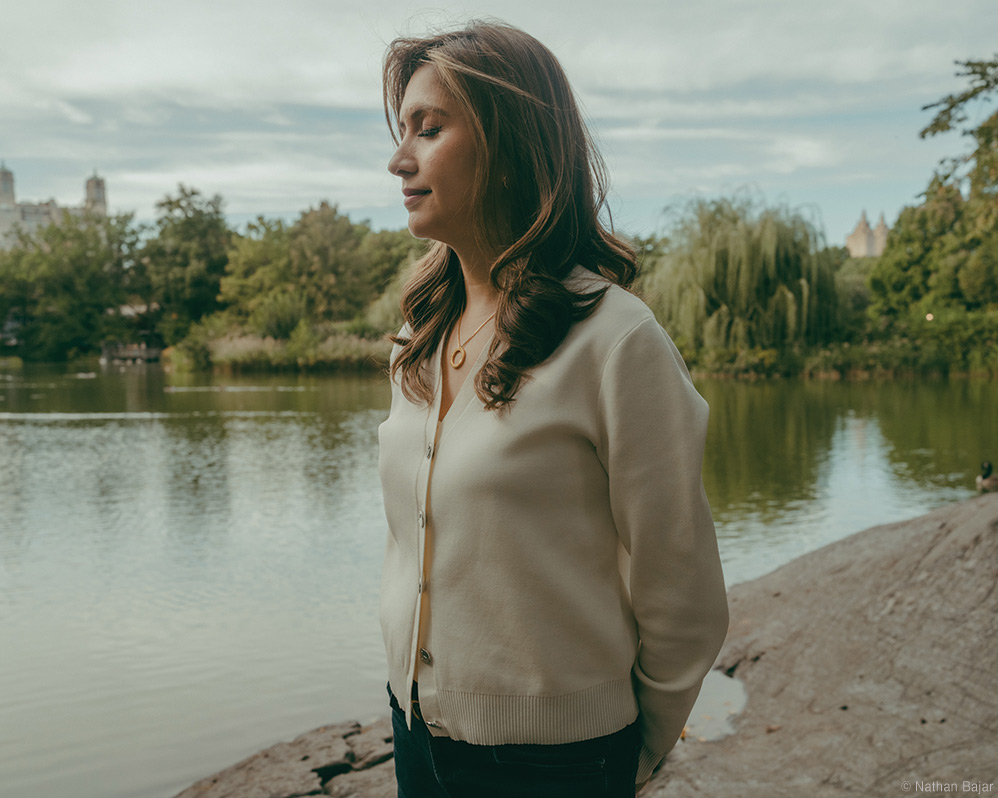
Meanwhile, Hashmi spends much of her day enjoying the small things: walks in Central Park with her husband, playing squash with her son three times a week, watching Pakistani dramas with her daughter in the evening. She’s taken up birding, using an app that identifies bird sounds in the park. “Before all of this, I would have never even looked up at the sky,” she says. “Now everything is completely different.”
—Alyson Krueger C’07