Melding the future and the past of a historic Philadelphia corridor.
It’s the mid-1850s and in the middle of Philadelphia’s Market Street dozens of produce, fish, and meat vendors hawk their comestibles in a series of covered sheds that run west to Broad Street. Midsize row buildings that stand cheek-by-jowl along the sidewalks beckon buyers with signs announcing the sale of carpets and cigars, seeds and shoes.
By the 1890s, the scene has changed and huge, newfangled department stores dominate Market Street’s retail landscape. Horsedrawn carriages, trolleys, and pedestrians clog the streets. Money is changing hands at a furious pace.
In the 1970s, a new kind of commerce enters the picture. It’s called The Gallery, an urban riposte to suburban malls. Neither as chaotic as the covered sheds nor as elegant as Europe’s shopping arcades, it entices consumers off the street and indoors to peruse the wares of national chains.
Today, too many of the small storefronts of yesteryear stand vacant, while the magnificent retail palaces that still exist have been converted into offices and apartments. Even the mall has been retooled; now called The Fashion District, it leans more on entertainment spaces than retail ones.
It’s no secret that Market Street has been a place of abandonment and decline for some time now. And so, last fall, a cadre of architecture, historic preservation, and city planning students at Penn’s Weitzman School of Design joined an ongoing discussion that’s got everyone from the mayor’s office to ambitious developers dreaming about reviving what was once the city’s premier shopping district.
Engaging in a multidisciplinary investigation of the site and its issues, the students proposed out-of-the-(big)-box remedies and unveiled pie-in-the-sky visions. Then this summer, a few loosely connected and more tangible projects evolved from these studios.
First among them is Meantime on Market, an intervention born of a partnership between the City of Philadelphia, Center City District, and local property owners. Launched in May, the effort marked the latest effort from Meantime, a nonprofit arm of the Philadelphia-based architecture firm ISA, which matches local businesses with unrented storefronts.
“The thinking is, if we don’t know what to do with the area, why don’t we at least try a temporary fix?” says Brian Phillips GAr’96, the head of Meantime, a founding principal of ISA, and a Weitzman School lecturer. “While an owner waits for a traditional tenant, Meantime will come in and do its thing, typically for 30 days, though we’ve even done one week. Market Street has been our largest and longest activation.”
The overarching idea is that pop-ups can help the street and the building look viable and vital; in return, Meantime asks that owners forego collecting rent. Empty storefronts force a “public good kind of discussion,” Phillips says. “They benefit no one—not landlords, not citizens, and not the many small businesses looking for affordable leases. We think that storefronts belong to the community. They’re not private property in the way that apartments and offices are.”
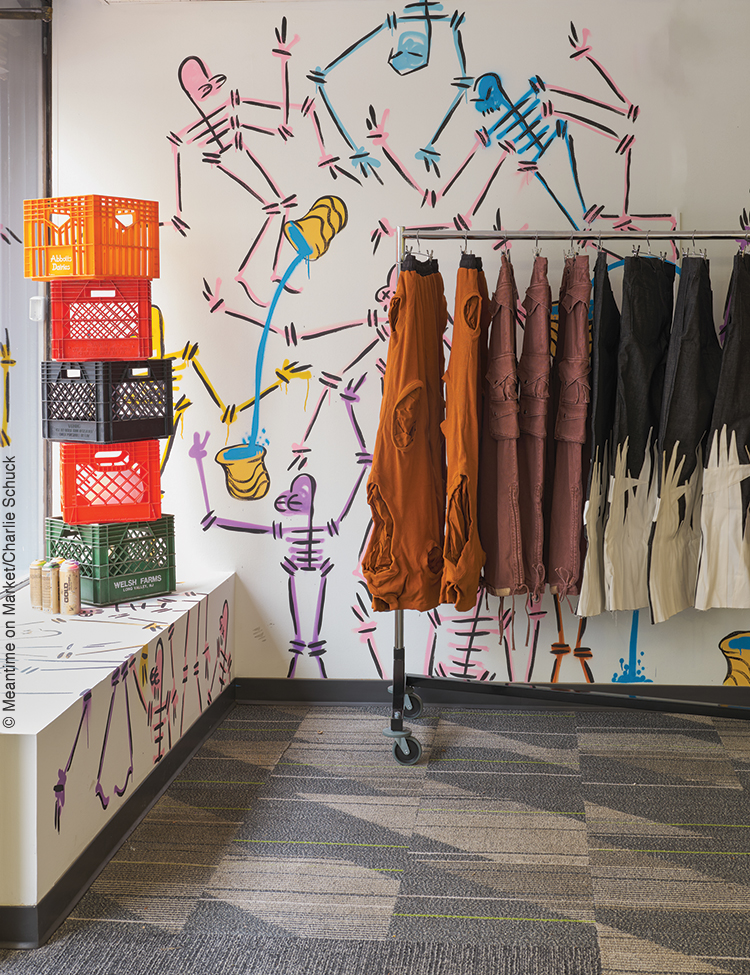
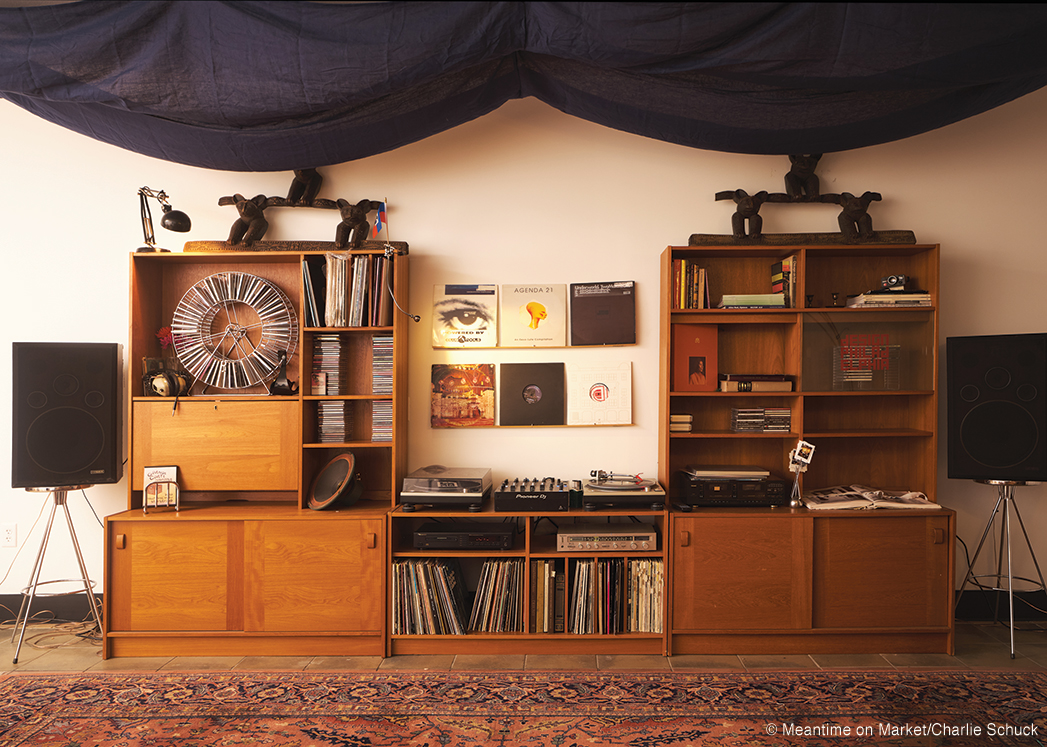
Handpicked by Phillips, who knew some of the business owners personally, the original set of pop-ups on the south side of the 900 block of Market included offshoots of Two Persons coffee shop, Rarify mid-century furniture, and Siddiq’s, the beloved West Philly water ice shop, as well as outlets for creative businesses without permanent homes, like Almost Famous (vintage clothing), Clubfriends Radio & Records (a listening room), and Art Philly (a storytelling hub). Later in the summer, the project expanded with the opening of an outlet from independent bookseller Harriet’s in an empty storefront across the street and the Immigrant Marche, a marketplace of goods made by artisan immigrants, around the corner. “We were looking for diversity in all ways, but also I wanted people who were going to bring game,” says Phillips. “These businesses were excited by the idea and up for pulling it off.”
Also part of the mix was a storefront curated by PennPraxis, the clinical arm of Weitzman, which installed an exhibition prepared by lecturer Ashley Hahn GCP’08 GFA’08. Hahn combined findings from historic preservation students with her own research and presented the material in digestible chunks that brought Market East’s past to life while subtly informing its possible futures.
“There was a graphic component to the research that we wanted to highlight,” Hahn says. Sifting through watercolors, prints, photos, maps, signage, and newspaper articles, she also produced an accompanying 20-page zine Meet Market, which delves deeper into the Market East corridor through themes like centrality (geographical and metaphorical), celebration (all those parades!), commerce (it’s there in the name), and cycles of reinvention. “We also looked at the history of preservation itself,” she adds. “Examining, say, the Thomas Jefferson House, which was a reconstruction, or the Lit Brothers restoration, which was made possible by historic tax credits, helps us see how preservation approaches have changed over time. Like Meantime on Market itself, the zine is meant to provoke curiosity and to encourage a view of the street that stretches beyond what you see there now.”
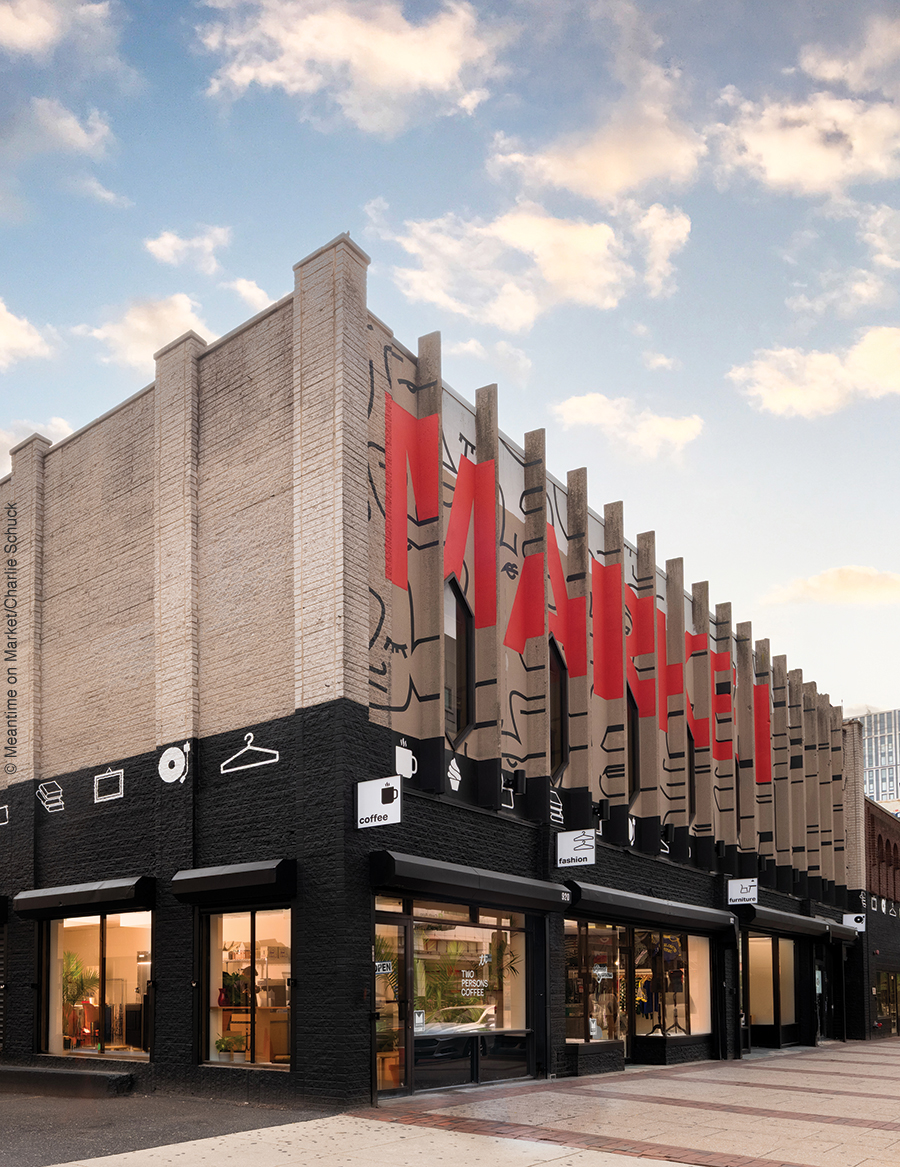
The original seven pop-ups were part of a parcel recently purchased by Comcast and HBSE (the company founded by Joshua Harris W’86 and David Blitzer W’91 which owns the Philadelphia 76ers and other sports franchises). Not long after these real estate partners pulled out of a contested mixed-use development that included an arena for the Sixers, the city announced a $1.85 million investment to spruce up the strip all the way to City Hall in anticipation of a summer of converging events, including the World Cup, Major League Baseball’s All-Star Game, and America’s 250th birthday bash. The beautification included dozens of newly planted trees, newly painted murals, and refurbished street furniture like bus shelters and light poles. The retail pop-ups were built out by ISA in less than two months and received a unifying coat of black exterior paint, branded black signs with white lettering marked “Coffee” or “Music” or “Books,” and a bold, vaguely mid-century-modern style mural.
Freed from rent pressures, the businesses often used their spaces as branding or to stage participatory and community-oriented events like coffee tastings or listening parties. During this summer’s extremely hot weather and the distractions of semiquincentennial celebrations and watch parties, store hours were spotty. But Phillips contends that “Meantime on Market is a demonstration project more than a real estate one,” and that just “getting this up and running at all was a success.”
“And if it changes some of the trajectory of the planning process for this area, that’s a success,” he says. “When someone says to me, I walk on this side of the street now, I don’t know how that can be measured. But it sticks with me because it’s so revealing. Philly is one of the great physically connected, dense, walkable places in America and we all have our pathways. This is partly about rewiring them.”
As this case study continues on its own path—originally targeted to run from May until the end of July, the project was recently extended through the rest of the year—Phillips and the other partners are “really immersed in all of the big questions that Meantime on Market is asking,” he says. “It touches on ideas of commerce, community, and equity. So far, the lesson learned is that there’s going to be a ton of lessons learned.”
—JoAnn Greco