Irvine Auditorium’s historic Curtis Organ is marking its centennial anniversary.
One hundred years ago, the third-largest pipe organ in the world at the time made its debut at the Sesquicentennial International Exposition in Philadelphia, a world’s fair commemorating the 150th anniversary of the signing of the Declaration of Independence. Thanks to Philly-based publisher and philanthropist Cyrus H. K. Curtis, the instrument, commonly known as the Curtis Organ, has become a touchstone at the University of Pennsylvania.
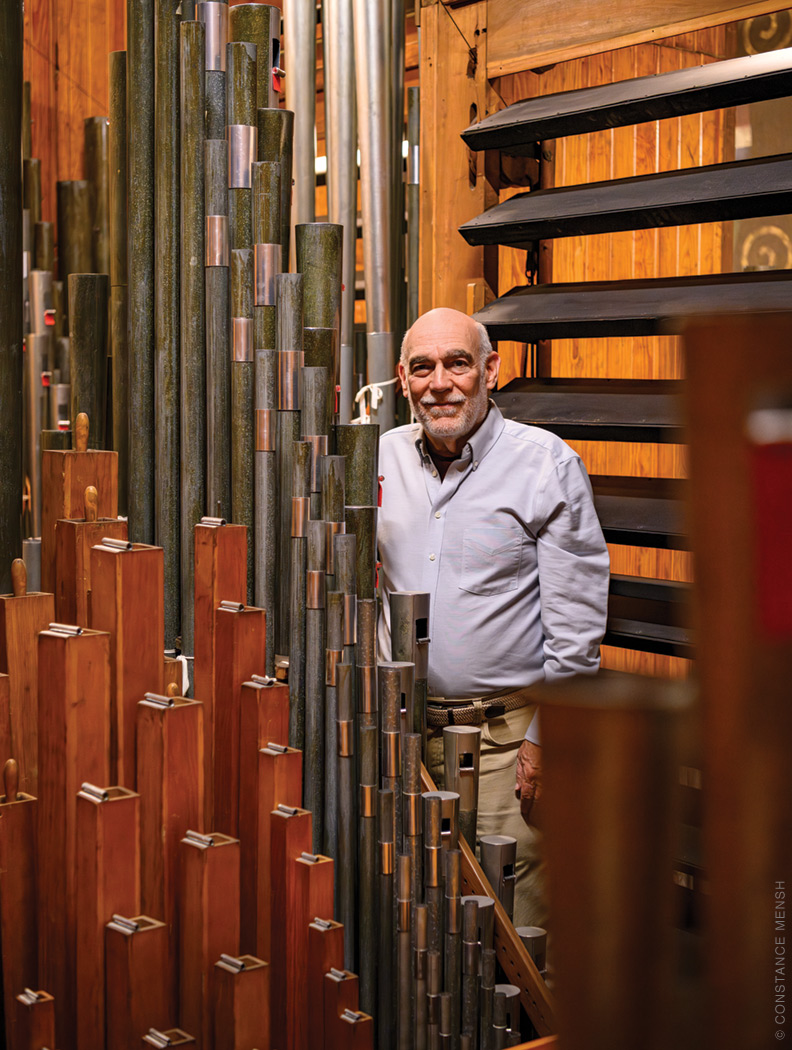
“It’s part of the University’s legacy and a tie to the earlier part of the last century when Penn was expanding tremendously,” says Max King, Penn’s former associate vice provost for health and academic services who in the 1990s became the organ’s curator at the request of then-Provost Robert L. Barchi Gr’72 M’72 GM’73.
Massive pipe organs were often built for exhibitions in the late 19th and early 20th centuries to entertain attendees, and the pricey instruments were later sold. For example, Philadelphia’s Wanamaker Grand Court Organ, the largest fully operational organ in the world, was built for the 1904 St. Louis World’s Fair and purchased by retailer John Wanamaker for his first department store in Philly, where it’s remained for the last 115 years [“Profiles,” Sep|Oct 2025].
But the six-month-long 1926 Sesquicentennial Exposition held in South Philadelphia was marred by a funding shortfall, political tensions between city and state elected officials, and low attendance due, in part, to frequent rain [“Old Penn,” Jan|Feb 2026]. Forced into a receivership in 1927, the exposition organizers put its assets up for auction. The organizers’ money woes allowed Curtis, publisher of The Saturday Evening Post and The Ladies’ Home Journal, to buy the organ for a fraction of the $150,000 cost to build it.
Curtis donated the organ to Penn for its new Irvine Auditorium, then under construction. Because very large organs’ extensive inner workings must be embedded in the building housing them, parts of Irvine Auditorium had to be redesigned to accommodate the instrument. Structural changes made before the building’s completion in 1928 included removing certain balcony seating and building a wooden superstructure to install the organ’s pipe chambers and its unusually large windchest, which contains the air that is channeled to the pipes, King says. “The Curtis Organ is one of the few where you can enter the windchest and see the nearly 50,000 moving parts in action while the organ plays,” he points out.
Powered by a system of electropneumatic mechanics, the Curtis Organ is one of the largest and most complicated musical instruments in the world, though it has slipped from third place in terms of size to somewhere between 10th and 20th place, depending on how size is defined, King explains. The Curtis Organ has 10,731 pipes; the largest is 36 feet tall and the smallest is the size of a person’s pinky finger.
Over the next several decades after its move to Penn, the Curtis Organ became an important part of the University’s academic and musical life. The Curtis Organ Restoration Society, established by Penn students, staff, faculty, alumni, and friends in 1973, raised funds to repair the organ after it had deteriorated so much that it couldn’t be played. In 1988, the Organ Historical Society of America recognized the Curtis Organ as a historically significant pipe organ. However, by the late 1990s, the Curtis Organ needed a full overhaul, which took two years, and included shipping some parts back to the manufacturer for refurbishing and repair.
Although King retired in 2019 after 23 years at Penn, he comes to Irvine Auditorium several times a month to help maintain the Curtis Organ and give tours of the instrument. Part of his work includes hunting for pipes that emit notes or other sounds out of the blue, a malfunction usually caused by dirt or other debris stuck in a pipe valve. “Because there’s 10,000 pipes, the question becomes, where is it?” says King, who once took three months to locate a pipe that was making an odd thumping sound, in a section that could only be accessed by crawling. The culprit turned out to be a penny, possibly dropped by a worker reinstalling the pipe.
Although King plays the saxophone, he has a deep appreciation for the sound of a pipe organ. “When you’re listening to a pipe organ, you are experiencing the sound, you’re not just hearing it,” he says. “I’m a jazz musician and I listen to jazz recordings all the time. But I’ll only listen to a pipe organ if I can do it live, because the sound is just so all-encompassing.”
When all the stops are pulled out—meaning when every knob on the organ’s console is engaged to push air into every pipe to create the fullest possible sound—the Curtis Organ can make Irvine Auditorium rumble with music. It’s no wonder that pushing a pipe organ to its greatest power has come to mean “making the absolute maximum effort.” There’s also a nostalgia factor. Many people have grown up hearing organs in church or at a theater. “Pipe organs give you an entirely different experience, but you may not get that experience much anymore,” King says.
Irvine Auditorium currently hosts two or three Curtis Organ concerts a year, but King doesn’t think that’s enough to raise awareness on campus about the historic instrument. “The building is heavily used by all kinds of student organizations,” he says, “but many students never get to hear it.”
—Samantha Drake CGS’06