
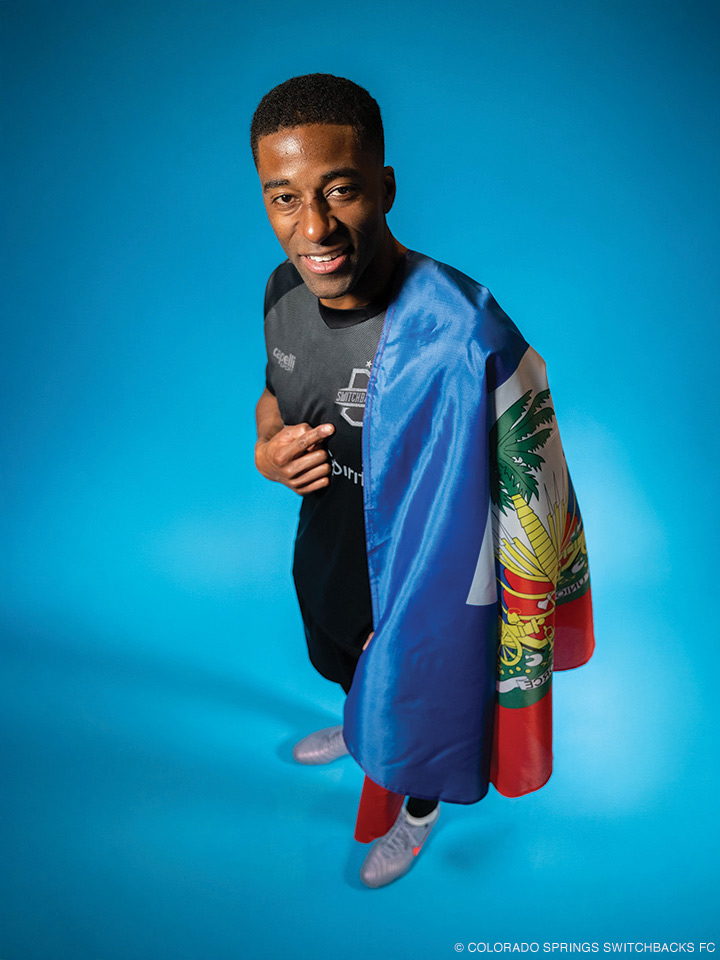
This former Penn soccer star has never been to the Caribbean country that he helped lead to this summer’s World Cup.
Duke Lacroix C’15 thought the moment he experienced on June 13, 2023, might never happen—not just because he was making his international soccer debut at the age of 29, for a country he had never set foot in, but for the myriad obstacles on the journey there.
And he hardly dared to dream that two years after first appearing for the Haitian national team, he’d play a key role in navigating the Caribbean nation back to the FIFA World Cup for the first time since 1974 and just the second time ever.
“I couldn’t have written it better myself,” Lacroix says. “It’s incredible. I’m extremely grateful to be representing Haiti and have this opportunity this summer.”
It took Lacroix a decade of grinding it out in the uncertain world of minor league soccer to find his way to the national team. An all-Ivy standout at Penn who graduated with the fifth most points in program history, the 32-year-old has carved out a reputation as a trustworthy defender in cities like Indianapolis, Reno, Charlotte, Sacramento, and now Colorado Springs.
He was first approached by the Haitian Football Federation in 2019. The governing body for soccer in the Western Hemisphere’s poorest country casts a wide net for members of the diaspora who might be eligible. Lacroix, who was raised in New Jersey, expressed interest, but his passport application stalled at the onset of the COVID-19 pandemic. “I just thought my stuff probably fell through the cracks,” Lacroix says. “At that point, I was like, Oh man, this probably isn’t for me, and I didn’t think much of it.”
But four years later, Haiti reached out again. This time, Lacroix and his family sorted out the paperwork as Haiti, under a new coach, crafted a roster for the 2023 CONCACAF Gold Cup, the biennial championship of North and Central America and the Caribbean. Lacroix made his debut in a friendly match in Florida against St. Kitts and Nevis in June … and then promptly injured his knee, ruling him out of the tournament.
Lacroix didn’t play again for Haiti in 2023 but started a pair of vital World Cup qualifiers in June of 2024, scoring his first international goal in a 3–1 win in Barbados. “I was already on the list of one of the oldest players to score for Haiti,” he says. “So that was really where my age was like, Holy cow.”
Lacroix started three of six games in the CONCACAF Nations League tournament. He was named to the squad but didn’t play in a disappointing three-game winless run through the 2025 Gold Cup.
This past fall, however, he became indispensable in World Cup qualifiers. He played every minute of the first three contests, registering two assists as Haiti notched two draws and a win. He was recalled to the team in November with Haiti needing results to recover from a 3–0 October loss in Honduras where Lacroix didn’t play.
What happened next changed everything. Haiti entered the final two games of CONCACAF’s final qualifying round sitting in third place in its four-team group. The top team would automatically go to the World Cup; the second-place team could qualify for an intercontinental playoff in March. Haiti had two games in Curaçao, its de facto home since 2021 on account of civil unrest in Haiti itself.
“I was thinking about what it could mean to qualify, but it’s more like, Hey, take this moment as this moment,” Lacroix says. “You can’t think about qualifying until you complete this moment now.”
Haiti defeated Costa Rica, 1–0, on November 13. Five days later it beat Nicaragua, 2–0. Lacroix played every second of both matches, taking his total to 13 appearances. When Honduras and Costa Rica drew in a simultaneous kickoff, Haiti had made history by qualifying for the 2026 World Cup—to be hosted by the US, Mexico, and Canada this June and July.
“We finished our match and then had to huddle around cell phones, waiting for phone calls coming in and announcements,” Lacroix recalls. “To celebrate with the Haitian fans in Curaçao, that was amazing.”
Lacroix now hopes to make the World Cup roster for Haiti, which opens the tournament against Scotland on June 13 in Foxborough, Massachusetts, where Lacroix’s fiancée’s family is from. Haiti’s second game brings it to Philadelphia, the city where he starred with the Quakers more than a decade ago, to face mighty Brazil. It finishes the group stage against Morocco in Atlanta. If Haiti finishes third in its group, there’s a chance that it could then play in Lacroix’s backyard in East Rutherford, New Jersey.
“It’s unbelievable how all this stuff comes together,” he says.
No matter what happens this summer, Lacroix’s family has relished seeing him in a Haiti jersey these past few years. Both of his parents were born near Port-au-Prince, Haiti’s capital, and emigrated to the US as children. His grandparents spent most of their lives in Haiti, but his paternal grandmother moved to New Jersey when Lacroix was young. Lacroix calls Asbury Park’s Haitian community home, a constellation of aunts, uncles, and cousins that go far beyond blood relations.
When Lacroix was first called up to the national team, “I think my dad might have cried,” he says. “My mom was yelling on the phone. … They were extremely proud.”
Although the team is a mixture of players raised in and out of Haiti, soccer is a uniter, Lacroix says. “I always make the joke that I don’t speak Creole, but I speak soccer.” So is having Haitian roots. “There’s a cultural anchor, which is the Haitian culture, that I can identify with my teammates,” he says. “No matter where you are, there’s certain aspects of that culture that brings you together. Not everyone might have done it the same, whether in France, the US, born in Haiti, somewhere in Asia, South America—wherever they grew up, they have culture from that area they grew up in—but there’s always an anchor point of Haitian culture, and you connect with your teammates in that way.”
Haiti’s qualification campaign came as the US State Department reissued a “Do Not Travel” advisory for the country in 2025. Haiti has been in a state of emergency since March 2024. Yet the universal language of soccer has helped Lacroix—who studied sociology at Penn and is active in several community-focused causes [“Profiles,” Jul|Aug 2022]—open a dialogue about his heritage.
“This is what sport can do,” he says. “It can bring people together. It can engage in those conversations to bring more perspective and to hopefully bring some further understanding.”
—Matthew De George