Franklin goes electric in The Sound of America.
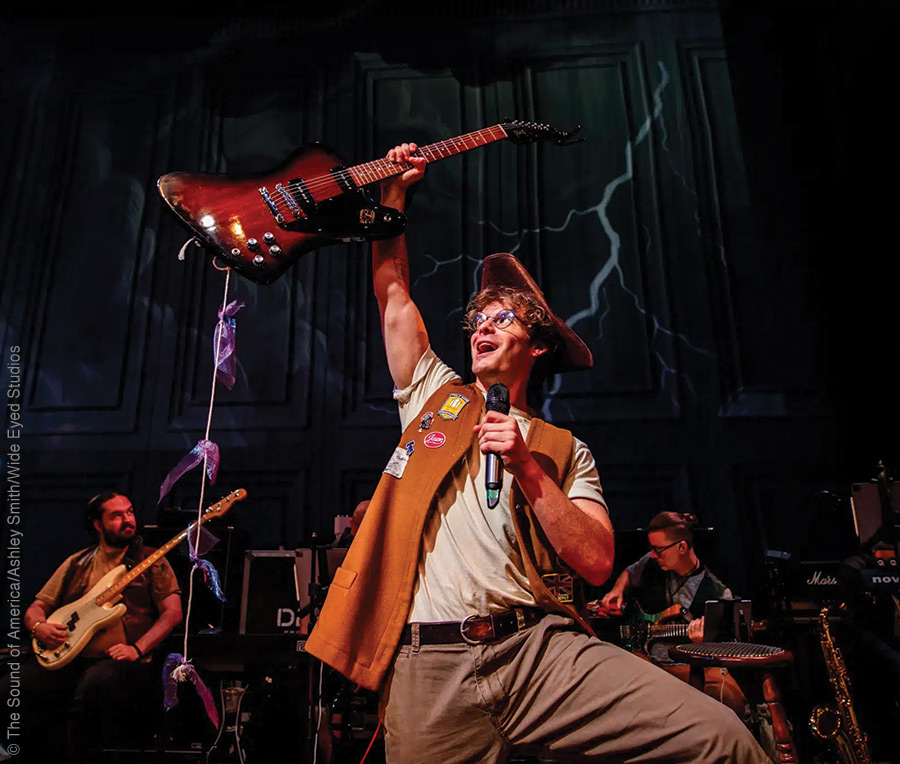
The Sound of America’s Benjamin Franklin is a far cry from the bald-pated elder statesman of 1776. As depicted in the new musical by Randall Lane C’90 and Todd Schwartz—which premiered at Philadelphia’s FringeArts on July 1 and played through the month at the flagship of the city’s annual alternative theater festival—Ben has an impressive head of dark curls under his tricorn or beaver fur hat and presents himself as the original rock star. (“Before the Beatles or Elvis … Before Chuck Berry or Nirvana … There was only me. Ben Franklin.”)
The version of Penn’s founder (not referenced, sadly) in The Sound of America rises from rebellious teenage runaway to indie-darling singer-songwriter to global arena-rock sensation; there’s even a second act disillusion/dissolution-and-redemption arc that plays out just in time to turn back the “British Invasion” and declare America’s rock and roll independence.
Echoing the familiar story, Franklin runs away from Boston and indentured servitude to his half-brother James (Tito Jackson to Ben’s MJ in the musical’s terms) but, along with his famous three loaves of bread, arrives in Philadelphia bearing an acoustic guitar hand-decorated with a kite. Lane has fun analogizing Franklin’s early days as a printer and local acclaim with Poor Richard’s Almanack—when he was still pseudonymous, however.
Poor Richard knows a penny saved’s a penny earned
Poor Richard knows the best investment’s what you learn
But who knows Richard?
Lightning strikes when, well, a bolt of lightning electrifies Franklin’s guitar, sparking (!) a wave of international acclaim and a swelled head for Ben, who breaks from his band The Leather Apron Club and sets off for France as a solo act, but instead abandons himself to indulgence, including fathering an illegitimate son, identified as WTF.
Meanwhile, back home Franklin’s best friend and business partner Hugh Meredith and common-law wife and soulmate Deborah Read attempt to hold the line against British “Harp Hellion” Lord Alexander Wedderburn (front man for The Redcoats), who declares that, while America may have invented it, “rock and roll belongs to the mother country.”
Franklin’s timely return signals a battle of the bands, followed by reconciliation and the formation of a “supergroup” incorporating Wedderburn (who switches to electric guitar), with WTF as an opening act (a happier ending than real-life Franklin and his loyalist son William ever managed). In a last-minute cameo, Roger Daltrey appears on video as the “Royal Governor”; proceeds from the production support The Who lead singer’s cause Teen Cancer America.
Gazette editor John Prendergast emailed with Lane about The Sound of America and how Franklin really was—and is—a rock star. Their exchange has been lightly edited and condensed.
Why Franklin? Why you? Why now?
Anyone who went to Penn feels Franklin’s shadow; as an American history major, me more than most. We live in a time when I think it’s natural to pine for great leadership—whether business, cultural, or politics—and with every decade, Franklin looks better, wiser, more selfless within all three of those. This country could use 100 of him right now.
Did you start this with the nation’s 250th anniversary in mind? How did the connection with Philly and FringeArts come about?
The 250th was just a lovely coincidence. There hasn’t been a breakthrough rock musical in a long time and our goal about two years ago was to take a stab at one. We figured we’d make some music we like and if others did too, we’d raise money and go the traditional route: off-Broadway, with dreams of Broadway. Once we got close to finishing last winter, though, it was hard to look at the calendar and not see the obvious: a show about Philadelphia’s most iconic citizen, in the birthplace of our country, on its 250th birthday. Philly could be our off-Broadway. It felt like Ben willed it.
After we shared our Spotify soundtrack and script, three different Philadelphia theaters made firm proposals, including the Kimmel Center, which was flattering. FringeArts made the most sense for a rock show—great vibe and acoustics and there’s a bar attached to it. Plus, it’s precisely under the Ben Franklin Bridge!
Where did the conceit of Franklin as a rock star come from?
I obviously knew Franklin’s story coming out of Penn, and Walter Isaacson’s biography positioning him as the “first true American” was foundational. Hearing him say nice things about The Sound of America on Morning Joe was surreal. But Isaacson’s thesis could be pushed further and grander: more than just our first citizen, he was the first rock star. The lyricist for colonial America. A preening performer, who became the first globally famous American. He toured the world. He had fans. He had groupies. He had an illegitimate son. He soaked up the limelight. He got fat in exile in France. Once you start looking through that lens you can’t unsee it.
The analogy between Franklin writing the Poor Richard’s Almanack and being a singer-songwriter works very neatly. Things get a little messier in the second act, and it’s hard to imagine Franklin ever really being idle, but the rock and roll story has its requirements. How did you approach the history part of it?
Every story needs an arc, and Franklin’s late-life adventures in Europe provided that opening. He was perceived then as a skirt-chasing dilettante who was enjoying the good life in France while the country fought for independence. It turned out that Ben was just saving the day yet again, in his own way, cajoling France into the war. The ultimate comeback. Ditto his castigation in London [when Franklin appeared before the Privy Council in 1774] at the hands of Lord Wedderburn, our villain. We stripped these ideas down, but they’re directionally correct. Rosalind Remer [senior vice provost for libraries, collections & archives at Drexel University], who curated the federal Benjamin Franklin Museum in Old City, is a coproducer. Her job essentially was to scour the script and keep me historically honest.
Not to fact check too closely, but William Temple Franklin is Franklin’s son William’s illegitimate son, not Ben’s. Was the WTF reference—used at several points in the show—too good to pass up?
Yes! When I first gave the script to Ros, I told her flat-out: I tried very hard to be historically accurate, certainly directionally so, but I’m acknowledging one asterisk in advance. One generation of middle-name skipping. The very definition of too good to pass up. And I’m sure Poor Richard would have approved.
Talk about the role of headgear—especially the beaver hat, which is a great prop. It was supposed to show Franklin as a frontiersman, right? And yet it also seems perfectly at home in the high Sixties.
Yes, Franklin employed that in France to rebrand himself as a man of wild America, to curry favor. Your analogy holds, as he looks like a self-indulgent rock star at the moment we segue from his tricorn-hat earnestness.
How did the musical style develop? What were your and Todd Schwartz’s main musical influences?
Todd and I are both rock nerds, and we speak in shorthand—“this one should have a Pet Sounds vibe,” or “that needs a Stone Temple Pilots riff.” We tried to bring in a lot of elements—blues, heavy metal, punk—at the correct plot points. That said, Todd was a professional rock frontman and has a professional studio in his basement in Brooklyn, and all those weekend jam sessions took place under a poster of The Who at the height of their powers. A top three band for both of us. To have Sir Roger Daltrey attached to this project—with the coolest title, “Royal Governor,” and the coolest video cameo—well, it’s one of the best pinch-me moments of my life.
What’s it been like for you seeing the show being performed? How has it been received?
It was at Penn, and The Daily Pennsylvanian, that I got used to people digesting things I helped produce. But to observe people react in real-time, that’s new, and the magic of live theater. So much love from Philadelphia, from Visit Philadelphia to Federal Donuts, which made a special Sound of America Ben-themed treat. The reviews have been terrific, mostly notably the Inquirer, which has helped set up the next act.
Do you have plans to take the show to another venue or do anything else with it in the near future?
Two different groups have now approached us about taking this bigger—one in New York, one nationally. Very flattered, very excited. We’re going to weigh options quickly, but one way or another, Ben Franklin, in this rock star incarnation, again gets to tour the world and bask in the adulation.