
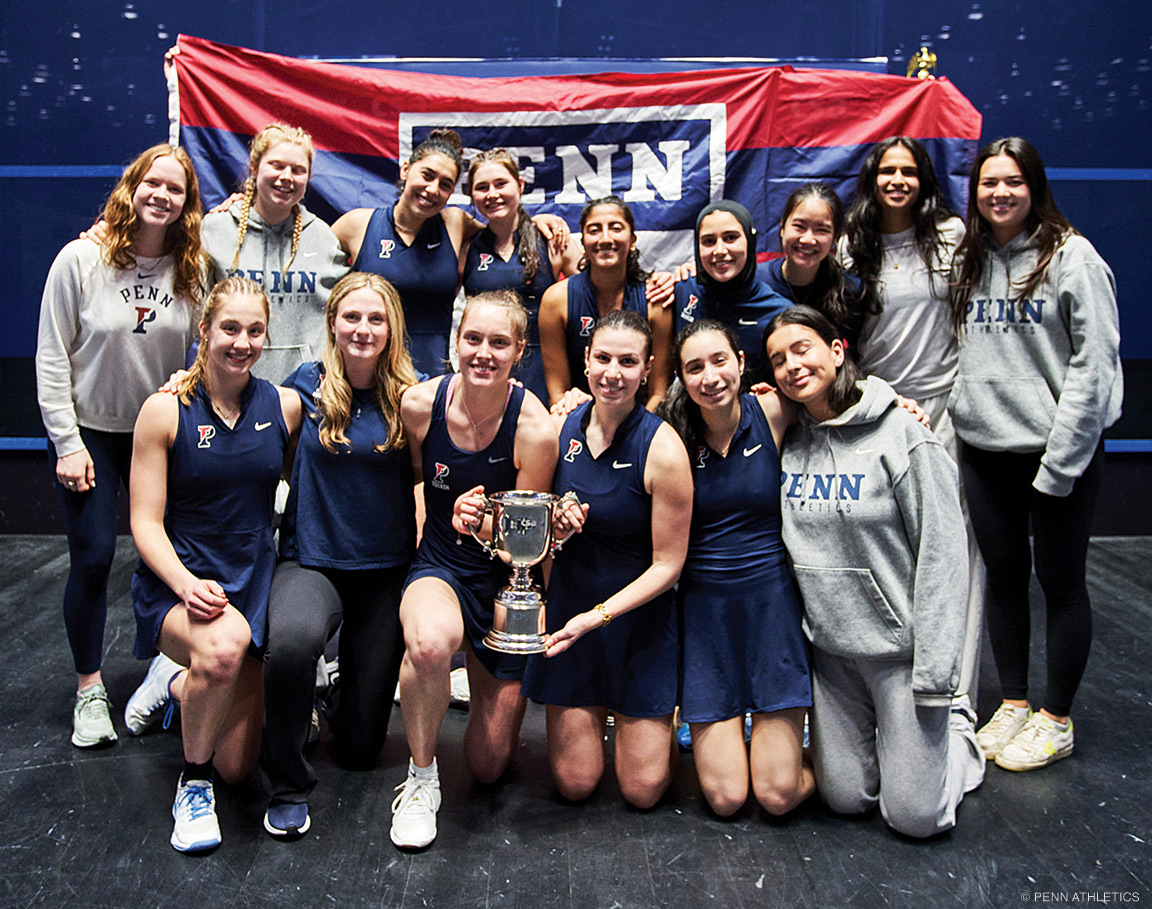
After two straight men’s squash national titles, the Penn women’s squash team captures one of its own.
Jack Wyant was numb. Happy and calm, he tried to explain, but still numb.
It was a little more than 24 hours after the coach had led his Penn women’s squash team to the program’s first Howe Cup national championship in 26 years, and the second one ever. After two losses to archrival Princeton earlier in the season—one a road dual match and the other in the final of the Ivy League tournament, also at Princeton—the Quakers upended the top-ranked Tigers, 5–4, at Philadelphia’s Arlen Specter US Squash Center in early March in a dramatic deciding match between the two bottom-ranked players on each squad. Wyant still couldn’t believe what had happened.
“We’re not the New York Yankees,” Wyant said as he stared at a phone he said had lit up like a Christmas tree with congratulatory messages from former players, alumni supporters, opposing coaches, friends, and family. “We don’t just roll out of bed and win a championship.”
As the program’s head coach since 2004, Wyant had never before won a College Squash Association (CSA) national championship, though his teams reached the Howe Cup final four previous times, enduring heartbreaking losses to Princeton in 2008 and to Harvard in 2010, 2016 and 2017. After becoming Penn’s director of squash in 2018—which includes overseeing the men’s program that is coached by former All-American Gilly Lane C’07 G’14 LPS’20—Wyant was also present when the men lost the 2020 and 2022 national title matches, both to Harvard.
So before the 2024 championship, Wyant was only half-joking when he suggested to Lane that perhaps he should stay home because his record in finals was so dismal. (To his credit, Wyant did win a national title while a freshman at, of all places, Princeton.) But the Penn men went on to beat Trinity two years ago and then were undefeated last season to repeat as national champs [“Sports,” May|Jun 2024, May|Jun 2025].
This year the men were denied a threepeat with an upset loss to Harvard in the CSA semifinals, but their No. 1 player, senior Omar Hafez, won the individual CSA national championship [“Sports,” Mar|Apr 2026]. Many men’s players, including current standouts Salman Khalil and Marwan Abdelsalam as well as former No. 1 Nick Spizzirri, were a vocal presence in the crowd at the women’s final.
Despite a convincing win over Cornell and a 5–4 squeaker against Stanford in Penn’s first two tournament matches, Wyant wasn’t optimistic going into the final against Princeton. Two days earlier, junior Anne Leakey, the team’s No. 6 player, retired from her match with what turned out to be a torn ACL, requiring a last-minute shuffling of the lineup. Junior Ashna Tumuluri was also competing with painful shin splints. “On paper, we should have gotten murdered,” said Wyant. “It’s really impossible to comprehend.”
All season, Wyant relied heavily on his top four players, especially junior Malak Khafagy, who played No. 1 and lost just one dual match, against Princeton’s Zeina Zain, before beating her in four games in the national finals. For the second straight season, Khafagy was named Ivy League Player of the Year.
Junior Franka Vidovic and senior Malak Taha were solid at No. 2 and No. 3 all year and junior Sohaila Ismail was undefeated in dual matches at No. 4. Savannah Ingledew, a sophomore who played No. 8, came up with two massive 3–2 wins against Stanford and Princeton.
Despite playing just two dual matches prior to the Howe Cup, senior co-captain Jana Dweek, who has been plagued by back pain due to bulging discs that caused her to drop out of the lineup, was suddenly called into action before the Cornell match.
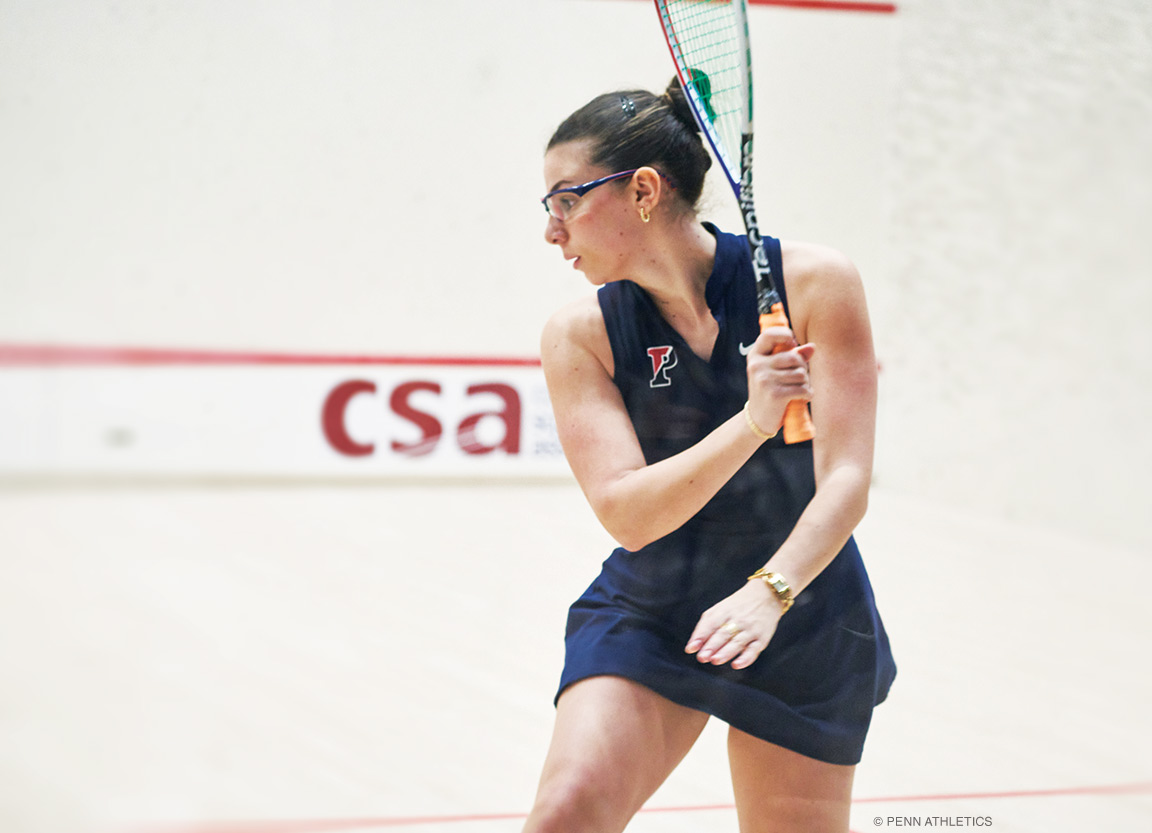
“I really wasn’t expecting to play,” Dweek, who spent most of the season cheering for her teammates from the sidelines, said by phone from her home in Calgary days after the final. “I wasn’t moving very well. I didn’t win any of the challenge matches I played. The only time I played was when they needed somebody.”
But Dweek rose to the occasion. Down 2–1 to Cornell’s Lamees Shalaby at No. 9, Dweek fought back to win in five dramatic games. As she was cooling down after her match, Wyant told her to be ready to play in the semifinals against Stanford. She lost that match, but Wyant needed her against Princeton.
“I trusted Jana,” Wyant said. “I know that there’s a mental component to winning challenge matches when no one’s watching and then playing in front of 100 screaming fans. She’s so solid in those moments.”
With the score against Princeton locked at 4–4, Dweek was on court for the decider. Wyant had noticed how hard Tumuluri, Allie Stoddard, and Hailey Wong, despite their losses, had fought for every point, taking the team’s motto of “Don’t Defer” to heart. He thought to himself, “Maybe, just maybe, this could be our day.”
Dweek was clearly nervous before her match. Pacing back and forth while wearing big headphones to block out the noise, she relied on words of wisdom from her best friend, Ismail. “She said, ‘You’ve played 1,000 matches, just don’t look at the score,’” Dweek recalled. “Once your eyes wander, your head goes to dangerous places. So instead I just took baby steps and tried to imagine the trophy.”
With fans leaning over railings and squeezed into every corner of the stands, it took Dweek just three games to oust Princeton’s Sonya Sasson, and claim the title for Penn. Chants of “JA-NA DWEEK” reverberated throughout the building.
“I don’t know that it gets any more dramatic than this,” said Penn athletic director Alanna Wren C’96 GEd’99 GrEd’15, who was on hand at the Specter Center all weekend, craning her neck to watch Dweek’s victory. “People talk about storybook endings, but this really was one. It was a spectacle, one of those days you’ll carry with you forever.”
What was especially remarkable about the team victory was that four of the women were competing while at the same time fasting for Ramadan. Khafagy, Taha, and Ismail (all of whom are from Egypt), and Dweek (who was born in Egypt) ate and drank nothing from sunrise until sundown, even on match days. To prepare, they practiced while fasting for a week before the tournament began.
That wasn’t the only adversity the Quakers faced. In October, before the season began, the squad was by some accounts in disarray. Teammates were arguing about their place in the lineup, factions formed, and one player frequently missed practice and expressed a desire to play in pro tournaments instead of college matches. “The attitude last fall was so bad,” Wyant admitted. “We had to have a lot of heart-to-hearts about being a good teammate and doing this for the collective.”
Both Khafagy and Dweek can take some credit for the turnaround. Dweek leaned on advice about team unity that she learned from classes she attended through the Wharton Leadership Academy, a program for student-athletes [“Obstacle Course,” May|Jun 2022]. And Khafagy understood the desire to combine college squash with the pro tour, because she herself delayed coming to Penn by a year to compete internationally. (Khafagy is currently ranked in the top 25 on the PSA women’s tour, just behind Melissa Alves C’18, a former Penn standout and current assistant coach.) “I get it,” Khafagy said by phone during a postseason California vacation with her teammates Vidovic and Tumuluri. “Playing for a team was never a thing back home. For five years I was only playing for myself, preparing by myself. Suddenly I’m playing for 15 girls and a whole university where every single match and every single game matters.”
But everyone eventually bought into the team’s camaraderie, and Khafagy reckoned that all the midseason headaches were worth it, especially after the final balls were struck. “I felt something I never felt before,” said Khafagy, who joined her teammates and coaches in making toasts and sipping beer from the Howe Cup trophy at LaScala’s restaurant just off campus on the evening of the final. “I never cried after a match before. I’m just so happy and so proud. Winning nationals when all the odds were against us is so much sweeter. The team was broken, so shaky, but we had nothing to lose.”
“This is college squash,” Khafagy added. “Anything can happen. We just kept saying, ‘Do it for the team.’ And we did.”
—Cindy Shmerler C’81
Cindy Shmerler played for the Penn women’s squash and tennis teams and is an award-winning print and broadcast sports journalist, with a particular emphasis on racket sports.



Jack and Gilly have been amongst the best squash coaches in the country and the world from day one. We are lucky to have them coaching our men and women squash players. Congratulations to them all – coaches, players, trainers and the entire Penn Athletics staff.