
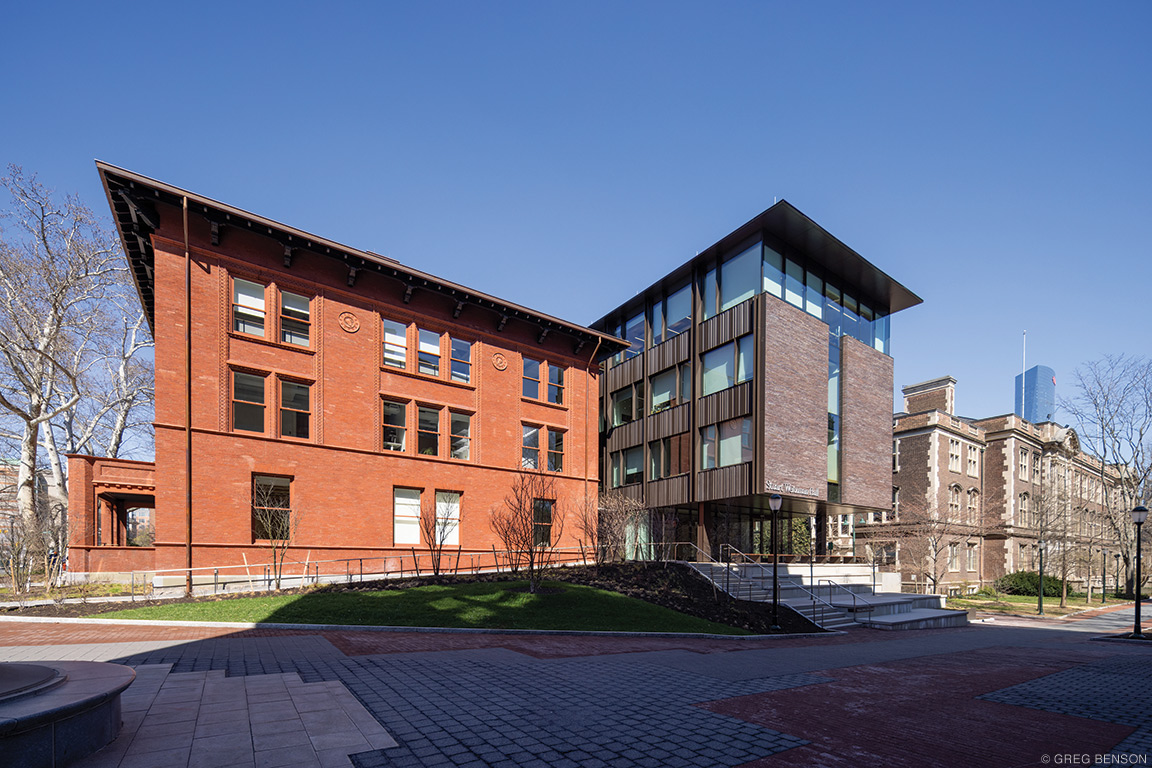
Stuart Weitzman Hall mixes old and new in a space-doubling project.
The stretch of campus along the eastern side of 34th Street has seen several projects in recent decades that artfully carved out new space within a limited footprint in concert with building renovations.
The latest is the former Morgan Building, dedicated in February as Stuart Weitzman Hall, which will house the Department of Fine Arts and provide space for the Kleinman Center for Energy Policy and the Penn Art Collection, as well as a variety of new meeting, classroom, studio, and office spaces. Previously, in 2010 the neighboring Lerner Center doubled the music department’s space with an addition designed by Ana Beha Architects [“Gazetteer,” Jul|Aug 2010].
Both structures date from 1892 and were designed by Cope & Stewardson, Penn’s late-19th/early-20th-century go-to architecture firm—though they were not built for the University but as residential and classroom space for the Foulke and Long Institute for Orphan Girls of Soldiers and Firemen. Penn purchased the buildings around the turn of the 20th century and for most of the subsequent decades, Morgan, the orphanage’s education building, housed the physics department. From the mid-1950s until the 1970s, it was occupied by the Nursing School and since then has been used by the Weitzman School of Design for artist studios, offices, and a printmaking studio.
The renovation and expansion effort, the school’s first major capital project in more than 50 years, was announced in May 2022. Construction, managed by Target Building, began in March 2024 and was largely completed by September 2025.
The architect selected for the $58 million project was Philadelphia-based and alumni-founded KieranTimberlake, whose design for Levine Hall—which provided a new building for the Department of Computer and Information Science in what had been a service and parking zone, while linking the historic Towne Building (completed 1906) and 1960s-era Graduate Research Wing—was the first puzzle-piece project in that corner of campus [“A Passion for Putting Things Together,” Nov|Dec 2003].
In an interview posted on the School of Design’s website about the Weitzman Hall project, Stephen Kieran GAr’76 commented on the interplay between the original building and addition. “The Weitzman School has a real diversity of need that I think the combination of the two buildings really suits. You couldn’t almost do it new and have it work as well,” he said. “It’s got a little bit of everything, from research areas to classrooms to faculty office spaces to studio art spaces to design spaces to various centers and archives.”
The firm’s design preserves the original building’s terra cotta façade and Italianate porch and balcony while reconfiguring the interior space. For the addition, rather than echo the red palette of the original, the façade gestures toward the darker color of the Collegiate Gothic-style Towne Building, with handmade bricks sourced from Denmark.
The addition doubles the building’s capacity to 38,500 square feet, extending toward the Towne Building from the rear and outward to adjacent Smith Walk, with terraces and gardens wrapping the site. An accessible entrance on the Smith Walk side leads to a covered outdoor patio and a glass-walled gallery that can be set up for exhibitions, lectures, and other uses. The first floor also includes an entry foyer, department offices, and flexible spaces. Upper floors feature classrooms, faculty offices, individual artist studios, research areas, and variously sized studios and spaces for critiques. Maker and fabrication spaces in the basement include facilities for woodworking and welding. —JP