Fueled by its star Egyptians, Penn squash continues to reach new heights.
Penn junior Jana Dweek watched intently as her brother, senior Abdelrahman Dweek, pranced across the hardwood floor, swatting balls deep along the side walls, off the glass behind him, and into the crevices just above the “tin” line marking out of bounds that stretches across the front wall. After Abdelrahman, known simply as Dweek to his teammates, lost the first game of the practice match against his teammate, junior Omar Hafez, he sat on the bleachers at the Penn Squash Center, put his head down, and muttered to himself in Arabic.
“He’s telling himself what he did wrong, how he should hit short when his opponent is caught behind him,” Jana translated. “They’re not allowed to be coached during practice matches, so he coaches himself. And it’s always in Arabic.”
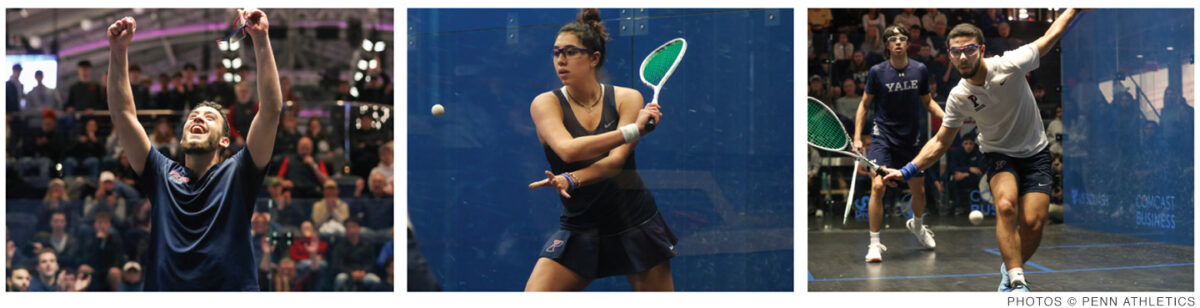
The Dweek siblings are two of nine Egyptians on the Penn men’s and women’s squash teams. Five of the top 10 men hail from Egypt, as do four of the top 10 women. That includes the Quakers’ No. 1 male, sophomore Salman Khalil, and No. 1 woman, sophomore Malak Khafagy, as well as Hafez and freshman Marwan Abdelsalam (Nos. 3 and 4, respectively) and sophomore Sohaila Ismail, who plays No. 3 on the women’s side.
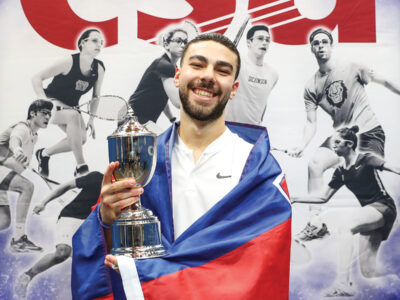
The men’s squad, which also includes senior stalwarts (and non-Egyptians) Nick Spizzirri, Nathan Kueh, and Dana Santry, is the most successful in Penn history. In March, they won their second consecutive College Squash Association (CSA) Potter Cup national team title, capping a perfect 20–0 season. And in the final of the CSA individual championship, played at New York’s Grand Central Station in late January, Khalil defeated Hafez for the title. In the process, Khalil—a two-time All-America selection and this year’s Ivy League Player of the Year—became the first Quaker to win the Pool Trophy since Ned Edwards C’81 beat his teammate, Jon Foster C’79, for the crown back in 1979.
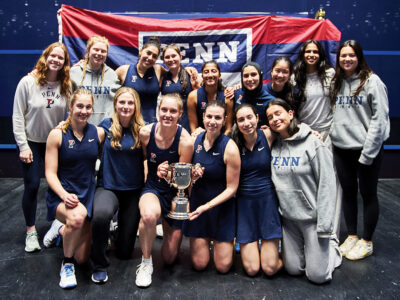
The Quaker women, meanwhile, finished 15–4 and reached the semifinals of the Howe Cup for their best result since losing to Harvard in the 2017 final.
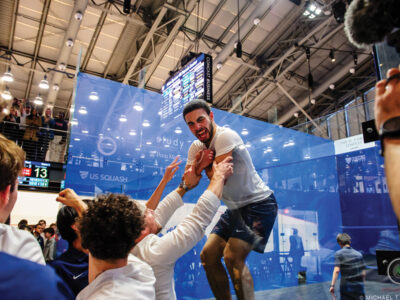
“The team championship was so much more important than the individual,” said Khalil, whose win at No. 1 clinched the men’s national title for the Quakers in a 6–3 victory over third-seeded Yale. “It doesn’t even come close. Playing as a team is more fulfilling because you have something to fight for.”
Men’s squash head coach Gilly Lane C’07 G’14 LPS’20 said the Egyptians have been “instrumental in building the program,” which began to establish itself as a national powerhouse three years ago [“Squashing the Narrative (and Competition), May|Jun 2022] before capturing its first national championship last year [“Sports,” May|Jun 2024]. “When we won last year, it was pure joy winning it for the group that came before them,” Lane said. “This year was about winning it for each other. This year was a legacy championship.”
The first standout player to travel the 5,550 miles from Egypt to West Philadelphia was Haida Lala C’16, who helped the women’s team to a perfect Ivy record in 2015, and then a runner-up finish at the Howe Cup the next year.
“Those of us who pay attention to squash saw Egypt rise up,” said Jack Wyant, Penn’s director of squash and head coach of the women’s team. “But most of them weren’t interested in coming to college in the US.” That began to change after the 2011 Egyptian revolution and the 2013 Egyptian protests, according to Wyant, who said that “parents of top Egyptian players were investing a percentage of their income in squash, and if their kids weren’t going to become world champions, at least they could be world class and still get a top education in the US.”
The Dweeks were caught in the middle of the upheaval in Egypt. Their father, Tamer, a pharmacist, was trying to protect his store in the middle of the night when he was nearly shot by friendly fire. That scare prompted the family to emigrate to Calgary, Canada, in 2012, fleeing on one of the last flights allowed out of the country at the time. Abdelrahman and Jana honed their skills in their adopted country, but both say their work ethic was established in Egypt.
Abdelrahman credits Egypt’s culture for its squash prowess. The country has been producing top players since the 1930s and today boasts more than 2,000 courts, including at popular government-sponsored clubs like Heliopolis in Cairo and the Sporting and Smouha clubs in Alexandria. “We’re so competitive from a young age,” he said. “The clubs are very big, half the size of the Penn campus. You train there, study there, and stay there till late at night. Your friends are your competitors. If you break bread and butter together, you are brothers. On the court you want to kill each other but then you go home and play some PlayStation.”
The Dweeks, Hafez, Abdelsalam, and Penn senior Roger Baddour all developed their skills at Smouha, which is thought to be the largest sports club in the world, featuring everything from soccer fields and tennis courts to a golf course, equestrian range, and working racetrack. Squash is a popular attraction. “We have only two big cities in Egypt where squash is prevalent, so the juniors are in close proximity to the top pros,” said Baddour, who was sidelined with a knee injury for much of his last two seasons. “You get to learn from them and hear their stories, get advice. From a young age we have someone to look up to.”
The current Professional Squash Association rankings exemplify Egypt’s dominance, with several of the top players hailing from the Middle Eastern country. Among them are former Penn star Aly Abou Eleinen C’22 (ranked No. 12 nationally as of mid-April) and current Penn student Khafagy (ranked around 30 on the women’s side). Many of them are expected to compete in Los Angeles in 2028 when squash becomes an Olympic sport for the first time.
Khafagy admits that she has at times had a love-hate relationship with the sport. At one point while growing up as a star youth player in Alexandria, she considered quitting. But a conversation with Wyant drew her to Philadelphia and back to the game. “My body was fragile, and I wanted a backup plan,” said Khafagy, who went 13–3 in team competition this year, losing an especially brutal match to a fellow Egyptian, Zeina Zein of Princeton, during which she was hit in the face by Zein’s racket. “At Penn I realized that I could play on the team, play pro tournaments, and study at the same time.”
Transitioning to college life thousands of miles from home is sometimes challenging, especially when culture, religion, and even language can be a barrier. But Penn squash players lean on each other. Never was that more apparent than when tragedy hit the men’s team just after the New Year holiday.
Hafez was preparing for the most critical part of the season when he learned that his 51-year-old father, Said, an obstetrician, had died of a heart attack while assisting surgeons in Libya. It was Baddour, a longtime family friend, who delivered the shocking news and then stayed by Hafez’s side as he decided to make the 16-hour journey home. “It was so hard,” Hafez said through tears. “My dad convinced me to give up soccer for squash. He used to support me and watch every match online. I just wanted to make him proud. I never felt that feeling before, so broken and alone. But I felt the love from my teammates.”
Hafez had barely arrived in Alexandria when Lane received a text from him at 4 a.m. Wednesday morning local time. It simply said, “I’m in for the match on Saturday.” Hafez indeed returned to Philadelphia in time for Penn’s matches against No. 4 Trinity and No. 2 Yale (with an assist from Lane, who picked him up at Newark Liberty International Airport and dropped him home after midnight) and won both of his tilts, including a grueling five-set triumph over Yale during which Hafez rallied for a 13–11 victory in the final game.
“After I lost the first game 11–1, I was all turned around—but I had to turn that fear into hunger,” said Hafez. “I felt like mentally I was done, but I had to adapt and recover. My teammates and coach were helping me. They believed in me.”
Daily prayer and the support of his peers has also helped Hafez—who, less than two weeks later, found himself in the final of the CSA Individual Championships, where he lost in straight games to Khalil after beating opponents from Harvard, Yale, and Trinity.
Muslim culture emphasizes frequent prayer, so Lane ends practices by 1 p.m. on Fridays so that the Egyptian players can attend services. After Hamas attacked Israel on October 7, 2023, and war erupted in Gaza (which borders Egypt), both coaches worried as tensions escalated around campus. Wyant, who has several Jewish student-athletes on his team in addition to the Egyptians, called both groups together and asked if they wanted to talk. Everyone agreed that there’s never been any issues on either squad and that team camaraderie supersedes any conflict.
This year Ramadan began just days before the start of the CSA team championships, a particular challenge for athletes competing while fasting from sunrise to sunset and refraining even from drinking water. Some of the men and women slept from 4 a.m. until just before match time to conserve energy and avoid feeling hungry. Khalil, who was down 2–1 in games and survived five match points in the semifinals against Trinity before rebounding to win 3–2, cramped during dinner after the match. He came back the next day to beat his Yale opponent in four games. Neither Hafez nor Abdelsalam lost a match during the team championship run, despite fasting throughout.
“These guys are so clutch in tough positions because in Egypt they have to be the best to win,” Lane said. “They’re warriors.”
Both teams insist that having multinational rosters—other players come from Croatia, Malaysia, South Africa, Hong Kong, India, the United Kingdom, and Connecticut—has helped, not hurt, their efforts to form a cohesive unit. “I’ve never seen a bit of hostility on either team,” Wyant said. “We try to be a safe place every day.”
In the end, they all agree, it’s about the squash.
“This men’s championship isn’t solely about Egypt,” said Lane. “It’s about a blending of brotherhood. It’s about a group of alphas coming together and playing for something bigger than themselves. They had a goal, their cultures blended, and they won everything they could possibly win.”
—Cindy Shmerler C’81
Cindy Shmerler played for the Penn women’s squash and tennis teams and is an award-winning print and broadcast sports journalist, with a particular emphasis on tennis.