From lost creeks to leveled hills, Philadelphia like you’ve never seen it before.
In 1997, Adam Levine C’80 clambered down into a Philadelphia sewer and stumbled upon a metaphorical rabbit hole that would obsess him for decades. His gingerly descent began as a colorful contribution to a freelance article he was researching for the alternative newsweekly Philadelphia City Paper. But his exploration of the system that keeps human waste “out of sight, out of nose,” as he quipped in the resulting piece, took an unexpected turn when someone he had interviewed at the Philadelphia Water Department offered him a gig organizing the utility’s archives.
Levine’s been there ever since, given carte blanche to sift through not only the department’s records, but those housed in other municipal collections and local institutions like the Historical Society of Pennsylvania and the Library Company of Philadelphia. It’s a dream job for the 67-year-old writer and historian. His fascination with what lies beneath had begun in the mid-1980s, when he first learned about the spidery network of creeks that once spread across the city before planners, taking advantage of their flow to flush out waste and storm runoff, converted the waterways into underground sewers. “I’ve been searching everywhere for information on this stuff for a long time now and continue to do so,” Levine says. “I didn’t even know what I was looking for at first. It’s been a four-decade education.”
Over the years, he’s offered glimpses of these archival riches on his blog, WaterHistoryPHL.org, and in public presentations. But his project has now culminated in a captivating free exhibition at The Athenaeum of Philadelphia. Lost Creeks of Philadelphia: Burying the Streams, Building the City, on view through May 16, channels a small but deftly curated collection of plans, surveys, photographs, maps, paintings, and drawings into an enthralling perspective on how Philadelphians built their city by transforming the landscape it lay upon. The installation also serves as a preview of Levine’s book Lost Landscapes of Philadelphia, which is due to be released next year from Temple University Press and will feature original photography from Joseph Elliott, a lecturer in the Stuart Weitzman School of Design’s Department of Historic Preservation.
In the Athenaeum show, Levine and Elliott document the long and winding story of how Philadelphia’s creeks were diverted, segment by segment, into pipes; and how hills and valleys were leveled with fill culled from the surrounding landscape and then overlaid with a grid of streets. Levine acknowledges the practical goals behind these tactics: protection from the waste and chemical pollution that was routinely dumped into the rushing waters; and the creation of a street grid that offered protection against spreading fires and provided a base for the quick and orderly construction so necessary to a growing city.
Levine’s revelations about what Philadelphia buried in the name of progress can evoke a measure of wistfulness. “I mourn the loss of the natural landscape and think a better way to develop the city would have been to view that landscape as an asset,” he concedes. “My greater point with this work, though, is not to offer an opinion but to draw attention to what was here.” And the exhibition’s portrayal of how that natural state was altered proves equally compelling.
Organized to unfurl the processes involved in transforming the natural and pastoral during the 18th and 19th centuries into the gridded and gritty city of the present day, the exhibition first presents bucolic visions of what was once here, then showcases the industrial might and creative energies that went into taming that landscape. There’s a lot to unpack, starting with a reproduction of a 1934 hand-colored lithograph from the Penn Museum that purports to be the Philadelphia Region when known as Coaquannock—“Grove of Tall Pines”—and as first seen by the white men. This whimsically illustrated map is crammed with information, much of it not immediately obvious. A close inspection reveals the paths that the Indigenous Lenape cut through the forest, a smattering of villagers gathered around several fires, an abundance of animals and birds (labeled as per William Penn’s gently wondrous descriptions printed around the border) and place names ranging from the familiar (Manayunk, “Where We Go to Drink”) to the forgotten (Chickhansink Hell Creek, which is annotated “Where We Were Robbed”).
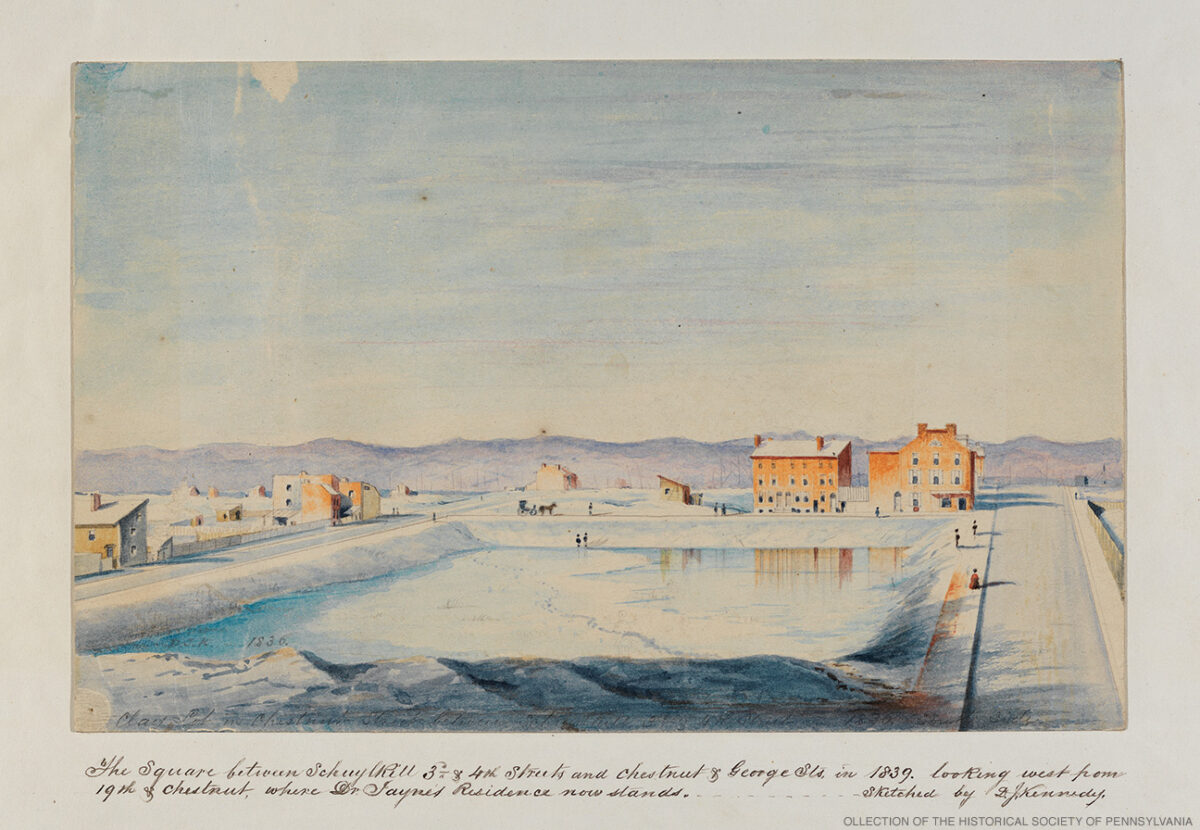
Across the gallery, 10 delicate watercolors by David Johnston Kennedy (1816–1898) depict mid-19th-century scenes. Some are of older blocks already built up, while in West Philadelphia, a street consists of just a few houses perched on a hill. Somewhere in between, development-wise, a square block near Rittenhouse Square is lined with houses along its curbs—but its center hasn’t yet been infilled, leaving a rain-filled depression that Levine likens to a waffle’s pouches sopping up syrup. A depiction of Chestnut Street between 19th and 20th from 1836 illustrates the inverse situation: the city had cut streets through high ground in accordance with the regulated grade but the block’s private owner had yet to follow suit as required, resulting in a surreal scene of cows grazing several feet above the heads of passing pedestrians and a horse-drawn wagon.
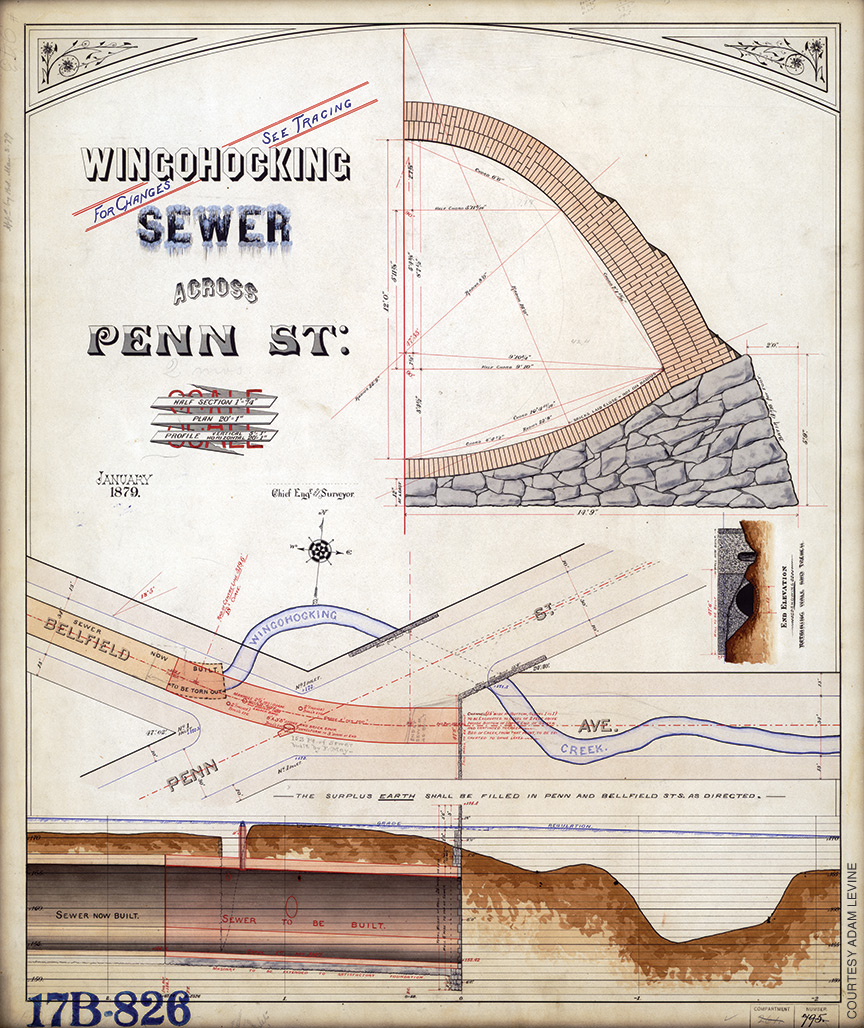
Quirky maps and misty paintings notwithstanding, perhaps the exhibit’s most beautiful assemblage is the one devoted to the draftsmanship associated with the construction of post-Civil War sewers. The care so clearly involved in producing these meticulously rendered elevations and section drawings of ring stones and manholes offer silent tribute to the ornamentation and detail that’s present in the monumental sewers themselves. The artist’s hand expresses itself in the floral flourishes that adorn the corners of one drawing and in the fanciful fonts in others that enhance the word “Sewer” with dripping icicles or in lettering that resembles woodsy twigs.
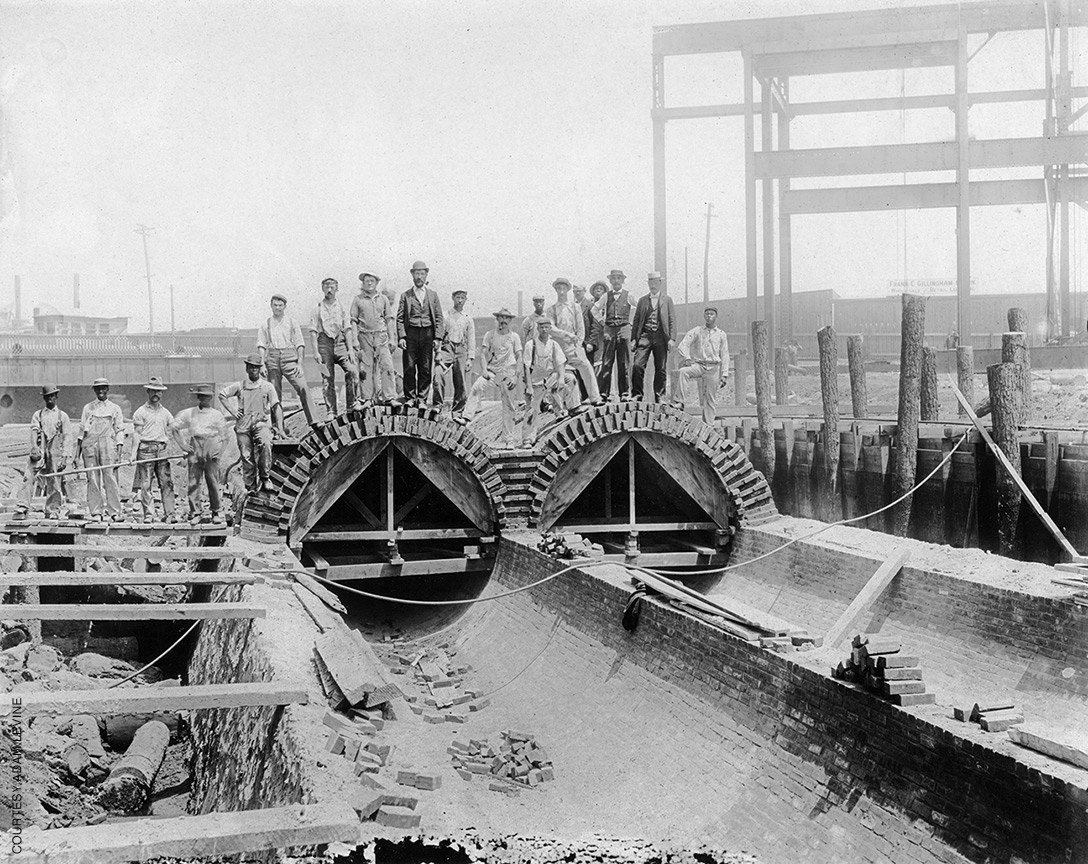
Next, a series of evocative photos bring to life the laborers and construction sites of the 1880s—but, as another photo array of caved-in streets makes clear, many of those workers were inexperienced in fashioning underground conduits and the sites were not routinely inspected. Civil engineers were also learning as they went along and constrained by the shortcomings of the materials at their disposal, like brick. Partly because of these failures and also because brick just couldn’t stand up to the stress of increased traffic rolling over the streets, most large sewers in the city built after 1910 were made from reinforced concrete, a far more solid and longer-lasting material.
By the time Northeast Philadelphia was being built out in the 1920s, planners were increasingly likely to leave streams in place, whether incorporated as part of regional parks or simply as backyard creeks. The shift in approach came not so much from an appreciation of nature, as from the realization that the expense involved in converting from stream to sewer might not be worth it, especially in less dense areas.
A handful of photos by Elliott serves as an apt coda to the exhibit, presenting examples—a manhole, a concrete channel, a diagonal avenue—that hint at the meandering creeks’ presence below today’s urban fabric. Spend an hour or so at this exhibit and you too will start seeing evidence everywhere of the hills and valleys, tributaries and streams that once were a part of daily life in Philadelphia.
—JoAnn Greco