How a former real estate developer built a tourism company that brings American history to life.
A crowd has gathered at Boston’s Old South Meeting House. Egged on by a fiery speaker, they’re getting angrier by the minute. One man stands up, waving his fist. “Here, here,” another yells. “Huzzah!” respond the rest. Rising to their feet, the horde rushes out to nearby Griffin’s Wharf.
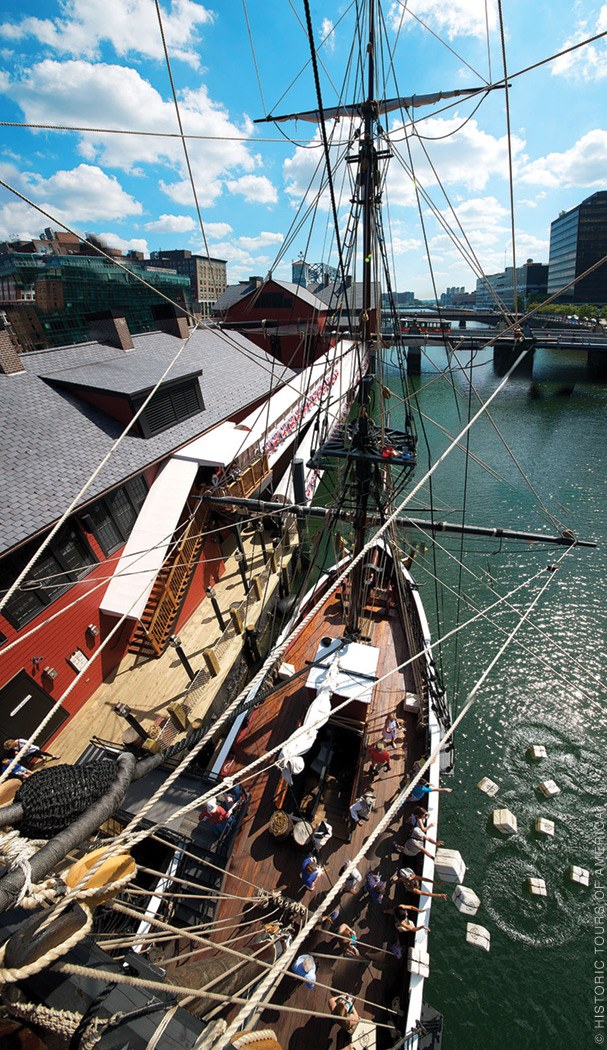
Exhorted to dump bales of tea into the water, the participants—accompanied by costumed actors—are actually tourists reenacting the Boston Tea Party, standing on the same spot where the iconic uprising took place in December 1773.
Together, everyone moves onto a gangway to board the Eleanor and the Beaver, full-scale replicas of the 18th-century sailing vessels carrying the tea. By the time they enter a nearby museum to further explore the events leading up to the Revolutionary War, the spilled “tea” will have been hoisted up and readied to be re-tossed for the next show.
This immersive experience is offered by the Boston Tea Party Ships & Museum, one of the star holdings in the portfolio of Historic Tours of America (HTA). Billing itself as “The Nation’s Storyteller,” HTA was founded in 1980 by Chris Belland W’70 and Edwin O. Swift III, as an outgrowth of their real estate development activities in Key West, Florida. Their privately held company now operates nine trolley tours and 15 museums and attractions in cities across the country.

“The traveling public is insatiable when it comes to the fascinating stories behind what happened and who it happened to,” Belland says, adding that the tea party recreation is “the best indication of where tourism has to go. There’s not a kid who goes through it and doesn’t have the time of his life, while also coming out with a clearer understanding of the sacrifices and heroism involved. You can’t get that any other way but by participating.”
Born in Miami, Belland became interested in business as a youngster, taking on gigs washing cars, mowing lawns, and selling holiday cards, and later watching his father’s successful career in real estate. After graduating from Wharton with a degree in economics, he returned to Miami and worked as a real estate broker. In 1973, after visiting Key West for a weekend, he wound up staying there.
“The whole town was in an economic depression,” Belland, now 78, recalls, “and it was years away from hitting its stride as a tourist destination.” He soon ran into Swift, who was buying up buildings around the city, and joined him in acquiring and developing a batch of undervalued Civil War-era and 19th-century commercial structures on the city’s main drag, Duval Street. “Living in Philadelphia for four years during the early ’70s certainly had a tremendous impact on me wanting to become involved in historic buildings,” he says. “Much of Society Hill had recently been restored and I thought the wonderful buildings down there were just magical.”
Over time, the duo became the largest property owners on the island, according to Belland, and played a significant role (along with Jimmy Buffet, no doubt) in its eventual resurgence as a vacation destination. In 1978, looking to better link their buildings—and the then-struggling tenants who had opened up stores in them—to popular Mallory Square, they bought Old Town Trolley, a local operation whose sole honky-tonk vehicle had been jerry-rigged from a cut-down bread truck hauling a single-boat trailer outfitted with a plywood platform and park benches.
Clearly, an upgrade was in order. “After seeing antique- style trolleys in the Orange Bowl Parade, we purchased six from the manufacturer and reopened the Old Town Trolley in 1980,” says Belland. “On our first day of operations, with 13 employees, we carried 34 passengers. By the end of our first year, we wound up carrying 77,000 with a new tour concept we called The Continuous Loop Tour. It’s now referred everywhere as Hop On, Hop Off, but we were the first.” Eventually, HTA would bring its trolley tour operations to Boston, San Diego, Savannah, St. Augustine, Nashville, San Antonio, Charleston, and Washington, DC. (Contractual issues derailed two short-lived versions in Miami and Philadelphia.)
HTA made its initial foray into the attraction business when Key West leased it the operations of the city aquarium. In 1994 the company opened the Key West Shipwreck Treasure Museum, where actors, videos, and artifacts merge to unravel the story of the wrecking crews that manned observation towers to spot disasters in the making, then scrambled down to be the first on the scene to help save lives—and to call dibs on the salvaged treasures. To capture that energy, visitors are encouraged to climb to the top of the museum’s replica of a wooden 65-foot lookout.
The group gradually built a collection of attractions, some of them leased from government entities, others bought outright. HTA susses out the properties’ compelling stories and writes dramatic scripts that bring them to life with the aid of in-house cast members and exhibit designers. The company’s acquisitions range from Harry S. Truman’s presidential limo and a moonshine still to rare treasures like the only tea chest known to have survived the Boston Tea Party and a first-edition poetry volume by Phillis Wheatley, the first enslaved person to publish a book of poetry.
When it took over the operating lease for the Boston Tea Party Ships & Museum, which had been around since the Bicentennial, “we could see that there was a tremendous lack of detail that could be explored,” Belland says. “People won’t put up anymore with reading a bunch of text panels.” In 2014, HTA invested $25 million into the museum to help customers “be drawn into a situation where they’re a part of things, to feel like they’re the spark igniting the event.”
The company now employs 1,500 people—including several executives drawn from the two partners’ families—and more than 4 million annual visitors flock to its trolley tours and attractions. “It’s been a wild ride,” Belland says, “that’s required a lot of effort and passion.” And as Americans reflect on their country’s beginnings and celebrate its 250th birthday, he recognizes a special opportunity to “reawaken visitors with a new appreciation for the ideas behind the nation’s founding,” Belland says. “We operate from a deep-rooted belief that without telling this story in a fashion that people remember and cherish, Americans and the world will begin to forget what it took to become the United States.” —JoAnn Greco