The ICA presents the material culture of a radical Christian sect alongside contemporary artists it has inspired.
Last year Germany’s Vitra Design Museum presented The Shakers: A World in the Making, juxtaposing Shaker-inspired contemporary art with traditional Shaker crafts. By the time the traveling show reached Penn’s Institute of Contemporary Art, where it runs through August 9, the title and subtitle had flipped.
That was no accident. “What we want to emphasize here is the way that the Shakers thought about world-building, and how contemporary artists have taken up that call,” says Hallie Ringle, the Daniel and Brett Sundheim Chief Curator at ICA, and the exhibition’s cocurator.
Among the questions the show asks, according to Ringle: “What does it mean to build today for tomorrow? What are things we can use to move forward, and how are contemporary artists also part of those solutions? How are they building their worlds as well?”
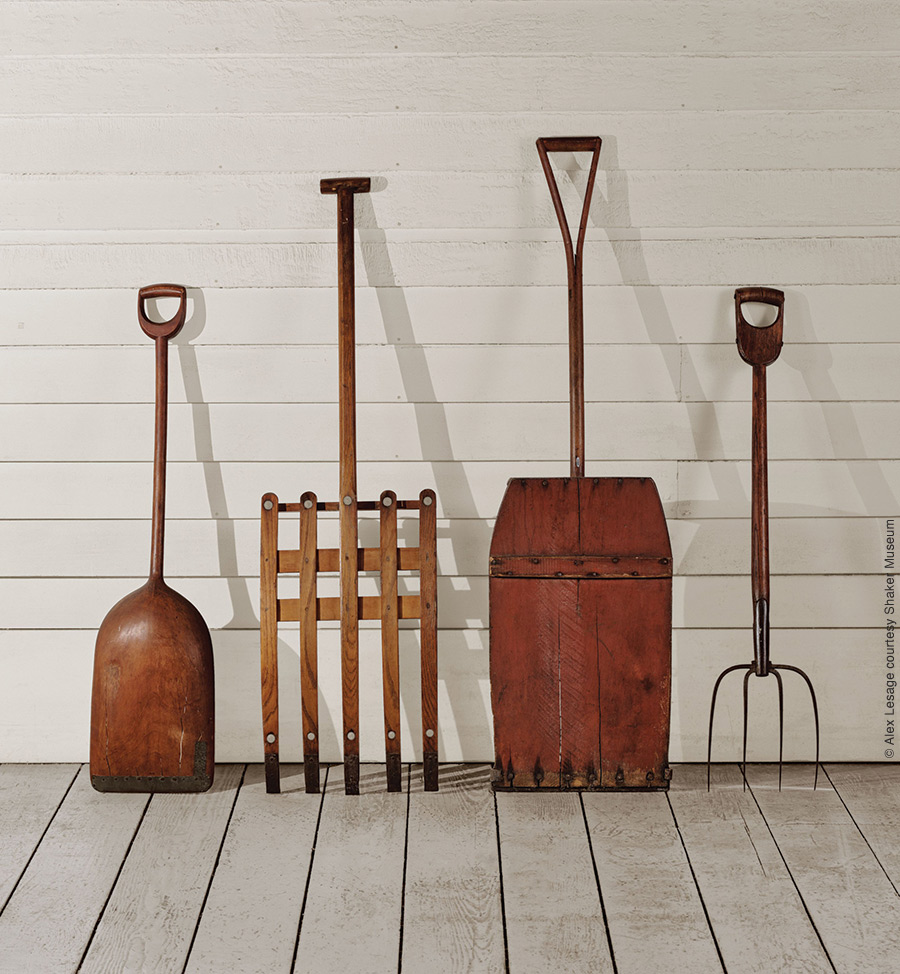
Originated by the Vitra Design Museum, A World in the Making was co-organized by ICA, the Milwaukee Art Museum, and the Wüstenrot Foundation in collaboration with the Shaker Museum in Chatham, New York, which lent most of the more than 100 artifacts in the show. These include Shaker furniture, agricultural implements, and clothing, as well as Shaker-related images and documents. The exhibition travels to the Milwaukee Art Museum this fall and to the Carnegie Museum of Art in Pittsburgh next year.
The show describes the paradox of Shaker worship as “radical openness in movement and voice, yet constriction through doctrine, celibacy, and separation of the sexes.” Each themed section uses a quotation from Shaker writings as its title, including, “When we have found a good thing, we stick to it.”
The curators commissioned seven artists—from the United States, Denmark, and the Netherlands—to respond to the Shakers’ objects and ethos. The resulting works riff on the Shaker meetinghouse (Amie Cunat and Chris Liljenberg Halstrom), fuse traditional Shaker dances with Black spirituality (choreographer Reggie Wilson), meditate on sustainability and mortality through the medium of woven coffins (Christien Meindertsma), and mine the mystical writings of Mother Rebecca Cox Jackson (Kameelah Janan Rasheed). In 1858, Jackson, a free Black woman, founded the Shakers’ only urban community, in Philadelphia.
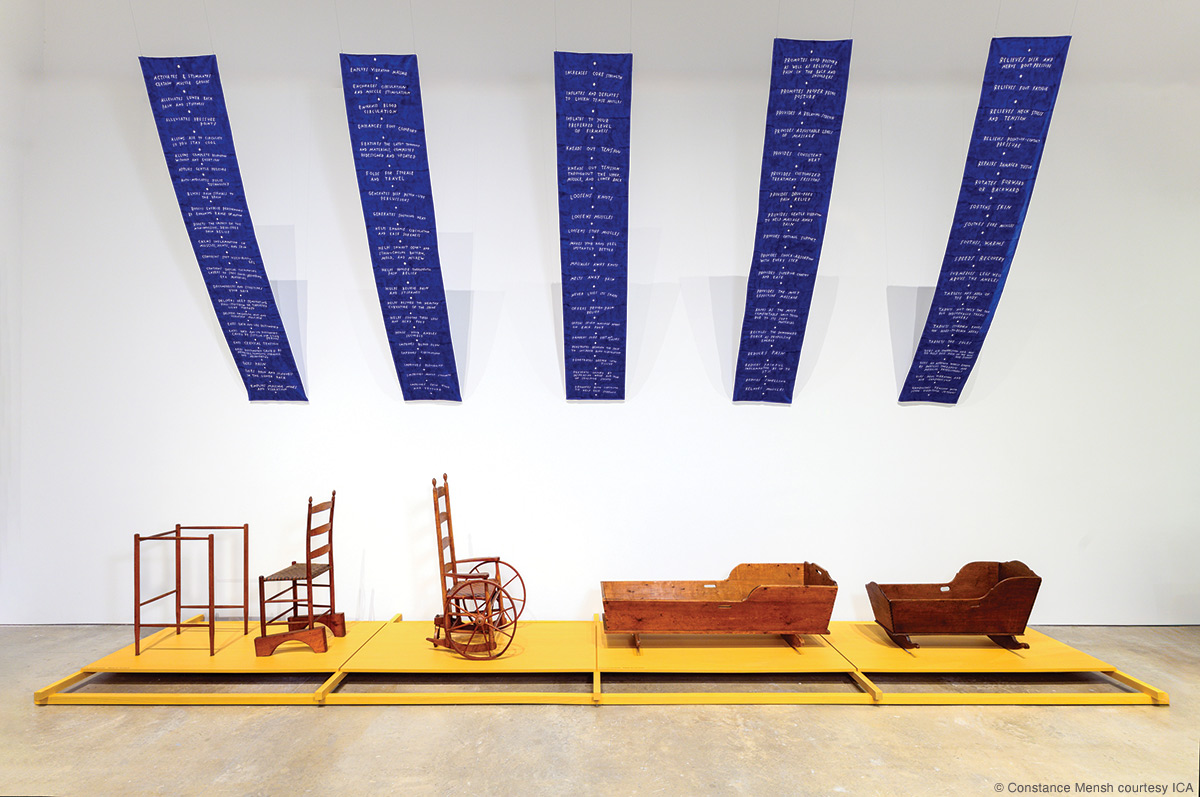
David Hartt’s refracted video installation, The True Artist Helps the World by Revealing Mystic Truths (Tree of Life), “engages with the spirituality, artifice, and history of the Shakers,” according to the exhibition catalog. And Finnegan Shannon’s I Want to Believe, featuring fabric banners with a poem “assembled from promises of pain relief,” responds to Shaker pharmaceuticals and assistive devices on display nearby.
A World in the Making rides a crest of interest in the Shakers, including several recent exhibitions coinciding with the 250th anniversary of their 1774 arrival on American shores. That story is told in Mona Fastvold’s 2025 movie The Testament of Ann Lee, a biopic about the charismatic Shaker leader that emphasizes the sect’s ritualistic embrace of song and dance.
An offshoot of the so-called Shaking Quakers, the Shakers were known for both their utopian religious communities and their minimalist designs—two aspects of Shakerism that Ringle sees as closely connected. “The Shakers were looking at design as a product of their faith,” she says. “That is really how we are looking at the Shaker objects—that every value that they held, every religious belief, came through in these objects.” Among those beliefs, she says, was the ideal of “complete equality between genders and races.”
Today, three Shakers—one of them a new recruit—still practice their faith in the Sabbathday Lake Shaker Village in Maine, the sole representatives of a group whose numbers peaked at about 6,000 in the mid-19th century. (The Shakers’ commitment to celibacy was not exactly a prescription for growth.) Yet their sleekly functional designs, for everything from brooms to chairs, live on, some of them “unimproved upon since their invention,” Ringle says. Sustainability is another theme that resonates with contemporary artists, she adds.
Cunat says her 2016 visit to the Hancock Shaker Village, a living history museum in western Massachusetts, influenced her thinking about the nature of community. After the presidential election, she says, “I wanted to recreate a Shaker meetinghouse, where like-minded people—in this case, artists—could gather in person. It seemed important to make a space to come together.”
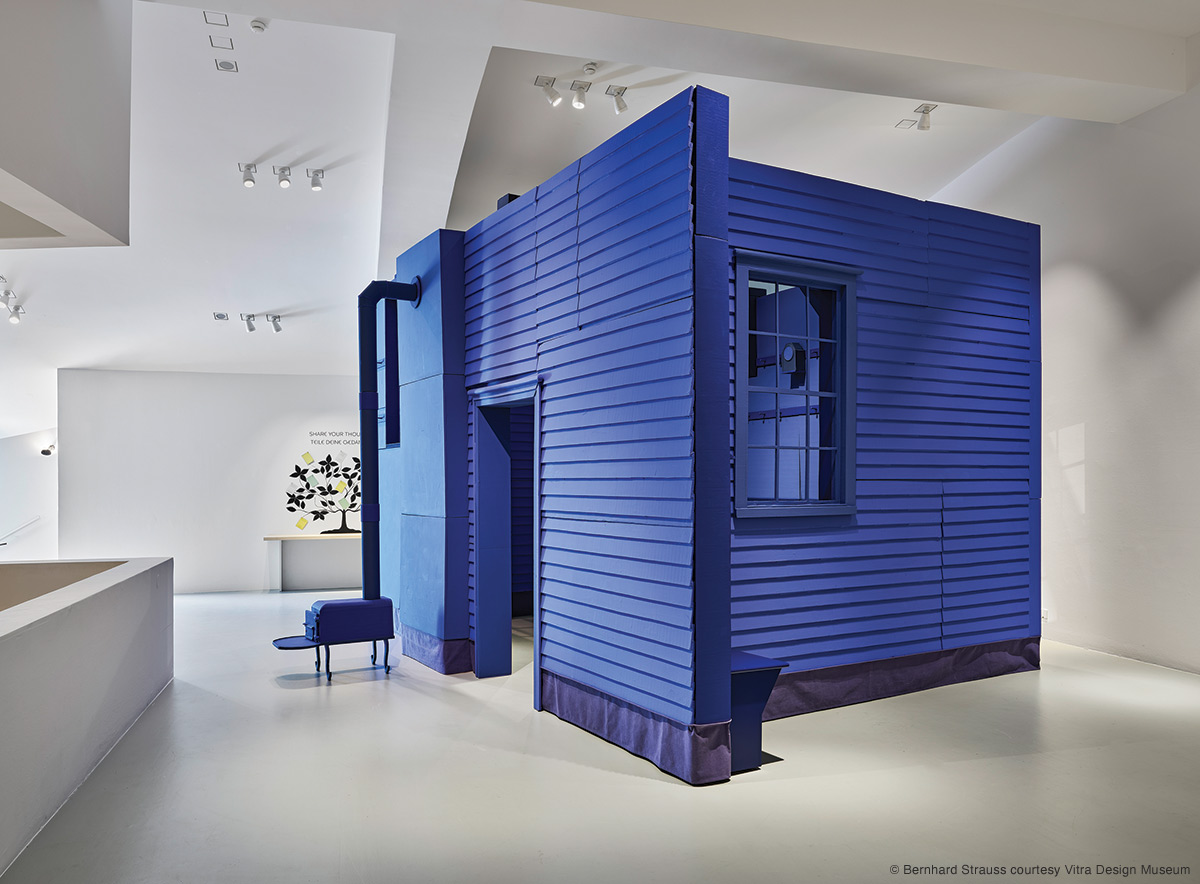
That piece, Meetinghouse, led to further involvement with the Shakers, including a 2024 trip to Sabbathday Lake Shaker Village. On that visit, Cunat says, “I experienced their meetinghouse by looking through its windows. Frankly, I was late for the community service on that day so could not get into the building.” This “looking in” helped shape the new project, 2nd Meetinghouse, which examines architectural symmetry and its implications for equality.
In 2nd Meetinghouse, Cunat says, “cues that signify interiors, like a stove or benches, are placed outside as an invitation to experience the site from different places.” She painted the installation blue “because it had a few associations with heaven, sky,” and was used by the Shakers for meetinghouse interiors. “I see 2nd Meetinghouse as a space of inclusion,” she says, a project “to address the urgency of the present,” while also igniting questions about American history.
For her part, Rasheed has long been “deeply interested in a range of religious and spiritual movements”—especially how beliefs change and are manifested in material culture. After discovering the Shakers about a decade ago, she became fascinated by Rebecca Cox Jackson’s mystical leadership. While visiting ICA to give a talk, Rasheed saw a book in Ringle’s office about the Shakers. That led to a conversation about Jackson and the Philadelphia settlement—and, ultimately, the commission.
For the ICA version of the show, Rasheed contributed two large, embroidered banners, inspired by both Jackson’s handwritten journal and Shaker gift drawings. She also created a video loop using excerpts from the journal and a diaristic novel by the pioneering Black science fiction writer Octavia E. Butler.
“I’m really interested in Black women who have become heretics in some sort of way or have exceeded the boundaries of expected religious behavior,” Rasheed says. “There’s something important for me in thinking about the radical potential of divergence, of disobedience, of charting your own path.”
One of the challenges of the installation, Ringle says, was “making sure that the Shaker objects and the contemporary work felt in conversation. That can always be really tricky.” The original design by Formafantasma was adapted for ICA by Richard Harrod. The first object visitors encounter is Cunat’s 2nd Meetinghouse, whose exterior stove is juxtaposed with an actual Shaker stove. In another example, Wilson’s dance video is situated near the prints of Shakers that helped inspire it.
“We live in a time of great change, of a real shift in everything from values to the way we interact with community,” Ringle says. “It’s exciting to be able to look back in history, and say, ‘How did people think about this in the past?’”
—Julia M. Klein