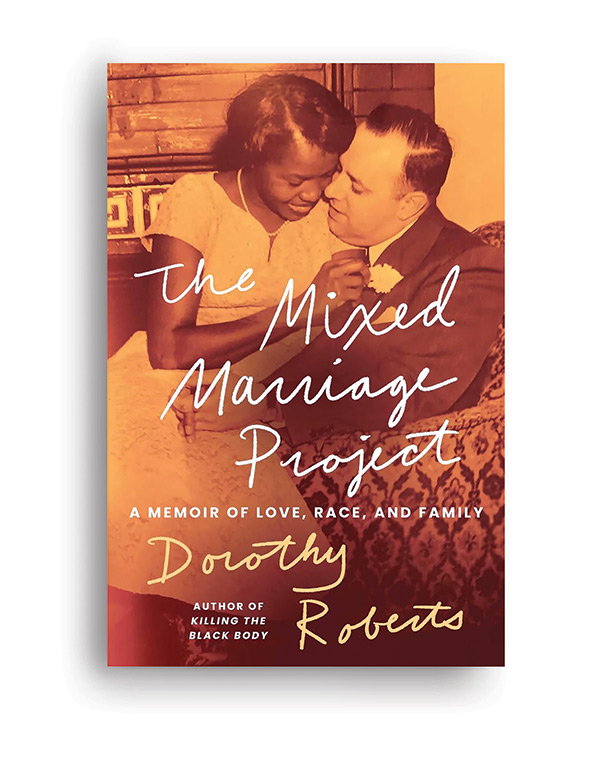
A Memoir of Love, Race, and Family
By Dorothy Roberts
One Signal Publishers/Atria,
320 pages, $30
In an enthralling mash-up of memoir and sociological treatise, Dorothy Roberts probes her father’s lifelong but unfinished investigation of mixed-race marriage—including the one that begat her.
Review by Julia M. Klein
It is not easy to categorize The Mixed Marriage Project, the latest book by Dorothy Roberts, the George A. Weiss University Professor of Law and Society. Which should come as no surprise.
The founding director of the Penn Program on Race, Science, and Society has reveled in crossing disciplinary boundaries [“Dangerous Ideas,” Jul|Aug 2016]. She trained as a lawyer, but her research has ranged across sociology, social work, criminology, and bioethics, among other fields. In books such as Killing the Black Body, Torn Apart, and Shattered Bonds,she has advocated for reproductive justice and critiqued the US child welfare system. In Fatal Invention, she detailed how politics and science have shaped conceptions of race.
The Mixed Marriage Project is subtitled A Memoir of Love, Race, and Family. Roberts serves as its first-person narrator, but this is not a traditional memoir. At its core is Roberts’ sympathetic summation and contextualization of her (white) father’s decadeslong, mostly unpublished investigation of interracial marriage in Chicago. The resulting amalgam is a sociological treatise laced with reflection and framed by her family history.
It’s an ambitious enterprise: enthralling in its detail, matter-of-fact in its storytelling. Robert “Bob” Roberts, the son of German and Welsh immigrants, had more than an academic interest in interracial marriage; he was in one himself, with the Jamaican-born Iris Rosalie White. Only the timeline was a surprise. “I believed that my father’s faith in the promise of interracial marriage grew from the steadfast devotion they shared,” Roberts writes. “Turns out that he had begun interviewing Black–white couples,” as well as dating Black women, “more than a decade before he met my mother.”
The personal and professional strands of her father’s life are challenging to tease apart. Roberts discovers that her mother, as her father’s student at Roosevelt College, assisted him with some of the interviews. They divided the work along gender, rather than racial, lines: She questioned the wives, while he talked to the husbands. By then, the two were already romantically involved—an ethically problematic situation by today’s standards.
Roberts also uncovers another seeming deviation from research protocols: Many of the pseudonymous couples her father surveyed became part of her family’s social circle, some even close friends. One, she suspects, was likely her piano teacher. Her parents “took participant observation to a heightened level—one that may have shaped the very social phenomenon they were studying,” Roberts writes.
The spur for The Mixed Marriage Project was not unusual. After her parents’ deaths, Roberts, the eldest of three sisters, became the custodian of 25 boxes containing family archives. One summer she ensconced herself in an apartment on Chicago’s South Side, near her childhood home, to pore through their contents. Along with family photographs and other memorabilia, she found voluminous notes and transcripts relating to her father’s (and mother’s) investigation of the couples and, later, their children. The project began in 1937 and continued into the 1980s, encompassing nearly 500 interviews, some of them lost.
Bob Roberts found his subjects largely through referrals and pursued them with the doggedness of an investigative reporter. Chicago’s Communist Party was one source of promising leads; nudist camps were another. He returned repeatedly to tease out intimate details.
His research was referenced in other people’s work. Two trade publishers offered him book contracts. He wrote a handful of scholarly articles. Yet despite his passion, he was never able to complete a book of his own—a tragedy that shadowed the entire family. “Perhaps, by trying to do too much, he managed to accomplish too little,” Roberts writes.
So she tries, in effect, to write the book for him, combining finely drawn portraits with general observations. Bob Roberts was, she suggests, ahead of his time. Perhaps influenced by his travels in India, he described the racial hierarchy in Chicago as a caste system, and was aware of “his white male privilege.”
Nearly all the couples he interviewed lived in the city’s Black Belt. “In segregated Chicago, white spouses … were pushed into Black neighborhoods, risked losing their jobs, and feared neglect in hospitals,” Dorothy Roberts reports. White spouses often were rejected by their families; many concealed their marriages at work. “I don’t think a man should marry outside of his race unless he has a lot of intestinal fortitude,” said one husband, himself apparently biracial.
The social pressures doomed some marriages (as did more conventional marital stresses). White immigrant wives married to Black men seemed especially bitter after encountering racism for which they were unprepared. Other marriages survived or thrived—the Roberts union among them.
But Bob Roberts, too, had to cope with his family’s racism: He waited for his mother to die before marrying and was estranged from one of his brothers. (A final, heartbreaking note from the brother suggests that fraternal love persisted, even if it couldn’t conquer all.)
As was typical in mid-20th-century America, the husband’s career took center stage, even though Dorothy describes her mother as “the most gifted person in the family.” Iris Roberts nevertheless abandoned her graduate studies in anthropology at Northwestern University to become “the consummate homemaker” and called her first-born, Dorothy, “my PhD.”
Apart from an interlude in Liberia, her mother’s onetime home, Dorothy Roberts spent her seemingly idyllic early years in the racially mixed neighborhood of Kenwood. Bob Roberts headed Roosevelt College’s joint anthropology and sociology department. But a disastrous investment and the forfeit of two book advances imperiled the family’s finances and forced the sale of their house. The boxes were Dorothy’s only material inheritance.
As a child, Roberts writes, she responded to questions about her race by saying, “I’m just human.” She took pride in her family as “a living symbol of racial harmony.” Later, though, she began identifying as Black, even hiding the fact that her father was white. And she chose to marry two Black men. (The first marriage ended in divorce after more than three decades and four children.)
Even after immersing herself in her father’s research, Roberts confesses that she still doesn’t share his optimism about interracial marriage. She continues to see the racial utopia he envisioned, and tried to embody, as elusive. “For me,” Roberts writes, “interracial intimacy can’t be disentangled from the larger forces of race, gender, and power that continue to govern our world.”