The Arthur Ross Gallery revisits the upheaval of Basque Separatism through the lens of Fernando Postigo.
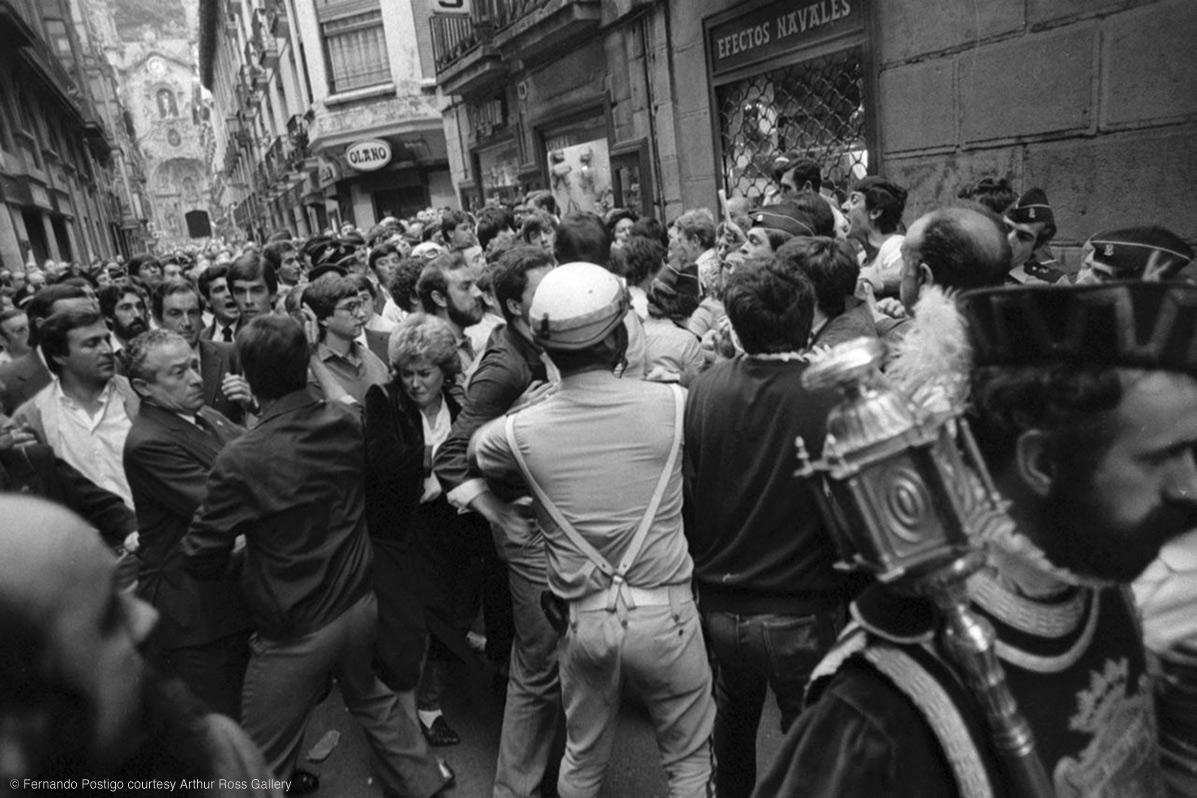
In the quarter-century that Fernando Postigo CGS’71 spent documenting the violent politics of Basque Separatism in northeastern Spain, the photojournalist gained two reputations. One was for an omnipresence that verged on the uncanny. After returning to his native San Sebastián in 1977 from self-imposed exile in Philadelphia, he developed a sixth sense for the turbulence that marked Spain’s uneasy transition from the dictatorship of Francisco Franco. In a city riven by car-bombings and assassinations in broad daylight, the stocky Nikon shooter seemed to be everywhere at once, bearing swift witness on the back of a motorcycle that earned him the nickname “Postigo Express.”
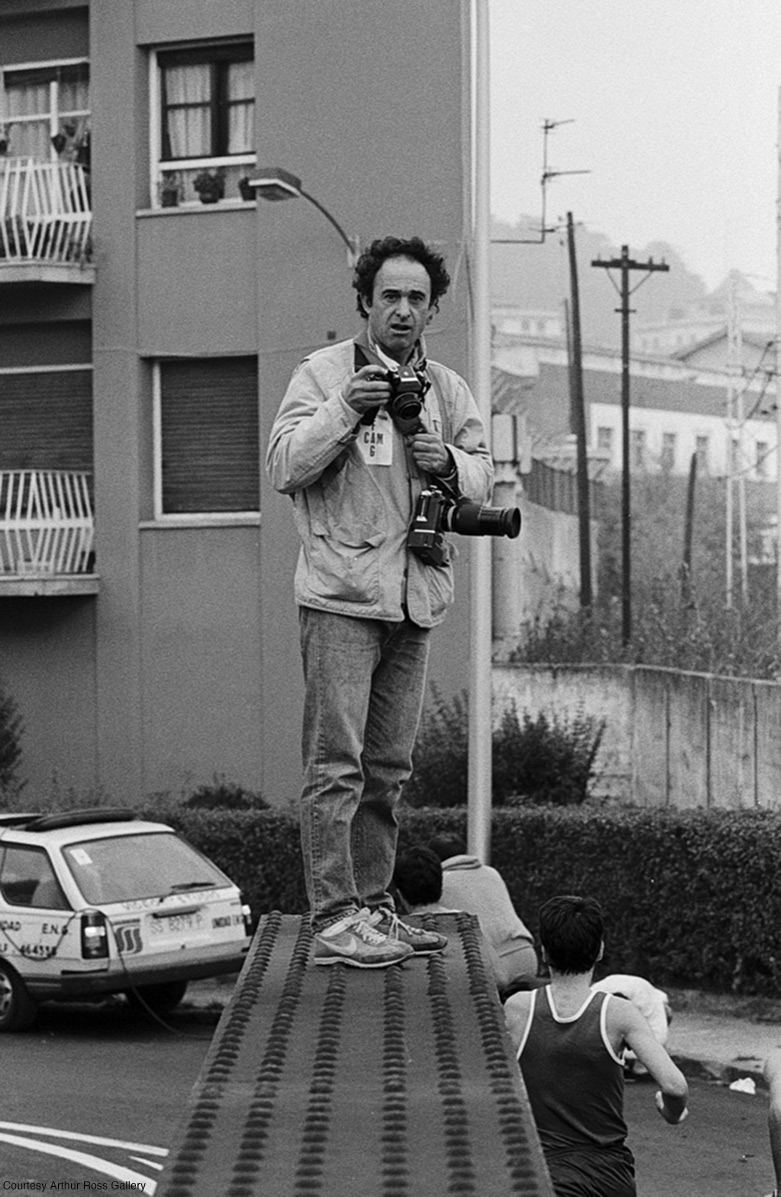
The second source of his renown was how deeply embedded he became in a society at war with itself. “He knew both sides of the gun,” says Peter Decherney, the Edmund J. and Louise W. Kahn Endowed Chair in the Humanities and curator of an exhibition of the photojournalist’s work at the Arthur Ross Gallery that runs from November 7 to January 4. “He knew members of the government, and he knew members of the ETA”—the armed Basque separatists responsible for killing roughly 800 people and injuring upwards of 20,000 between 1968 and 2000.
The 1995 slaying of politician Gregorio Ordóñez was emblematic. Several hours after meeting and photographing the mayoral candidate, Postigo was called upon to record images of the man’s corpse—felled by a gunman whose family Postigo had also come to know.
Born in San Sebastián in 1940, Fernando Postigo grew up amid the severe repression imposed after the Spanish Civil War by Franco, who illegalized the usage of regional languages such as Catalan and Basque. In his late 20s he married an American student named Mary Wildman, and the couple moved to Philadelphia. Postigo studied political science in Penn’s College of General Studies (precursor of the College of Liberal and Professional Studies), and meanwhile served as a social worker in Philadelphia’s Department of Public Welfare. In 1977, two years after Franco’s death, the couple moved with their two children to San Sebastián.
There Postigo embarked on a career in daily newspaper photojournalism, working first for La Voz de España and then El Diario Vasco. Shooting in black-and-white, he chronicled Spain’s tentative transition to democracy amid the escalating violence of ETA separatists. The group attained notoriety in 1973 with the assassination of Prime Minister Carrero Blanco, Franco’s handpicked successor, but its bloodiest years came between 1978 and 1980, coinciding with Postigo’s repatriation.
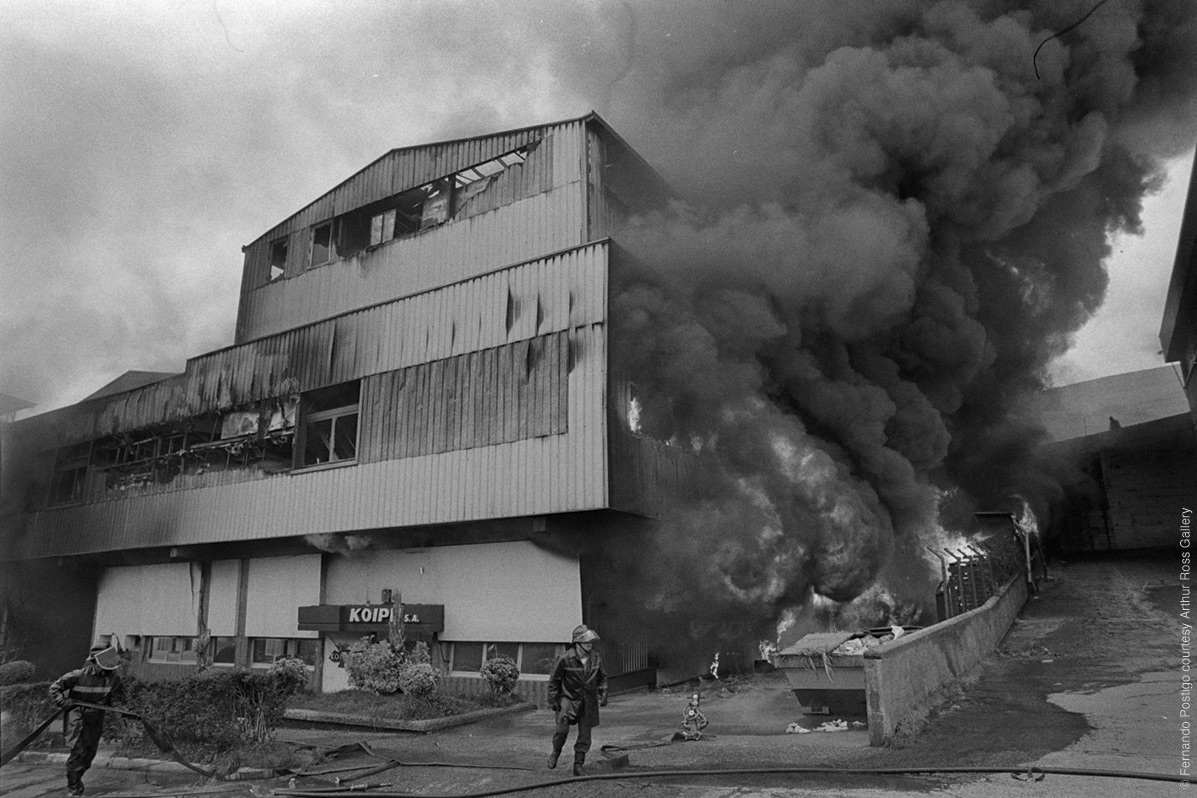
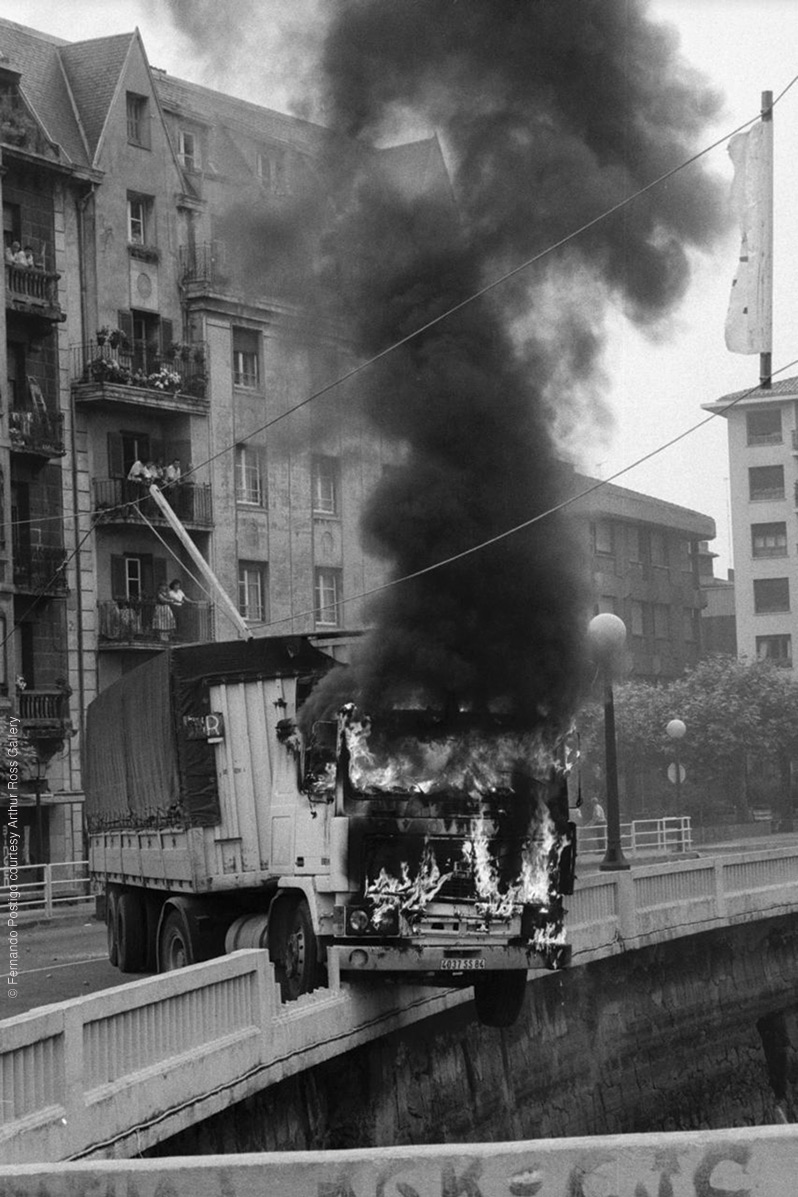
“Postigo Express: Documenting the Basque Conflict in San Sebastián, 1977–2003” will feature more than 70 12-by-18-inch prints spanning the photographer’s career, drawn from an archive of approximately 50,000 negatives. His own images will be supplemented by snapshots depicting the journalist in action—like one that shows him scrambling through a 1979 street riot in one direction as a man hurls a chair through the air in the other. Postigo’s granddaughter Libby Paquette, a freshman in the College, served as assistant curator.
The still images will be accompanied by a short documentary film directed by Decherney, in which Postigo revisits the scenes of social upheaval in a city that has been transformed in the 21st century. For the gastronomic tourists thronging Michelin-starred restaurants above the picturesque Bay of La Concha, San Sebastián’s violent past can be hard to imagine. Yet even though the ETA ceased armed activity in 2011, and disbanded entirely in 2018, Postigo’s photographs can still touch a nerve. When the city’s San Telmo Museoa exhibited his work in 2020, according to Decherney, the museum “didn’t want to show some photographs, because the wounds were too fresh.” That was the first dedicated retrospective of Postigo’s work. The Arthur Ross exhibition will be the second.—TP