A Penn Libraries exhibition surveys the remarkable afterlives of the great Greek thinker.
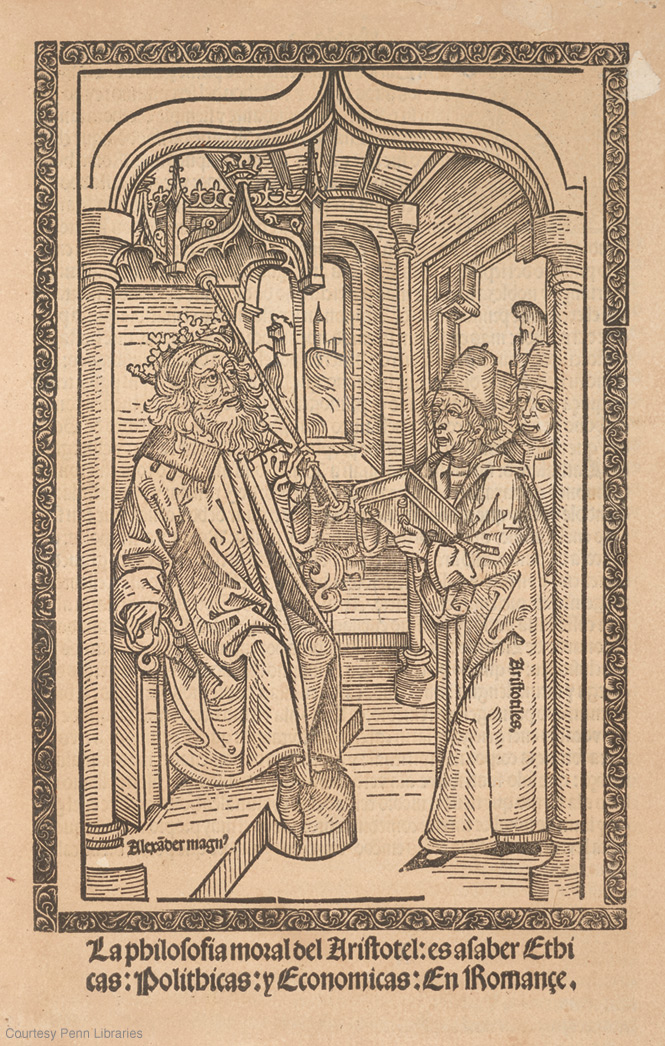
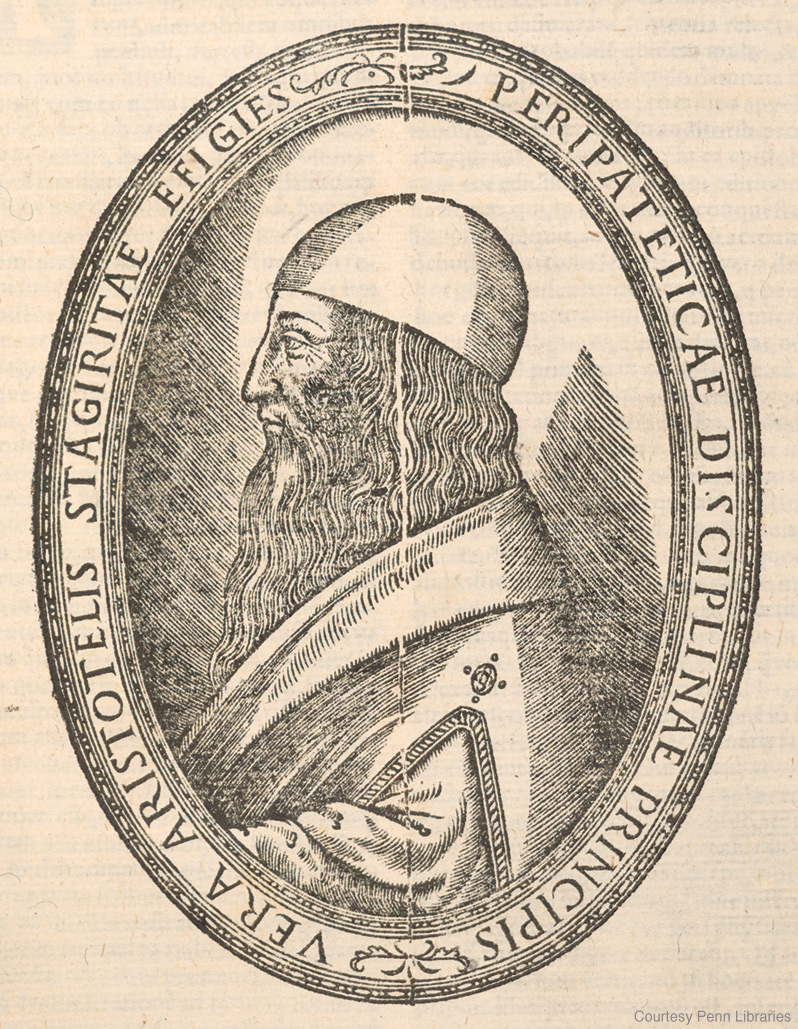
Behold Plato’s most illustrious student. Though posterity has no photographs, portraits abound. Here’s Aristotle draped in a toga. There he is decked out like a Renaissance courtier. Now we see the handsomely robed polymath wielding a quill pen—a technology that appeared roughly a thousand years after he held court in ancient Athens. But that is perhaps a small quibble compared to a 16th-century Flemish depiction of the philosopher on all fours, mounted side-saddle by a nude temptress raising a riding crop above her hapless captive.
These are some of the striking likenesses on view through January 16 in Van Pelt Library’s Goldstein Gallery, where an exhibition called “Reinventing Aristotle” thoroughly lives up to its title. Was the philosopher’s nose slender or bulbous? Did his beard cascade past his sternum in luxuriant curls, as presented by Guillaume du Val in 1619? Or was it close-cut to frame a boxer’s square jaw, as drawn in a Japanese manga series in 2004? The answers, of course, are all yes. And for all the liberties artists have taken with the philosopher’s face and physique, the substance of his actual thinking has been bent in even more bewildering directions.
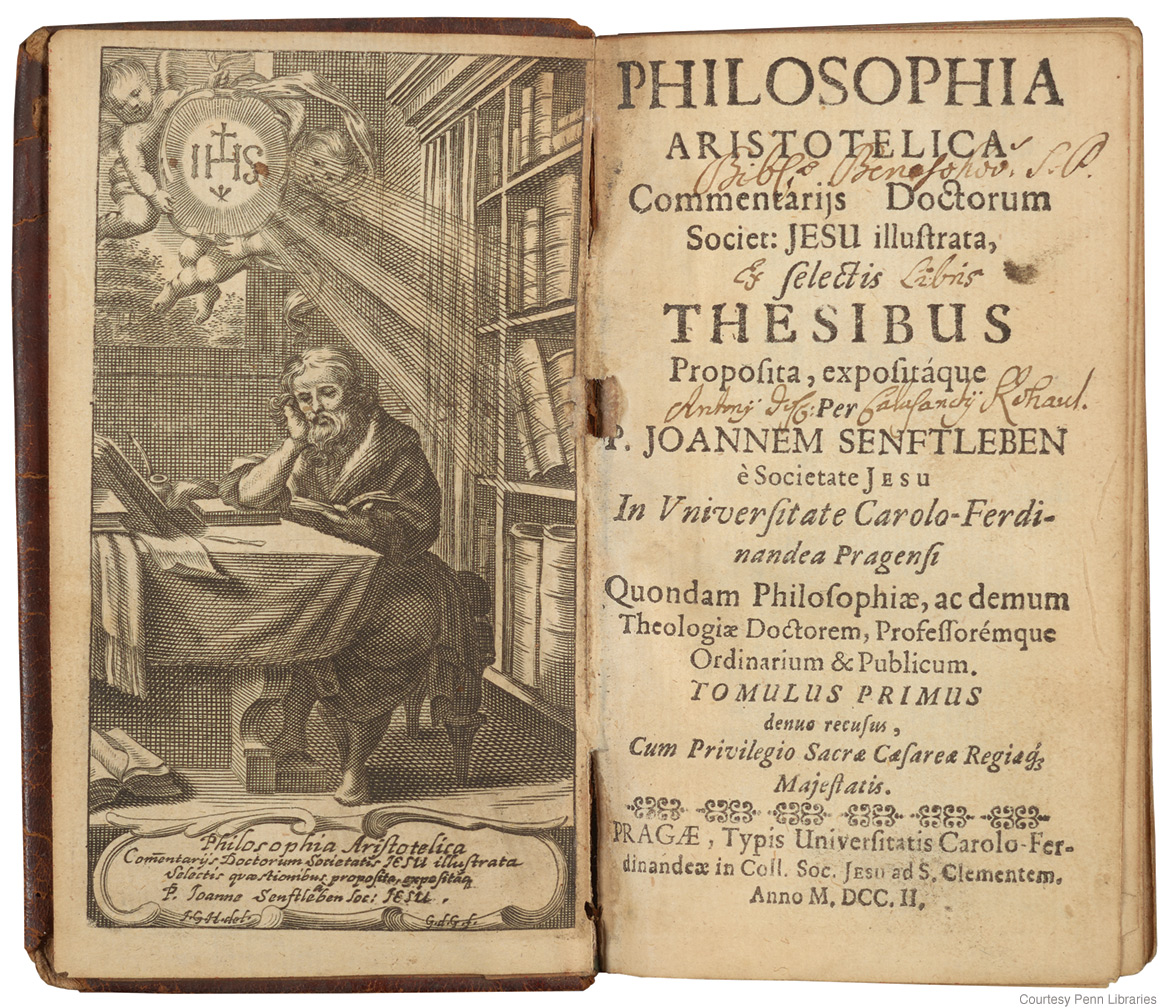
In about a dozen glass cases spread around the gallery, a lively variety of books and manuscripts make Aristotle out to be a great many things. An Arabic treatise from 1394, purporting to be a translation of a letter he wrote to his pupil Alexander the Great, details secret knowledge ranging from astrology to the magical properties of gems. A first edition of the infamous sex manual Aristotle’s Masterpiece boasts a frontispiece showing a naked and furry “Maid all Hairy” next to “an Infant that was born black, by the imagination of the Parents.” In different times and places, Aristotle has emerged as a devout follower of the Pope, a convert to Judaism, an expert on midwifery and conjugal pleasure-seeking, a cautionary character in medieval sexual morality tales, and the author of an Italian ABC of misogynistic sayings.
“One of the things this exhibit tells you is that we make our ancients over in the form in which we want them,” observed Anthony Grafton, an emeritus professor of history at Princeton University, in remarks at the exhibition’s opening. “We make Aristotle Christian because we need him to be Christian. Or we make him Jewish because we need him to be Jewish. … You make Aristotle believe that the world had a beginning—even though it’s pretty clear he actually did not believe the world had a beginning—but Christianity has a Creation and Plato has a Creation, so Aristotle’s got to have one too.”
Aristotle was plainly a victim of his own renown, and it didn’t help that many of his own literary works disappeared in antiquity. In medieval and early modern Europe—from which most of this exhibition’s artifacts derive—those circumstances set the stage for a rash of pseudo-Aristotelian manuscripts and publications. The motives ranged from religious evangelism to good old-fashioned profiteering. For peddlers of “gynecological works of a certain pornographic interest,” as Grafton described the fake Aristotle’s Masterpiece, “if you want people to buy them and think that they’re authoritative, say that this is Aristotle’s gynecological work of pornographic interest.”
The playful and thought-provoking exhibition is curated by Lynne Farrington, director of programs at the Kislak Center for Special Collections, Rare Books and Manuscripts; Hannah Marcus C’09, a professor of the history of science at Harvard University; and Eva Del Soldato, an associate professor of Italian Studies at Penn. “In the millennia since Aristotle’s death,” as noted in a summary, “the philosopher has been repeatedly reinvented by his students, his antagonists, his admirers, people wanting to cash in on his prestigious name, and even Shaquille O’Neal.”
That last figure would be the self-proclaimed “Big Aristotle,” who wore number 34 for the Los Angeles Lakers and had a penchant for the philosopher’s credo that “excellence is not a singular act, but a habit.” Which the Athenian did not actually utter, but does at least accord with his Nicomachean Ethics—which cannot be said about much of the material this diverting exhibition explores.—TP