Penn football’s new head coach has lofty ambitions for a 150-year-old program.
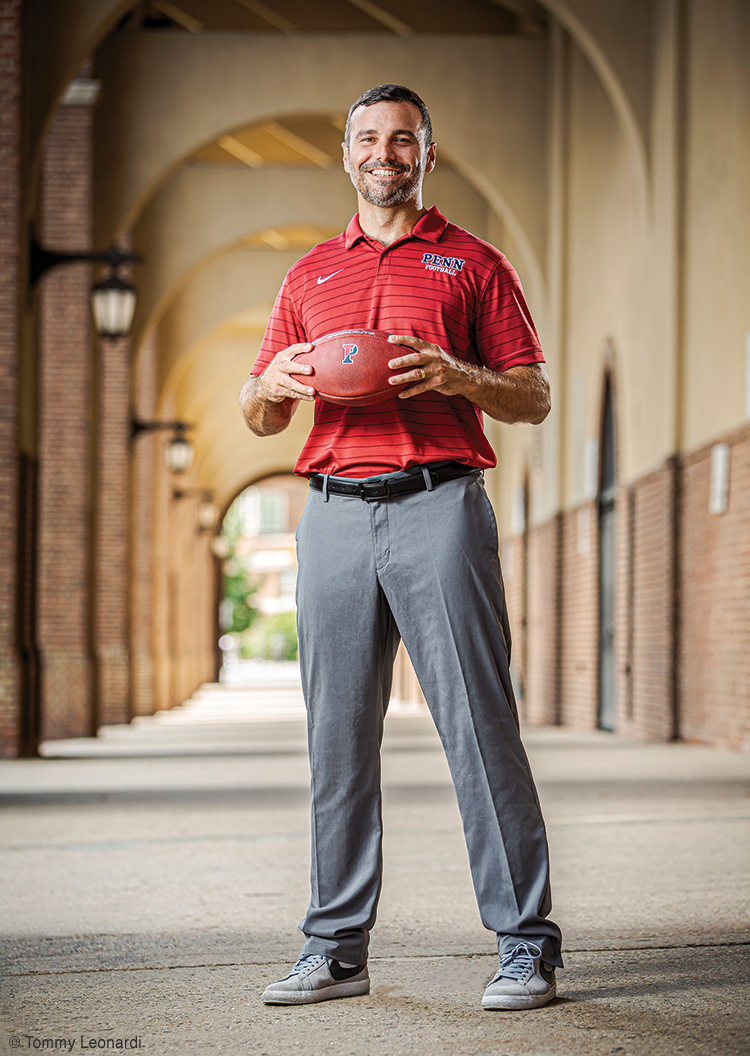
Not long after Rick Santos became Penn’s new head football coach, he and his staff landed a recruit who seemed to meld the program’s storied past with its lofty aspirations for the future.
Miles Teodecki, a standout quarterback from Texas, spurned offers from several power conference schools to come to Penn—where his father, Steve Teodecki W’97, played quarterback 30 years ago.
The younger Teodecki had initially committed to play at Kansas State, but after a coaching change there, reopened his recruitment in January. That prompted Santos to call his dad and persuade the family to come for an official visit. “And we instantly hit it off,” says Santos, who was hired to replace Ray Priore in December after a five-year stint as the University of New Hampshire’s head coach [“Sports,” Jan|Feb 2026]. “What’s not to love about him? A football family, a great competitor, brilliant, and obviously how talented he is as a football player.”
Although Teodecki’s family connection certainly played a role in his decision to play in the Ivy League over the country’s premier conferences, Santos believes the Quakers will be able to “move the needle” and reel in other big-time national recruits as he looks to position Penn back atop the Ivies after eight straight seasons without a title.
He is confident that he’ll be able to sell recruits on a vision that “you can accomplish everything you possibly want from here” by pointing to alums who earned Penn degrees before going to the NFL or, more recently, earning money as a graduate student player at another university during their fifth year of eligibility. To that end, networking with Penn football’s vast alumni base has been a critical mission for Santos, so students can not only get a glimpse into what a successful post-college life can look like but also advice on how to win Ivy League titles—which the Quakers won 18 of before their recent drought.
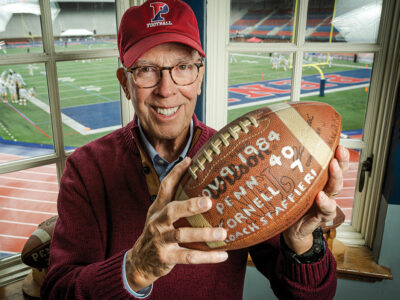
“I talked to a lot of guys who played on all of those championship teams over the decades, [asking] why were you guys so special? What made you different?” says Santos, who’s already been to alumni events in California, Texas, Florida, New York, and the Jersey Shore, among other stops. He’s also had Zoom calls from players dating back to the 1950s, learning some of the history of a program that will mark its 150th anniversary this season. (Penn lost its first intercollegiate contest to Princeton, 6–0, on November 1, 1876, in a game without helmets, pads, touchdowns—or coaches.)
In truth, though, Penn football’s rich history would be hard for the 42-year-old coach to avoid. Every day that Santos comes to work in an office overlooking historic Franklin Field, which has hosted 130 seasons of college football, he walks by old photos of program legends and items like a replica of the Heisman Trophy in honor of John Heisman L1892 [“Heisman’s Game,” Sep|Oct 2019]. “It’s humbling to be a part of this, and I don’t take that lightly,” Santos says. “I understand the expectations are really high in a program like this, but that’s what my staff and I signed up for. We want to compete and win championships and restore this great program to its glory.”
And beginning an exciting new chapter while celebrating 150 years of Penn football is a responsibility the Quakers’ first-year head coach embraces. “We need to acknowledge all the great past players and coaches that have come through this program,” he says. “It’s really balancing the two and making sure we can honor them with how well we play this year.”
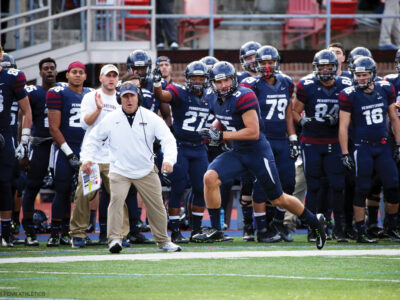
Although this year’s Penn squad lost a slew of key players to graduation, including standout receivers Jared Richardson C’26 and Bisi Owens W’26 (now playing, as graduate students, at Duke and Purdue, respectively) and quarterback Liam O’Brien W’26 (Cincinnati), Santos believes “we can win here early, and make an immediate impact in the Ivy League and beyond.” One thing he’s especially excited about is working with the quarterbacks—including Teodecki and junior Karson Siqueiros-Lasky, who’s been tapped as one of the team’s captains (along with linebacker Cole Olsztyn, offensive linemen Ryan Mitchell and Luke Sacchetti, and defensive back Josh Narcisse) and is in line to potentially start when Penn opens its season at Bucknell on September 19.
“The overall narrative is we have a lot of guys eager to prove themselves,” says Santos, a star quarterback while playing at New Hampshire. “We’re going to be flying under the radar this year. I think the whole league probably won’t expect much from us, and we’ve got something to prove.”
To build the program back up, “recruiting is the most important thing,” says Santos, who led New Hampshire to a 37–24 overall record and three Football Championship Subdivision (FCS) playoff berths in the last five years. Unlike at his alma mater, Santos knows he needs to “chase test scores around the country” in a nationwide search for recruits.
He also believes the transfer portal will pose less of a challenge than at other schools where you’re “constantly re-recruiting your roster” when players chase money elsewhere. “It’s kind of the bane of your existence as a head coach,” he says. While that still might happen occasionally at Penn (it did in the last offseason, for instance, when Malachi Hosley bolted for Georgia Tech), Santos insists the vast majority of recruits will stay with the Quakers, thanks in part to a new NCAA age-based eligibility model that allows most student-athletes to play five years in college without redshirting (though it’s still four in the Ivies). “We want to develop these guys and see them through” to an Ivy League degree—and then, perhaps, to another school after they graduate, as Penn has “a really good track record of fifth-year seniors transferring and getting paid a lot of money in the portal,” he notes.
Another rule change that could benefit recruiting is the one that allows Ivy League teams to compete in the FCS playoffs [“Sports,” Sep|Oct 2025], which began last year with Yale and Harvard both earning berths. With that in place, Santos thinks “in the next three to five years, the Ivy League is going to be a top three FCS conference,” he says. “We’re going to have multiple teams in the Top 25.”
And he is intent that the Quakers will be right there leading the charge, as they’ve done at various times throughout the program’s illustrious history. “There’s no doubt in my mind,” Santos says, “that in the next couple of years, we will be contending for national championships on a yearly basis.” —DZ