Amid an ever-shifting college sports backdrop, Ivy League teams can now participate in the football playoffs.
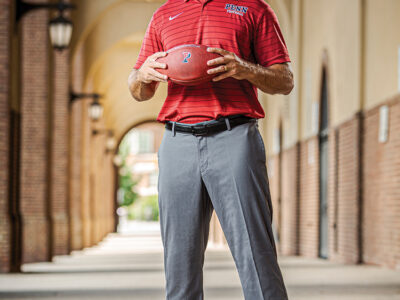
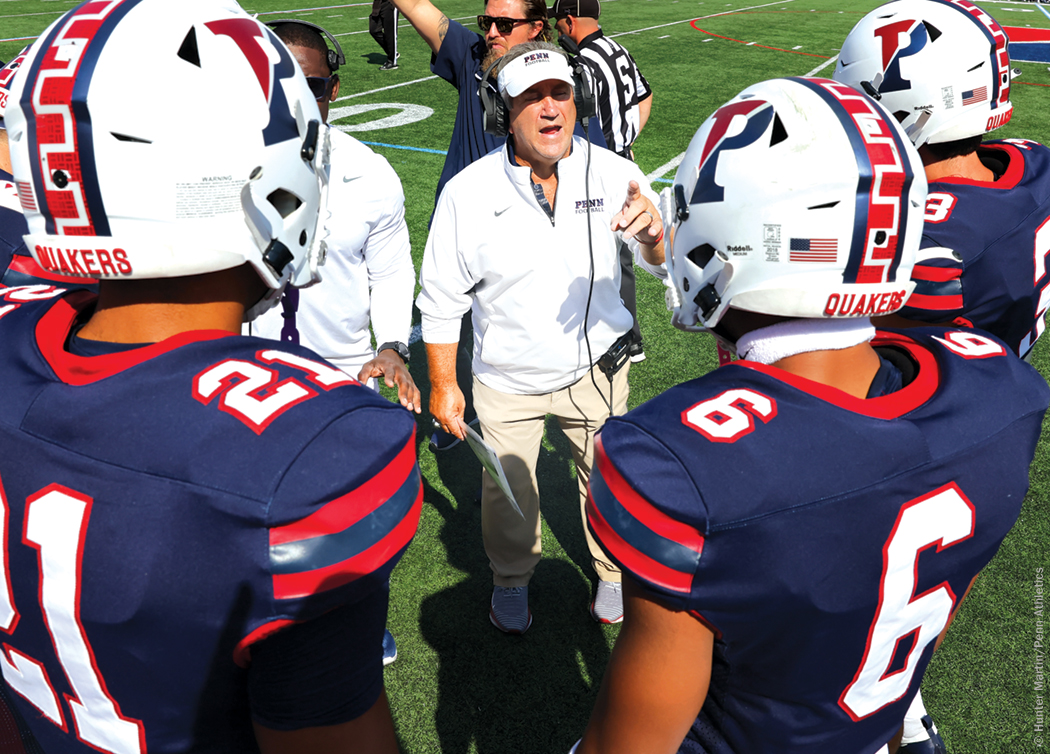
Sitting in his office in mid-July, ahead of his 39th year at Penn, head football coach Ray Priore is thinking about some of the best Penn football teams he’s ever seen.
There are the 1993 and 1994 squads that reeled off back-to-back undefeated seasons. The 2002 juggernaut that decimated almost everyone, and the 2003 group that followed with the program’s last 10–0 season. And then there’s the famed 1986 group that, a year before Priore arrived at Penn as an assistant coach, went a perfect 10–0 with a huge road upset win over Navy to boot.
It’s fun for Priore and others to ponder how far some of those teams might have gotten in the national playoffs had the Ivy League been eligible to participate.
Soon, they’ll no longer have to wonder.
Starting this season, Ivy League teams will for the first time be allowed to compete in the NCAA Division I Football Championship Subdivision (FCS) playoffs, with the conference winner getting an automatic berth. The Ivy League Council of Presidents reversed the longstanding league policy in December following a yearlong process initiated by the Ivy League’s Student-Athlete Advisory Committee.
“It’s a great thing for the league,” Priore says.
And a long time coming, too.
It’s been about 70 years since Penn gave up big-time football to join the Ivy League [“The Price They Paid,” Nov|Dec 2024]. The general principle since then has been that participating in a football postseason would disrupt final exams and run counter to the league’s longstanding commitment of prioritizing academics.
Over time, however, the league’s self-imposed postseason football ban felt increasingly archaic and unfair, especially as Ivy athletes in every other sport could compete for a national title. “There was never a good rationale, other than that’s what we’ve always done,” says Priore, who notes that coaches over the years have “always asked the question” regarding the postseason ban but had “never had the ability to push through” a change.
Why now? Priore chalks it up to student-athletes having “more voice” at a moment when the current crop of Ivy presidents seemed receptive. And in many sports, “we have our own Ivy tournaments now,” Priore notes, meaning “Ivy League sports in general have grown and developed through the years.”
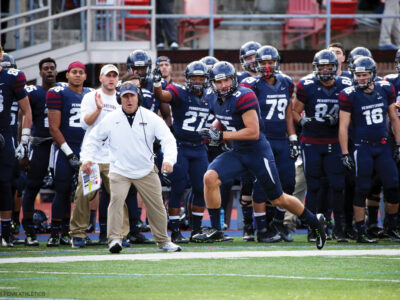
If there are any traditionalists who’d still prefer that Harvard versus Yale and Penn versus Princeton conclude every season, rather than an FCS playoff game, Priore hasn’t heard from them. He admits the news was “a little bittersweet” for members of past teams that were nationally ranked and could have “done some major damage” in the postseason. But current players, he says, are “really excited” to test themselves and now have an extra incentive for winning the league. “You just don’t know until you get to that next level,” he says.
As for disrupting final exams, Priore notes that the first two playoff games would be held before the exam period and would likely be somewhat regional. Only in the third round would potential conflicts emerge. But spring-season teams often face similar situations. And it’s unlikely any of the original Ivy architects would compare the FCS (formerly called Division I-AA) playoffs to the big-money postseason bowl games that once made them shudder. Should the Quakers win the Ivies, they wouldn’t be facing Alabama, Michigan, or any of the other powerhouses of the Football Championship Division (FBS, formerly known as Division I-A). The best FCS teams are mostly out of the limelight and in the Great Plains—North Dakota State, South Dakota State, Montana—while the top local teams often include Villanova and Lehigh.
The Ivies are still a world away from the “money that’s in college sports right now that’s really influencing a lot of decisions that are being made,” Priore says. And, in some ways, that’s hurting them. The ease of the transfer portal and the allure of Name, Image, and Likeness (NIL) money and Power Four conference football spurred running back Malachi Hosley to transfer from Penn to Georgia Tech in December, about a week after he became the 11th Quaker to be named Ivy League Player of the Year and the first to win Offensive Player of the Year.
Hosley’s departure was a tough one to swallow for Priore, though he understood the rationale and praised the star running back as a “phenomenal young man” with incredible talents. “His instinct, his vision, his athleticism, you just can’t teach that,” Priore says of Hosley, who established himself as one of the top FCS running backs with 1,915 rushing yards and 16 touchdowns over his first two seasons at Penn, catching the attention of high-level programs.
Other players have transferred before, but usually they graduate from Penn first—like defensive tackle Joey Slackman C’23, who won an Ivy League Player of the Year award the season before Hosley did, before finishing up his college football career as a graduate student at the University of Florida last year. Priore hopes Hosley leaving after his sophomore season doesn’t begin a trend, pointing out that over the years many of the program’s players have had scholarship opportunities coming out of high school but decided on Penn for the academics and “perhaps they got enough aid to make it affordable for their families.” Had the extra NIL incentive existed earlier, Priore wonders if someone like Justin Watson W’18 might have been “poached”—though with three Super Bowl titles since his graduation and a recent two-year, $5 million contract from the Houston Texans, the wide receiver has demonstrated that an Ivy League grad can make it big in the NFL, as others have before him.
Still, Priore said he was “worrying every minute” about other players transferring—and is pleased that standout wide receivers Jared Richardson and Bisi Owens are returning for their senior season, along with kick returner and offensive playmaker Julien Stokes and defensive lineman Paul Jennings, among others. “I think once our kids get through their junior year, they’re less apt to leave for just a single year,” the head coach reasons.
Richardson, Owens, and the rest of the receiving corps will be catching passes from senior quarterback Liam O’Brien, who assumed the starting role midway through last season when Aidan Sayin W’25 went down with an elbow injury. O’Brien—who set Penn single-game records for both passing touchdowns (six) and total touchdowns (seven) in a 67–49 win at Cornell last year—is “a little bit more mobile, more athletic” than Sayin and has developed “a great connection” with his receivers with impromptu summer training sessions in Central Park, Priore says.
O’Brien should also get solid protection as Penn returns all five starting offensive linemen, including preseason All-American Netinho Olivieri. “Our strength,” Priore says, “goes through the offensive line.”
On the other side of the ball, the head coach is confident the defense will improve, with Jennings and linebacker John Lista returning from injury. The key to capturing the program’s first Ivy title in nine years (and possibly becoming the first Ivy team to play in the FCS playoffs) will be figuring out how to avoid the narrow losses that caused the Quakers to stumble to losing conference records the last two seasons.
“They understand what the mission is,” Priore says. “We’ve worked hard on this. I think everyone understands that we’ve lost too many games by too few points.”
Coaching Shakeups
After a disappointing 4–10 season last spring, Penn decided to part ways with Mike Murphy GEd’04, the winningest head coach in Penn men’s lacrosse history. “While difficult, a change in leadership is needed to elevate the men’s lacrosse program to compete for Ivy and national championships,” athletic director Alanna Wren C’96 GEd’99 GrD’15 said in the announcement.
Murphy had led the Quakers since 2010, compiling a 109–96 record and a 44–40 mark in Ivy League play. He was named the Ivy League Coach of the Year in 2019 after guiding Penn to Ivy regular-season and tournament titles [“Sports,” Jul|Aug 2019].
Murphy was replaced in July by Taylor Wray, who arrived at Penn from nearby Saint Joseph’s University, a program he led to eight regular-season conference championships in 14 seasons. “It’s an incredible privilege to serve as a steward of more than 125 years of lacrosse history and tradition,” said Wray, an Edmonton, Alberta, native who starred collegiately at Duke and was an all-star player in the National Lacrosse League (NLL) for the Calgary Roughnecks and Philadelphia Wings.
Wren also announced a new head coach for the women’s volleyball program, with Tyler Hagstrom taking over for Meredith Schamun, who resigned in June to become the associate head coach at the University of Illinois.
Hagstrom comes from Bucknell, having earned Patriot League Coach of the Year honors last season after leading the Bison to their most wins in 30 years. —DZ