By Ben Yagoda
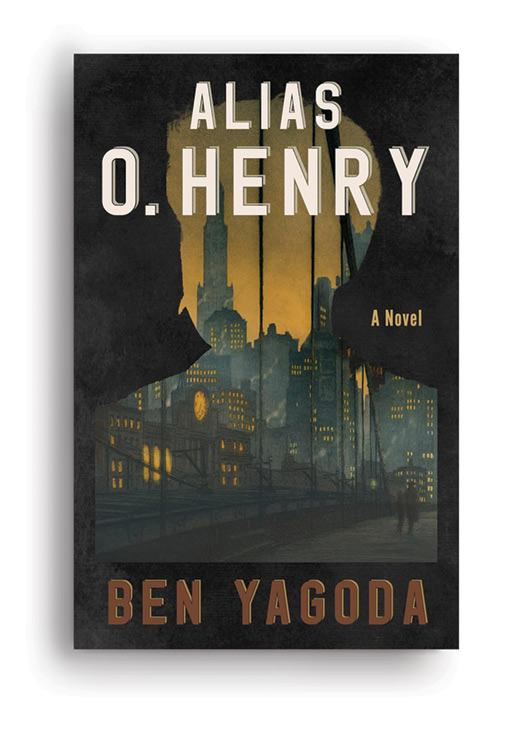
Paul Dry Books, 279 pages, $18.95
A new novel locates the enigmatic author known as O. Henry within a richly detailed portrait of New York at the turn of the 20th century.
Ben Yagoda G’91 is the author or editor of more than a dozen books—spanning subjects that include biography (Will Rogers), cultural history (About Town: The New Yorker and the World It Made), music (The B-Side: The Death of Tin Pan Alley and the Rebirth of the Great American Song), and several on language. But he’s never tried his hand at a novel—until now, with Alias O. Henry, a playful and densely researched tale about the prolific writer of popular fiction (some 400 stories and shorter sketches in all) whose “real” name was William Sidney (later Sydney) Porter. Gazette editor John Prendergast spoke with Yagoda about the elusive Porter and his own path to becoming a first-time novelist. Their conversation has been edited for length and clarity.
How did you come to O. Henry as a subject? And why a novel?
My first book was a biography of a somewhat comparable guy, Will Rogers, and I had this thought to do another biography. I’m not sure exactly how O. Henry got on my radar, but I started reading his stuff and stuff about him. I came upon this biography from 1957. And I just thought the author, Gerald Langford, had done a really great job, and I just didn’t feel like reproducing that.
So you thought of writing about him first, and then started reading his stories more seriously?
I was familiar with “The Gifts of the Magi” and “The Ransom of Red Chief,” and another one I’m forgetting the name of, about a guy who deliberately gets arrested [“The Cop and the Anthem”], but that was it. I had the sense of him as sentimental, somewhat hokey—and that’s not totally unfair, but I was really impressed with how funny and clever many of the stories were, and also the portrait of New York in the period. He was known as the chronicler of New York, but he set foot in New York for the first time in 1902, at the age of 40. It was all new to him, and that was fascinating to me. So I proposed doing this collection of the stories for the Library of America and did that.
In Langford’s biography—which is also called Alias O. Henry; I acknowledge borrowing or stealing the title—and the others that have been written about Porter, he was an enigmatic person, and he was very secretive. And this big catastrophic event in his life was his being arrested and tried and convicted for embezzlement and spending three and a half years in prison. At his trial, he essentially didn’t mount a defense—he didn’t plead guilty, but he just presented no defense. And this led the early biographers, which are sort of hagiographies, to say, ‘Well, he really didn’t do it. He was covering up for somebody.’ But they never said who. And there were other mysteries as well.
I forget where I saw this analogy, but it compared a historical novel to a kind of a tent pole where the poles are the verifiable facts, and then to get from one to another, you can use your imagination to try to present some sort of explanation. So that was really how it all got started.
One of the great aspects of the book is the portrait of the magazine industry and New York in general that it presents. Is there anything else you want to say about how you went about researching that and weaving it all in?
I bought on Kindle for like $2.99 the Complete Works of O. Henry, which can be done because they’re all in the public domain. For the novel, I had this color-coded note-keeping system. One color was any sort of slang or language term, and another was any sort of scene that I might incorporate into a book. One of the books I was reading that really inspired me was called Greater Gotham: A History of New York City from 1898 to 1919 by Mike Wallace. And just doing any sort of historical project within a certain period, in this day and age there’s so much online. With newspapers.com and the New York Times archive and the Internet Archive, I was able to get so many contemporary sources.
A variety of famous characters pop up for cameos in the story. Was that something you were on the lookout for?
Oh, definitely. There were a number of people who were in New York at the time that I didn’t really get a chance to weave in—like Maxim Gorky was around and about, and [Enrico] Caruso was a sort of colorful character I didn’t get in there. But yeah, that was a fun thing. Some of them are relatively major characters like [the Old West icon] Bat Masterson and Edwin Porter [who directed The Great Train Robbery]. But there are a few that I don’t mention by name, and I’m kind of interested to see if readers pick up on them. Definitely a couple have already.
Another running theme is people asking why he calls himself O. Henry and Porter coming up with different stories to explain it. You have your own answer, which I won’t give away, but were those real stories? They’re wonderfully varied.
They’re all things that he really said or were said by others as a serious explanation, and the majority of them are in that Langford biography. I hit on that early on as just such an amazing example of him messing with people and not wanting to reveal anything, and I guess also his imagination.
How different was the experience of writing a novel versus your usual process? Are you interested in that genre now for the future?
Well, it started out probably too similar, in that like with a biography or historical work, or any sort of nonfiction works that I’ve done, I just load up on the research. Part of it is kind of a security blanket, just to know that you had that. And also, the more you know, the stronger the writing is. It’s a bit of the Hemingway iceberg theory—that what you write is the tip of the iceberg, but you need that stuff under the surface to support it. But the early drafts of the book were a little too research intensive at the expense of things like character and plot and intention and stuff like that. So each successive draft—of which there were four or five—got less research stuff and more with the characters. And probably that was the main thing I learned in the course of doing it.
Reading interviews with fiction writers over the years, a thing you hear a lot is someone saying, ‘It got to the point where the characters took over. I surprised myself with what came out.’ And by the end, I got a little bit of that, and that was nice. As for another one, I don’t know. I wouldn’t bet on it.