
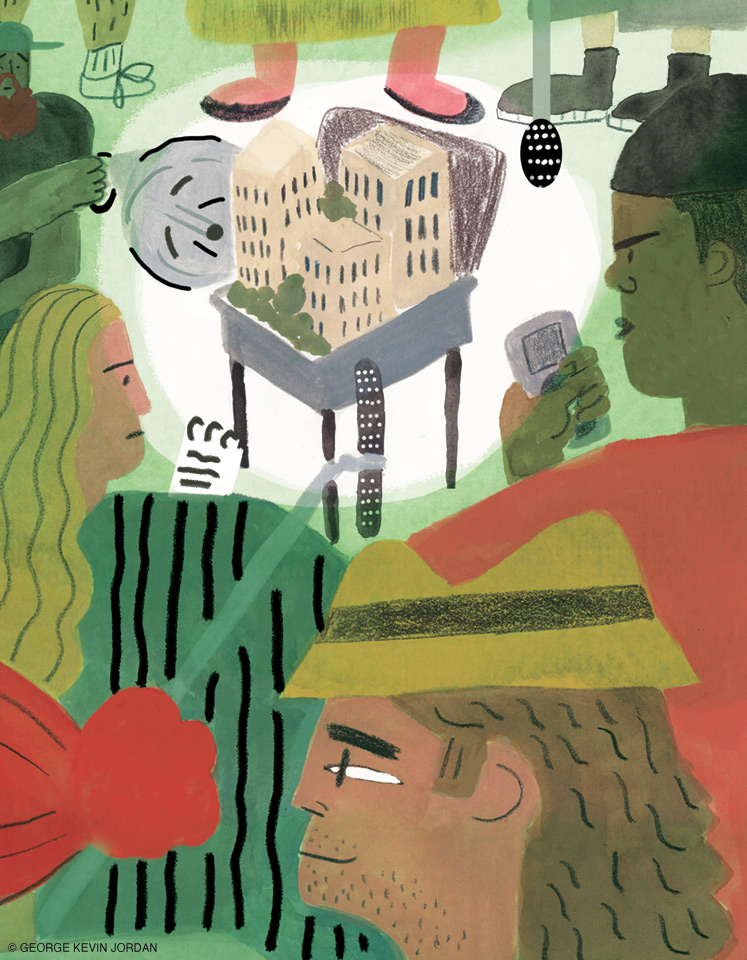
A new course probes the connection between neighborhood sounds and identities.
It’s the end of April but it feels like summer has suddenly arrived. The windows of a small conference room in the Jaffe History of Art Building at 34th and Walnut Streets are thrown open, inviting the sounds of the city to enter: the tentative honking of cars, the muffled chatter of campus passersby, the soft bounce of a plastic bottle being tossed into a bin. A chorus of bird calls and chirps floats through this appropriate soundtrack for an afternoon where about a dozen students are presenting summaries of the final projects they will be handing in to Stanley Collins for his course, Listening to the City: Soundscapes, Music, and Place.
The Urban Studies course builds on research that Collins—a provost’s postdoctoral fellow in city and regional planning at the Weitzman School of Design—conducted while pursuing his PhD in sociology at Temple University. The Philadelphia native worked on a project related to gentrification while getting his master’s in sociology at Oklahoma State. After moving back home to pursue a doctorate, he began wondering if he could somehow bring his passion for music into his ethnographic studies. “I started going to concerts and one night I ended up at the Fillmore in Fishtown,” he says. “I was sitting there, sort of drifting mentally and looking around the room, when I noticed a furnace in the corner.” That got him wondering about the building’s original purpose—and how it had come to be converted into a trendy music venue. His idle musings would provide the fodder for his dissertation.
Turns out, the structure had been built in the early 1900s, one of many warehouses and manufacturing plants that once called the area home. Along with unpacking its industrial bones, Collins learned that the white working-class neighborhood had acquired a reputation as being insular, racist, and hostile to outsiders. The advent of clubs and music venues in the last 20 years, though, has hastened gentrification while aiding the neighborhood’s recovery from its post-industrial doldrums.
In Collins’s class, that confluence of music, racial identity, and gentrification is the basis of listening to the city. One student, for example, examined changing neighborhood dynamics by capturing soundscapes in West Philly’s Cedar Park area and comparing them to recordings made by David Guinn and Aleks Martray in 2008 to accompany Guinn’s mural The Heart of Baltimore Avenue. Another combined interviews with her own experiences as a young line dancer to better understand how soul line dancing spaces contribute to community formation, particularly for aging Black women in the city. Using yet another research method, an undergraduate analyzed news coverage and social media posts to dig into racialized and religious-based noise complaints made in Singapore about both mosques and the sounds of Hindu bellringing.
Collins says he designed his inaugural class to give students the sociological tools to analyze varied aspects of urban development. One of the first projects for the students was to create a “sound biography” from sourced audio and video clips that evoked their homes. Later, in an echo of the trajectory that brought Collins to teach this class, the students dug deeper into various public spaces by recording their acoustic environments and researching their histories. Another activity sent them off to parts of campus—the Franklin’s Table food court, the Inn at Penn, a local CVS—to examine the background music and consider why it had been chosen and who it was meant to attract.
Collins is teaching the course again this spring with additional readings planned and more activities outside the classroom, including visiting local music venues and speaking with the staffs there about their successes and challenges. “Too often, we privilege the visual over the auditory,” Collins says. “I certainly do because of my training and work. But this is a budding strain of research and I’m happy to be able to explore it with my students.”
—JoAnn Greco


