Weitzman School alumni and faculty are prominent in a movement to make US playgrounds more challenging, stimulating, educational—and fun!—for users of all ages.
By JoAnn Greco
Download a PDF of this article
We all hold a certain image of a “playground” in our mind. For children of the 1960s and 1970s, it might involve skin-searing steel slides, knee-scraping concrete, and bruise-inducing monkey bars assembled from pipe fittings. For later generations, the images may be less abrasive, soaked in neon-hued plastic and vivid green artificial turf.
Today, though, your grandkids and kids are forming different memories.
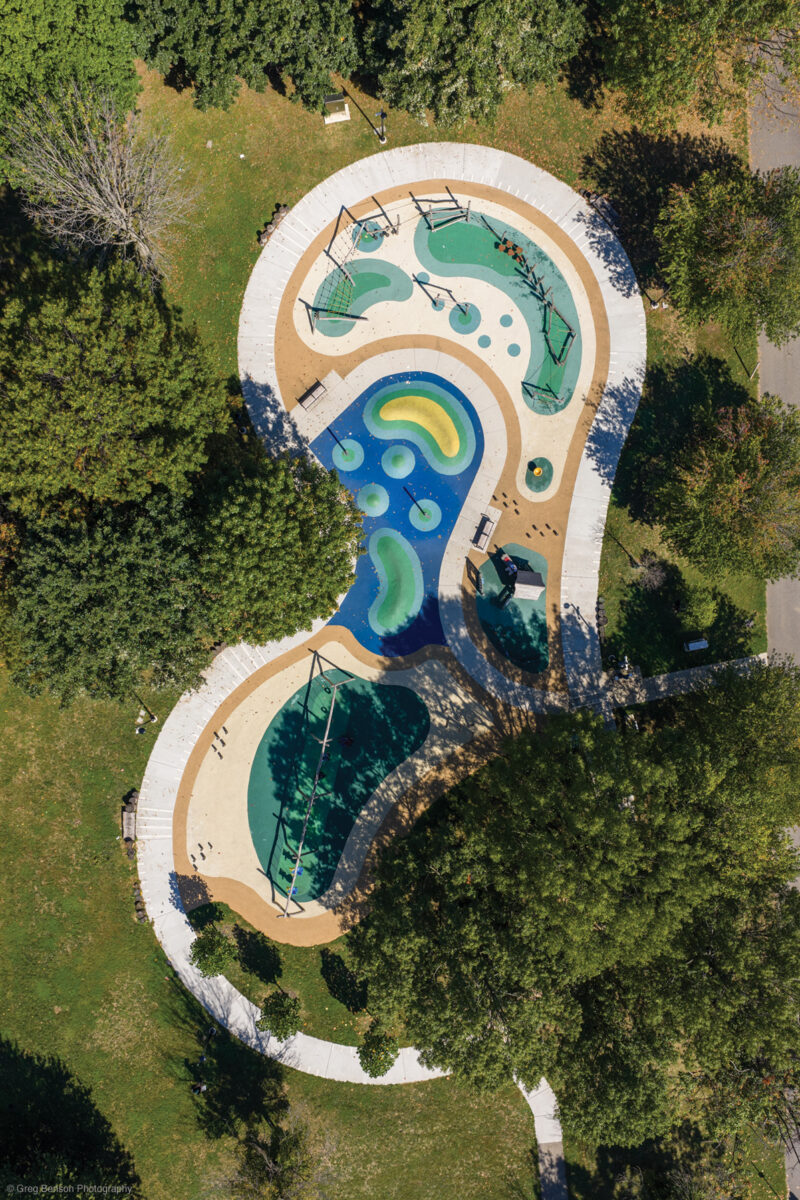
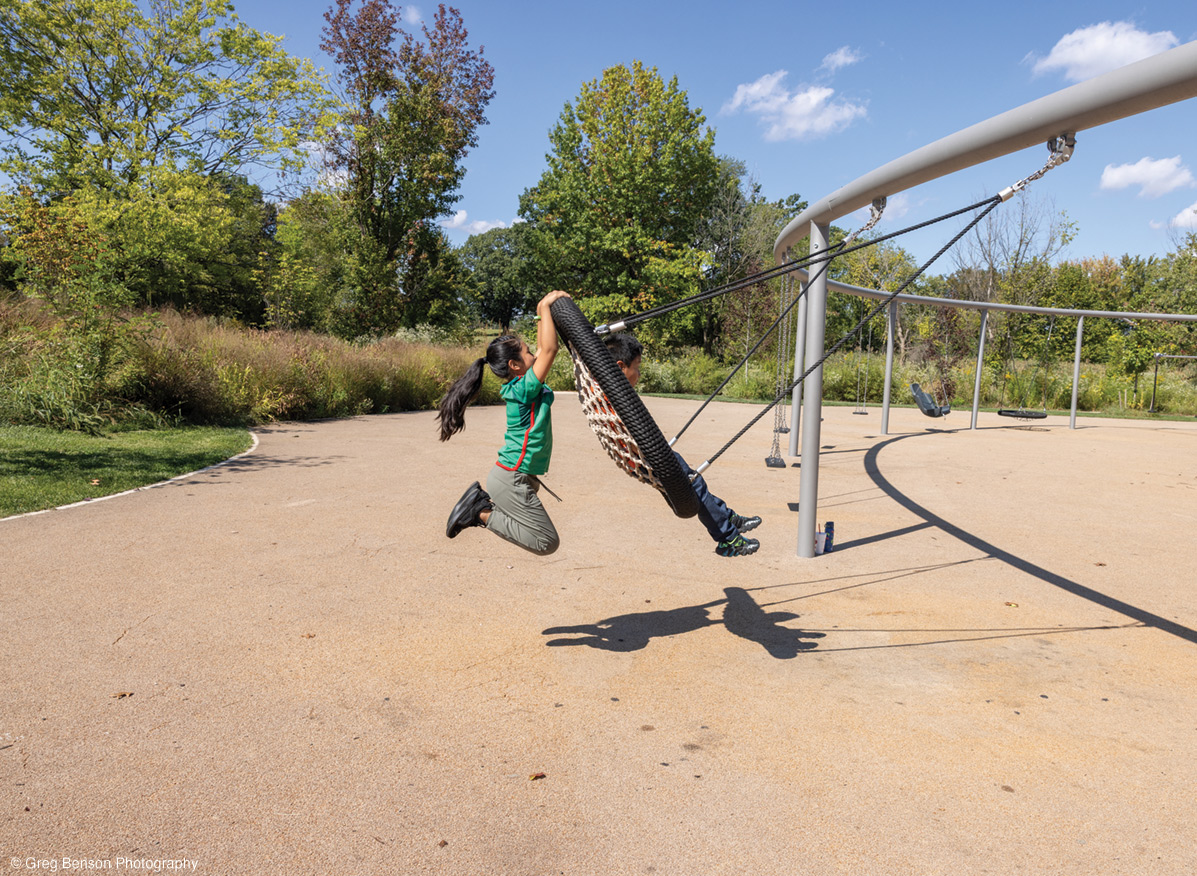
In South Philadelphia, they may find their way to a destination like the Anna C. Verna Playground, a small part of a $250 million makeover to sprawling FDR Park. As you approach this two-acre, $5 million dreamscape, three soaring, intricately constructed, birdcage-like climbing structures beckon with infinite possibility. At the center of the playground, an array of nearly two dozen swings is positioned around a huge oval, ready to accommodate up to 30 people of all sizes.
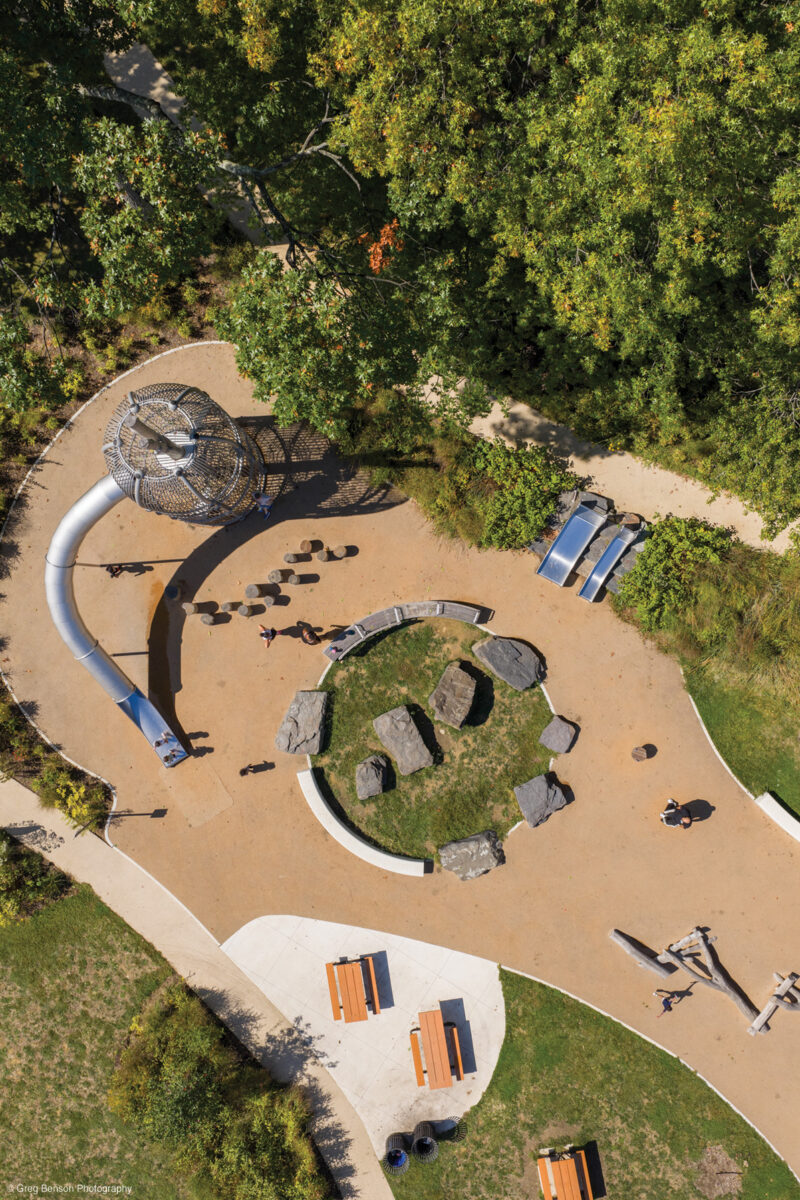
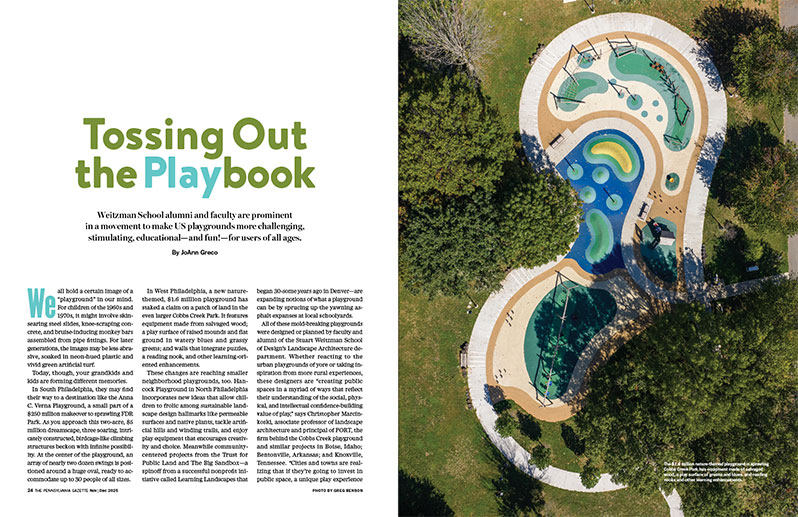
In West Philadelphia, a new nature-themed, $1.6 million playground has staked a claim on a patch of land in the even larger Cobbs Creek Park. It features equipment made from salvaged wood; a play surface of raised mounds and flat ground in watery blues and grassy greens; and walls that integrate puzzles, a reading nook, and other learning-oriented enhancements.
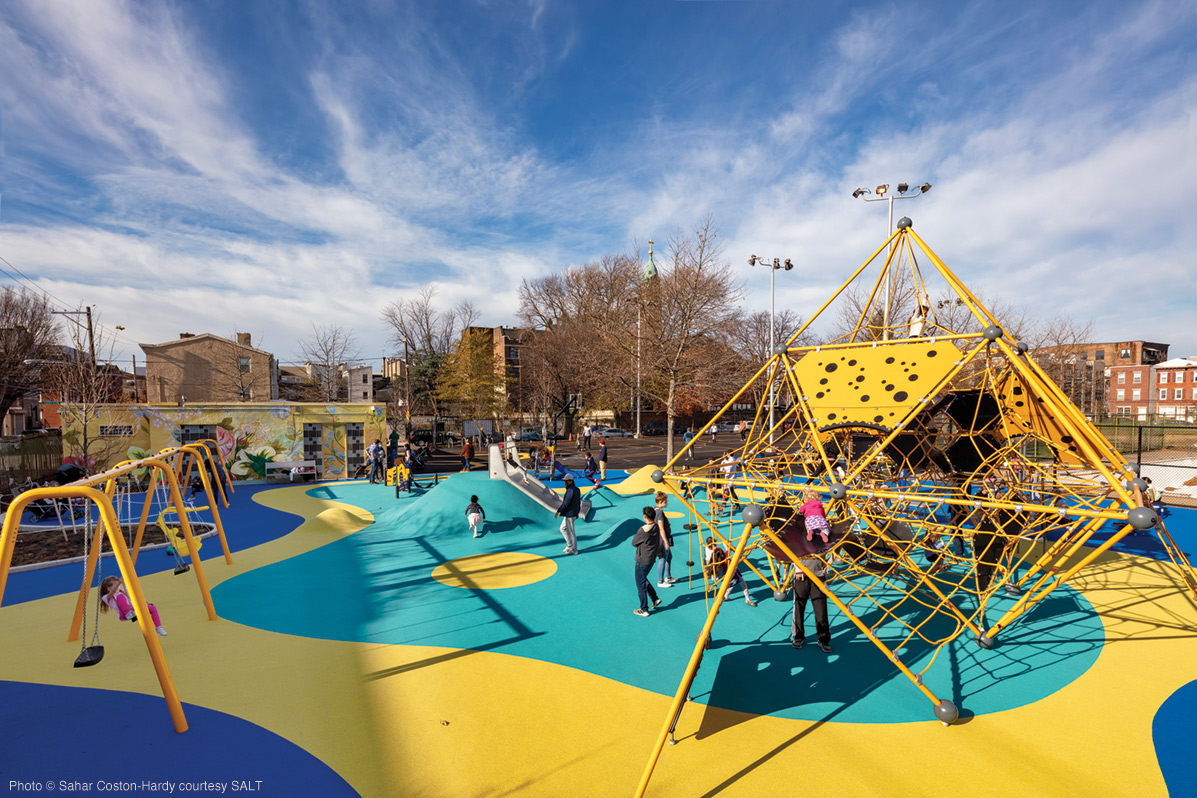
These changes are reaching smaller neighborhood playgrounds, too. Hancock Playground in North Philadelphia incorporates new ideas that allow children to frolic among sustainable landscape design hallmarks like permeable surfaces and native plants, tackle artificial hills and winding trails, and enjoy play equipment that encourages creativity and choice. Meanwhile community-centered projects from the Trust for Public Land and The Big Sandbox—a spinoff from a successful nonprofit initiative called Learning Landscapes that began 30-some years ago in Denver—are expanding notions of what a playground can be by sprucing up the yawning asphalt expanses at local schoolyards.
All of these mold-breaking playgrounds were designed or planned by faculty and alumni of the Stuart Weitzman School of Design’s Landscape Architecture department. Whether reacting to the urban playgrounds of yore or taking inspiration from more rural experiences, these designers are “creating public spaces in a myriad of ways that reflect their understanding of the social, physical, and intellectual confidence-building value of play,” says Christopher Marcinkoski, associate professor of landscape architecture and principal of PORT, the firm behind the Cobbs Creek playground and similar projects in Boise, Idaho; Bentonville, Arkansas; and Knoxville, Tennessee. “Cities and towns are realizing that if they’re going to invest in public space, a unique play experience is part of what will make the project successful,” he continues. “There’s a real contrast between the green plastic off-the-shelf, catalog version and the kind of projects that we and others are involved in. They inspire curiosity and joy and become part of what a place is known for, part of its identity.”
For a long time, “we’ve had a very fixed idea of playgrounds in the United States,” says Meghan Talarowski GLA’13, a playground researcher and designer whose Philadelphia-based nonprofit firm, Studio Ludo, is responsible for the FDR playground. “It’s been about platforms and posts and plastic, where a child climbs up and slides down and then does it all over again. A researcher in London calls them KFC—kit, fence, carpet. You buy the thing, lay it out on a soft pad, and you’re done. Our goal at Studio Ludo is to create places, not to check boxes. My strong belief is that everyone deserves a great place to play,” she adds. “And kids don’t get to choose where they grow up.”
When Talarowski—who’s been a rock climber since she was in her teens and has also worked as a climbing instructor—thinks of her own first experiences with play, she doesn’t remember a playground so much as bike jumping and running around in the acres of open space that beckoned just a block away from her suburban home in Northern California. “It took until I was an undergraduate and living on the South Side of Chicago near some public housing towers to understand how special having access to space and nature was,” she says. “I realized that for many children, that isn’t part of their lived experience.”
Sara Pevaroff Schuh GLA’95, founding principal of Philadelphia-based SALT Design Studio, the team behind Hancock Playground, similarly remembers spending her childhood summers on a remote island in Canada. “We had a makeshift cottage on Lake Huron with no running water or insulation,” she says. “Even into my 20s, I didn’t really understand how much it shaped my opinions about what constitutes nature and what play is.”
Lois Brink C’76 GLA’78, founder of Learning Landscapes and the Big Sandbox, grew up in Philadelphia’s Mt. Airy section. There were “no playgrounds in my neighborhood—we played in vacant lots,” she says. But she too fell in love with nature as she spent great swathes of time on a Canadian island that her family owned in the St. Lawrence River. “I know it sounds luxurious, but it was very primitive,” she says. “Things would rot away in front of your eyes and fixing them became a big piece of my play experience.”
Understanding Play
No matter where it happens, play is a vital contributor to childhood development. The United Nations even regards it as a fundamental right, along with shelter and education. And while it’s been observed that “play is the work of childhood,” many believe it hasn’t always gotten its due. “In the 1990s, there was a rush for parents to get their kids to be the geniuses of the future—and ‘play’ became a true four-letter word,” says Kathy Hirsh-Pasek Gr’81, a psychology professor and director of the Infant and Child Laboratory at Temple University. “But what we’ve found since then is that the very definition of play—to be engaged, interactive, joyful—are the same characteristics behind how we learn and thrive. Children don’t respond well to being empty vessels that teachers pour information into.” Through play, she says, they can easily practice what she calls the “6C” learning skills—collaboration (building something together); communication (listening, writing, talking); content (learning facts or acquiring self-regulatory behaviors); critical thinking (sifting through information); creative innovation (solving problems in new and original ways); and confidence (persisting through failure).
“I’m very interested in seeing how we can translate this new science of learning, especially since kids spend about 80 percent of their waking lives outside of school,” Hirsh-Pasek continues. “This becomes particularly important for those from under-resourced environments who might not have a functional playground nearby, or even puzzles or books in their homes.” Addressing those gaps is the idea behind Playful Learning Landscapes (PLL), a nonprofit which she cofounded in 2010 to introduce fun reading and math experiences into places like libraries, laundromats, and lobbies.
The idea that play can enhance children’s development and not just be a babysitting tool has been around for a while now. Historian Susan G. Solomon Gr’97 opens her 2014 book The Science of Play: How to Build Playgrounds That Enhance Children’s Development (University Press of New England) with a 1965 quote from Marjory Allen, an English noblewoman and landscape architect: “Life demands courage, endurance and strength, but we continue to underestimate the capacity of children for taking risks, enjoying the stimulation of danger, and finding things out for themselves.” After a tour of playgrounds in Boston, New York, Philadelphia, Baltimore, and Washington, DC, Lady Allen professed herself to be “totally shocked” by what she found, the New York Times reported. “Children quickly tire of fixed mechanical equipment, she believes, and of the ‘over-slick’ play sculpture which, being immobile, is useless to the energetic young,” the story continued.
Solomon’s book highlights the different values that researchers claim children need to develop in order to thrive, and which go missing in most American playgrounds: risk, mastery (with the possibility to fail on the way to success), executive function (planning, problem solving), friendship (including having pals of differing ages), exposure to nature, and rough-and-tumble play. She wrote of her visits to Europe and Japan, where designers have produced playgrounds that “invest trust in young people, avoid the rigidity and predictability of traditional playground equipment [and] are cost effective, usually sustainable and accessible, and frequently unique.”
Children who play in this fashion “can mature physically, emotionally, and cognitively in a way that has nothing to do with reading or school as we know it,” Solomon says. “It’s a different kind of learning, but a simple plastic piece that has kids go up the stairs, across a bridge, and down a slide over and over again, won’t do it. Figuring out something challenging and taking a physical risk, or being able to hide, or to move things around to reconfigure them—all of that leads to creative ways of learning and thinking.”
The late Brian Sutton-Smith, a world-renowned expert on play who taught in Penn’s Graduate School of Education between 1977 and 1994, was an outspoken advocate of the value of play for its own sake. “Much of the modern developmental psychological emphasis is only upon the increases in ‘useful’ learning and cognition that play does include—literacy, numeracy, and so forth,” he wrote in the Gazette in 2008. “Certainly learning in this more limited sense is a valuable part of play, but play has its own purposes that are more fundamental. Adults may sometimes be able to understand what children are accomplishing by it, but often they will not—and perhaps cannot, given how self-contained and irrational the mental worlds of children sometimes appear to be.” [“To Play or Not to Play,” Jan|Feb 2008.]
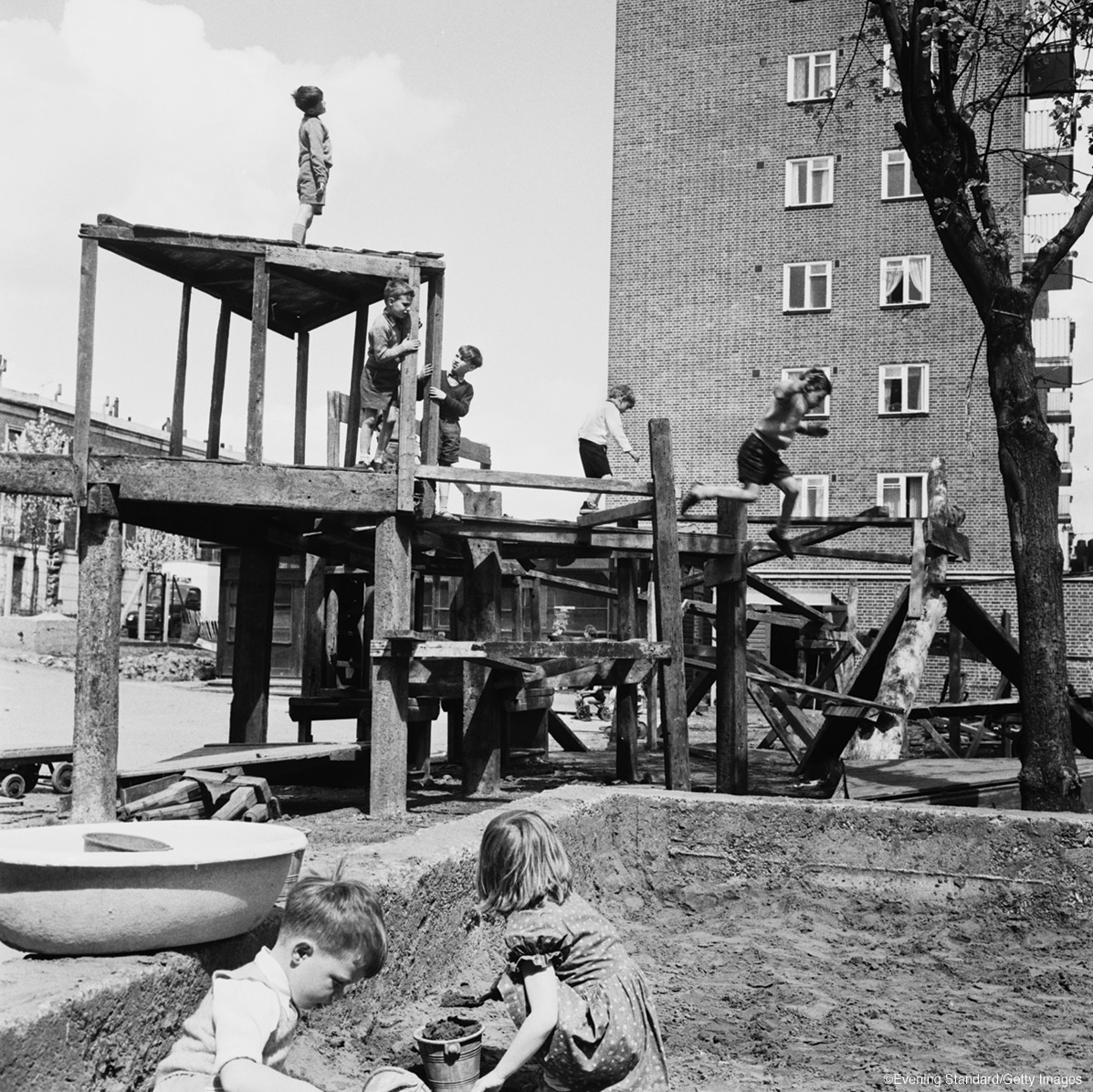
European countries have set the standard of what makes for exciting play ever since landscape architect Carl Theodor Sørensen noticed kids romping among rubble in Copenhagen and created the first “junk playground” in 1943. Lady Allen ran with the idea a few years later to develop former World War II bombsites and other locationsinto a slew of “adventure playgrounds” in London, where kids hammered and clambered away, building and tearing down their constructions with abandon.
When Talarowski found herself living in the English capital for a spell in 2015, she discovered that some 70 years later the city had continued to innovate when it came to playground design. “There was wood all over the place, huge concrete mountains with slides, a lot of landforms, giant tree houses, tons of sand and water play,” she says. “The play environments were so diverse and so much pushing the envelope. They also had great support for caregivers, with clean bathrooms and really nice cafes.”
Inspired by what she discovered as she wandered around town with her toddler, Talarowski—who had helped develop a research arm at OLIN during a stint with Laurie Olin’s eponymous landscape architecture firm [“Mr. Olin’s Neighborhood,” Jul|Aug 2007]—launched Studio Ludo (Latin for I play). She spent a few months taking videos at 16 London playgrounds and used them to document the apparent age, gender, ethnicity, and physical activity of 18,142 people. She then compared data from an American study that focused on playgrounds in New York, San Francisco, and Los Angeles of similar size (.25-.75 acres) and population density (50,000-175,000 people within a one mile area) to those in London. She discovered that the London playgrounds had 55 percent more visitors, 14 percent more adults, and that children and teens were 16-18 percent more physically active. London also had the advantage when Talarowski compared costs, due in part to the use of grass and sand cushioning rather than rubber tile, and a predeliction for turning boulders, logs, topography, plantings, and trees into play enhancements.
Talarowski had gained experience designing more traditional playgrounds while working for the Trust for Public Land shortly after completing her undergraduate studies in architecture at the Illinois Institute of Technology. “On my first day, they gave me a box of equipment catalogs and said go!” she recalls. “There was no training on best practices or anything, but these environments are really essential for kids’ development, and I just thought we should know more. That’s why I started Studio Ludo, to share and educate and dive deep into what it is people want from their play experiences.”
She ended her report with a call to action. In responding to the perceived dangers that many parents believed had plagued America’s playgrounds, the US had reached “peak safety,” she wrote. “We have created a nation of overly expensive, homogeneously safe and insidiously boring play spaces. To turn the tide, the solution is to follow London’s lead.”
Her recommendations included: designing for all ages, since she found just about an equal number of adults and children using the playgrounds; thinking outside the catalog, by using grass and stones and logs as design elements and opportunities for “loose parts play”; and remembering that risk is a good thing. In the lower right-hand corner of the final page, she added a few sentences that would become her mantra. “Everyone loves boulders. Sand brings out the kid inside us all. Caffeine and a bench are keys to playground success.” The New York Times wound up referencing the report, which was eventually published in the journal Public Health in a 2019 article on risky play.
After several years of practice back in Philadelphia, Talarowski undertook a new study in 2021. This time she had a client—the National Institutes of Health (NIH), who charged her with assessing the state of American playgrounds. The report, Playground Design and Physical Activity, compared 30 post-and-platform playgrounds with 30 innovative playgrounds—defined as “having a variety of surface types; naturalized and planted areas designed for play; open-ended structures that do not dictate play sequences; loose, movable equipment; and not comprised solely of traditional structures.” Her team found that innovative playgrounds in the 10 cities studied attracted more than twice as many users and generated almost three times as much moderate-to-vigorous physical activity. (After controlling for playground size, population density, neighborhood poverty, and destination location, innovative playgrounds still attracted 43 percent more visitors than traditional playgrounds.)
“Risk has always been hard to sell to Americans,” says Solomon. When she was writing her cri de coeur for more inventive play, “landscape architects working in the US would say, ‘This is what I’ve been feeling for some time, but we’re so hemmed in by the guidelines and the municipalities,’” she adds. “That’s why Meghan’s approach, to look at what people want, is so valuable. Her data is so strong that cities are taking notice, and we’re finally seeing some play spaces—especially the bigger, destination ones—that are more helpful to kids’ development.”
As American communities start to come around, playground equipment manufacturers have responded with taller, faster play apparatus that are made of natural materials and present children with more choices and challenges. Playground guidelines, too, have been updated to reflect a broader understanding of the importance of balancing safety with the developmental benefits of play. “Designers recognize that there are certain metrics in reading and math that kids need to achieve, and we know that a lot of children in Philadelphia and other cities are behind in those metrics,” Talarowski says. “But being comfortable with sitting still comes more easily when there are opportunities to channel your energy. Innovative playground design works toward those goals by incorporating play that keeps kids engaged and challenged—in contrast to traditional playgrounds, which become dangerous precisely because kids get the hang of them so quickly and start looking to do things they’re ‘not supposed to do,’ like climbing up the outside” of a structure.
Redefining Play
Introducing calculated risk is one of the touchstones of today’s forward-thinking playground designers. And the research backs them up. “Norwegian child psychologist Ellen [Beate Hansen] Sandseter has become a leading scholar of risk,” says Solomon. “Her characteristics of risky play include achieving fast speeds, going to great heights, being able to get lost, and rough-and-tumble play.” Sandseter has observed that children negotiate their way between truly dangerous activities and the ones that merely seem scary. “When they reach their own sense of equilibrium,” Solomon writes in her book, “they express … glee in having an experience for which there is not a single route or a known conclusion.”
At the FDR Park playground, for example, risky play is built into the birdcage structures to allow ambitious climbers to test their limits. “The tallest tower starts with a wobbly ladder,” Talarowski says. “Then it has a net spiral, which lets you get to the top quickly, but if it feels too scary you can easily retreat to try again another day. Its connected twin is intentionally a little tighter and trickier for teens and adults to navigate, and its slide is shorter,” the designer adds. “The wishbone climbers and log scrambles are non-prescriptive, so kids can use them however they want … climbing, laying, balancing.”
One of Studio Ludo’s most ambitious efforts yet, the FDR Park playground taps into another hallmark of envelope-pushing playgrounds: inclusivity. Its sophisticated material palette—wood, steel, and ropes, with no bright colors—is designed to make all ages feel welcome, while the smallest, separate tower has a transfer platform to a net spiral for those with limited mobility that also allows an adult caregiver and a younger child to climb and play and slide together. “The idea of inclusive play started with providing for those with disabilities,” says Talarowski, “but it’s opening up to include all generations in response to the fact that we are aging as a society—by 2030, there will be more people over the age of 65 than under the age of 16. Rather than so-called ‘adult playgrounds,’ my goal is to give parents the chance to play with their children.”
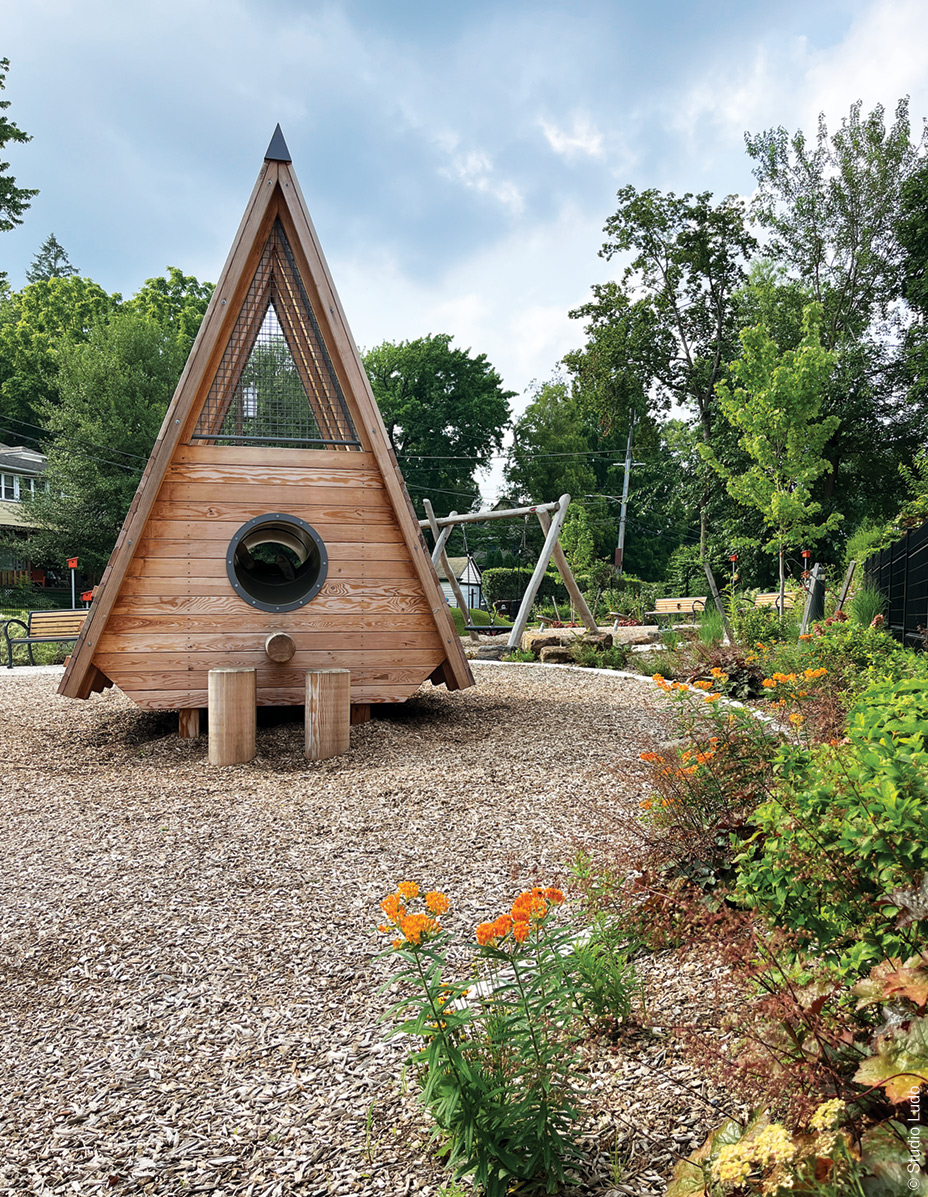
Nature playgrounds such as Studio Ludo’s McKinley Park—a transformation of an asphalt parking lot at the end of a tree-lined street in suburban Lansdowne, Pennsylvania, into a play space for the under-five set—are another trend. While a slide, swings, and spinners keep little ones active, opportunities for adventure play and loose parts play are everywhere, from the native plantings whose sticks and seed pods have boundless appeal to both children and birds, to boulders and logs that invite sitters and scramblers, to a focal point play structure that resembles a birdhouse and offers opportunities for hiding, climbing, and perching.
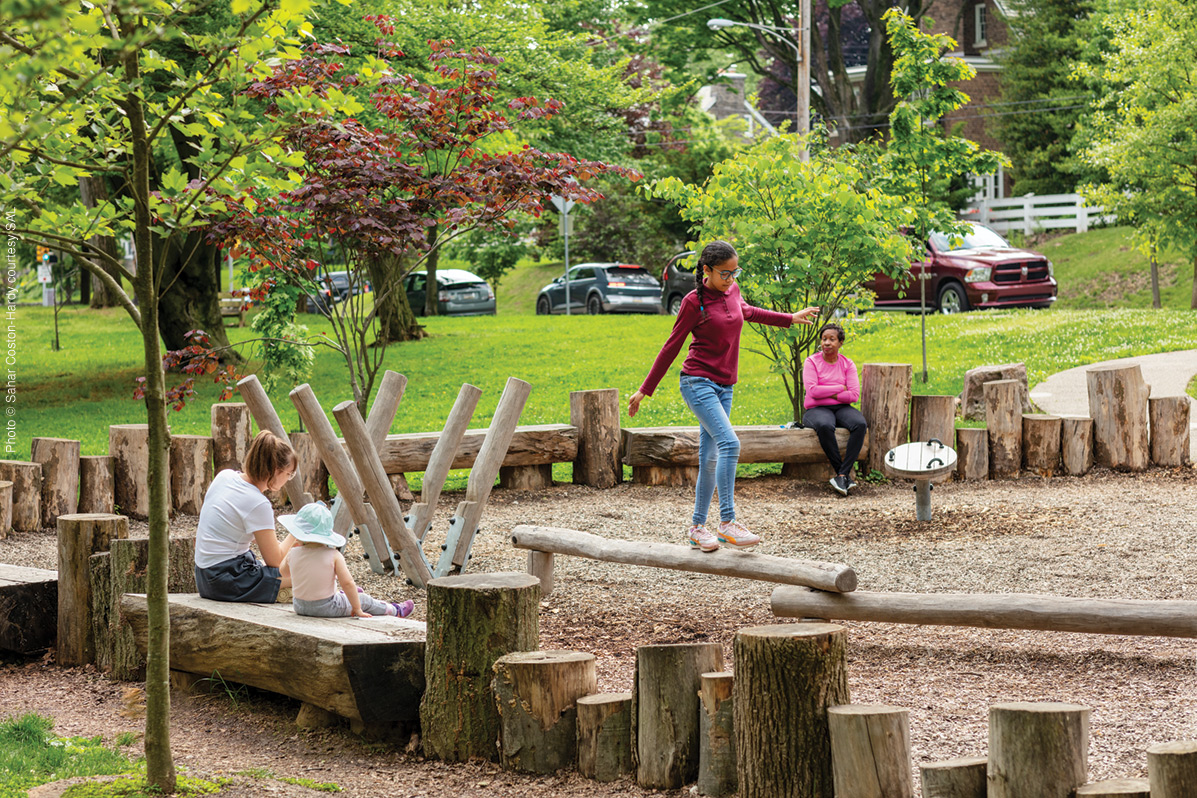
In Philadelphia’s East Falls neighborhood, SALT’s idyllic playground in McMichael Park seems the kind of place where the regal Grace Kelly, who grew up in a house across the street, might have felt at home. Tucked beneath a lush canopy of the park’s mature trees, parents gather on strategically placed log benches to watch their kids clamber up, down, around, in and out of a rustic wood climbing structure. Other caregivers join their youngsters in jumping along a row of log stumps, or squeezing onto swings with them. Backed by a picturesque fallen tree limb, the whole half-acre site appears to emerge from the midst of the woods, at one with its surroundings.
But, as they have in London and Berlin and Copenhagen, these new ideas are finding their ways to less bucolic settings, too. In response to the community engagement efforts it conducted while designing Hancock Playground, for example, SALT made room for outdoor adult fitness equipment like pull-down weights, parallel bars, steps, and pavement markings for agility training. Its eye-catching centerpiece is a striking steel and mesh assemblage that begs to be explored. It too is verdant, with dozens of newly planted canopy and understory trees, shrubs, native perennials, and grasses providing shade for visitors, stormwater control for the municipality, and pollinator habitat regeneration for the environment.
Learning From Play
Lois Brink started her Learning Landscapes initiative in Denver in 1992 simply to offer her daughter a less unlovely play experience than the one that confronted them at the local schoolyard. “It was scorched earth,” she recalls. “Just a field of pea gravel with a pathetic play structure from the ’50s in the back. I thought, ‘This is it? Are you kidding me?’” She remembered her own childhood experiences and how throughout her career she had drawn heavily on her Canadian summers, relying on design elements like “boulders, constant changes in elevation, views, and perspectives.” This particular asphalt-scape was certainly not that.
She decided to take matters into her own hands, bringing her graduate students from the University of Colorado, where she was (and still is) a professor of landscape architecture, to meet with neighbors and parents to listen and develop ideas for improvement. Raising their own funds and becoming their own design-builders—Brink calls the goal “grass roots, grass tops”—the group finished its initial project in 2000. Then city and private funders grew interested and supported the redevelopment of about two dozen more schoolyards. In 2003 and again in 2008, the school district floated bonds to support reconstruction of the remaining ones. Both passed—even though, Brink points out, 60 percent of the voters didn’t have children.
Learning Landscapes eventually redesigned all 99 public elementary schoolyards in the city, marking them with gateways (to signal their openness for use by the entire community) and filling them with a mix of traditional and custom pieces, vegetable gardens, artwork, seating, shade trees, and creative learning opportunities. Equally important, “we try to instill the idea of caring for something that you helped create and that belongs to you and your community,” Brink says.
In 2023, Brink released a study of the program’s effectiveness, documenting a 7 percent decrease in student transfers after the Colorado schoolyards were transformed, along with statistically significant increases in students’ annual progress toward state reading and math standards (by 8.5 percent and 5.5 percent, respectively). Since public schools receive state funding, Brink hopes another stat from the report—an annual average of $1,341,777 revenue increase in Colorado state funding for 152 new students enrolled—will be impactful as she brings the program to Philadelphia, where schools narrowly escaped the chopping block this year, but budget shortfalls, dwindling enrollment, and aging built assets continue to pose an existential threat.
This spring, The Big Sandbox (TBS) celebrated its first schoolyard redevelopment at Tanner G. Duckrey Elementary in North Philadelphia—the culmination of an effort that started about 10 years ago when Brink brought her grad students to talk with the community about what they’d like to see in the space. Shortly after, more than 100 parents, students, and faculty at the K–8 grade school kicked off the project by painting 6,000 square feet of asphalt into brightly colored games, mazes, and patterns. The rest unfolded year by year, piece by piece, as TBS raised money from various sources.
Next up: a trio of other North Philly elementary schools, Edward Gideon, Richard R. Wright, and James G. Blaine. Since this time state funding has been earmarked and TBS has secured the required matching amounts through federal community funds (for a total of $1.8 million), “we’re hoping to complete them much faster,” Brink says. “We’d like to have all three done in 2026, so that the investment will be visible if the District starts looking at closing schools.”
With Playful Learning Landscapes (PLL), Temple University child psychologist Kathy Hirsh-Pasek has looked even further beyond playgrounds to unveil a moveable feast of “third places” between home and school. A joint project of Hirsh-Pasek’s lab at Temple and the Brookings Institution, where she is a senior fellow, PLL marries community involvement, learning sciences, and placemaking to bring playful experiences to everyday spaces. Since its beginnings in Philadelphia, its programs have been replicated in cities across America.
Philadelphia-based KSS Architects recently worked with PLL on a project supported by the William Penn Foundation’s Literacy Rich Neighborhoods Initiative to add elements of play to the Cliveden, Wyck, and Johnson historic houses in Germantown. “Through a robust process of community engagement, we developed a narrative for the project sites, since part of what makes learning meaningful for children is connection,” says Mayva Donnon GAr’04, a partner at KSS. “We spent a lot of time thinking about places that would feel fun and educational while inviting different kinds of movement.” KSS designed play installations that included interactive puzzles and spinners, Little Free Libraries, multiple seating options, I-Spy elements, story starters, a weather wheel station, word games, and an audio story station, all aimed at building vocabulary, observational skills, and critical thinking.
The numbers suggest that such efforts can make a difference, says Hirsh-Pasek. For a PLL project at three supermarkets in Philadelphia and Delaware, signs prompted caregivers to ask questions of their children while they shopped. Researchers found that caregiver-child interaction increased by 33 percent and that caregivers and children spoke more about numbers—a predictor of later math ability—when the signs prompted number language.
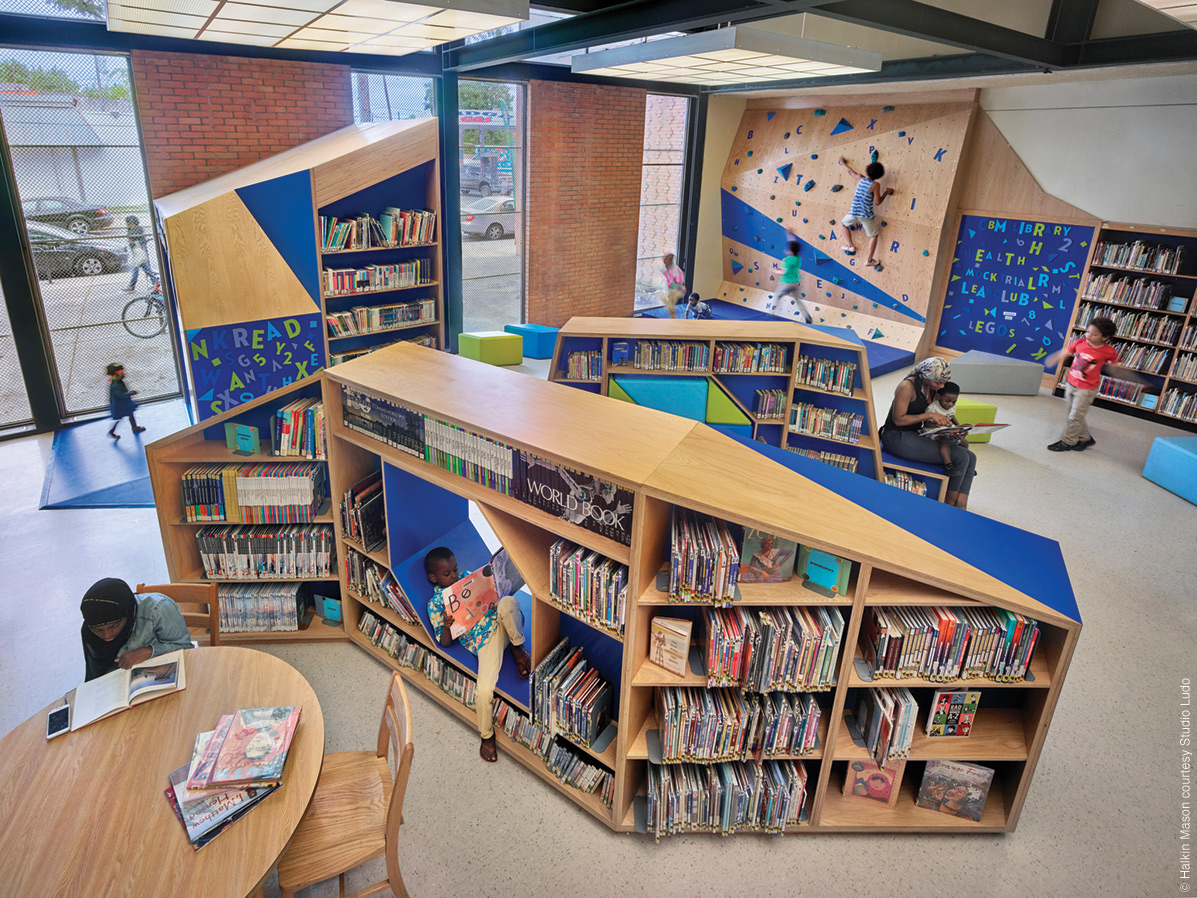
Pevaroff Schuh and Talarowski have also collaborated on PLL initiatives. SALT is currently working on playful learning interventions at bus stops and intersections along Ridge Avenue that will include painted pavement games and free-standing play features like musical instruments, interactive history markers, and other similar ideas. Studio Ludo’s project at a branch library in North Philadelphia includes a climbing wall with letters placed near hand- and footholds to encourage children to construct words as they ascend. “There are already city budgets for libraries, for sidewalks, for bus stops—so why not build right within the system?” says Hirsh-Pasek. “With loneliness and anxiety levels going through the roof, this is a great opportunity to make everyday places exceptional spaces.”
Whether it’s spending a few minutes to strengthen math skills at a grocery store, or two hours to flex social and physical muscles at a destination playground, “play can be and do so much more than it’s traditionally been asked to,” concludes Talarowski. “It’s exciting to see this feedback loop of designers and manufacturers and municipalities now challenging each other to do better.”
JoAnn Greco writes frequently for the Gazette.