The trailblazing broadcaster was honored for “her leadership and contributions to journalism.”
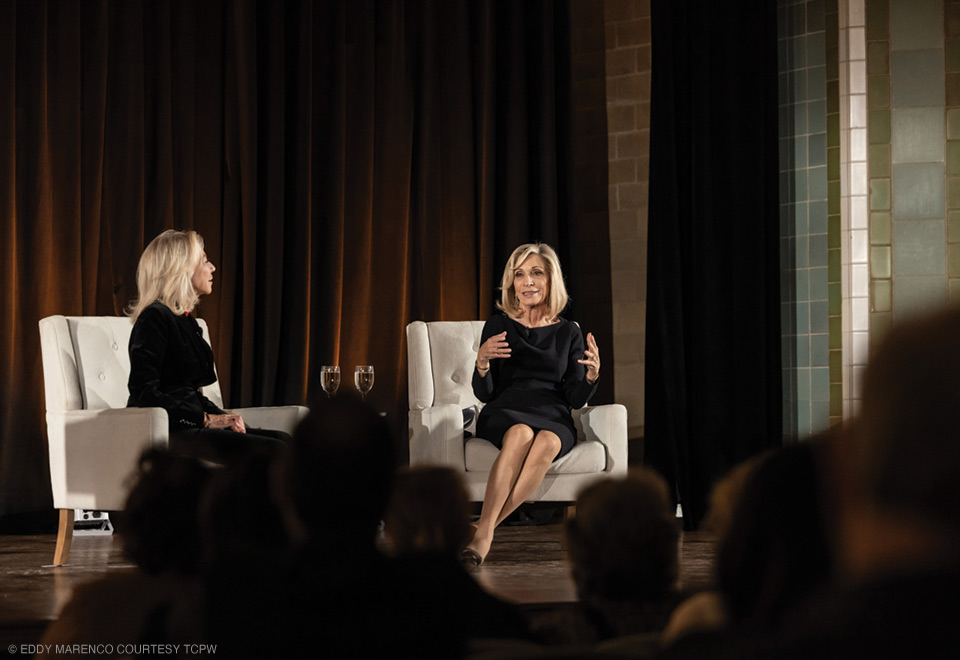
Early in their “fireside chat” following the Trustees’ Council of Penn Women (TCPW) having awarded legendary broadcast journalist Andrea Mitchell CW’67 Hon’18 its highest honor, the Beacon Award, former Penn President Amy Gutmann Hon’22 fondly complained that Mitchell kept turning questions about herself back to the reporting she’s done on others. “You see what Andrea does? She talks about Nancy Pelosi!” Gutmann said, when the question “When did you first realize the global importance of your role?” morphed into a preview of an interview with the former House Speaker about her decision not to run again for Congress in 2026.
But if Mitchell was reluctant to sing her own praises, the ceremony itself and a video montage of well-wishers from Penn and colleagues and mentees at NBC supplied the deserved superlatives about her singular impact as a journalist and her devotion to her alma mater.
TCPW Chair Aliya Karmally Sahai W’99 said that she felt as if Mitchell’s “insightful reporting” had been a presence all her life. “Andrea has held my hand through the notable and the notorious events of our times,” she said, and the journalist embodies the mission of TCPW to “support, foster, and promote advancement of women and women’s issues” at Penn since its founding some 40 years ago. “Andrea has consistently led the way in journalism, bringing clarity to defining moments of our time,” Sahai added, as well as being “a steadfast supporter of her alma mater” and “a mentor and champion of women” whose leadership “inspires a new generation of women to pursue their dreams and to strive for positions of influence.”
Mitchell called the award the “capstone” of her long involvement with Penn, which—in addition to TCPW—has included volunteer service as a University trustee and a chair and member of the School of Arts & Sciences board of advisors, as well as financial support to establish the Andrea Mitchell Center for the Study of Democracy and to advance other Penn programs.
Mitchell harked back to the 2001 celebration of 125 Years of Women at Penn [“Gazetteer,” Jan|Feb 2002] as a highlight of her volunteer career, along with having been sent, after Penn President Judith Rodin CW’66 Hon’04 had announced she was leaving College Hall, to vet a potential successor—then-Princeton Provost Amy Gutmann. Gutmann, who is back on campus after serving as the US Ambassador to Germany from 2022 to 2024, said that Mitchell was the one “who convinced me that I really should want this job here.”
Mitchell got her start as program director at WXPN—then entirely student-run, she emphasized—and her first job was as a “copy boy” on the night shift at Philadelphia’s all-news radio station, owned by Westinghouse. (This was after failing to win the Thouron Award “that I had my heart set on” closed off the prospect of an academic career, she noted.) “I worked there during the tumultuous ’60s and ’70s and that was the crucible,” she said. A storied career followed, with Mitchell first establishing herself on radio and TV in the Philadelphia market and then moving to NBC News, serving as the network’s chief Washington and foreign affairs correspondent, reporting from all over the world and interviewing figures from Ronald Reagan to Fidel Castro, and until recently hosting her own show Andrea Mitchell Reports.
Mitchell credited an early mentor, journalist Sid Davis, with helping raise her visibility when he was bureau chief in Philadelphia and then bringing her to NBC nationally. (Davis died in October at 97, but until about six months before had kept up a practice of messaging her after shows.) “There were no female mentors then,” Mitchell said, but she’s tried to be one in her own career. “When I had the ability to hire a producer, I would hire a woman, because there weren’t enough women,” she said. “And then when I had my own show, I would make sure that I put the researchers on the air and give them a shot, because I knew they were good reporters.”
She also commented on the ongoing transformation of the media environment—with cable companies plagued by cord-cutting, the economics of streaming services uncertain, and newspapers continuing their long decline—and what that might mean for young people contemplating a career in journalism. “We have to figure out a way that people get their information not just from social media, and we’re in the middle of this right now, so I don’t know where it’s ending.” Future journalists will have career trajectories very different from hers, she added. “I would just say, ‘Study everything. Don’t specialize too early. Read everything. Don’t predict what you’re going to do.’ I came [to Penn] as a violinist. I was going to be an English professor. That didn’t happen. You don’t know where your heart and interests are going to take you.”
Mitchell did answer Gutmann’s question about her “global importance,” if in her own way. “I always felt like journalism is an obligation and a responsibility, a civic responsibility. You don’t always get it right, and it’s harder now in these days of social media, where anything you said can be taken—and now by AI taken completely—out of context and mischaracterized,” she said. “And so you never feel that you’re quite there. You always feel that you’re only as good as your last story.”
Which, in this case, happened to be about Nancy Pelosi. —JP