Penn’s interdisciplinary Integrated Product Design program churns out inventive entrepreneurs.
While they were graduate students at Penn’s Integrated Product Design (IPD) program, Max Liechty GEng’22 and Kausi Raman GEng’23 spent a year and a half testing and finetuning their prototype before launching a Kickstarter blitz in September 2023. “We met our goal [of $50,000] in the first 23 minutes,” Liechty says, “and ended our 30-day campaign with $1.17 million in preorders.”
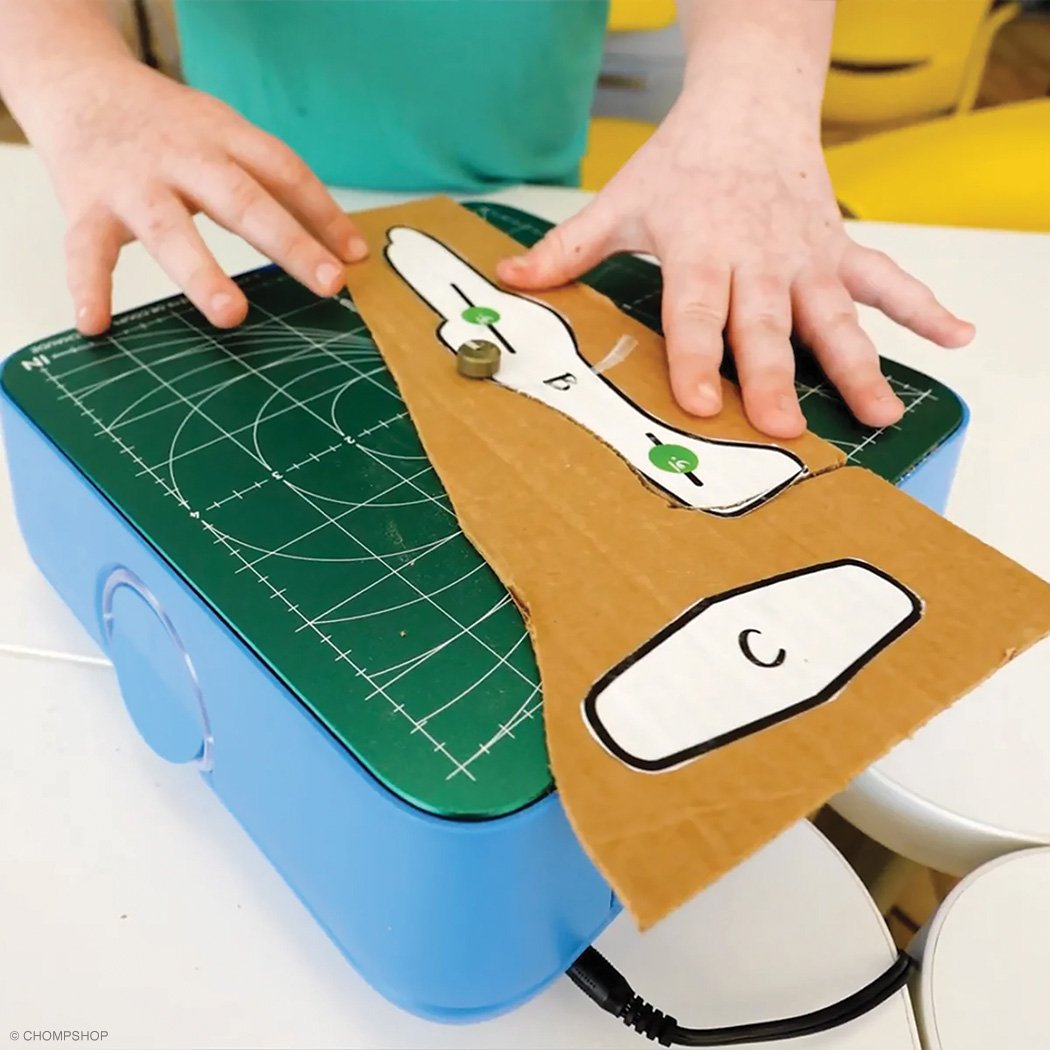
No wonder the producers of the ABC reality show Shark Tank noticed, inviting Liechty and Raman to a tryout. The propitious series of events reached a zenith when the team appeared on a fall 2024 episode with their invention: ChompSaw, a kid-safe power saw for cutting cardboard. After entertaining multiple offers from the investor panel, they made their choice and walked away with a cash infusion of $250,000 from Lori Grenier and Mark Cuban, who predicted the saw could be the “hot product of Christmas.” Before the show aired, the duo had already sold 10,000 units at about $230 a pop; after the Shark Tank boost they sold another 5,000 units, resulting in a total of $3 million in sales for 2024.
Last year, things got hotter still for this simple tool that the company likens to a high-speed hole punch. Fast Company magazine gave it a spot on its 2025 Innovation by Design list, Time magazine did the same for its Best Inventions of 2025 list, and Raman (who conceived of the idea and designed the prototype) closed out the year by earning a place on Forbes’ magazine’s 30 Under 30 list. Revenue for Chompshop, the parent company, reached $14 million in 2025 on sales of almost 55,000 ChompSaws, plus ancillary products.
Liechty and Raman’s success may be extraordinary but other graduates of the IPD program—which encourages students to harness design, engineering, and business skills to bring products to market—have started companies to sell a bra designed to help breastfeeding moms produce more milk, a tablet-based point-of-sale system for sports arenas and other venues, and a battery technology that brings power to first responders and other government workers in the field.
“It’s great to see students who came into the program not sure of what they wanted out of it, five years later leaning into their potential and operating at a badass level,” says Sarah Rottenberg, an adjunct assistant professor in the Weitzman School of Design and the executive director of IPD, which offers two degrees: a master of integrated product design and a master of science in engineering in integrated product design. It also offers a certificate in integrated product design for students who are pursuing other graduate degrees at Penn.
Approximately 15 percent of IPD graduates start companies based on ideas they’ve generated during the two-year program. Others land design jobs at Fortune 500 companies ranging from Apple to Walmart. At an IPD reunion in late 2024, some 65 graduates discussed where they’d ended up, including in jobs as disparate as building AI programs to improve federal government services and developing virtual reality tours for a real estate platform. “Initially, the program was very anchored in physical design,” Rottenberg says. “Now it’s focused on processes that can lead to digital and physical products.”
Faculty members Vijay Kumar (the Nemirovsky Family Dean of the School of Engineering & Applied Science), Karl T. Ulrich (CIBC Endowed Professor at Wharton [“Method Inventor,” Sep|Oct 2016]) and William W. Graham (Professor of Architecture at Weitzman) cofounded the program in 2007. “It’s not a coincidence that they started the same year as the introduction of the iPhone, the Kindle, and Airbnb,” Rottenberg says. “They saw things happening and wanted to prepare their students for these changes. The idea was to look toward Penn’s other schools as assets.”
That interdisciplinary bent starts with how the program is set up: it nests inside of the School of Engineering; Rottenberg’s appointment is in the School of Design; its physical presence is in a Wharton building (Tangen Hall at 40th and Sansom Streets); and students take classes in all these disciplines. Assembled into small groups, they also work on projects for in-house clients at the College of Arts & Sciences, Children’s Hospital of Philadelphia, and the Schools of Law, Medicine, and Nursing.
“What’s especially unique about IPD is that there are so many pathways that students can take,” says Taylor Caputo GEng’15. “If you’re interested in robotics, you can work at Engineering’s GRASP Labs. If you’re thinking about a wearable medical device, there are opportunities at Penn Med.” For Caputo, entering the IPD program was a great fit after graduating from Temple University with a bachelor of fine arts degree in Metals, Jewelry, CAD-CAM. “I wanted to transfer the design and fabrication skills I had acquired to a new world of product design that’s expanded into systems thinking and entrepreneurship,” she says. “I ended up with a thesis project focusing on STEM education and that got me more interested in pedagogy, and so I transitioned into teaching.” She now teaches two IPD courses, “How To Make Things” and “Designing Connected Objects and Experiences.”
Caputo also serves as director of the Engineering Studios @ Venture Lab, a series of labs for new idea testing and tangibility. “I’m really excited about how digital fabrication is shaping the prototyping landscape and turning thesis projects into entrepreneurial realities,” she says. ChompSaw’s team, for instance, used the resources at Venture Lab (which include three laser cutters and six industrial 3D printers), as did another IPD team, Serpent Robotics, which was named the 2025 Pennovation Accelerator Winner for developing a robotic arm for pruning trees.
The hallmarks of IPD boil down to a “core of human skill sets like critical thinking and coalescing, along with learning to pay attention to different stakeholders and market signals,” Rottenberg says. “The legacy companies and start-ups that hire our students appreciate that they’re really strategic problem solvers. AI may be able to spit out ideas at amazing speed, but the insistence on discernment and follow-up that we teach is a really important human advantage.”
—JoAnn Greco