The sanctity of mosh pits and movie nights.
By Lila Dubois
The first chord left to hang in the air, it tempts. Tantalizes. Oscillates across the room in blown-out tendrils of sound, a grungy and poorly mixed metal buzz, the bomb just before the moment of total devastation. The lead singer of Fat, Evil Children opens his Fat, Evil mouth and then the whole clattering cacophony of four 20-something garage musicians charges forward. From the audience, I imagine our ear drums collectively blown into a million pieces. An exploded disco ball of hearing loss. We are willing casualties, though, the masochistic subjects of our own sonic mutilation. This is precisely what we came for.
By the third song, someone’s little brother has crowd surfed to the front of the stage. Early in the night for this kind of behavior, but not unheard of at a show like this, where the physical exertion of the crowd is the ultimate gauge of the performers’ aptitude. By this measure, tonight’s openers Fat, Evil Children, and headliners Frat Mouse are masters of their craft.
As always, the Frat Mouse line “I’ve spent too long on the 101 North” nearly brings the crowd to their knees. It’s elation, a total release, a moshing so hard you end up on the far side of the room with a new friend group.
It’s Slow Media at its finest.
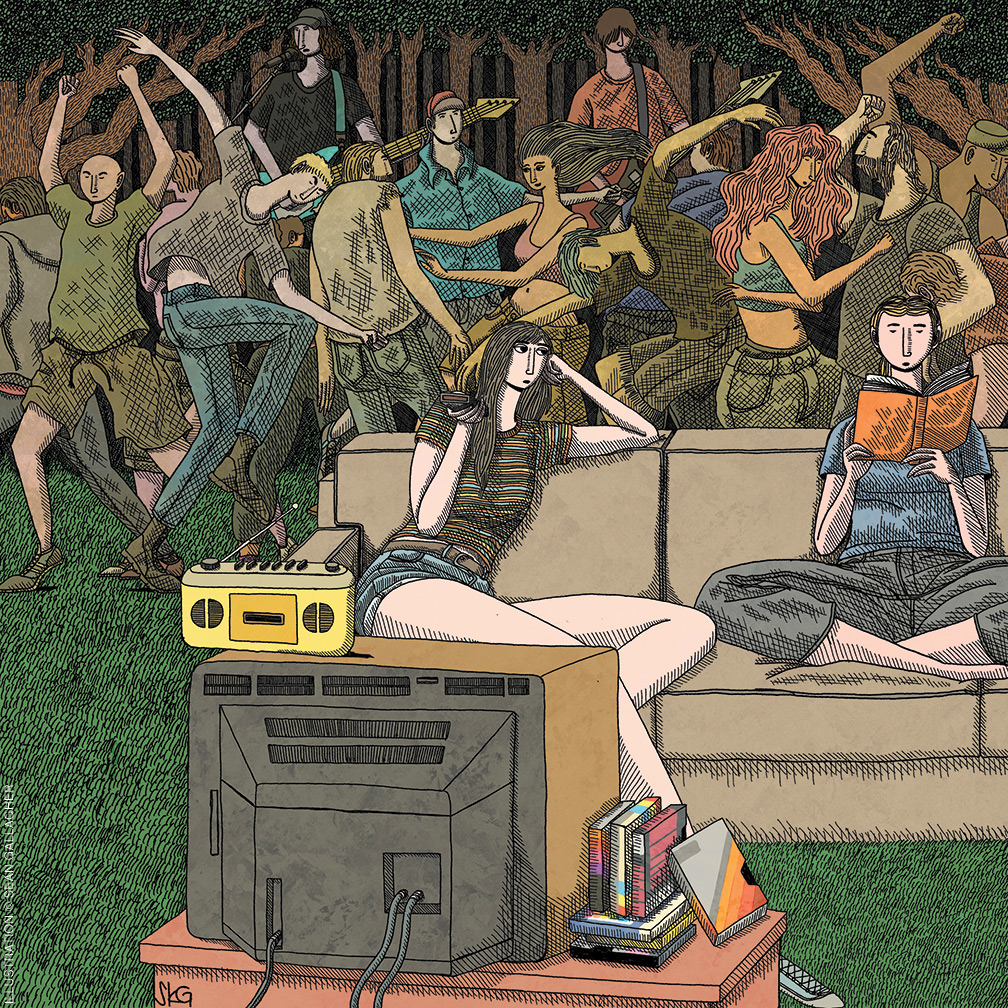
Slow Media could also be a movie. A museum. A musical or a karaoke night where a drunken coworker will make “Yellow” by Coldplay completely new for you (the quality of his performance beside the point—all you know is that you now, inexplicably, no longer hate the song). The search for Slow Media might involve donning a leotard-adjacent arrangement of neon latex straps and triangle shapes, taking a subway, then a bus, then walking for 30 minutes to an eerie industrial sector of the city, navigating with only an echolocational sixth sense for an 808 kick drum pulse, and arriving finally at the all-night rave. It could be perusing a magazine with your girls or watching synchronized swimming, televised live at noon, with your grandpa (should you both be so gainfully unemployed). It’s a book club, a biweekly Golden Bachelor viewing, a dance party.
For most of human history, the only way to partake in art was to do so in the public sphere. Today though, it’s possible to live entirely in the echo chamber of one’s algorithm, building a robust but solitary universe of movies, books, paintings, and more, curated unwittingly by your somnambulistic clicks and taps. It’s become almost countercultural—an act of resistance—to experience media once again in the presence of others.
Media, which delivers most of our art these days, can of course help us realize and inform the self, but when taken up in the public sphere, it can also be our tap into the community. It’s the heat off the person in seat G8 next to your G9. It’s making a friend in line at the Beyoncé presale. It’s the old man at the park stopping to comment on the title of the book you’re reading (it’s Sex, Drugs, and Cocoa Puffs, of course). It’s going early for the opener and realizing they’re your new favorite band (it’s Fat, Evil Children, of course). It’s being beholden to showtimes and setlists and friends’ preferences outside of the narrow options you’d consider by yourself. Experiencing art in community means putting your trust in someone else, opening yourself up to total disappointment or the utterly sublime, but always a thrilling perspective outside of your own.
Not long ago I sat on a bench beside my friend Maya, huddling in the morning chill with our coffee and our favorite issue of People magazine: the hallowed annual “Sexiest Man Alive” edition. John Krasinski smiled coyly in the centerfold, leaning awkwardly across a taxicab, and Maya and I proffered that perhaps 2024 declaring John Krasinski the Sexiest Man Alive might be an indicator of a chaotic political climate, a whole country yearning for the teddy bear of The Office, so fervently as to redefine sexy as stability, safety, and quotidian cute.
And in the haze of our shared breath, warm air rising before us like evidence in the cold, Maya declared that her idea of a life well lived was exactly this: one where she simply consumes as much media as possible.
I understood then how the content did not matter (nothing against People). What mattered was the Slowness. Our sitting on a bench, chatting, driving to new levels of engagement with each other and the world. Maya’s life devoted to media, I believe, is made meaningful by the slow, togetherness of it, and the insistence that you can get something from anything (a wide-angle Krasinski hailing a cab!) if you digest it thoughtfully, multiplying its meaning through the lenses of others around you.
When you join your roommates for movie night, as opposed to watching alone on your computer, you are participating in a sacred act of aesthetic communion. Splayed out across the frayed faux green suede couch you’d hauled across the city, saved from the sidewalk for the express purpose of rotting together in this way, you and your roommates are fulfilling cinema’s ultimate purpose. In cheetah print capri pajamas and a Sabrina Carpenter concert t-shirt (for example), you are giving life to the movie Valley Girl (for example) through your reactions, just as the film is giving life to your conversation, collaborative thinking, and, ultimately, connection. Because without the film, there would have been no living room chat on the demise of taffeta since the 1980s, or conjecture about whether high school parties remain a battleground still unwon by feminism. Without my audience-in-arms, what would Valley Girl be to me? A reduction, shrunken to fit the static singularity of my own head. Boring.
Which brings me back to this particular saline cesspool of B.O. and stereo fuzz. Where my sister has been crowned queen of the mosh, ascended and held above the crowd, an angelic figure floating on a sea of willing hands, the Frat Mouse fandom—the Mouse House—in full force. For a moment, as if time suspended, all of us worship our new goddess of sound and form, along with the crusty midwestern-meets-San-Fernando-Valley emo band that has transformed my sister’s flesh, blood, and Brandy Melville tank top into a substance vaguely more divine.
After the show people spill onto the sidewalk and down the street in smoke-haloed crews. Neighbors in the hills behind the venue sit on front stoops, listening. This time no one calls the cops.
It would have been a ridiculous scene if not so earnest, the dancing and Frat Mouse’s vocal fry, delivering the lyric “I’ve spent too long on the 101 North” with such genuine desperation. Concertgoers leave with arms around new friends and humming “Plywood” solo lines, already nursing mosh pit bruises and with hearts aching for bassist girlfriends they will never have.
Fat, Evil Children’s “Running” coasts my sister and me the whole drive home, two girls in need of deodorant and a midnight snack, howling down the spine of the 101 freeway. South this time. Everything feels violently real and connected, the night cold and crystalline in the dark beyond our headlights, my sister already making plans for the next show.
Lila Dubois C’25 lives in New York.