The cofounder of New York Stage & Film—which has helped launch Hamilton, Hadestown, and hundreds of other projects since 1985—is tackling another medium right now: TV. With her new MGM+ show enjoying glowing reviews, yet still on the bubble for a second season, Leslie Urdang C’76 reflects on the high points of her 40-year career as a theatre and film producer—and the challenges of making stuff in 2026.
By Molly Petrilla
Sidebar | Day By Day (By Decade By Decade)
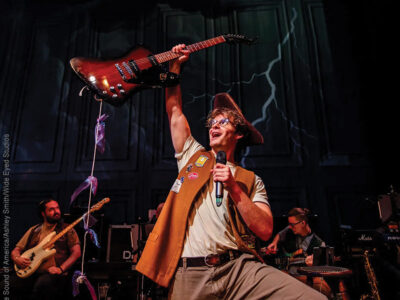
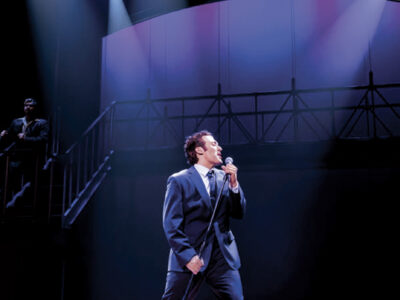
The student production of Godspell that included some of Penn’s biggest future Hollywood players.

When the renowned actress Laura Linney was filming her latest TV show—an MGM+ series called American Classic—she often looked toward one specific chair on set.
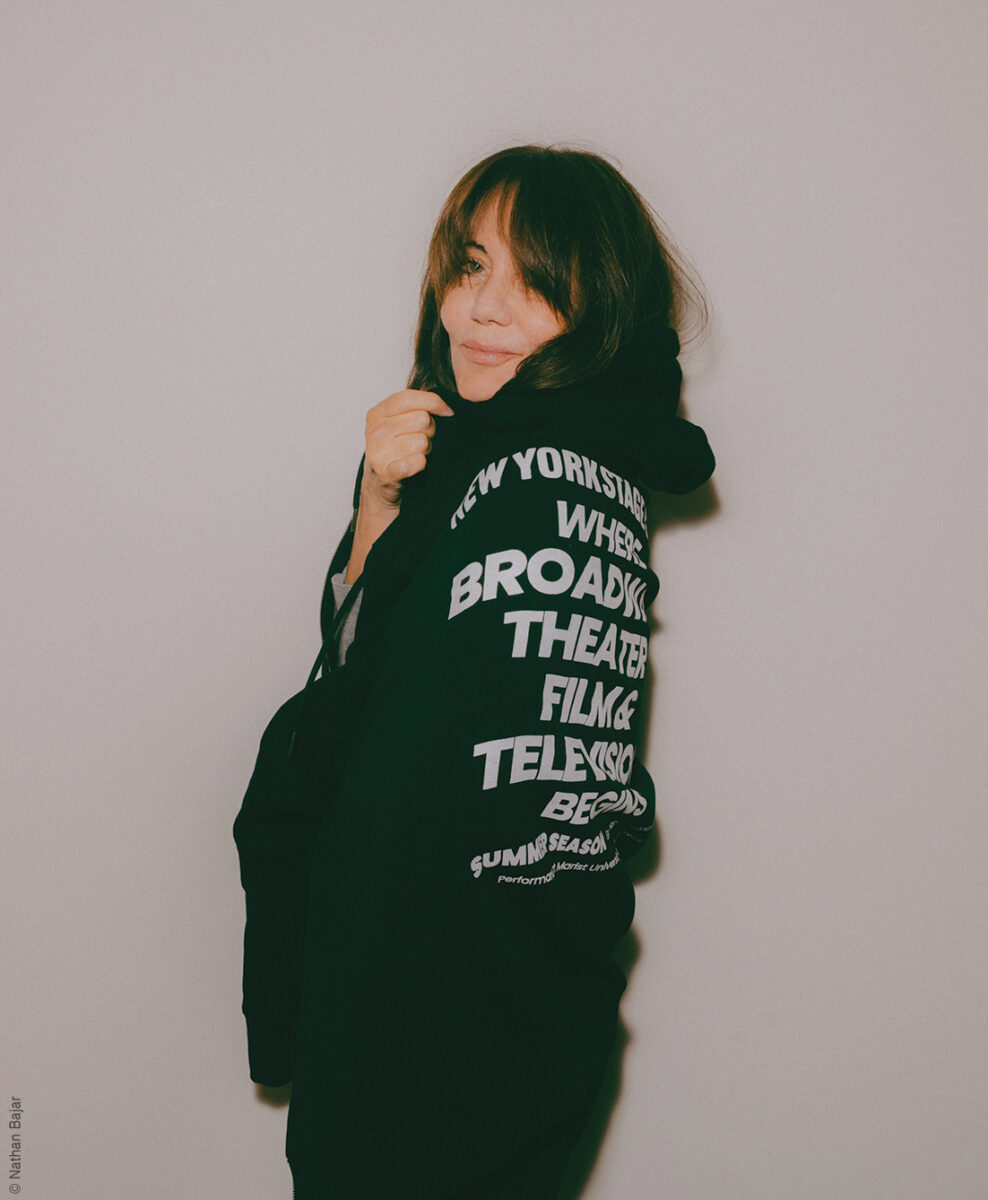
Sitting near the monitor, her face framed by long dark curtain bangs and headphones at the ready, the show’s executive producer Leslie Urdang C’76 “was always there in a way that felt supportive and never intrusive, never judgmental,” Linney says. “It’s a huge relief when you have a leader like that.”
Linney’s not the only one who thinks so. Over the last 40 years, hundreds of writers, directors, and actors have found a steadfast and encouraging presence in Urdang, who is both an accomplished theatre and film producer and a cofounder of New York Stage & Film, a widely acclaimed incubator of new plays and movies.
“When she is working closely with an artist, she’s one of the most ferocious champions for them of anybody I know,” says Johanna Pfaelzer, New York Stage & Film’s former artistic director. “There aren’t that many [producers] who do it with the depth and commitment that she does.”
The results speak and sing for themselves. Through New York Stage & Film, Urdang has helped bring the world Hamilton, Hadestown, the Pulitzer-winning play Doubt,and hundreds of other new theatre and film projects. She’s also produced over a dozen movies, including Beginners (2011), which won Christopher Plummer an Oscar and a Golden Globe, and Rabbit Hole (2010), which scored an Oscar nomination for Nicole Kidman.
“Good material drives me,” Urdang says. “When you find good material, there are always great directors and actors who want to get involved, even if you’re doing it independently and paying them less money.”
American Classic, which debuted in March and marks her foray into TV, is the latest of those driven-by-good-material projects—and it came straight from an idea Urdang dreamed up in late 2018.
Imagine the actor Kevin Kline, she thought, playing a big Broadway star who has to return to his hometown after facing a scandal. Imagine that his family owns a community theater. Imagine that his brother is still living there, married to the woman they both loved.
Almost eight years later, that’s exactly what audiences are watching, with Kline in the role she envisioned for him, Linney playing his sister-in-law, and Urdang’s husband Jon Tenney as his brother.
“It’s a show about friendships, about theatre, and about the power of art in our lives to bring people together, remind them of the best in themselves, and make people feel less alone,” Urdang says. “I think that’s a really valuable thing to put into the world right now, and it felt very satisfying.”
There’s even a Penn nod. Miranda—Kline’s character’s niece on the show—is torn between pursuing an acting career in New York or attending Penn, where she’s been accepted. Eventually she starts to come around, admitting that Penn’s theatre scene is actually “kinda cool,” with its rich extracurricular options instead of a conservatory setting.
As a longtime Urdang collaborator and friend, American Classic showrunner Michael Hoffman was fully aware she went to Penn. So when he was looking for a college where theatre is mainly student-run, Urdang’s alma mater sprang to mind. “That was definitely because of my experience at Penn,” she says—and that Penn experience also planted the seeds for Urdang’s own future career.
Though never an actor herself, Urdang fell in love with the performing arts while growing up in Queens.
She was the second eldest of six children in a blended family. Her mom—a Jewish immigrant who escaped from Nazi Germany at age three—had “reinvented herself as this American girl,” Urdang says. The family rarely talked about her mom’s experience, but still, Urdang and her biological sisters discovered they were all having the same nightmares about crossing an ocean with bombs dropping over them.
“They say children of people who escaped Nazi Germany often carry the experience. It’s passed down in the DNA in some way,” she says.
She started ballet when she was four years old, and three years later, joined the School of American Ballet. “Ballet was very formative to my aesthetic and my appreciation of rigor and discipline and form and beauty,” she says. “It gave me a great deal of self-possession and joy.”
Dancing in George Balanchine’s annual Nutcracker extravaganza came to define her Decembers. “That’s what Christmas was,” she says. “It was elegant, filled with music and sparkles and late-night dancing and doing your homework on the subway going home.”
But it also meant trade-offs: after-school dance lessons six days a week; missed family trips, especially during Nutcracker season. At 15 years old, she had to decide between the professional-ballerina path or exploring other interests—specifically college and politics.
The other interests won. Urdang transferred from the High School of Performing Arts to her local public school and continued on to Penn as a political science major, with plans to take the LSAT and ultimately go into politics. In the meantime, she choreographed and directed campus productions purely for the fun of it.
Directing Godspell in particular left a mark (see sidebar). It was a Quadramics show—and the then new student group was rarely granted use of the Annenberg Center theaters. Those were the domain of the more established Penn Players. But why? Urdang wondered. Annenberg’s black-box Hal Prince Theatre would be perfect, she thought, for the Godspell she imagined.
She approached Todd Haimes C’78 [“The Roundabout Way,” Nov|Dec 2015] and Jed Bernstein C’77, two heavy hitters on the Penn Players scene. “I want to do it here,” she told them. “Why don’t we get to do it here? We’re all in the same school, paying the same tuition.” She outlined her vision for Godspell in the Prince. The Players agreed—“and wound up being very helpful,” she adds.
Before Urdang cast him as Godspell’s Jesus, Max Mayer C’77 sat behind her in a class on the American novel. At first, the future filmmaker admired her shiny brown hair. Then he came to know her as “smart, creative, tireless, persistent, and loyal,” both at Penn and now. “She will always tell you almost exactly what she thinks, which is very, very rare in our business,” he adds.
In one of their earliest conversations, Urdang told Mayer that she was going to become a senator. She went to work for one on Capitol Hill after graduating from Penn, but it wasn’t what she’d pictured. “I’d go home and cry at night,” she remembers. “I missed the deeper connection to human beings. I thought going back and working in the arts was where you did that.”
So it was on to the School of Drama at Yale, where she completed the theatre-management program with an eye toward producing. (She also left with a collection of future-star peers, including actors Tony Shalhoub and Mark Linn-Baker, both of whom appear in American Classic.)
New York Stage & Film grew out of her master’s thesis at Yale, and in 1985, became a joint endeavor with Mayer (post-Penn) and Linn-Baker (pre-Perfect Strangers). The nonprofit plucks artists out of the New York City pressure cooker and drops them into the Hudson Valley. There they can finetune their plays or films through readings, workshops, full productions, and labs.
“There’s a need for a place to develop new work that feels safe,” Urdang says. And after 40 years and still going strong, “the fact that [New York Stage & Film] is still useful is very, very satisfying.”
Launching a brand-new arts company would leave most people steeped in stress, but Urdang remembers a distinct lack of panic when she, Mayer, and Linn-Baker founded New York Stage & Film. “It was a fearlessness of youth and not knowing all the problems you’re going to face,” she says. “We just had an idea, and we thought we could do it. I felt very determined.”
The trio hopped in a car and drove around “looking at everything from barns to college campuses” to find a home within a hundred miles of New York City for the summer. They settled on Vassar College in Poughkeepsie—close enough for New Yorkers to get there by car, far enough north to feel like another planet.
Their first season offered three plays and three readings, including a production of Savage in Limbo by playwright John Patrick Shanley, still at the dawn of his career. “Shanley agreed to have faith in our little company,” Urdang says.
After The New York Times came to review Savage in Limbo, Urdang and Shanley stayed up late, waiting for the paper to hit newsstands. Then they sat together on the curb of a New York sidewalk, reading and, in Urdang’s case, weeping. “It was this dismissive, terrible review,” she says. “I was bereft. And Shanley was consoling me.”
He’d experienced the sting of a bad review before, and he also knew that his play was strong enough to still find audiences. “And he was absolutely right,” Urdang says. “The play is a classic play, and we were sold out every night.”
Even with a tough Times review, by the end of that first season, New York Stage & Film “was working, it was alive, it was vibrant,” she remembers.
And it’s still solidly kicking. This summer, the organization was headed back to Poughkeepsie with eight new plays and three new musicals—including one about Jean-Michel Basquiat from John Legend C’99 [“Making a Legend,” Jan|Feb 2005], and a new Andrew Lloyd Webber piece. “Then there will also be projects by people who’ve never heard their words out loud,” Urdang says.
“We think there’s a great value in bringing a range of emerging and established artists together,” she adds. “The more established artists are often refreshed by the enthusiasm and passion of the younger artists, and the younger artists learn so much from the more established artists.”
In addition to play readings at the Annenberg Center via Penn Live Arts this past fall, New York Stage & Film has also “brought a lot of Penn alums through our doors,” Urdang says. That list includes Marc Platt C’79 [“Passion Plays,” May|Jun 2006], who workshopped a play with them in 2012, and Ken Olin C’76, who has directed and acted in multiple pieces.
“We’ve often worked with people when they were doing their first or second things, or just at the beginning of hatching a piece of work,” Urdang notes. They held a workshop of Lin-Manuel Miranda’s Hamilton when the second act wasn’t even finished yet. (“We all knew something extraordinary was happening,” she remembers.) Shanley went on to write and win a Pulitzer Prize and Tony Award for Doubt, land an Oscar for Moonstruck, and create many other plays and movies. Jon Robin Baitz, now a two-time Pulitzer finalist, has premiered numerous works there, too.
“She has a really good eye for talent,” Pfaelzer says of Urdang. “There are people whose earliest work she has responded to who now are considered titans in the industry, and who she continues to work with decades later. I think that speaks to their respect for her as well.”
As a veteran Broadway actor, Linney can’t remember exactly when she first heard about Urdang—but she’d known of her for decades before filming American Classic.
“Leslie’s sort of legendary for New York Stage & Film and what she created there,” Linney says. “Not many people of my generation—particularly women—have stepped into a type of producer role the way that she has. She created a company and a movement, really.”
Linney notes that within the city’s theatre world, “everyone knew about [New York Stage & Film] and everyone wanted to be a part of it. … From the outside looking in, it always seemed like a very nurturing place where people have a lot of fun.”
Still, by the mid-1990s, Urdang was ready to try Hollywood. She landed a deal producing movies with Fox, which meant she could stay in New York and keep working with New York Stage & Film, too.
But even on film, her theatre side continued to shine through. First, she turned Shakespeare’s A Midsummer Night’s Dream into a 1999 movie starring Kevin Kline, Stanley Tucci, and Calista Flockhart. 2011’s Rabbit Hole came from a Manhattan Theatre Club play. In 2018, she adapted Chekhov’s The Seagull into a film. And in 2020 she produced Wild Mountain Thyme, based on a Shanley play, led by Emily Blunt and Jon Hamm.
“It’s not intentional,” she says. “I think I’m drawn to literary material—and I’ve also steeped myself in reading plays and seeing plays over the years. … Going back and forth between the film and theatre worlds has been such a blessing, and I’m so grateful for it.”
Whether it’s making a movie or mounting a play, many people aren’t quite sure what producers do. They’re the ones who accept Tony awards for Best Play or Best Musical and Oscars for the best movie winners, but that’s the only time you’ll see them center stage.
“Being a producer, you wake up every morning and try to figure out how you’re going to make something happen,” Urdang says. “There are no rules, and you’re reinventing the wheel all the time.”
There’s planning, executing, urging, and sometimes cajoling. “I’ve watched Leslie tackle so many dilemmas,” says Pfaelzer, who now runs Berkeley Rep. “Whether it’s the sudden loss of funding, an actor who pulls out of something at the last minute, a writer who violently disagrees with a note. She can be incredibly persuasive.”
Even as the student director of Godspell, “she just knew what she liked,” says Mayer, “which is great for producing, actually. … And if she sees a problem, she’ll figure out a way of addressing it.”
“She was creative about how to get what she wanted to do done,” he adds, “which is also the definition of a good producer.”
Urdang describes her “unconscious drive,” possibly passed down through her mom’s genes, to “make the world safe and gather people.” She’s the one who wrangles family and friends for get-togethers. Who keeps in touch with colleagues for decades after a project. And as a producer, she strives to help artists feel supported.
“I’m just always relieved when I’m around Leslie because she is so smart and she is so capable and she is wise,” Linney says. “She’s a terrific leader. … She just makes everyone feel safe and appreciated.”
But even with her deep experience and many triumphs, Urdang isn’t immune to her industry’s current challenges. “It’s a miracle when anything gets made these days,” she says.
That includes American Classic. Between its engaging premise, strong writing, and all-star cast, Urdang was surprised when only one streamer offered to make a pilot. And because MGM+ is smaller than other streaming services, “a lot of people still haven’t heard about the show or found it yet,” she says. Despite strong reviews and enthusiastic audience responses, a second season was still in doubt in August. (In addition to MGM+, the first season is streaming on Amazon Prime through the end of September.)
She’s also been running into roadblocks pursuing her next indie film project. “The old model’s not working unless it’s a huge genre movie or a big movie-star vehicle,” she says. “So what comes next? What can we do that’s different? How do we keep doing good work that we care about?”
They’re tough questions that all of her industry is wrestling with right now. But as she sat on the American Classic set one memorable day, Urdang wasn’t thinking about the hard stuff. She was watching Kline rehearse his Shakespeare lines. Admiring a 94-year-old costume designer, who came out of retirement for the show and was stringing beads onto a dress that needed just a bit more sparkle. She was welcoming an actor who’d run straight over from Broadway, where he was performing in Hell’s Kitchen.
“I looked around the room and my eyes filled with tears,” Urdang remembers. “I said, this room is filled with gold, and we created this room.”
And so she keeps going. This work matters too much to her and brings her too much joy not to. “It means something to me to tell stories,” she says. “It’s so human, and I think these days, to be reminded of our humanness is really fulfilling and moving and vital.”
Molly Petrilla C’06 writes frequently for the Gazette.
SIDEBAR
Day By Day (By Decade By Decade)
The enduring magic of Penn’s 1975 Godspell production.
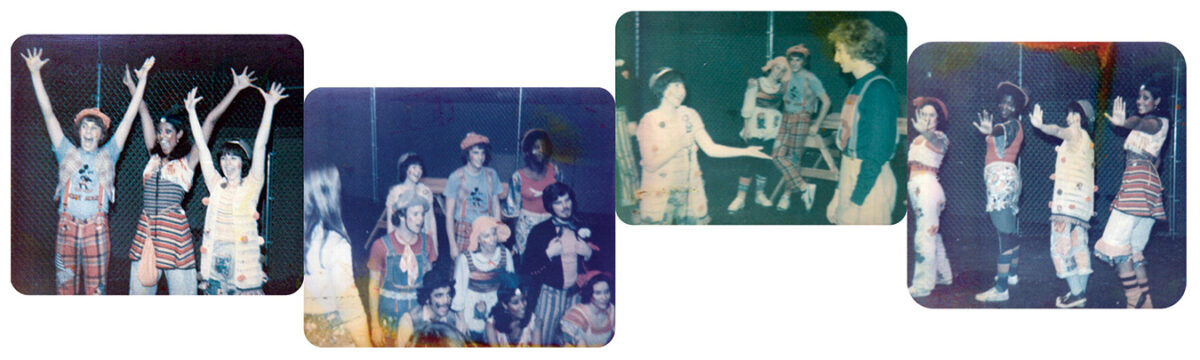
In 1971, the musical Godspell opened off-Broadway. With music and lyrics by Stephen Schwartz—fresh out of college and still decades away from creating Wicked—it fused New Testament parables with joyous music, thrifted costumes, and vaudeville gags.
Day by day, Godspell danced along for over 2,000 performances before moving to Broadway in 1976. By then, Leslie Urdang C’76 had gone to see it multiple times. “I loved the spirit of it, the energy, that it was about community and family,” she says, “and I loved the music and the stories within the story.”
That’s why, in late 1975, Urdang chose Godspell for her directing debut with Penn’s student theatre group Quadramics. The group was still new at the time—just two years old, and focused on Quad-only productions. The Penn Players, meanwhile, had been around since 1936, producing professionally directed shows.
“It was sort of a small, not-that-well-known group on campus,” Marc Platt C’79 remembers. “There was kind of an underdog feeling to the whole enterprise.”
But if there’s such a thing as a smash-hit college production, Penn’s Godspell was it. The performances all sold out. “We had to create standing room and there were wait lists,” Urdang says. She describes standing ovations, “lots of tears at the end,” and “one big, shared community experience of connection and joy. … I think the fun we were having spilled over to the audience.”

All of which is noteworthy—but the names inside its program push that production into legendary territory now.
Urdang, the director, went on to a major career in theatre and film (see main story above). And so did a significant portion of the rest of the cast and crew. From producing Broadway and Hollywood hits, to running major arts organizations, directing and acting in movies, TV and stage productions, and writing some of the biggest films of the last 40 years, the Quadramics Godspell credits would leave anyone wondering what was in the Annenberg Center water fountains that year.
The show marked its 50-year anniversary last winter, and we caught up with some of its cast and crew to learn more about this all-star endeavor.
Penn didn’t have a Theatre Arts major until 1985. Instead students relied on campus groups like Quadramics to both perform and learn how to organize a production.
“Student theatre at Penn was a space that was not in any way inhabited by teachers. We did the plays we wanted to do. There was no professional oversight. We were young and passionate about the theatre and acting—and there was nobody to squelch that by telling you the ‘right’ way to do it.”
“I couldn’t sing, so I wasn’t in [Godspell]. And I didn’t know much about musicals. My investment in it was kind of peripheral. This was very much Leslie’s wheelhouse.”
“Marc Platt had a beautiful voice. That was certainly a big deal. I didn’t know Marc very well then, and we didn’t cross paths again until he was an executive and I was doing something in Hollywood, probably Thirtysomething. I certainly remembered him. Then all of a sudden, he was a big executive.”
Ken Olin C’76
Role: Assistant Director
Future credits: Directed on TV’s The West Wing, Alias, Tracker, and This Is Us, among many other shows. His acting credits include Thirtysomething (with a Golden Globe nomination for Best Actor in a TV drama), Brothers & Sisters, and Hill Street Blues.
Platt was a first-semester freshman when he was cast to perform the soulful ballad “All Good Gifts.” It was his first show at Penn and also his introduction to Stephen Schwartz, with whom he would later work as producer of the Wicked musical and films.
“There’s a song toward the end of the first act, ‘Light of the World.’ We would each take a cup of what was supposed to be wine and give it to someone in the audience. I remember giving it to the woman who would eventually become my wife, Julie Beren [Platt C’79].”
“I didn’t perform much after Godspell, but I did direct and then produce [student shows]. A lot of the issues and problems that you solve are smaller scale but not completely dissimilar to issues and problems you solve on a bigger scale when you’re producing a Broadway musical or a film.”
“This particular experience is so vivid, and it meant so much to me. I still think of it very fondly and feel connected to these people. On the anniversary of our opening, I would reach out to Leslie and others and say it’s been 10 years, it’s been 20 years. It’s just amazing how all these folks remained in some ways intertwined and went on to do interesting, exciting, different professional things. How we all shared that moment in time is quite extraordinary.”
Marc Platt C’79
Role: Cast member and soloist on “All Good Gifts”
Future credits: Producer of Wicked, La La Land, and Legally Blonde, among many other Broadway and film hits.
The Godspell group bonded quickly. Several were friends already going into the show, and many of them have stayed in touch through the years, both personally and professionally. Max Mayer and Urdang started New York Stage & Film together; Olin directed there. Vicki Reiss often encountered them—and Platt—in the theatre world. Platt and Gary Ross teamed up on potential projects, and for many years had neighboring offices on the Universal lot. The number of cross-collaborations is dizzying.
“It probably cured me of ever wanting to stage manage again. There wasn’t really a part for me in the show, and I wanted to hang out with my friends, so I told Leslie I’d stage manage. Not an easy gig to learn on the fly. I directed other plays while I was at Penn but I think it was a great experience doing just the nuts and bolts of a show.”
“I’ve stayed in touch with most of the people who were in that show. Max Mayer and I have remained good friends. We went backpacking in the Sierras last year. I’ve stayed in touch with Leslie and Ken Olin over the years. Obviously, I’ve seen Marc Platt a lot in a business context, and we are friends as well.”
“It was a really good time and a very good show. Fortunately, I have not heard Max sing in falsetto since then.”
Gary Ross C’78
Role: Stage Manager
Future credits: Wrote the screenplays for Big, Seabiscuit, Pleasantville, The Hunger Games, and other major movies.
Godspell is a joyful show that values enthusiasm and ensemble spirit over technical perfection. When their Jesus couldn’t hit a top-note harmony due to a cold, no one minded. When some of the cast came in with limited dance experience, their choreographer understood.
“I studied dance from a very young age, and I started choreographing shows in junior high. This was a rock musical, and so of-the-moment. The music was thrilling—it just cried out for choreography. I remember being easily inspired by the brilliant songs and the wonderful cast. This is also a show where people were not cast for their dance abilities. We did not do any dance auditions for this show. It was not supposed to be a show with polished dancers.”
“With Marc Platt being so involved in theatre, our paths have crossed numerous times. I remember when we were at an industry luncheon together, and he was there with Stephen Schwartz. Marc jokingly introduced me as ‘my Godspell choreographer Vicki Reiss.’ I got a huge kick out of that.”
“Godspell has played a very important role with me emotionally, sentimentally. It was a big deal at a very nascent time in my life. I had no sense that I was going to be in the arts going forward. But I was completely consumed by the energy of this production. It continues to feel like an early spark in my life that got me excited about working in the theater world. This was very special to me, and I feel very fortunate to have been there at that moment in time.”
Vicki Reiss C’77
Role: Choreographer
Future credits: Executive director of the Shubert Foundation—the country’s largest provider of unrestricted support for nonprofit theaters and dance companies—since 1993.
Urdang had a strong vision for her take on Godspell, heavily inspired by the production she’d seen multiple times Off-Broadway. She took her leadership role seriously—and her vision for it landed with her fellow Penn students.
“Doing the show was kind of like being a rock-and-roll star, because the audience just went crazy. There were people seeing it multiple times. Occasionally it felt like a wall of noise at the end of songs, and at the end of the show, people were cheering. It was really quite amazing.”
“In 1975, there was still a counterculture that the student body had a connection to. Godspell had that kind of revolutionary, things-could-be-better feeling to it. We’d just come out of Watergate. There was contempt for the government. This show was about self-rule and making up your life with a group of people.”
“I remember auditioning for it. Leslie and I were friends by then. I thought that she kind of wanted me to do it, but I knew that Marc had a better voice. I sang one of the songs. Leslie said, ‘That was good, could you do it again? And this time do it better.’ So I laughed and did it again. I don’t know if it was better or not, but she finally decided to cast me.”
Max Mayer C’77
Role: Jesus
Future credits: After a stint as an actor, he went on to direct dozens of plays, TV episodes, and several indie films, as well as to cofound, with Urdang and (non-alum) actor Mark Linn-Baker, New York Stage & Film.
As director, Leslie Urdang was Godspell’s convener. She’s still close to many of her cast and crewmates—and the memories from that production are deeply ingrained.
“I didn’t know how to do tech rehearsal, really. So I asked Ken to help me run the tech rehearsal and I let him set all the light levels. Then we stepped back and did a run-through and I was like, ‘Oh my god, Ken, this is a musical comedy. I know that’s not your thing, but we have to bring up every light level, like, five to eight points,’ because it was this moody, darker patina that he’d put over the whole show.”
“I was not a good director. I had fantasies of being a director, but despite how beautifully the show turned out, it was much more about casting the right people and filling the room with a kind of joy and energy.”
“I remember Marc buying me a thank-you gift during the show. He said, open it during my song. He sort of sang ‘All Good Gifts’ to me from the stage during one of the performances, and I opened the gift, which was an opal ring. It was just a very loving, fabulous time.”
“Because there wasn’t a standard theatre major at Penn, you were forced to invent how you’re going to tell your stories, and to use all the skills and lessons from your other classes to be entrepreneurial and resourceful. And if you love the arts, that’s a great combination to go out and then run studios or become producers or found things and make things happen.”
Leslie Urdang C’76
Role: Director
Future credits: Film, TV, and theatre producer; cofounder of New York Stage & Film.
The number of alumni from Penn’s 1975 Godspell production who went on to major careers in entertainment is a mystery even to the alumni themselves. What was so special about that moment in time? How did it breed so many big names in theatre, TV, and film?
“For my part, I’ve always thought it was simple: We inspired each other. I mean, I truly was amazed at how good my fellow performers were. And I think we sort of reached a critical mass, where just being in the same show with these folks made everyone stronger, convincing us we could actually have a career in show biz.”
“I got drafted [into Godspell] by Leslie after they’d already had a few weeks of rehearsals. I think the original guy they had didn’t work out for some reason, and Leslie knew that I lived and breathed performing and would jump at the chance to get on stage again.”
“On opening night, during my big number, I went up on my lines and instead of the actual lyric (‘We pray for sanc-ti-ty!’), substituted the rather ridiculous ‘We pray for you and me-ee-ee!’ At which point I heard a very inappropriate and loud outburst of laughter from the middle of the audience. Still singing, I looked up through the lights and saw both Leslie and Vicki doubled over in their seats. In that moment, I felt like the biggest idiot in the world, of course, but I also knew that I would be graciously forgiven for my screw-up. Leslie was the best kind of director. Kind, direct, and she never raised her voice.”
Ron Darian C’77
Role: Cast member and soloist on “We Beseech Thee”
Future credits: TV writer/producer whose resume includes Mad About You, Frasier, and Seventh Heaven. He also performed in the original production-run of Grease on Broadway and worked as a stand-up comic. —MP