For more than 100 years, Penn Hillel has served varying functions with a wide range of offerings—but has always been a spiritual home for the University’s Jewish students. At no point in its history has its mission been more vital.
By Dave Zeitlin
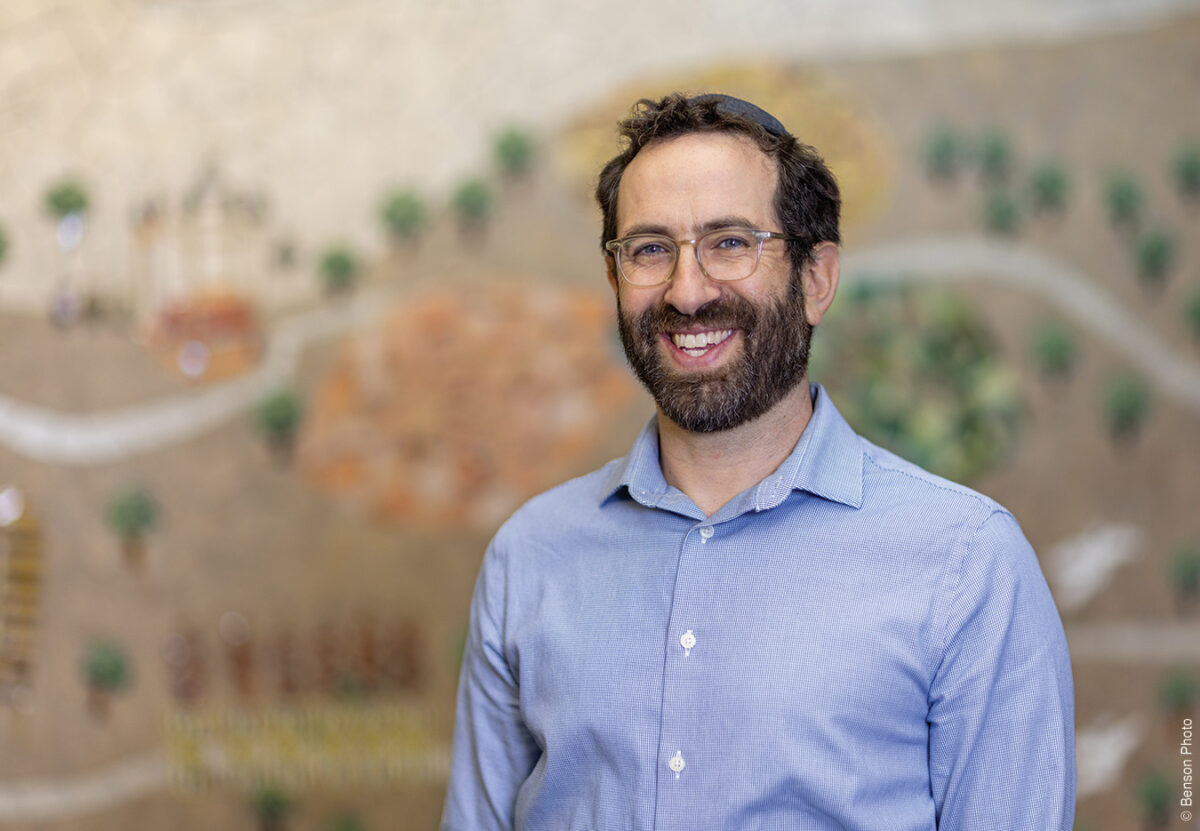
On the first day of July, as a heat wave scorches a quiet campus, Rabbi Gabe Greenberg is excitedly pacing around his second-floor office in Steinhardt Hall.
Although students are gone for the summer and the typically bustling building, located on 39th Street between Walnut and Locust Walk, is virtually empty, the Penn Hillel executive director has just finished an email to the University’s incoming Jewish freshmen, with information on High Holidays services. “It’s very cool to see the new names, where they’re coming from,” says Greenberg—who then digs out a handwritten letter, with a similar objective, from exactly 50 years earlier.
In the summer of 1966, then Penn Hillel president Howard Schulder W’67 used lively language to recruit freshmen to join their ranks. “Let’s get down to brass tacks—no preliminary niceties, no general come-ons, no we-like-you and you’ll-like-us bit—just business,” he began, before promising a “dynamic, multi-faceted program including religious services, study classes, cultural opportunities, social events, forums, etc.” and help with any questions a new student might have (“from religion to blind dates, from academics to maid service”).
For Greenberg, Schulder’s letter is a reminder of both Penn Hillel’s vast history and the cyclical nature of campus life. For more than a century, the Hillel has strived to help teenagers leaving home for the first time.
Yet at no point in the organization’s history has it served a more vital role in helping Jewish students navigate challenges—from freshmen to graduate students, from Orthodox to secular Jews, and everyone in between.
October 7 and Its Aftermath
Greenberg was only two years into the job running the University’s hub for Jewish student life when Penn became a focal point in a national debate over campus free speech and institutional responses to antisemitism.
The fall 2023 semester began with a controversy over speakers at a Palestine Writes Literature Festival and antisemitic vandalism at the University. In September a swastika was found painted on a wall inside Meyerson Hall, and a week later an individual disrupted the peace in Penn Hillel by shouting obscenities and overturning furniture. The October 7 terrorist attacks by Hamas on Israel and the ensuing war in Gaza escalated tensions on Penn’s campus, which was further rocked by alumni and donor backlash and the resignation of then Penn President Liz Magill after Congressional testimony, which was condemned by, among others, Penn Hillel for Magill’s “inability to state clearly that calls for the genocide of Jews constitute bullying and harassment,” Greenberg wrote in a December 2023 email. The 16-day pro-Palestinian encampment on College Green at the end of the following semester, which caused distress and fear among some Jews on campus, capped a tumultuous school year that still reverberates today.
“I would say the last three years have had extended periods which were quite difficult personally and professionally,” Greenberg says in the first of two interviews in his office this summer. “The bad was really bad, including threats to my safety and the safety of members of my team. And explicit acts of antisemitism on campus were all very difficult.” Yet he has experienced more than just strife. “There have been moments which made me optimistic about the future of Jewish life on campus, including members of other cultural communities and faith communities reaching out in acts of solidarity and support. There were beautiful moments amongst the pain as well.”
Things have calmed down considerably at Penn. Greenberg calls 2025–26 a mostly “normal year” for Jewish students. The lone exception, he says, was the US Equal Employment Opportunity Commission’s legal campaign against Penn to obtain private employee information as part of a federal antisemitism investigation. “Every Jewish student, Jewish staff, and Jewish faculty member that I’ve spoken with at the University of Pennsylvania all agree that this is not how the [Trump] administration should have approached this issue, though many of those people want the government to take seriously the issue of antisemitism on campus,” Greenberg remarks. “I’ve never seen such unity. This one hit the wrong way.” (The Trump administration ended up dropping its subpoena demanding personal contact information for Jewish employees.)
Looking back on the fall 2023 semester and its fraught aftermath, Greenberg admits that “perhaps naively, I did not anticipate how deeply political and politicized this job would become.” For him, that meant fielding media requests from national outlets including The New York Times and Washington Post (most of which he declined) and interacting with politicians. He and a couple of other Penn Hillel staff members also received a threatening email that was “quite explicit,” from a sender who was never identified.
The challenges have spurred Penn Hillel to become “fundamentally much more outward facing,” Greenberg says, in terms of advocating for Jews on campus in talks with the Penn administration and participating in the University Task Force on Antisemitism. Penn Hillel also began to welcome “many more” students into its building to seek solace, Greenberg notes. With a noticeably increased security presence outside Steinhardt Hall, most visitors felt secure in the building—but not all. “I remember vividly a student who did come to a Shabbat dinner after October 7, and saying to me through tears that she did not feel safe coming but felt that it was important,” Greenberg recalls.
That conversation, among others, drove home that Jewish students at Penn “are not a monolith,” Greenberg remarks. “Jewish students responded to the events on campus in a wide variety of ways,” he says. “Some said, Now is the time to do bridge building and to reach out culture to culture, religion to religion, faith to faith, person to person. And that’s beautiful. And we at Penn Hillel tried to support students that want to do that.
“Other Jewish students said, This is a time where I want to spend a lot of my time with other Jews, and I just want to know that I can go to a Shabbat dinner with a joyful community of other Jews and feel supported in that. And that’s critical and beautiful. And we support that as well.”
There was, however, one thing many of them agreed about. As some alumni and people outside of the Penn community relied on social media feeds or cable news portrayals painting the University as a hostile and unwelcoming place for Jews, the reality on the ground—aside from a few troubling instances—was different.
“Most students over the past three years,” Greenberg says, “expressed to me and to others that there was a significant gap or dissonance between the level of external media attention and discourse and rhetoric about what was happening on campus and what they felt.”
And Penn Hillel was a big reason for that.
Open Dialogue and Seeking Comfort
When Gabe Greenfield C’27 got his first email from Penn Hillel, he did a double take. With such a similar name to the organization’s director, “I was like, why am I emailing myself?” he recalls with a laugh. But he hooked on with Penn Hillel immediately, going to its pre-orientation program for incoming freshmen held at a Jewish summer camp before becoming a regular at Steinhardt Hall. “They’re really fantastic about reaching out and making it accessible,” says Greenfield, who enjoys the free coffee K-pods as well as the opportunity to “just walk into the office and chat with my favorite staff members.”
He was in his first semester of college when the October 7 attacks happened, which “shaped my trajectory, and honestly created a launch point for me to go on this journey of understanding.”
Penn Hillel played a big role in that journey. Greenfield was “already really interested in learning other perspectives and broadening my worldview” when he got to college. As the war in Gaza unfolded, he reached out to Muslim students to form small discussion groups about what was going on in the Middle East and Penn’s campus—“not to argue or debate but just to foster understanding.” Those conversations, part of what was called the Breaking Bread initiative, were often held at Steinhardt Hall. Greenfield recruited students from Penn Hillel to join. “I think creating that space in the middle is important,” says Greenfield, who also serves as president of Penn’s PRISM interfaith club.
Greenfield might seem like an unlikely person to foster connections with self-declared anti-Zionists. He comes from a modern orthodox background in Teaneck, New Jersey, and spent a gap year in Israel before arriving at Penn. He’s visited the Jewish state several other times, including this summer.
But in dialogue sessions, he has strived to focus on similarities between the Torah and Quran, and to understand geopolitical perspectives beyond his own. And, he says, he’s never felt scared or uncomfortable walking around Penn’s campus while proudly donning his Star of David necklace, which “I don’t even think twice about wearing in public.”
“But even if I wasn’t feeling particular targeting, it was still an interesting time to navigate as a student,” he admits. “And I think Hillel has been very good about being a place for people to come and unload and talk. Obviously they’re going through it as well, but they’re always here to listen … trying to actively engage with students and make it a place that everyone feels comfortable in.”
Perhaps that’s one reason why Greenfield pushed back when friends and family members singled out Penn and other college campuses as primary hotbeds of antisemitic behavior and hate. “I have a friend in the IDF [Israeli Defense Forces] and I’m on the phone with him catching up, and he’s like, Gabe, I hear it’s really bad on Penn’s campus,’” Greenfield recalls. “I’m like, Ethan, I joined a fraternity this semester. You are in a war.”
Beaue Bernstein C’26 proudly wore her Jewish star around campus, too. But she says that “being anywhere visibly Jewish was a little frightening” around the time of the encampment, calling that episode “really difficult emotionally” to deal with at the end of her sophomore year. Yet Bernstein also expressed a more nuanced view than many media portrayals. Although she did have a friend who was yelled at for wearing a yarmulke, she said explicit antisemitism like that was rare. “It was more the organizing against Israel that was hard, because there were so many people from off campus who were coming and riling everybody up.” (Greenfield also believes non-Penn-affiliated agitators “commandeered” the encampment and “I don’t think really represented the beliefs of the students that genuinely cared about the conflict.” When Penn Police disbanded the encampment on May 10, 2024, Penn students only accounted for nine of the 33 people arrested and charged.)
But there is a “large population of students that is very outwardly anti-Israel,” Bernstein says, “and so that feels kind of isolating.” Unlike Greenfield, she found it “exhausting” trying to engage with them and instead opted to hunker down and spend “more time within the Jewish community, because I don’t really feel like wasting my energy in other spaces where I’m going to feel isolated.”
She credits Penn President Larry Jameson’s leadership for helping to restore enough of a sense of calm to “give us a chance to actually focus on Jewish activities and Jewish life” in a more ordinary way. For her, that meant leading the Penn Shabbatones, a Jewish a cappella group that practices in the basement of Steinhardt Hall and became the backbone of her undergraduate social life. She also took part in Penn Hillel’s Shabbat Hosting Lab, a fellowship that includes funding and support to host two Shabbat dinners, and the Jewish Leadership Initiative, a fellowship for upperclassmen to meet with Jewish leaders across different industries. “That has been, by far, one of the most impressive things that Penn Hillel does,” says Bernstein, who appreciated hearing executives, doctors, judges, and others discuss how their Jewish values shaped their careers.
More than anything, Bernstein took advantage of the extensive travel opportunities that Penn Hillel provides, visiting Israel through the Birthright program (her fourth time there), London with the Jewish Leadership Initiative, and Poland and Greece to learn about Jewish history. “That was really meaningful because my great-grandmother is from Poland,” she says, “so I got to reconnect with that part of my heritage.”
Other travel opportunities include a Winter Break trip to the United Arab Emirates and Israel for Wharton undergraduates to learn about the Abraham Accords, because “Penn Hillel is doubling down on supporting students in learning more about the conflict from every angle … and about the broader Middle East,” Greenberg notes. And thanks to Penn Hillel’s fundraising efforts, those trips are heavily subsidized for students. “We want to make these trips as accessible as possible,” he says. “We’re always trying to explore Jewish stories around the world.”
A Rich History and a Bustling Building
Travel has been an important part of Penn Hillel since Jeremy Brochin served as executive director from 1987 to 2010. So has social justice, rooted in the Jewish value of Tikkun olam. During Brochin’s tenure, the organization led trips to Central America, Russia, and Germany. It began a partnership with the Greenfield Intercultural Center and the African-American Resource Center that sent Black and Jewish students to the South to retrace the history of the Civil Rights Movement [“Gazetteer,” May|Jun 2005], and a program that sent Jewish and Muslim students to rebuild in New Orleans after Hurricane Katrina.
But despite a large and active Jewish community that spread its wings around campus and well beyond, Penn Hillel was based out of what Brochin calls a “pretty schleppy building” on 36th Street near Walnut Street that has since been torn down. “It became clear that the community was too large for that facility,” he says.
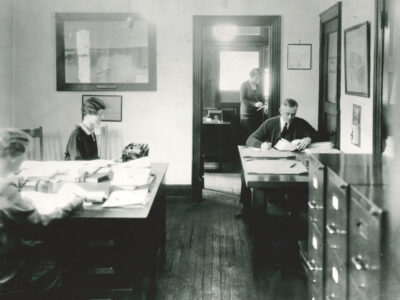
By then, Penn Hillel had been a part of campus life for many decades, having gone through several iterations. In 1919, the Women’s Council of Conservative Judaism began an independent Jewish student house, which a few years later became one of the first Jewish student associations in the country. Later named the Louis Marshall Society, it affiliated with the B’nai B’rith Hillel Foundation in 1944 and moved into its house on 36th Street not long after. It then grew into one of the largest and most active campus Hillel chapters in the world, today reaching about 85 percent of Penn’s Jewish students with a wide variety of social, cultural, religious and educational opportunities. But according to Greenberg, its mission has shifted over time.
“My understanding of some of the earlier kinds of permutations was that Hillel, in many ways, was a synagogue—a purely religious space,” says Greenberg, the organization’s 11th director since 1944. “It still serves those functions, but it grew to be a Jewish Community Center [JCC] model,” which is a community-based recreational and social space. “And then it expanded its mission to become a campus cultural center, and then again in recent years to become an advocacy organization. But we are still a synagogue and we’re also still a JCC.”
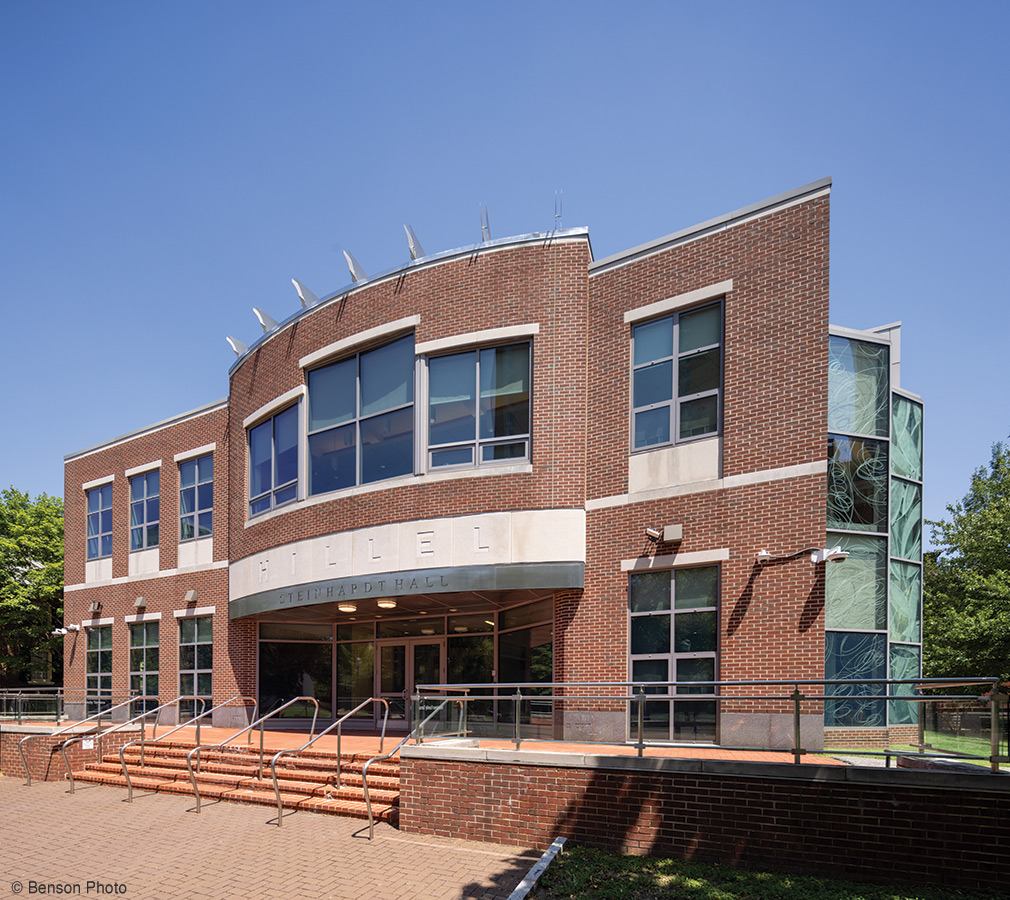
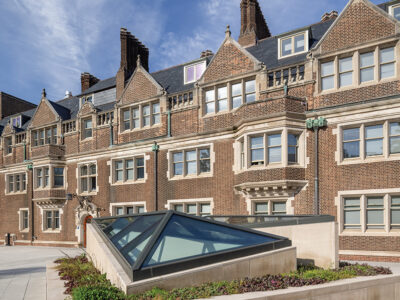
The move to Steinhardt Hall was necessary to continue Penn Hillel’s growth. Brochin credits the late Ed Berkowitz C’49 as a driving force in negotiations with the University for space as well as raising the money for the $12 million project. The three-story, 36,000-square foot space, designed by JacobsWyper Architects, opened in October 2003 [“Gazetteer,” Jan|Feb 2004], beginning what Brochin calls the “heyday” of the organization after a “difficult” period before that. “In the early 2000s, you’d get 400 people here for Shabbat between services and eating,” Brochin says. “People couldn’t believe the beauty of the building, especially compared to the old place.”
With comfortable spaces including a rotunda, library, student lounges, an activities space, and a 300-seat auditorium for classes and events, the building “is definitely a place of gathering,” says Bernstein, who calls it “one of my favorite places on campus.” Greenfield believes that the central location is key and that the atmosphere is welcoming for all kinds of Jews (and non-Jews too). “It’s a very pluralistic space,” he says. “If you go to the third floor, you can learn Talmud all day. Or you could sit on the first floor and just grab lunch and that can be your connection to Judaism for the day. Or if you go in between to the second floor, there’s a staff member that would love to talk to you about your Jewish journey.”
That’s always been the goal for Greenberg, who says “the vibes are great” in the building, even when things have felt uncertain outside of it. “You can come just to hang out, meet with friends, and do homework,” the Penn Hillel director says. “We have free printing and free coffee. And then, while you’re here, maybe you want to check out some of our offerings, be they more academic, or more social, or more cultural. It gives me great joy that I’ll come here on a random Tuesday or Wednesday night, and you might have a rabbi teaching an intro to Judaism class, you’ll have someone teaching a group of non-Jewish students about Judaism or Israel, you’ll have a club, or a sorority meeting, or a non-Jewish dance group practicing. That, to me, is sort of at the intersection of what we want a Jewish space at a university to look like.”
The building also boasts a popular kosher dining hall, which two years ago eliminated a surcharge in order to match the cost of any other campus dining hall. “The moment they did that, it increased traffic into our building significantly,” Greenberg says. “For lunchtime and dinner, there’s a line out the door.” The make-your-own chicken wraps are a particularly tasty draw, for Jews and non-Jews alike.
“I like to say the biggest combatant of antisemitism on campus,” says Greenfield, “is the dining hall.”
A Wide Array of Programming—For Grad Students, Too
While Steinhardt Hall has been an easily accessible hub for Jewish life at Penn for the last 23 years, it hasn’t always felt that way for the University’s graduate students.
“In graduate school, there are significant differences in starting age, level of professional experience, and academic focus,” says Liza Goldstone GEng’27, who is pursuing a master’s degree in Penn’s Integrated Product Design (IPD) program after graduating from Duke in 2025. “The landscape is complex, and building community requires intentionality.”
After enjoying Jewish experiences at Duke, Goldstone recognized that “Penn Hillel could be an anchor” in her city. In the spring before she started at Penn, she was introduced by a friend to Ariel Nissan, who had recently stepped into the role of director of a new program called GradHillel. “We had never served graduate students in a formal way,” Greenberg says. “After October 7, graduate students said, en masse, We really need support socially, politically, we need you to advocate for us. It was a wave that really hit.” In her first year in the role in 2025–26, Nissan was tasked with identifying the needs of the University’s Jewish graduate and professional students and offering learning opportunities and social gatherings both on campus and around Philadelphia.
Describing Nissan as a “warm community builder” and “an incredible human,” Goldstone immediately felt embraced by Penn Hillel. She found that the events and people provided her with “a sense of place on Penn’s campus” while helping her build her Jewish knowledge and identity. She participated in hands-on classes and workshops, including making bagels and themed cocktails. She enrolled in the Shabbat Hosting Lab and brought together a dozen Jewish students and young professionals for meaningful conversation over brisket and chocolate-covered matzah at her Rittenhouse Square apartment. And she has expanded her network, connecting with law, medical, education, and business students who embrace Jewish values. “Being a member of GradHillel has truly enriched and defined my Penn experience,” she says.
Calling the program’s debut “a wild success,” Greenberg hopes to build on it and get more grad students inside the building for all of Penn Hillel’s offerings, including its wide array of speakers. The most well-attended recent ones have ranged from serious panels featuring Holocaust survivor Michael Katz CCC’49 [“Gazetteer,” Jul|Aug 2025] and October 7 survivors, to events featuring filmmaker/actor Jesse Eisenberg and NFL running back AJ Dillon, who is African American and Jewish and was asked both about how Judaism impacts his identity as a football player and deeper-in-the-weeds questions about the Philadelphia Eagles (for whom he played in 2025).
“We have to push Jewish joy,” Greenberg says. “Students are seeking joyful, interesting, compelling ways to connect to their Jewish identity.”
Penn Hillel also continues to build on its “strong social justice pillar,” Greenberg says, which includes a student-run soup kitchen in the building and a partnership with the Jewish Relief Agency to pack and deliver food to the homes of Holocaust survivors. The organization maintains other partnerships across the University, including with other cultural and minority groups, often through interfaith service projects and trips. Mike Uram—who served as Penn Hillel’s executive director from 2010 until Greenberg took over—told the Gazette as he was leaving Penn Hillel [“Gazetteer,” Mar|Apr 2021] that he was proud of those programs but noticed that Penn’s Jewish students were often more concerned about “justice and equality and inclusivity for everyone … than how do we protect the Jews?”
As antisemitism has grown nationwide since Uram’s departure in early 2021, Greenberg has noticed Jewish students “closing ranks a bit” and “seeking out more community with more Jewish students.” But he believes that over the next few years, Penn Hillel will restore its interfaith work and that its advocacy efforts will extend to other communities that need support.
“As long as antisemitism continues, we are going to need to have a strong core of showing up for our community and advocating for ourselves,” Greenberg says. “But as long as we’re doing that and have that core, then we also need to make sure we’re showing up for others as well.”
A Survey About Israel and Antisemitism
Back in November, Greenberg hosted a webinar for alumni, parents, and other members of the Penn Hillel community—his seventh one, he noted at the outset of the talk, since October 7, 2023. An important way to keep people updated on campus happenings, the impetus for this particular iteration, he said at the time, was “the feeling that we are really closing the page on a chapter in Jewish life at Penn” with an opportunity to look ahead to a brighter future.
In addition to recapping the “highly destabilizing and deeply upsetting” previous two years and the work Jewish leaders did to “rise up” and advocate for a safer campus, Greenberg had two students speak about their personal experiences. One, a freshman named Judah Blitstein, discussed writing a paper on the mislabeling of Zionism for a writing seminar. “And my teacher, surprisingly, greeted it very warmly, and she really encouraged me to write about that and be passionate about that and talk to my fellow students about the topic,” Blitstein said. “And I think that’s been really great about Penn. I think it’s really shifted from this kind of almost polarized spectrum to a place where people want to have conversations about this type of thing.”
Yet that hasn’t been the experience for everyone in the classroom, and fewer students nowadays are likely to identify as Zionists. Greenberg also used the webinar to introduce alumna and professional pollster Shira Angert C’06, who had conducted for Penn Hillel what Greenberg called “the first major survey on Jewish life at Penn in over a decade.” Having polled hundreds of students during the 2025 spring semester, the survey found first that “Jewish students at Penn have very strong Jewish identities,” Angert said on the webinar. “They’re proud to be Jewish and they’re highly engaged in Jewish life.” But while 96 percent of students agreed with the statement that they are proud to be Jewish and 87 percent said that being Jewish is very important in their lives, the numbers dipped when they were asked about Zionism, which is defined as the movement to support and protect the existence of a Jewish homeland and state in the ancestral region of Israel. Angert noted that while 65 percent of those surveyed have traveled to Israel and 84 percent believe it has the right to exist as a Jewish state, only 62 percent described themselves as Zionist. “So that really speaks to the fact that Zionism has become coopted by the other side as a dirty word,” Angert said. “There’s a hesitation among Jews to identify as a Zionist, despite the fact that the vast majority believe that Israel has the right to exist as a Jewish state.”
Greenberg calls that a “fascinating gap” but one that is “very similar” to national polling data. More specific to Penn, and “more challengingly, was that a majority of Jewish students still feel that in the classroom they pay a penalty for expressing their political beliefs, specifically about Israel,” Greenberg says. “So that’s a problem that needs work.”
In the poll, Angert found that while about 80 percent of Jewish undergrads used a positive adjective to describe how it feels to be Jewish at Penn, 51 percent also used negative words—“things like alienated, isolated or lonely, scared, difficult, anxious, nervous, confused,” she said. Roughly 45 percent of students reported that they felt intimidated or uncomfortable because they are Jewish or because of Israel, and nearly a third felt as though they needed to hide their Jewish identity. A higher number—85 percent—said they had either heard about or seen something antisemitic at Penn, “but these experiences have been pervasive across all college campuses,” Angert said, adding that the numbers “mirror almost exactly the findings that the ADL and Hillel International had on their nationwide study of Jewish college students.”
Greenberg says he’s committed to doing a similar poll every five years. In the meantime, he’s felt buoyed by hearing “great success stories” like Blitstein’s remarks about his classroom experience, which he believes is what “most professors” want. But he knows that issues still lurk. In his own conversations with Jewish students, the Penn Hillel director found that “some felt a deep and pervasive sense of antisemitic feeling on campus, whereas many students did not feel that,” he says. “Some students were deeply upset by expressions of anti-Israel rhetoric on campus, and other students were more able to grapple with that and engage with it, both on Locust Walk and in the classroom.”
At the end of the November webinar, Greenberg looked ahead to “the next chapter,” detailing Penn Hillel’s efforts for “bridge-building between Jewish communities and other communities” as well as “restoring Jewish unity” after a post-October 7 rift, “ensuring that all Jewish students respect one another, are in the room together, and can build their capacities to have difficult and courageous conversations.” But perhaps more than anything else, Jews need to see Penn as a place they want to go to college. “If we do not stem the decline of Jewish students at Penn,” Greenberg told members of the Hillel community, “then, frankly, it kind of doesn’t matter what else we solve.”
Recruitment, Advocacy, and Leading with Love
The declining proportion of Jewish students at Penn has been a source of frustration for many alumni—and one that Greenberg has been trying to figure out and help solve since before October 7. At the turn of the 21st century, around a third of undergraduates at Penn were Jewish, a number that’s dropped to roughly 11 or 12 percent today, according to Penn Hillel data.
You can argue that Penn “did have sort of an overrepresentation in the second half of the 20th century, partially because some of its peer schools had quotas against Jewish admissions,” Greenberg says. Now, with an admissions shift geared toward attracting more international and first-generation, low-income students, it makes sense that the number of Jews would decline—yet “there’s some evidence,” he adds, “which seems to suggest it may have fallen at a greater rate than what would be explained by those factors.”
The percentage of Jewish undergraduates at Penn still dwarfs the proportion of Jews in the general US population (roughly two percent), but lags behind some other schools. In a 2025 report in the Hillel College Guide magazine, Penn’s 1,100 Jewish undergrads ranked 20th among private universities in the US in terms of total numbers. But when accounting for all colleges (public and private) and ranking it by the percentage of the undergraduate population, Penn fell to 57th (and fifth among the eight Ivies) at 11 percent.
Given the University’s long history of Jewish presence, beginning with the enrollment of Penn’s first Jewish student, Moses Levy, in 1772, “Penn Hillel has to do two things simultaneously,” Greenberg says. “We need to advocate toward the University to ensure that the Jewish population does not continue to decline as it has over the past 25 years. And we need to simultaneously make the case to prospective students that life is great for Jewish students, and if you’re considering it, we would love to have you.” To accomplish the latter, Greenberg has been traveling to Jewish day schools, sometimes with a Penn admissions officer, where he tells high schoolers that “the vast majority of Jewish students at Penn would say to you that life is great for Jewish students at Penn,” he says. “And if you don’t take my word for that, you can talk to students, and I will connect you.”
Anecdotally, Greenberg has seen a “bit of a bump” in the number of students coming from Jewish schools as well as freshmen participating in Penn Hillel’s new student programs, “but we have to keep our foot on the gas,” he says, noting it will take time to collect new data on Jewish enrollment. (The University itself does not track the religious identity of applicants.)
It’s an important issue for Penn’s current students, too. Greenfield, now in his senior year, says that he has friends who have transferred from American universities to Israeli ones because they feel more comfortable there, but if everyone makes that decision, “then there’s not going to be any more Jewish students here.” Bernstein notes that the thriving Penn Hillel was one of the main reasons she applied to Penn and that “luckily, there are a lot of proud Jews on this campus, and we’re not going anywhere.”
Maya Harpaz C’25, who served as Penn Hillel’s president as a senior and before that was president of the Penn Israel Public Affairs Committee (PIPAC), saw the same level of campus pride before graduating, even after instances of antisemitic vandalism. “If anything, I think it made people feel prouder to be Jewish,” she says. “You would think the opposite, that people would take off their Star of David necklaces and take off their kippahs. But I saw on average people displaying more signs publicly of their Judaism.”
After being elected president by her peers during one of the most challenging periods in Penn Hillel’s history, Harpaz went from “planning fun events” to meeting with University administrators and campus security personnel. She built out new things like a faculty mentorship program for undergraduates after “receiving lots of outreach from professors asking, what can we do?” And she served alongside Greenberg on the University Task Force on Antisemitism, whose final recommendations ranged from bolstering Jewish studies and incorporating antisemitism training into orientation programs to increasing support for Penn Hillel, Chabad, and other Jewish groups and “ensuring policies regarding speech and expression are articulated clearly and enforced evenly across campus,” Greenberg notes. (Greenberg also says he pushed for the University to “do a better job of recognizing and engaging with the Jewish community and Hillel as a cultural group” rather than a purely religious one, since many students “primarily identify their Jewishness as a culture.”)
In her close work with Greenberg, Harpaz found the Penn Hillel director to be “really great at balancing the nuance of the situation that we have been facing,” she says, “and he’s done a great job building relationships across the board with students, administrators, alumni, and board members.”
One person with whom Greenberg has formed a close relationship is Chaz Howard C’00, the University chaplain and vice president for social equity and community, who also served on the antisemitism task force. “He’s just a lovely human being,” Howard says. “He’s very smart, funny, kind, easy to talk to, down to earth—the kind of person whom I’d enjoy being friends with even if our paths here didn’t cross at Penn.”
Although Howard’s chaplain’s office works closely with Penn Hillel, as it does with all of the University’s religious groups, Penn Hillel functions as its own nonprofit organization, making it especially gratifying for Howard to see how much Greenberg has fought to improve the University. And during a “uniquely challenging time,” the Penn chaplain believes Greenberg “navigated it as best as anyone could have.”
“Gabe is very clearsighted, and by that I mean he’s clear about what he believes but he also sees other perspectives clearly and can humanize and even love people who radically disagree with him,” Howard says of Penn Hillel’s leader. “I’ve seen him sit down with Jewish students across the political spectrum. I’ve seen him sit down and journey with Palestinian Arab students, and with parents and alumni and University administrators and politicians and the media.
“It’s very hard to do, and I know it was also hard on Gabe, but he did it all with grace and love. He never stopped loving, and that’s something I deeply admire about him.”
Greenberg plans to continue to lead in that manner—and is hopeful that over the next century Penn Hillel will continue to “stand as a beacon of joyful Jewish expression, dynamic pluralism, academic equity, and cross-cultural leadership,” as it has for so long.
“It must remain both an accessible front door for everyday connection and a bastion of support during times of friction,” he says, “ensuring that every Jewish student at Penn can proudly, safely, and authentically explore and grow in their identity.”