Tracing the history of American English, one slip at a time.
By Stefan Fatsis
Plus: A Q&A with the author
As part of the reporting for his new book, Unabridged: The Thrill of (and Threat to) the Modern Dictionary, author Stefan Fatsis C’85 spent time working as a lexicographer for Merriam-Webster, the premier dictionary company in the US and the only originally brick-and-mortar/ink-and-paper outfit still standing after the internet ravaged the industry.
In Merriam’s headquarters at 47 Federal Street in Springfield, Massachusetts—a model of mid-century office design when the company moved in in 1940 but which had grown shabby by the time Fatsis first arrived in 2017—he labored among the dwindling staff proposing new words to include in the company’s online dictionary and crafting definitions to go along with them. These days such work takes place in front of a computer screen, but Fatsis also reveled in investigating the company’s Consolidated Files, where generations’ worth of paper materials of various shapes and sizes are stored away—a treasure house of insight into American language and culture whose fate is currently uncertain.
EXCERPT
What I cherished most about my all-access pass to Merriam-Webster was the paper.
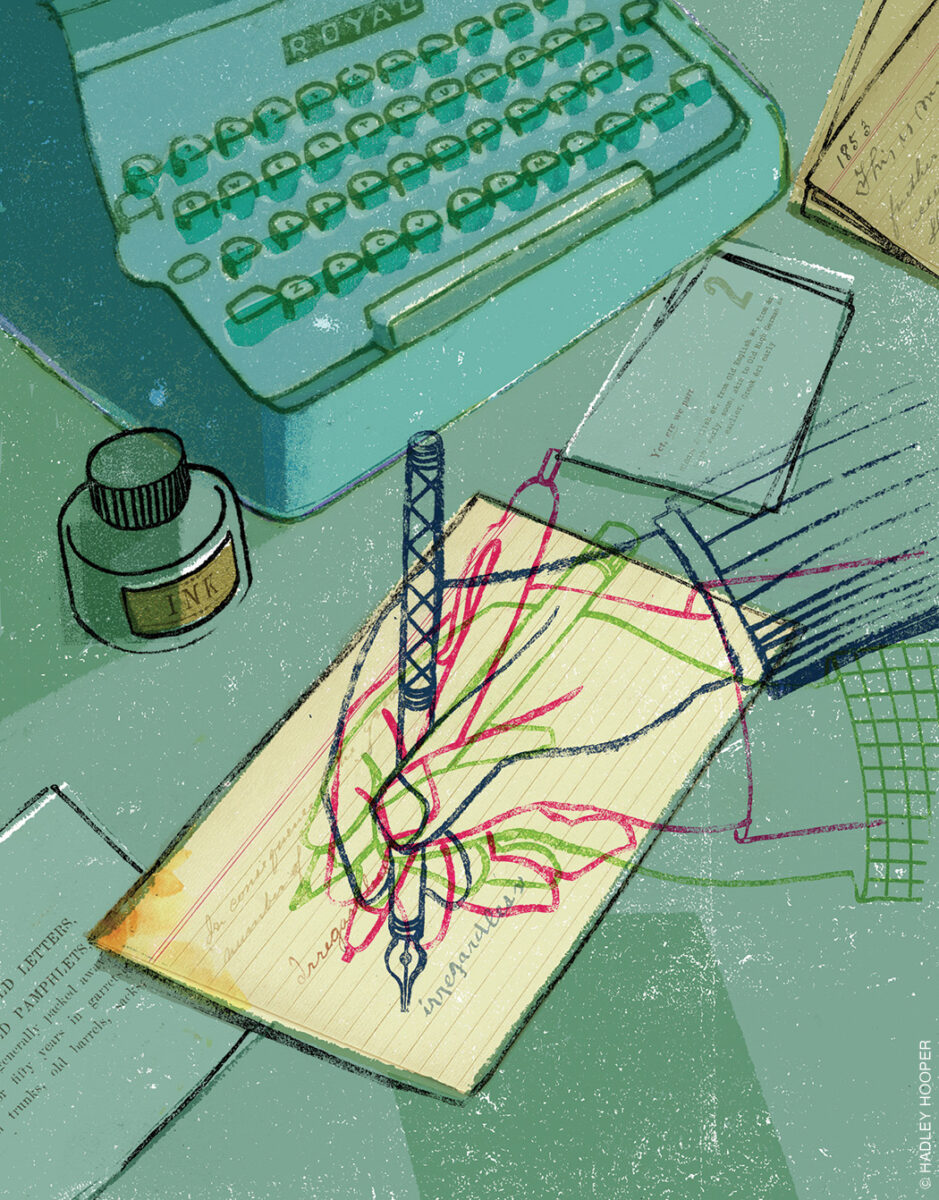
I loved rooting around in the Consolidated Files, stumbling on a yellowed snippet of a 1974 New York Times story by McCandlish Phillips—a reporter who once revealed that a Ku Klux Klansman had been an Orthodox Jew—that used the phrase Dashing Dan. Or extracting from a basement file a 1928 card with comments from an editor named Loveridge about an illustration to accompany green turtle (“Head very poor, claws on hind flippers over-accentuated”). Or finding in a metal cabinet a 1956 contract to pay an Ohio State University marketing professor $150 to define 652 business terms, from general store to window display. Or encountering a wall of boxes filled with words typed in reverse order. (This was the Backward Index, which was useful in identifying related terms that might be defined the same way, or particular groups of compounds, or words that rhymed. The index’s 315,000 slips filled 129 file boxes.) When I did any of that—which I did a lot—I was awed by what The Atlantic Monthly, in an 1879 review of a Merriam dictionary, called “this mighty thing.”
But my infatuation with the musty and sweet-smelling history—tens of thousands of pounds of cards and books and sheets of paper crammed inside drawers, stacked in stairwells, smushed into creaky filing cabinets in the basement of Merriam’s old brick headquarters—wasn’t just sentimental. Merriam didn’t need the paper to practice modern lexicography. Definers rarely made the trip to the Consolidated Files. But the paper—especially the slips—was more than a reliquary. It was a living, breathing portal into the history of American words. It was indispensable to charting and understanding the story of American English.
Merriam didn’t invent the citation slip. Samuel Johnson collected about 150,000 quotations for the 40,000 headwords in his 1755 dictionary. When James Murray took over in 1879 as editor of the Oxford English Dictionary, the creators of the then two-decades-old project already had amassed about two million citations, or quotation slips, as they are known at Oxford. From the outset, readers were instructed to send submissions on four-by-six-inch slips, “written out with its quotation and the full reference on a separate half-sheet of note-paper, lengthwise, and on one side of the paper only.” But contributors posted much more: book and newspaper extracts stuck on torn-off bits of envelopes or the back of theater bulletins.
The slips arrived at the Scriptorium, as Murray jokingly called the specially built, corrugated shed where he and his staff made the dictionary, in boxes and sacks and even a bassinet; “a hamper of I’s,” one worker said. They were sorted—by Murray’s eleven children, among others—and filed in specially designed bookcases containing more than a thousand pigeonholes and, as the number of slips swelled, on bookshelves. By the time the first edition was published, in 1928, the OED had amassed more than five million.
At Merriam, slips were used to make its 1864 unabridged dictionary, which for its creation, content, and look is considered the first truly modern lexicon. (After acquiring the rights to Noah Webster’s groundbreaking American dictionary after Webster’s death in 1843, brothers George and Charles Merriam overhauled the editing and marketing of the dictionary.) “Paper to be written on one side so as to be cut up into slips so that all the quotations for each word may be gathered readily together & be before the eye of the definer at once,” the editor of the 1864 book, Yale University professor Noah Porter, explained. Alas, I didn’t find any slips from that era in the Merriam company papers covering much of the nineteenth century, which are held at Yale’s Beinecke Library.
After Porter’s death in 1892, the Merriams brought the dictionary north from New Haven. The oldest three-by-fives in the company’s home base in Springfield date to the first book created there, Webster’s New International Dictionary of the English Language, published in 1909. Citations were handwritten on light blue slips and stamped with an inch-high numeral 1. A blue slip pops up in the Consolidated Files every quarter inch or so. When the next edition of the unabridged dictionary, known as Webster’s Second, was published in 1934, the files held 1,665,000 citations, known inside the company as “cits,” pronounced cites. New ones for that book were stamped with a big 2.
Philip Gove, the editor-in-chief of Webster’s Third, which came out in 1961, went at it more systematically than his predecessors. Gove told editors to read for up to two hours a day and mark new words or new senses of existing words from anything and everything. The intent was to portray “language as it is,” not as it was rendered by a hunched-over editor drafting a stilted sentence fragment with a pencil. Under Gove, editors collected about 80,000 cits a month, or nearly a million a year, bulging the files to about 10 million when the Third was published. The pace slackened after the big book was done, but editors kept precise track. Merriam’s 1976 in-house annual report noted that “208,646 citations were added to the files during the year, bringing the total number of citations to 12,275,742.”
The current 16 million number excluded slips with existing definitions cut from dictionaries, new draft definitions, cross-references, and editor comments and questions. There certainly had been a lot more. Before the company’s move to its current home in 1940, editors likely culled and tossed cits that had been rejected again and again. Retired Merriam publisher John Morse once tried to check the total by counting the number of cits per inch and then multiplying that number by the length of a drawer and then by the total number of drawers. His estimate was pretty close.
The Consolidated is a mosaic of colors and inks and fonts and papers and stamps. You can easily discern the period from the style. Elegant, flowing, fountain-pen cursive in the late nineteenth and early twentieth centuries. The evolution of manual and then electric typewriter fonts. There are carefully scissored quotations from newspapers and magazines, curt and precise and visually evocative of the dates typed beneath them.
The files are a century-long scrapbooking project. Full-page clippings folded one, two, three, four times, like a kid stuffing a school note into their back pocket. Black-and-white photostats that began appearing in the 1950s, when Gove instructed editors to take multiple citations from single passages, especially for common words, to avoid the tendency to flag unusual words while ignoring run-of-the-mill ones. Early computer printouts with truncated tails on the g, j, p, q, and y, which reminded me of the annoyed Penn professor who underlined every last one on a paper I submitted in the 1980s.
The aesthetics make the cit files a work of art. Their content makes them an irreplicable and irreplaceable archive of American English. The cards hold forensic clues to how identically trained curators compiled and adjudged the quotidian changes in the language for more than a hundred years. USED FOR SCHL DICT 4. REJECTED FOR 9 COLL. USED FOR CII. Those all-caps distinctions—C and COLL Collegiate, the name of Merriam’s bestselling desktop book; SCHL DICT for School Dictionary; the numerals for the editions—weren’t mere editorial and business judgments on what belonged in a dictionary. They were clinical assessments of the state of American English and American culture (and Merriam-Webster) on any given day. Every physical detail about a card—the ink, the typewriter, the publication font, the handwriting, the glue, the stamp, the type of paper—provided context about the word it chronicled and the time in which it was chronicled, about the way information about the language was conveyed, curated, and preserved.
Examining these slips, letters, and memos is a historical exercise; they add facts to our understanding of the evolution of language. But it’s also a personal one. I was eavesdropping on a multigenerational, intraoffice conversation. It was as if Gove and the other Merriam editors I came to know by their stamps and handwriting and three-letter initials were sitting around the table in the conference room filled with more than a century of unabridged editions hashing out what to do about fuck or ain’t or pragmatic—like the 1919 Black Sox emerging from that Iowa cornfield. These were real people making critical decisions about the way words are depicted. The slips let me join the discussion all these years later.
Sometimes the conversations lasted decades. On June 28, 1930, a Merriam special editor for grammar named A. D. Sheffield recommended saving four lines of print in the entry for preposition in Webster’s Second by deleting an explanation that a preposition “may follow (in position) its object.” An assistant editor with the last name Thomas replied in gorgeous, right-leaning red ink: “There is still abroad in the land a good deal of schoolmasterly feeling that such locutions are a bit off-color, as violating the etymology of preposition. I should retain the statement.” Thomas wrote that 29 years later, on September 17, 1959.
A conversation about how to label irregardless also lasted decades. Merriam dated the first use of the word to 1847 and reported that it was “popularized in dialectal speech” in the early 1900s. Commentators began calling it out as improper as early as 1927. “The most frequently repeated remark about it is that ‘there is no such word,’” a note in the irregardless entry in Merriam’s free online dictionary read. “There is such a word, however. It is still used primarily in speech, although it can be found from time to time in edited prose. Its reputation has not risen over the years, and it is still a long way from general acceptance.”
Merriam books have entered irregardless for generations. There’s also evidence in the Consolidated Files, extracted and promoted by former Merriam lexicographer Kory Stamper like a county-fair preacher spreading the gospel, that irregardless isn’t just a bastard form of regardless, it’s a word in its own right—an intensified form of the root word that enjoyed a dialectal minute in the South in the late nineteenth century. Stamper laid out her findings in a revised usage note in the online dictionary, explaining that while the ir- prefix normally expresses negation, in this case “it appears to function as an intensifier.” The note cites similar, “while rare,” words including irremediless for remediless, irresistless for resistless, and irrelentlessly for relentlessly.
I did my own spelunk into the Files, hauling the short stack of irregardless slips back to my desk. I was looking for debate: Did Merriam just willy-nilly include one of the most notorious words in English? How kid were the gloves worn by editors when debating how the entry should look? Did they have strong feelings about it?
They did. On page 1312, Webster’s Second labeled irregardless as Erron. or Humorous, U.S. Six years later, in 1940, on a single white slip, editors argued about that. Harold Bender, the Second’s chief etymologist, suggested that the entry include an etymology—irrespective + regardless—and lose the second part of its label. “It is Erron. as to linguistic history, but it is not Humorous,” Bender wrote. “It is good Colloq. Americana. I have heard & seen it many years.”
For evidence, Bender quoted a popular, racy (the unmarried main character has an abortion) recent bestseller, Kitty Foyle, by Christopher Morley: “But she can take things in her stride, irregardless of what’s happened.” Senior general definer John Bethel, however, wasn’t impressed with the etymologist’s incursion into the field of usage labels. “I see no reason, yet, to change,” Bethel wrote. “Certainly Kitty Foyle is no well of English undefiled—or even Colloq. if I hear right.” The Humorous label stuck in later printings of the Second. (I asked John Morse to decode the turf war. “I think I share Bender’s opinion on this matter, but this really isn’t his area of responsibility, so Bethel pushes back.”)
But opinions changed. As part of a purge of monitory labels, Philip Gove wrote in the explanatory notes for Webster’s Third that nonstandard would be “used for a very small number of words that can hardly stand without some status label but are too widely current in reputable context to be labeled” substandard. If you were going to include it at all—and its frequency of use demanded its inclusion in an unabridged dictionary—irregardless needed to be flagged. But how?
In 1958, as the Third’s deadlines bore down, two renowned editors—H. Bosley Woolf and Mairé Weir Kay, known in house as Miss Kay—took up the debate. In December, on one of the pink slips used for miscellaneous notes (white was for citations, yellow for draft definitions, blue for production details), Kay wrote cheekily, “Irregardless of our changing staff, yours seems to be as near a ‘usage desk’ as is currently available—does this seem an appropriate place for a substand label?” On the flip side of the slip, Woolf replied, “I don’t think substand is quite right, for irregardless is used by people who would never dream of using twicet, throwed, hisself, etc. And of course it isn’t slang. PBG”—Philip B. Gove—“suggests the OCCASIONAL use of nonstand, and this seems to me to be a proper place for it.”
The following June, another editor, reviewing the entry, noted that there was “no such label in style file as nonstand.” They clearly hadn’t read the earlier notes. “It is not generally acceptable,” a senior editor, Anne Driscoll, replied, “but PBG approved it for this and one or two other entries.”
When the Third was being condensed into the seventh edition of theCollegiate, published in 1963, an editor noted that irregardless had been deleted during preparation of the abridged dictionary but was used in the front matter as an example of a few words that “are disapproved by many but that have some currency in reputable contexts.” Should it be restored? the editor asked. Gove replied in red pencil: “Yes, pls. Should be as in 3d.”
Irregardless would never leave a Merriam dictionary again. Because it was a word, and these slips of paper helped explain why.
Among commercial dictionaries in America, Merriam’s slips were 16 million three-by-five sentinels of the nation’s linguistic legacy. John Morse had strong feelings about what should happen to the slips—and the books and company records and editorial files. “If you had all the money in the world, you ought to start the American museum of dictionary-making and house it at 47 Federal Street and bring in an archivist,” he told me. “That’s what ought to happen. But there isn’t a lot of money to make an American museum of lexicography.”
There was value in all of the material, and you didn’t know where or when it would turn up. Rummaging through some old desks that were about to be junked, Kory Stamper discovered a cache of correspondence from the 1930s between Merriam and the National Bureau of Standards about defining colors. She kept them, and wrote a book about the subject. I couldn’t have reported my book without the paper archives, either. “There’s just so much hiding in these files,” Stamper said.
Stamper once proposed applying for a National Endowment for the Humanities grant to digitize the slips and partner with a university linguistics program to link them to dictionary entries, but the idea stalled. The engineer who ran the Google Books project told me that scanning the slips wouldn’t be hard; Google could design a machine. But Merriam didn’t have the money or ambition for the project.
The fear was that, at some point in the possibly not-too-distant future, Merriam’s parent company, Chicago-based Encyclopædia Britannica, or a new owner would sell the building in Springfield. If that happened, a university might want to acquire the material. But there was a nonzero chance one wouldn’t, and Merriam would break up its history, donating some of it to a library, selling some of it to private collectors, tossing a few boxes to the Smithsonian. And dumpstering the rest.
Even John Morse thought that was possible.
“This is an incredible repository of information about the language and information about dictionary-making and information about the institution that really preserved Webster’s dictionary project longer than any dictionary project you can think of in the English-speaking world,” he said.
“On the other hand, let’s face it, dictionaries come and go. I think at some point you just have to assume that civilization moves on and not all of its artifacts are preserved. You can’t keep the entire historical record. I’m not happy about that.”
Excerpted from Unabridged: The Thrill of (and Threat to) the Modern Dictionary by Stefan Fatsis. Used with permission of the publisher, Grove Atlantic. Copyright © 2025 by Stefan Fatsis.
Q&A
The Unabridged author spoke with Gazette editor John Prendergast about his experience reporting and writing the book and the rich past and cloudy future of the American dictionary industry, launched around 1845 when the enterprising brothers George and Charles Merriam snapped up the rights to Noah Webster’s groundbreaking An American Dictionary for their expanding publishing business.
“Half that book would probably be worth, permanently, more than any thing we have, or ever shall have else,” wrote George to Charles urging speed in making the deal. (He wasn’t wrong.) And while the rise of the internet has brought the industry to the edge in terms of economic viability, Fatsis insists that dictionaries’ work of tracing how words appear, develop, and change over time remains vital. Their conversation has been edited and condensed.
In your introduction, you talk about getting the Webster’s New World Dictionary as a birthday gift when you were 11 years old as the start of this process, but how did that lead to the new book?
Getting that book on my 11th birthday sort of foreshadowed my life as a journalist. I used that dictionary until the bindings fell apart. But I really got connected with the world of dictionaries when I wrote Word Freak, my book about Scrabble [“Man of Letters,” Sep|Oct 2001]. Merriam-Webster publishes the official Scrabble players’ dictionary. I got to know people at the company and stayed in touch with them over time.
In the early 2010s Merriam undertook this project to revise its 1961 unabridged dictionary online. Merriam is a pretty closed company, privately held by Encyclopedia Brittanica, but I persuaded them to let me do a piece on the revision project. And after Slate published the piece in 2015, I asked Merriam’s publisher, John Morse, if I could write a book. His reaction was: “I knew you were going to ask that.” And then I said, “Well, if I do this, I want to embed as a lexicographer to understand, to watch this revision process of the unabridged dictionary, but to do it from the inside, to see how the linguistic sausage gets made.”
How big a part of the finished book was the embedding? My sense was that it was less central than in your previous book, A Few Seconds of Panic, about your experience as an aspiring kicker for the Denver Broncos football team [“Living the Lesson,” Sep|Oct 2008].
This is the third book of participatory journalism that I’ve done, and I’ve tried to structure all of them similarly, where I’m not the sole subject. The point of these books is to explore interesting and hard-to-get-into subcultures like Scrabble and the NFL and now lexicography. I’ve always viewed my role in these books as kind of a through line, a way to connect with the reader or allow the reader to connect with me. So something that might come off as dry, just a book about dictionaries or lexicography, I’ve always felt that a personal element gives a reader a connection to the story.
In Word Freak, you’re rooting for me to become an expert player, and with A Few Seconds of Panic, my football book, you’re rooting for me to make a field goal, or kick in an NFL game. Here it was less directly narrative, but I hope that people reading it will say, “Well, I wonder if Stefan actually will be able to write a competent definition and get it into the dictionary?”
I think my participation is essential in this book, too, but it’s not quite the dominant through line—which is fine, because I found that the world of language and words and dictionaries was fascinating and compelling and fun on its own and through the course of my reporting, I really uncovered some places and people that I wasn’t aware of when I started.
You get a lot of mileage in the book out of visiting different conferences and other gatherings on lexicography, linguistics, and related fields. What’s it like participating in these different worlds?
It’s fun. I spent 20-plus years as a newspaper reporter. We sort of parachute in, cover something, write a long feature, and get out. With books, you’re really centering your life around the subculture. So you’d better like it, and you’d better be interested, and you’d better care.
This one was different from the other two. With Scrabble, it was hanging out in a world where the people wanted to be written about. There was this passion they have that didn’t get covered a lot, and they relished the opportunity to have a reporter there—and one who wanted to become a player too.
With the NFL, it was sort of truth telling. My pitch to the players on the Denver Broncos was: I want to show people what life is really like in the league. And the only way, or a good way, to get the players to trust me and open up was to show them that I was willing to try to play, that I was willing to put myself out there, and by doing that, I could experience what they were experiencing, and that made them feel like I could get a real understanding of the NFL, as opposed to standing on the sidelines or in a press box.
This was different in that I felt really like an intellectual inferior in this world. It was way more intimidating to me than even kicking a football! And I know that’s weird to say, but I found the task of doing lexicography to be far more challenging than I expected intellectually. And I also found that I felt imposter syndrome way more doing this book, oddly enough, again, than becoming a kicker in the NFL. Everyone is so smart, everyone’s a linguist, everyone’s got an advanced degree.
The Merriam-Webster office itself is this library-like, quiet, monkish workplace where people are performing this deeply intellectual research, and these conference papers about linguistics and speech were way over my head. So in reporting the book I had to just fall back on what I do as a reporter, which is to be the curious interloper who asked questions. I knew—just as with Scrabble and football—I wasn’t going to become a professional, and nor did I want to, but I had to lean more on my reporting skills than on my embedding skills.
Reading the book, I was struck by the similar trajectories of dictionary-making and journalism as industries, which comes through in many passages about downsizing and the competitive pressures facing companies like Merriam.
One of the assumptions we have about the dictionary is that it’s this divinely created product—that it is this important, magisterial, historical reference source that is just out there. We don’t really stop and think that the dictionaries are written by people. We just sort of expect them to exist as this authoritative source for answering questions we have about language.
One of the more surprising things that I discovered in reporting this book was that American dictionary companies are media companies. They are facing the same struggles that every other internet-based media company is facing—the pursuit of eyeballs and clicks, the threats from Google and artificial intelligence. This business has declined dramatically in the last 20 years. Familiar names from our childhoods—Funk & Wagnalls, Random House, the American Heritage Dictionary—these were all once active players in a robust, competitive industry that has been stripped by the vagaries of the internet and modern life. The American dictionary business is down to two players, really: Merriam-Webster and Dictionary.com.
So the declines here do mirror the declines in journalism and the attempts to find ways to survive are notable, and similar too. The New York Times is thriving in part because of the growth of its games and recipes offerings. If you go to Merriam-Webster’s site right now, they have a roster of almost a dozen games to try to get people to the website and get them hooked so they come back every day. It can’t just be about the random lookup of a dictionary entry, even though there are still plenty of those. It’s got to be about something more if a company like Merriam-Webster is going to thrive and survive.
Though I probably shouldn’t have been, I was surprised by how political the book was. I hadn’t really thought about how large arguments about words and their usage loomed in the industry.
Language is political. It always has been, and we live in the most divisive times in the history of the Republic, right? So it came as no surprise to me, when I got to Merriam-Webster during the first Trump administration, that the words that I might end up defining and wanted to define were going to have some political aspect.
I very consciously chose a few words to define that fit into that category. So I defined microaggression and safe space and alt right. These were words that had cultural currency and then were politically controversial. I wanted to have the opportunity to wade into the salient aspects of language as a political tool. And the more reporting I did, the more I realized how powerful the dictionary’s role in this is.
Merriam-Webster and its editors have been routinely attacked in the last 15 to 20 years over revisions to words like marriage and woman and female, to the point that somebody was arrested and sentenced to prison for sending threatening messages to Merriam-Webster objecting to these definition revisions. So there’s a fundamental connection between what lexicographers do and how words are deployed in culture.
I write at some length about the history of the word woke in the book, and seeing its journey from a word coined, possibly by the singer Lead Belly, in the 1930s, that became a 1960s vernacular [term] among African American speakers, to something that went very mainstream in a pretty benign way, to something that was then weaponized by rightwing politicians and commentators.
Dictionaries’ role in understanding and parsing that is hugely important. Dictionaries have to go back and revise previous thinking about the way words are used. It’s part of the role of the dictionary to stay on top of fluctuations in language, and I got to see that happen at Merriam-Webster—the way that definitions were revised to reflect how the usage of particular words changes over time, those political words among them.
Did the book change as you were writing it? As with so many other things since 2020, COVID factored in.
This book took me a long time to write, and I’m glad, in the end, that it did. COVID was important to me for understanding just how critical the role of lexicography can be in society. Merriam-Webster did this remarkable thing that it had never done before during the pandemic, which is that it got COVID—the word which had been created out of thin air by the World Health Organization in early 2020—and other related terms into the dictionary in 34 days. Before that, the fastest that Merriam had ever included a new word into its lexicon was two years and that was AIDS in the 1980s.
But it showed that it was important, and it also reflected how the internet is a much better delivery system for dictionaries than physical books. You could get it in there quickly and give people access to this information that they needed in real time. COVID was a matter of life and death. People needed to understand what these terms meant. What was a stay-at-home order? What was a quarantine? What’s COVID? People were going to Merriam’s website hundreds, thousands of times a day looking for answers, and they weren’t getting them, because the dictionary hadn’t been updated. Merriam recognized that it was important to give people going to their website information, not just to their business but to society at large. They were a critical source of information for people who were confused and looking for answers.
The internet, as a delivery system for the dictionary, is really effective. Dictionaries can track how many times people look up individual words. Just like every other website, the companies know how many times people visit their websites and they can then target what words to update and focus on. The moment COVID was added Merriam editors could detect that people were looking up the word—before they had made any public announcement that they had updated the dictionary. It showed them that people were constantly looking for an answer, and then they were finally able to provide it.
What’s next for dictionary companies as commercial enterprises and for the larger study of the progress and change of language?
For dictionary companies, I think it’s a troubling time. Google began eating the lunch of dictionary companies almost 20 years ago when it started licensing dictionaries and putting definitions at the top of searches. You didn’t have to scroll down to get to Merriam-Webster’s link or any other commercial dictionary link. Now you get an AI overview when you type a word into a Google search bar. That’s having the same effect—with even worse potential results, because you can’t necessarily rely on the information in the AI overview. So commercial dictionaries are going to need to find ways to adapt, to harness ChatGPT for their own ends or find other ways to work around Google’s intrusion on the audience. It’s not going to be easy.
ChatGPT can write pretty good definitions of words. It can put together an entire dictionary, if prompted the right way. In America, the dictionary business has always been competitive, from the time of George and Charles Merriam, who bought the rights to Noah Webster’s dictionary after Webster’s death in 1843. We don’t have a tradition of academic oversight of or involvement in commercial dictionary-making the way that, say, the Oxford English Dictionary is supported by Oxford University. We don’t have a tradition of a public-private model, either. And as with journalism, the answer might be in some sort of nonprofit model, a cooperative venture that allows the painstaking work of the dictionary to proceed without the overhanging threat of commercial unviability.
Can Merriam continue to generate enough revenue to support itself and be profitable? It always has been, and it continues to be profitable to this day. But there are a lot of question marks about the future viability of a company like Merriam, with all of the unknowns about how AI and other technologies are going to reshape the way we consume information.