On the meanings of play, approaches to Alzheimer’s, final resting places, and more.
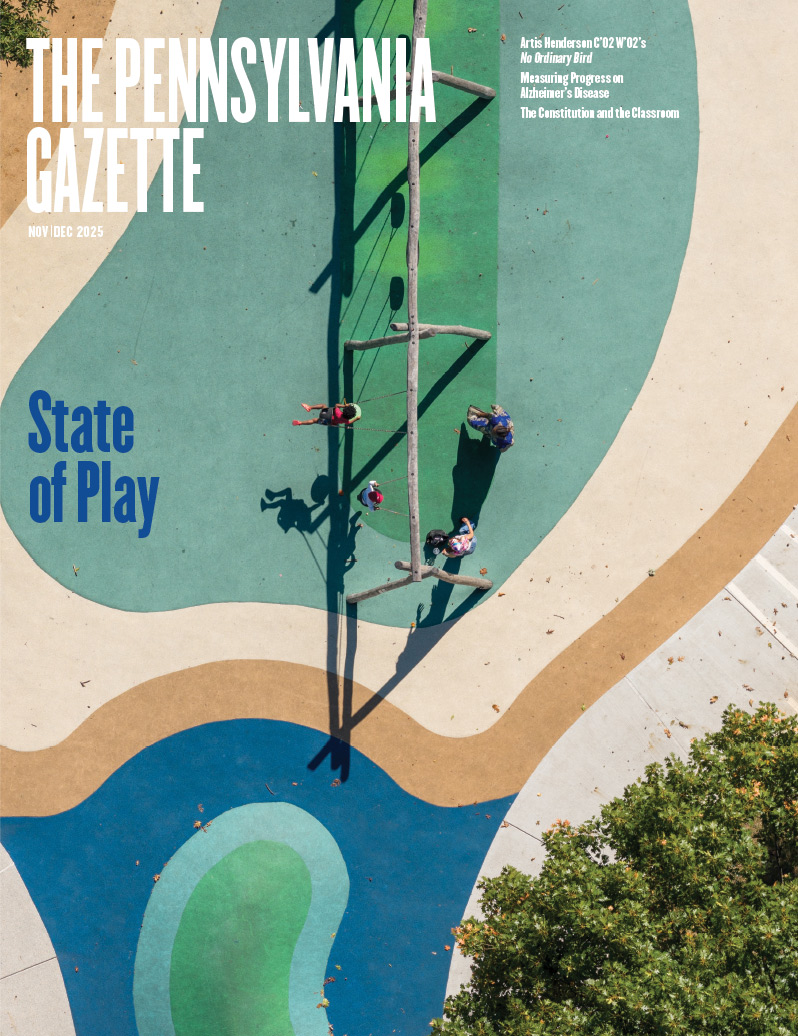
Grounds for Play
Reading “Tossing Out the Playbook” [Nov|Dec 2025], I remember my own 1972 sophomore-at-architecture-school designs for “The Playground” project, designs inspired by a childhood of treehouses, residential construction sites, a backyard creek, ice skating on nearby frozen lakes, jitney racing in the middle of the road, and Tarzan-style vine-swinging in those dark woods down the way.
“Whaddya tryin’ to do, kill all the kids in the neighborhood?” was typical criticism then. It’s wonderful to know that materials, designers, urban parks, and, above all, social attitudes have changed to allow for these remarkable creations featured in your article. Playgrounds of such caliber are too good to be limited to children, though. Why not something similar for those over 70?
Daniel Naegele GFA’94 Gr’96, Sapulpa, OK
As Seen on TV
Regarding JoAnn Greco’s article, “Tossing Out the Playbook”:
Rod Serling and Gene Roddenberry—creators of the iconic TV series Twilight Zone and Star Trek, respectively—know about play.
Twilight Zone, “Kick the Can,” aired February 9, 1962:
Charles Whitley is an elderly resident of Sunnyvale Rest, a home for the aged. It’s not a happy place and Charles’s hopes of moving in with his son David are dashed when he’s told they can’t take him in. He wistfully recalls his youth, where they played kick the can and didn’t have a worry in the world. His close friend Ben Conroy begins to worry about him when Charles suggests all you have to do is wish it, and you can be young again. Ben is worried his friend will end up in the loony bin, but it’s Ben who is in for a surprise.
Star Trek, “Shore Leave,” aired December 29, 1966:
Captain Kirk: “The more complex the mind, the greater the need for the simplicity of play.”
Then again there is Lord of the Flies.
Thanks for the article.
Peter Feinman C’71, Purchase, NY
Complete, Informative, Accessible
I was thrilled to read Mary Ann Meyers’s marvelous article “Alzheimer’s Now” [Nov|Dec 2025].
In addition to being a health lawyer for 35 years, I became even more committed to learning about Alzheimer’s through the years I was caretaker for my beloved husband Michael [M’66] during his Alzheimer’s journey [“Obituaries,” Nov|Dec 2025].
I report this just to say that despite my endless reading and researching, I never read a more complete, informative, accessible piece about Alzheimer’s and dementia. I have circulated it widely to many friends including my Support Group. Thank you, Mary Ann!
Stephanie Naidoff L’66, Haverford, PA
Time for a Balanced Approach
Regarding “Alzheimer’s Now” [Nov|Dec 2025], the most appropriate time to address Alzheimer’s disease is before it is a fait accompli, i.e., during the stage of mild cognitive impairment (MCI). Screening tests should include APOE4 if MCI is present and requires a multifaceted approach. Steps to halt progression may include assiduous observance of a Mediterranean or Japanese diet; checking for hyperhomocysteinemia, which is also elevated in vascular dementia; and, if elevated, checking for both B vitamins anda toxic metal screen is indicated. Methylated B vitamins are indicated if the MTHFR TT mutation is present. Serum ammonia should also be checked as even modest elevations can promote neurodegenerative changes. Gut and oral dysbiosis are both major contributors to the pathogenesis of Alzheimer’s disease, as are immune dysfunction and magnesium, vitamin D, selenium, and other micronutrient deficiencies. Components of the exposome—the lifetime exposure to pesticides, air pollutants, organic solvents, and other toxicants—are additional risk factors and need to be minimized. Indeed, causative factors of Alzheimer’s are very heterogenous and also include exposure to mycotoxins and cyanobacteria producing BMAA. Inflammaging, the combination of inflammation and defective clearance, among those aging relates to both cumulative toxicity and deficiency of micronutrients.
Clinical research addressing these aspects of neurodegeneration should be expanded, not dictated by pharmaceutical manufacturers, but informed by neuroscience research. Such an approach would likely also reduce other degenerative disorders in the advancing years, including atrial fibrillation, deafness, and macular degeneration—all also characterized by hyper-homocysteinemia. How long can we keep putting off such a balanced approach?
Arnold R. Eiser C’70, Philadelphia
The writer is an adjunct faculty member at the Perelman School of Medicine and the author of Preserving Brain Health in a Toxic Age.—Ed.
Music’s Salutary Effect
I was surprised that there was no mention of the salutary effect that music has for people suffering from this dementia. My wife, who is 82 and suffers from this affliction, sings the lyrics to the pop tunes of the 1950s for two hours every day. These are songs she remembers from when she was a teenager, and I believe it raises her spirts (and mine).
Jerry Sobol W’59, New York
How to Donate Your Body
This is a comment on Susan Fishman Orlin’s article “Where Rolling Hills Meet the Sky” [“Rabbit Hole,” Nov|Dec 2025].
Penn’s medical school receives cadavers for their Anatomy lab from Humanity Gifts Registry. There are no long forms to fill out if it is your desire to donate your body to further the education of our future doctors. The donor form requires a signature, date of birth, date signed, and address. You need two witnesses, not notarized, and mail it back to the registry.
It is so easy and very rewarding for the families who have honored the wishes of their loved ones. Contact: Humanity Gifts Registry, PO Box 835, Philadelphia, PA 19105-0835, hgrpa.org, 215-922-4440.
Frances Schleifer Sletvold HUP’62, Allentown, PA
Revisionist History
I read “Pandemic Lessons: The misfires last time” [“Gazetteer,” Nov|Dec 2025] with stunned disbelief. I had to reread it a few times, and ask a couple of friends to read it, as assurance that I had not overlooked something obvious.
How was it possible for the article to reflect generally on how America’s “politics failed us” without a single specific mention of President Donald J. Trump W’68? Not a word about the President’s false assurance that the virus would disappear in the warm April weather, his deliberate undermining and mockery of CDC guidance, those incoherent press conferences where he speculated about the efficacy of light and disinfectant as cures, the tweets urging his supporters to “liberate” their state houses, the super-spreader campaign rallies that directly resulted in the deaths of attendees, including businessman and former presidential candidate Herman Cain.
And while specifically mentioning and decrying President Joe Biden Hon’13’s vaccine mandates, scant attention is paid to differential death rates by state post-vaccine. In vaccine-skeptical Florida, for example, most COVID fatalities occurred after the vaccines became available. Nationwide, the trend was just the opposite.
Imagine if, before he first left office, President Trump had appeared on national television and said, “Look, this is a public health crisis and should not be politicized. Me and my family all took the jab. I urge you to do the same. It will not prevent you from contracting COVID, but it may very well prevent your hospitalization or death.” How many American lives might have been saved had the President chosen to publicly state those simple truths rather than tacitly pander to his “medical freedom” base?
Based on some of the letters you’ve chosen to print recently, I’m sure some of your readers will dismiss this letter as “TDS.” The fact remains that America, one of the wealthiest and most technologically advanced nations on Earth, accounted for 4 percent of the world’s population and 25 percent of the world’s COVID deaths by the end of 2020, with President Donald J. Trump in the White House.
I cannot help but see the massive elisions in this article as revisionist history and a form of capitulation that has been all too prevalent since President Trump’s reelection. I find this very disappointing in a publication that I have come to trust and value as a source of unbiased information.
Michael Arsham SW’81, New York
Creating a Welcoming Environment for Discussion
Thanks for reporting on the discussions that ensued from the School of Arts & Sciences 60-Second Lecture series regarding the US Constitution [“Gazetteer,” Nov|Dec 2025]. Dean of the College Peter Struck’s worry that students are no longer “saying intemperate things, strange things,” nor “mouthing off all the time” is indeed worrisome.
As Struck suggested, students and, collectively, all of us learn nothing from people who think like we do. Nor do we learn from people who think differently but don’t share their thoughts. So, ensuring that this generation “feels that they can speak their minds” is an imperative.
But how?
Professor Karen Tani’s suggestion that the entire university, not just professors, must cultivate a “culture of curiosity” makes sense. Her other concern, students’ feeling that they have no political agency, is causative. Without political agency, there is little reason to expend effort to develop and investigate one’s curiosities—or to draw, express, and defend conclusions.
Professor Emma Hart’s commitment to ensuring that dialogue and debate permeate every class session, even lectures, can help students to realize that their opinions are worthy of consideration, and thus, plant a seed of agency. But the idea also presents a problem.
What happens when an expressed opinion is premised upon no evidence, mis- or disinformation, or hateful ideologies? Does presupposing that any opinion voiced in the classroom is worthy of hearing award it a degree of validity and influence it ought not have?
I have confronted that very problem when teaching economics to graduate and undergraduate students and when facilitating discussions for a nonprofit I run to enhance political discourse (discoursefordemocracy.org). I typically have time to question the premise and thus give discussants opportunity to evaluate whether the expressed opinion represents received wisdom, a dubious proposal, or something in between. I imagine though, that in classrooms where a professor works against the clock, there might not be time enough to explore the premise. Then what?
Perhaps the Gazette could feature an article addressing how our Penn professors contend with the matter. Keep up the good work!
Matthew S. A. Feely WG’92 Gr’04, Dedham, MA
