The misfires last time.
The development of mRNA vaccines against SARS-CoV-2 was a medical and scientific marvel, but Operation Warp Speed’s breakneck pace—and its name—along with miscommunications about their effectiveness combined to undermine confidence in the vaccines and the public health establishment promoting them. At the start of the pandemic, non-pharmaceutical interventions were broadly similar across the states, but election-year politics and other factors led to a sharp divergence along partisan lines about masking and closures, especially regarding schools. And there’s good reason to question whether the US will do any better when the next pandemic strikes, as it almost certainly will.
Those were among the key takeaways from a Leonard Davis Institute of Health Economics seminar that featured vaccine expert Paul Offit, professor of vaccinology at the Perelman School of Medicine, and Frances Lee, a professor of politics and public affairs at Princeton University and coauthor of In Covid’s Wake: How Our Politics Failed Us.
Throughout the pandemic, Lee pointed out, governors were central figures. “Under the constitutional system, the primary responsibility for managing the pandemic rested with the states,” she said. “So it was the governors, primarily, who made the really critical decisions as to when, whether, and how to impose and lift pandemic restrictions,” as well as to manage the vaccination campaigns within their states—all in an environment of great uncertainty.
Stay-at-home orders were unprecedented at the time, and in fact ran counter to the recommendations of a 2019 World Health Organization report, which found little evidence that nonpharmaceutical interventions were effective and counseled against measures including “contact tracing, border closure, and quarantine of exposed individuals” to reduce the spread of a respiratory virus, she said. “So it’s quite remarkable.”
But the “information environment” in the spring of 2020 was a lot different than “when you had academics working on policy recommendations in the absence of crisis,” Lee added. The Wuhan lockdown in China had been deemed a success by WHO, and “to a great extent, the playbook was being thrown out in March of 2020 in response to the information that policymakers were getting.”
Governors needed guidance, and the federal Coronavirus Task Force became the main clearinghouse for information in 2020. “And so it was on March 16th that the White House held a press conference and recommended, in the wake of a very dire report [of potential death tolls] from Imperial College London, that governors in states with evidence of community transmission should close places where people congregate, including schools. And so you then begin to see the stay-at-home orders cascade across the states.”
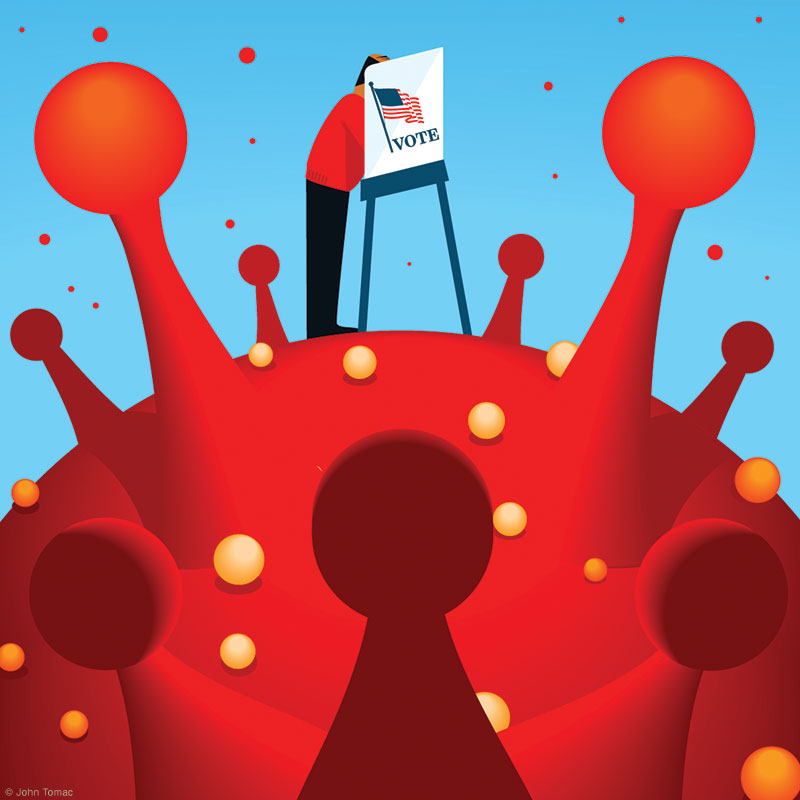
Among state governments, “there was a lot of uniformity around the country, initially, in the pandemic response,” Lee noted. That changed—and the fact that 2020 was an election year played a major role, she suggested.
“You had the party out of power saying that the party in power—the president in office—was doing a bad job. And of course, the pandemic would be part of that. So every piece of bad news about the pandemic would be laid at the feet of the incumbent president,” Lee said. “There’s nothing unusual in that kind of political opportunism, but you can see how that would divide the parties more deeply over the course of the summer.”
Red-state governors were also weighing the tradeoffs differently than their Blue-state peers. “Their view was that staying closed until the vaccine was available wasn’t feasible, and that we needed two weeks to slow the spread, to keep the hospitals from being overwhelmed, but that we shouldn’t try to maintain these policies for the better part of a year.”
“Out of that political environment you begin to see this hardening of partisan views. So you had Democrats beginning to view the face masks as sort of a signal of their personal virtue or morality, and also a signal of your partisan alignment, and Republicans viewing it similarly—but in less positive terms.”
While the pandemic became a very partisan issue in the US, “it’s not the case around the world,” Lee said. “Other countries didn’t see that same partisan divide around the pandemic the US featured. I think it was contingent on a range of developments that that happened. And significant among those was, I think, the fact that it was going to be a very competitive, very close, hard-fought election, and absolutely everything was going to be drawn into that fray.”
Offit recalled his experience, in December 2020, of serving on the FDA’s vaccine advisory committee looking at data for the Pfizer and Moderna mRNA vaccines, based on 40,000- and 30,000-person trials of adults, respectively. “It was unnerving in many ways,” he said. The vaccine was made a mere 11 months after the virus’s genome was sequenced. “So that’s the fastest vaccine ever made. That happened because of Operation Warp Speed, which basically took the risk out of it for pharmaceutical companies.” There was a fear that “people were taking shortcuts,” reinforced by the program’s title, which “was not my favorite,” Offit said.
But he emphasized that the effort “was an enormous success. I think it was one of the greatest scientific or medical advances in my lifetime.” In less than a year, “you had data suggesting this vaccine was highly effective—certainly at preventing what you wanted to prevent, which was to keep people out of the hospital, keep them out of the ICU, keep them from dying.”
Offit also voiced his objections to the terms “emergency use authorization” in the approval of the vaccines and “breakthrough infections” to describe COVID cases in vaccinated people. In the former case, he said, “the size of those two clinical trials for Pfizer and Moderna was typical of any adult or pediatric vaccine trial, and the data that you had was typical for that”; in the latter, the term made it sound like a failure rather than an expected feature. “People had the sense that this virus was just going to bounce right off of you,” Offit said, even though it was known that protection against mild disease wasn’t perfect and wouldn’t last long. “Because we were so desperate to get people vaccinated, I think early on we may have oversold this vaccine a little bit.”
Lee’s criticism was sharper. “I think that was a critical moment in science communication that has had lasting effects on trust in science agencies, because early on, the vaccine was portrayed as having the capacity of stopping transmission,” she said. That claim set up a backlash that arrived after a number of vaccinated people gathering in Provincetown, Massachusetts, got sick in the summer of 2021.
The Biden administration’s vaccine mandate for healthcare workers and large corporations in the fall of 2021 was another misstep. “The whole policy was based on wishful thinking—that the virus could be stopped through vaccination.” Meanwhile, thousands of people who declined to be vaccinated lost their jobs, “especially in military and working for law enforcement,” she added. “This created a lot of anger, and it was not necessary, nor did it advance public health.”
Making matters worse was the decision not to treat people who’d acquired their immunity through infection the same as vaccinated individuals, she said. Offit agreed, and he described a Zoom meeting of public health leaders where he and other advocates were overruled. “I think what happened, it was thought it would be a bureaucratic nightmare,” he said, “but I just think we again miscommunicated that. It wasn’t fair.”
Greater frankness on the part of policymakers and advisors “about the state of the evidence would have enabled them to switch gears more easily when they needed to,” Lee said, offering the example of the shifting guidance on face masks. “One of the repeated mantras of the pandemic was ‘We know what works against COVID-19.’ That’s what the CDC director and others would say, but they didn’t know for sure what worked against COVID-19.”
Looking to the future, “what we need to do out of this pandemic is try to do our best to learn what we can learn” about the effectiveness of the various measures taken, she added. “So then policymakers have some guidance and some quality evidence on which to base their decisions if they are presented with this problem again—which, of course, is very likely.”
Ideally, she’d like to see a nonpartisan COVID commission formed for that purpose. “As the years go by, most people aren’t going to follow this with the same intensity that they did during the pandemic,” she observed, “so I hope that expert communities will take a close and openminded look at this.”
“I’m a little pessimistic,” said Offit, who was removed from the FDA’s vaccine advisory group in September—without explanation, though he’s been a frequent critic of Health and Human Services Secretary Robert F. Kennedy Jr. “Are we better prepared now that we’ve had the experience with this pandemic? I think in some ways, we’re worse.” He pointed to the rise of a “medical freedom movement”—of which Kennedy is a product, he said—that takes the view of “‘I’m going to do what I want to do when I want to do it, and if I choose not to get a vaccine, or I choose not to get a mask, or I choose not to social distance or whatever, that’s my choice. Even if it affects somebody else, it’s still my choice.’ And that’s the opposite of public health. In public health, you do care about your neighbor, you do care about the society of which you are a member. And I just feel that that tension, if anything, has moved more in the direction of medical freedom and less in the direction of caring about your neighbor.” —JP