
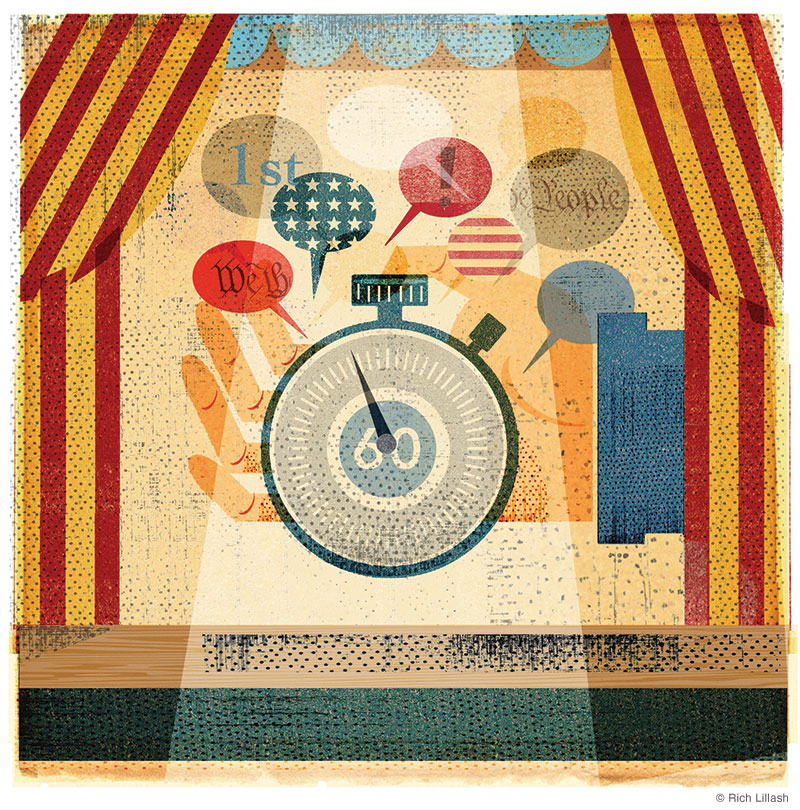
During a super-sized 60-Second Lectures program, SAS faculty weighed in on how to create a welcoming environment for discussion in a contentious time.
Penn Arts & Sciences stretched the boundaries of its long-running 60-Second Lecture series to mark the 238th anniversary of the US Constitution in September—presenting four separate one-minute talks, followed by a discussion and audience Q&A moderated by Peter Struck, the Stephen A. Levin Family Dean of the College of Arts and Sciences, all clocking in at about an hour. The full program can be found on the 60-Second Lectures home page. At one point, the discussion turned to ways to encourage free and open exchange of ideas in the classroom and beyond.
“As dean of the College, I worry a lot about where we are now,” Struck confessed. “I just contrast it with—if you’ll forgive me, young people in the room, for casting my mind back to when I was your age—when I walked into the campus at the University of Michigan in Ann Arbor. I couldn’t believe what I was able to see. I heard people saying intemperate things, strange things, things I’d never heard. Everyone’s mouthing off, all the time, to everybody else, and it was marvelous. I just felt like, ‘This is exactly where I want to be.’ It was like a circus of crazy ideas all over the place, and some of them were amazing. That, to me, is what a great education in the arts and sciences is all about: people speaking their minds, evidence and arguments, sharing their views, being corrected, learning from other people.
“I learn nothing in a room full of people who think like I do. I need people that have different views. And if we can’t preserve that now, I just don’t know how we move forward. … So with that as a preamble, I wonder if you all can speak to this time and how we’re going to ensure that this generation of 18-, 19-, 22-year-olds feels that they can speak their minds and become independent thinkers?”
“If you’re a professor, it starts in your classroom,” said Emma Hart, the Roy F. and Jeannette P. Nichols Chair of American History. “I’ve only been at Penn for a few years, and this is my first teaching environment in which I’ve had to do a lecture course all myself—just me talking to my class all semester. And I don’t like it, because it invites me to talk at them. And so I work really hard to try and make even a lecture a dialogue between me and the students, where they’re very comfortable asking questions and disagreeing with me and saying, ‘Why did you say that?’
“Obviously, I know far more about early American history than my class, but history is a debate, and I am always trying to emphasize that to them in every single lecture.”
Karen Tani G’07 L’07 Gr’11, the Seaman Family University Professor in SAS and Penn Carey Law, cited the need for “a culture of curiosity that is coming not just from professors, but from the entire university, and I think that could come through priorities, policies valuing debate and learning and not just credentials, and finding ways to push back against that temptation.
“Something else that I think a lot about is, do young people have a sense of political agency in the world? I worry that part of what we’re seeing as kind of a lack of willingness to be excited about ideas and speak [comes from this]. Was there a sensation in earlier generations that they had agency in the world that might be different today, because of money in politics, because of a gerontocracy in our politics, because of other factors that we should think about? How could we make it such that people could take their ideas and do something meaningful in the world?”
Beyond creating a classroom environment that welcomes “all political perspectives” and where individuals can “speak their mind and not be criticized for doing so,” Daniel Gillion, the Julie Beren Platt and Marc E. Platt Presidential Distinguished Professor of Political Science, pointed to the need to set an example more broadly. “We are in a very contentious political environment right now, where making statements that are just individuals speaking their mind, disagreeing probably with the status quo, has consequences that are unusual” compared to similar incidents in the past. “When you have that sort of pressure, I think it’s incumbent upon not the students but administrators to demonstrate the ability to create an environment of freedom of speech, offering perspectives, doing it constructively. But one thing that students need to see is that administrators, others in position of power, are not—I hate to say it like this—kowtowing or giving in to a very constrained political environment that’s limiting individuals’ ability to talk and speak.”
Gillion also emphasized the need to maintain spaces for people to “offer their perspectives” publicly. Referencing “contention around where protests can take place and where individuals can offer their opinions and perspectives,” he acknowledged the need to consider public safety, “but we also have to encourage students that there’s a space for you to put forth your voices. It might not be in front of the library, but it’s someplace here that’s not outside the City of Philadelphia, that you can have your voice be heard. And I think that’s important, creating an environment and also demonstrating that, Hey, we can put forth our voices in this particular political, contentious environment.”
“The awesome thing about freedom of speech,” noted Campbell Grey LPS’13, professor of classical studies, “is that I get to have my voice heard, but the person that I fundamentally disagree with also gets to have their voice heard. That’s the wonderful but really difficult part of freedom of speech.
“But if I can put my Classicist hat on just for a second,” he added, “the ideals that went into creating this constitution and this republic emerged fundamentally from two ancient writers, Polybius and Cicero, who were living in a world that was not in any way united. It was not in any way peaceful. It was, in fact, riven by faction. It was characterized by violence and murder. And it is the writings that those men presented to history that create this kind of idealized world of a coherent republic that functions. And I think that’s really interesting—because it seems to me that it’s the moments where we are most conscious of disunity that we think most carefully and coherently about the benefits of coherence and unity.” —JP